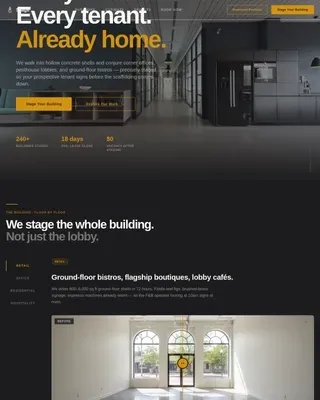
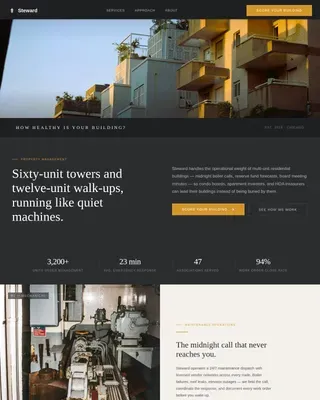
Mixed-Use Development Real Estate Booking Website Template
Atlas is a stats-first mixed-use development real estate landing page built for brokers who close institutional-scale deals. The asymmetric 60/40 grid, war-room map header, animated gold pins, deal-anatomy forensics, and dual conversion paths work together to turn serious investor interest into scheduled deal reviews, without a single wasted word.
by Rocket studio
Quick summary
Atlas is a single-page, stats-first real estate landing page template designed for mixed-use development brokers. It pairs a dark, interactive map with oversized portfolio data, deal forensics, and two focused conversion paths. Every section leads with a number before the narrative arrives, because in this market, the data earns the meeting.
Who this template is for
This template is built for a specific type of professional operating at the top of the real estate industry. If your clients are weighing cap rates, net operating income, and stabilized yield before they pick up the phone, Atlas speaks their language from the first scroll.
- Institutional investors and family offices evaluating urban infill and mixed-use property opportunities across major metro markets
- Developers sourcing entitled parcels with retail-residential zoning already in place, who need to understand deal context fast
- Mixed-use development real estate agents who need a landing page that positions their track record before any conversation begins
What problem this template solves
Most real estate landing page designs bury the proof. They lead with a headshot or a tagline, and investors have to scroll three sections before understanding the scope of what a broker has actually closed. That approach fails with sophisticated buyers who form a first impression in seconds and move on if the data isn't immediately visible.
Atlas solves this by restructuring the entire page around evidence first. The problem it addresses is specific:
- Institutional leads land on generic brokerage pages that don't reflect deal scale, property type specialization, or market depth, so they leave without contacting anyone
- Brokers closing deals worth eight or nine figures have no template that matches the authority their track record deserves
- Conversion from investor traffic to scheduled consultation is low because most landing pages don't speak to cap rates, net operating income, or occupancy benchmarks at all
What you get with this template
You get a complete, pre-structured real estate landing page focused entirely on the mixed-use development niche. Every layout decision, color choice, and section sequence comes from a single brief: make serious investors feel like they are in the room with someone who already knows the numbers.
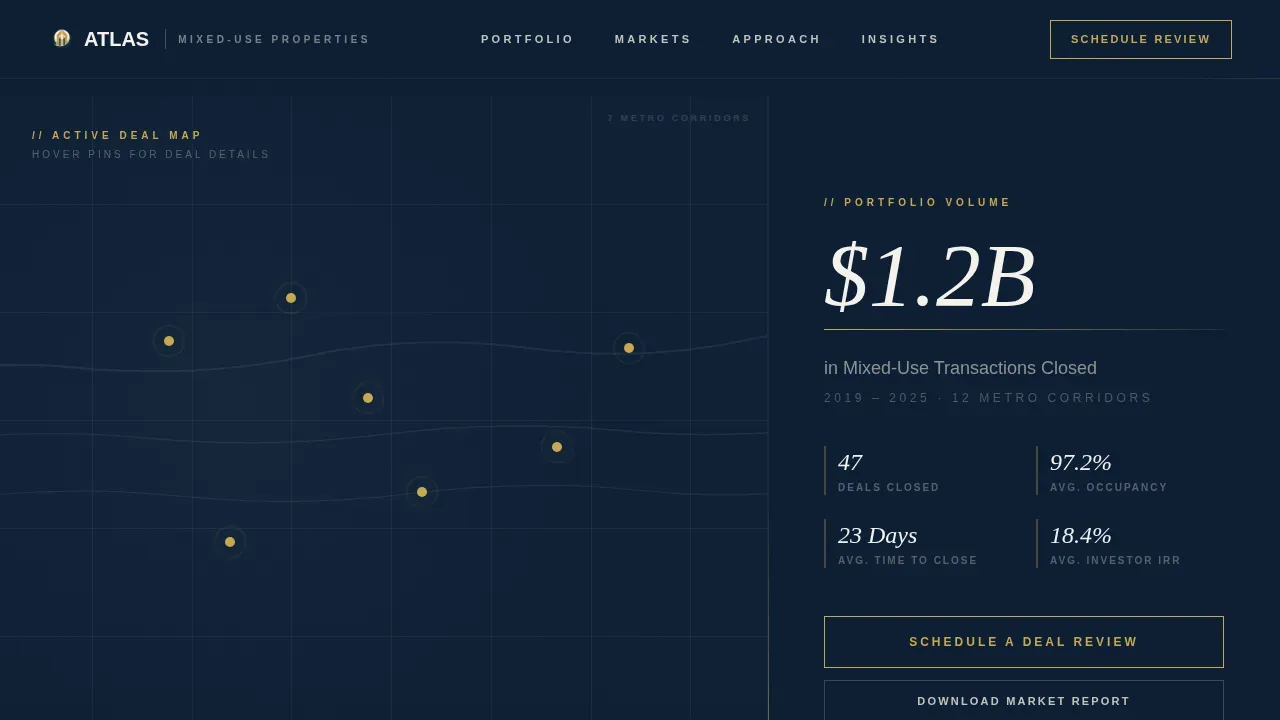
- A dark, stylized vector map filling the 60-column hero space, with pulsing gold pins carrying hover tooltips that display asset name, unit count, retail square footage, and close year, giving visitors portfolio understanding before they read a single line of copy
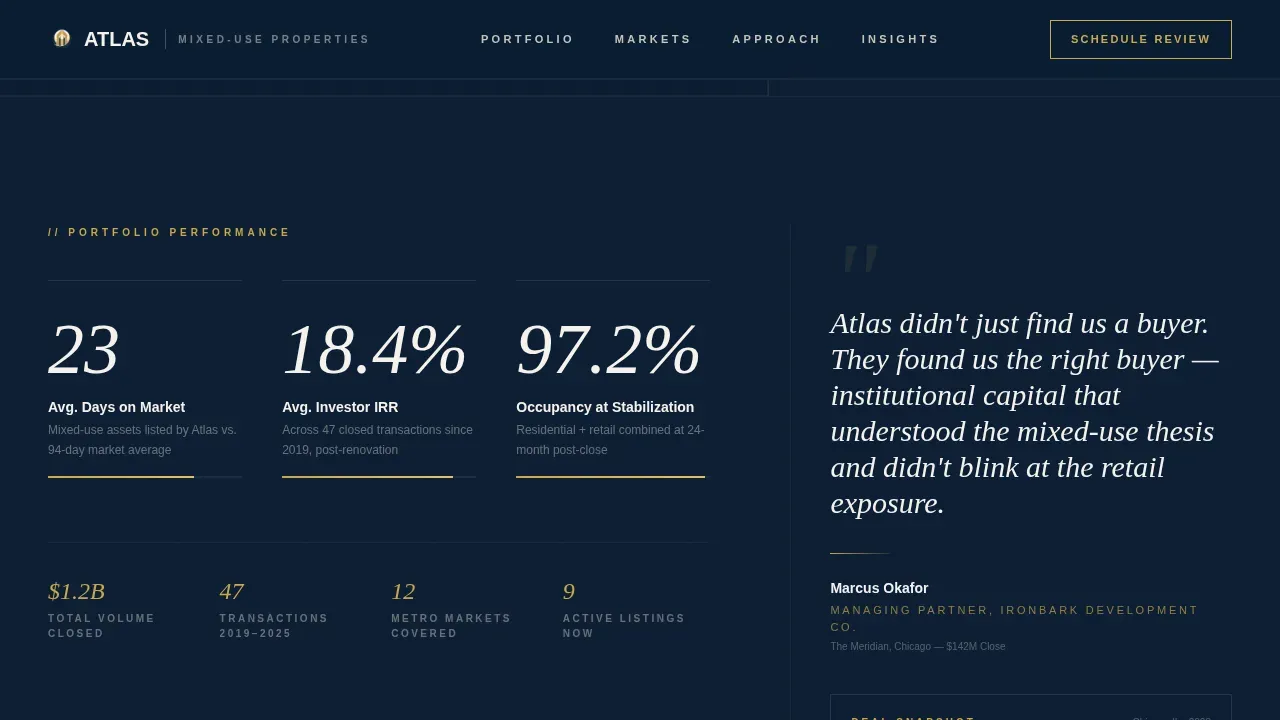
- A stats triptych section that leads the 60-column with three key metrics (average days on market, investor return percentage, occupancy rate at stabilization) while the 40-column holds a named developer testimonial for direct social proof
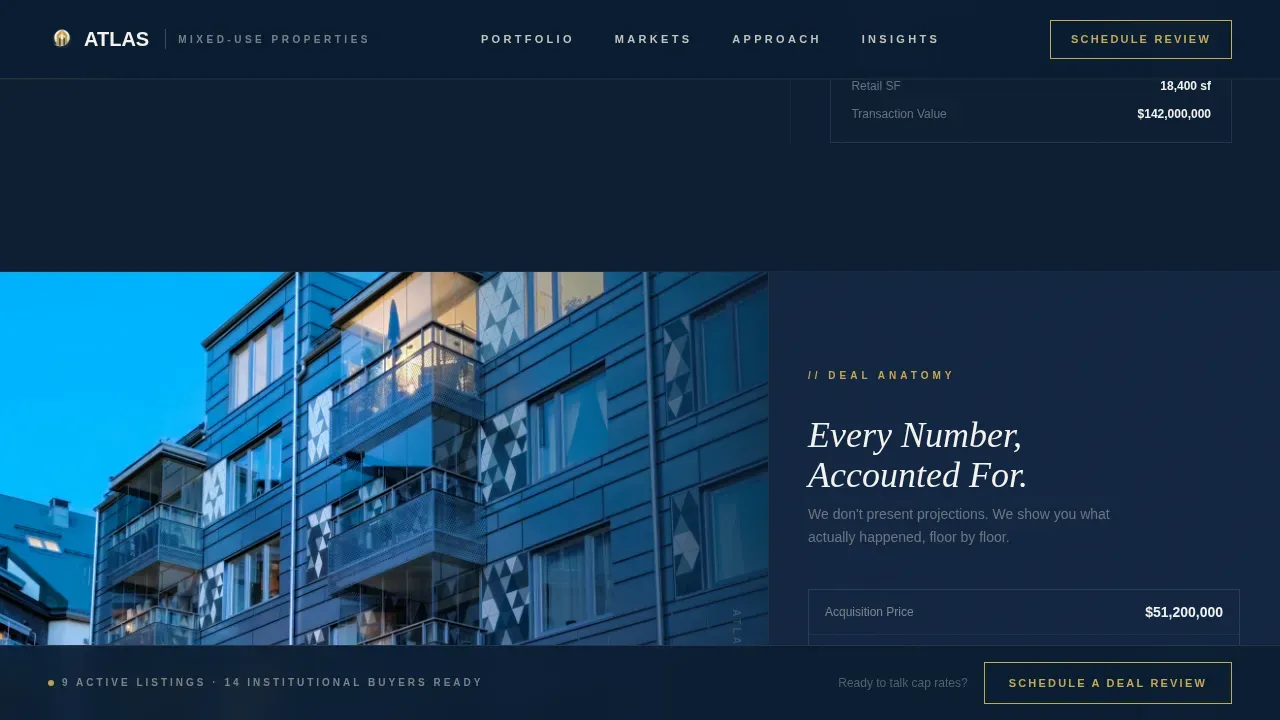
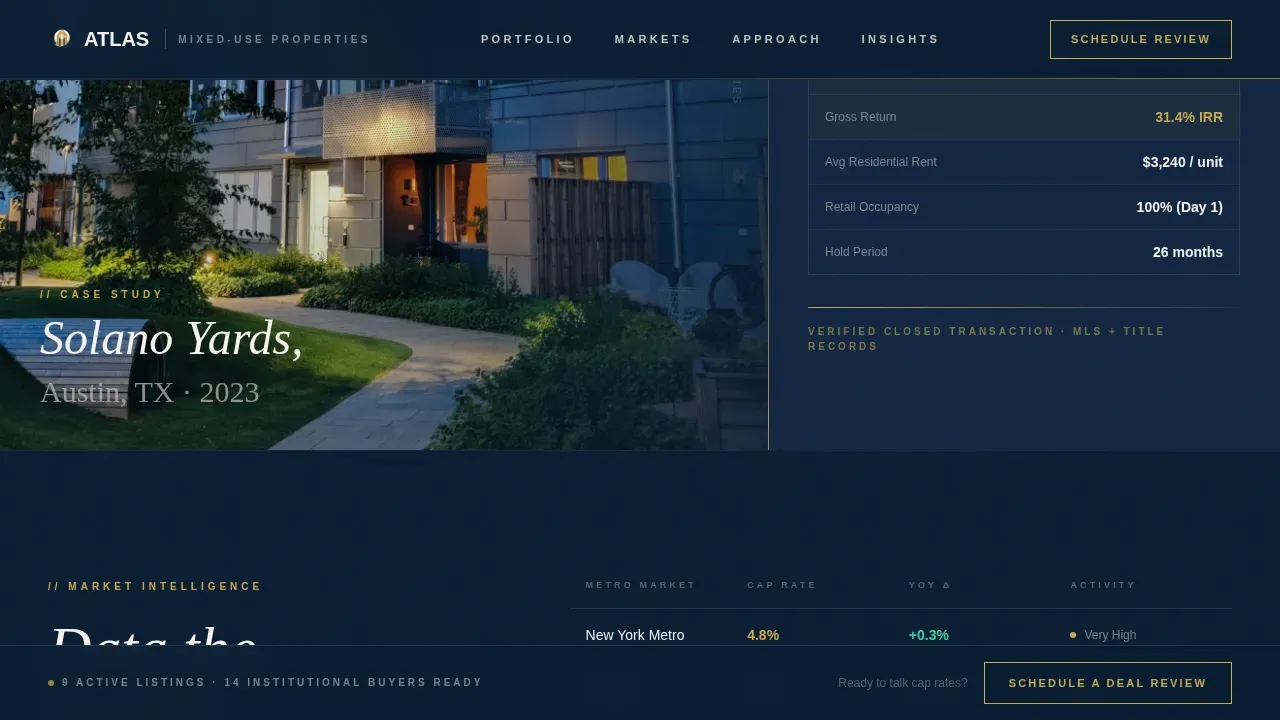
- A deal-anatomy section where a case study image bleeds into the 60-column and acquisition price, renovation cost, net operating income at year two, and exit cap rate stack cleanly in the 40-column
- A sticky "Schedule a Deal Review" call-to-action bar that appears after the second scroll section, with a gold-bordered button and an embedded calendar modal capturing meeting type, investment profile, and target metro market
- A secondary conversion path at the page bottom that gates a mixed-use market report behind an email and firm name form field, capturing leads who want the data before committing to a call
Feature list
This real estate landing page was designed around a set of deliberate, prompt-specified capabilities. Each feature serves a clear business purpose for agents operating in the mixed-use space.
War-Room Map Hero with Pulsing Pin System
The 60-column hero space holds a dark, proprietary-style vector map marking active and closed mixed-use deals across key metro corridors. Gold pins pulse subtly, one at a time. Each pin carries a hover tooltip showing deal-specific data: asset name, unit count, retail square footage, and close year. Visitors absorb portfolio scale and location breadth instantly, making the first impression data-driven rather than narrative-driven.
Asymmetric 60/40 Grid Layout
The page uses a deliberate asymmetric grid throughout, with the 60-column carrying primary visual and data content while the 40-column delivers supporting proof, testimonials, deal forensics, and stat callouts. This structure creates a natural reading hierarchy. Investors focus on the numbers first, then find the context they need in the adjacent column.
Stats-First Scroll Sequencing with GSAP Reveals
Every scroll transition leads with a number before narrative text arrives. GSAP-powered scroll reveals animate section entries, beam borders, and metric counters to create a pitch-deck pacing that feels deliberate. The sequencing moves from portfolio-wide stats to individual deal forensics to market trend data, each section escalating the proof and deepening investor understanding.
Dual Conversion Path System
The page offers two distinct paths for leads at different stages. The sticky "Schedule a Deal Review" bar targets investors ready to talk, routing them through a calendar modal that captures meeting type, investment profile, and target metro market in a single form. The bottom-page market report gate captures seller leads and early-stage buyers who want the data first, using a minimal form field asking only for email and firm name.
Deal Anatomy Case Study Section
A full-bleed case study image occupies the 60-column while the 40-column stacks deal forensics: acquisition price, renovation cost, net operating income at year two, and exit cap rate. This section provides a concrete example of how Atlas approaches a property transaction from acquisition through exit. It is one of the most crucial conversion elements on the page because it shows, not just tells.
Named Developer Testimonial Block
The stats triptych section pairs portfolio-wide metrics with a named developer testimonial in the 40-column. This written testimonial grounds the data in a real relationship and helps build credibility with institutional readers who rely on peer validation. It functions as genuine social proof alongside quantitative evidence rather than as a standalone quote divorced from context.
Page sections overview
| Section | Purpose |
|---|---|
| Hero Map Header | Display portfolio scope via interactive deal map with pulsing gold pins and $1.2B stat callout |
| Stats Triptych | Lead with three portfolio metrics alongside a named developer testimonial for peer-level social proof |
| Deal Anatomy | Show a full case study image with stacked deal forensics covering acquisition through exit cap rate |
| Market Intelligence | Present trend data visualization and secondary social proof to deepen investor understanding |
| call to action and Report Gate | Drive scheduling via sticky bar and capture early-access leads via gated market report form |
| Footer Split | Display logo and tagline on the left with navigation links on the right |
Design & branding system
The visual identity follows a Luxe Minimal theme built around the Navy Authority color system. Every palette decision signals restraint and institutional authority. Nothing shouts. The design earns attention the way a private offering memorandum does, through quality of presentation and precision of detail.
- Color system: midnight ink (#0B1D33) as the primary background, polished gunmetal (#3D4F5F) for secondary surfaces, ivory vellum (#F5F1EB) for body and data text, and brushed gold (#C9A84C) reserved exclusively for data highlights, hover states, and call-to-action borders
- Typography: DM Serif Display for headlines and oversized stat figures, Manrope for body copy and data labels, a pairing that balances editorial authority with clean numeric legibility
- Animation and interactivity: high-intensity GSAP scroll reveals, beam borders on section transitions, pulsing map pins, a sticky call-to-action bar, hover tooltips on map pins, a calendar modal, and a gated form at the page bottom
Mobile & speed optimization
Although Atlas is desktop-first by design, because institutional investors typically review deal documents on large screens, the page is structured to remain functional and readable across device sizes. A responsive landing page that adapts to different screen sizes ensures no qualified lead is lost due to a poor mobile experience. Over 58% of real estate traffic comes from mobile devices, making responsive structure a crucial baseline even for a desktop-priority template.
- The layout uses server components for static content (hero copy, stats, testimonials) and client-side rendering for interactive elements (map pins, modal, form gate), keeping the page load efficient for data-heavy sections
- Visual content including the map, video-style animated reveals, and deal forensics stacks is structured to reflow gracefully on smaller viewports so the message remains clear and the conversion path stays accessible
How this template helps you convert
Atlas is built around a single conversion goal: turn qualified investor interest into a scheduled deal review. Every layout decision, every section sequence, and every interactive element supports that goal. This is a high-converting real estate landing page because it removes the gap between "I found this broker" and "I want to talk."
- The hero map creates immediate credibility before any copy is read, investors see deal locations, deal volume, and portfolio scale in the first three seconds, setting a first impression that generic brokerage pages cannot match and making follow up feel like a natural next step rather than a cold inquiry
- The sticky "Schedule a Deal Review" bar anchors a single call to action across the page after the second section, ensuring that any moment a visitor decides to convert, the path is one click away, no hunting for a contact form or a phone number
- The gated market report at the page bottom captures new leads who are not yet ready to schedule, giving the broker a follow up opportunity with investors who are still in research mode, and the data becomes the trust that closes the gap
Other information about this template
This section provides additional context for buyers evaluating Atlas alongside other real estate landing page options on the marketplace.
- Atlas is specifically designed as the atlas stats first mixed use development real estate landing page template for brokers who operate in a niche where generic designs actively hurt conversion
- The template supports digital marketing campaigns including paid traffic from sources such as Google Ads, making it effective as a dedicated landing destination for targeted ad spend
- A well-structured real estate landing page like Atlas helps real estate agents create landing pages that present their unique value proposition without requiring extensive coding skills, the template provides the professional design framework; brokers customize the data and copy
- Understanding the spatial context of mixed-use investments is crucial for success in the commercial real estate market, and Atlas makes that spatial context visible from the first scroll via the interactive map system
- Key data points for mixed-use projects, including population density, average household income, and nearby retail and office vacancy rates, can be incorporated into the market intelligence section of the page, giving potential clients the benchmarking data they need to feel confident
- The National Zoning Atlas approach of demystifying local zoning regulations aligns with how Atlas presents deal anatomy: breaking complex property transactions into clear, digestible data stacks that define the deal structure at a glance
- Real estate agents can use the report gate to manage and expand their lead database over time, capturing firm names alongside emails for higher-quality follow up segmentation
- The page structure also supports use cases beyond a single broker, a small team or boutique firm can use Atlas to represent group listings and services across multiple metro markets without redesigning from scratch
- Pricing for the template is set at the marketplace level; buyers receive the full page design including all interactive components, section layouts, and the dual conversion path system described in this listing
- The template does not include a built-in real estate CRM connection, but the form gate and calendar modal are structured to feed data into any preferred contact or lead management workflow the buyer already uses
Theme
Luxe Minimal
Creative direction
Stats-First Impact
Color system
Navy Authority
Style
Asymmetric Grid (60/40)
Direction
Booking/Scheduling
Page Sections
War-room Map Hero with Pulsing Pins
Stats-first Asymmetric 60/40 Grid
GSAP Scroll Reveals and Animated Transitions
Dual Conversion Path with Modal and Form Gate
Deal Anatomy Case Study Section
Named Developer Testimonial Block
Related questions
Who is the Atlas template designed for?
Can I customize the deal data, map pins, and testimonials?
Does the template work for paid ad campaigns?
How does the dual conversion path work?
Is Atlas suitable for a team or just a solo broker?