Precision Manufacturing Landing Page Template
The Prototype Precision Manufacturing landing page template is built for consumer goods prototyping and rapid prototyping services. It uses a zigzag case study layout to walk potential clients through real manufacturing stories, from DFM analysis to finished parts. The Engineering Blueprint visual theme and B2B conversion flow make it easy to earn trust and capture qualified leads.
by Rocket studio
Quick summary
This single-page template turns a rapid prototyping and consumer goods manufacturing service into a credible, client-converting landing page. It uses a zigzag case study narrative to walk visitors through real project stories, from first CAD file to shelf-ready part. The Engineering Blueprint theme signals technical authority from the first scroll.
Who this template is for
This template is designed for precision manufacturing shops and prototyping services that work directly with product-focused business clients. It speaks the language of engineering and supply chain without losing the buyer.
- Rapid prototyping studios offering injection molding, overmolding, or multi-shot manufacturing
- Consumer goods manufacturers targeting CPG brand teams and startup product managers
- Packaging engineers and industrial service providers pitching B2B clients on tight retail timelines
What problem this template solves
Most manufacturing service pages look like capability lists. They tell visitors what the shop can do but never show why it matters in a real project context. Buyers arrive skeptical and leave unconvinced.
- Visitors need evidence of real-world outcomes, not just a list of machines or processes
- B2B buyers evaluating prototyping partners want to see timelines, tolerances, and complexity handled well
- Early-stage leads need a lower-commitment path before they are ready to share CAD files
What you get with this template
You get a fully structured single-page layout built around client storytelling and progressive credibility. Every section is designed to answer a buyer objection before they think to ask it.
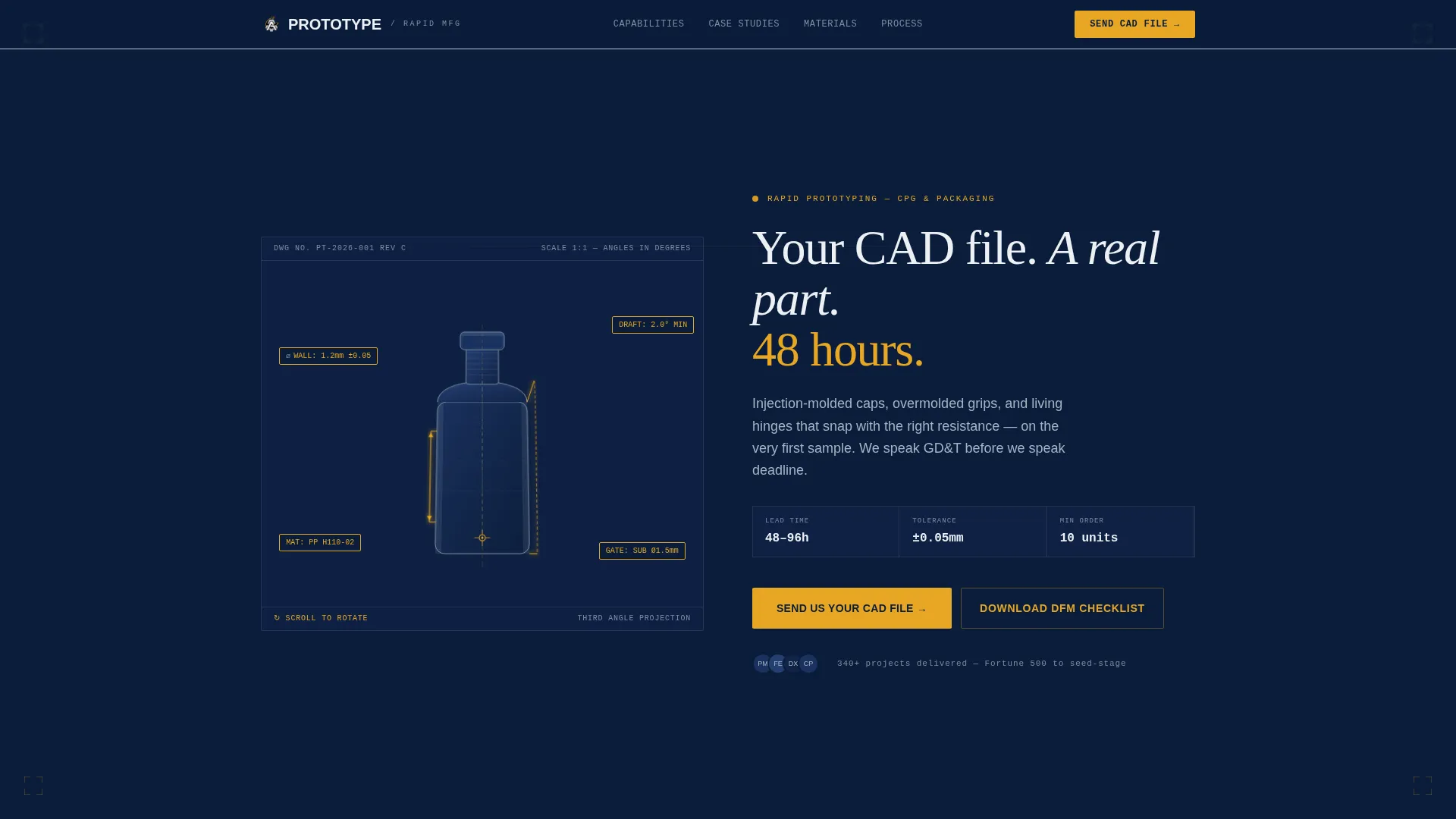
- An annotated isometric header with animated dimension callouts and a scroll-triggered rotation effect
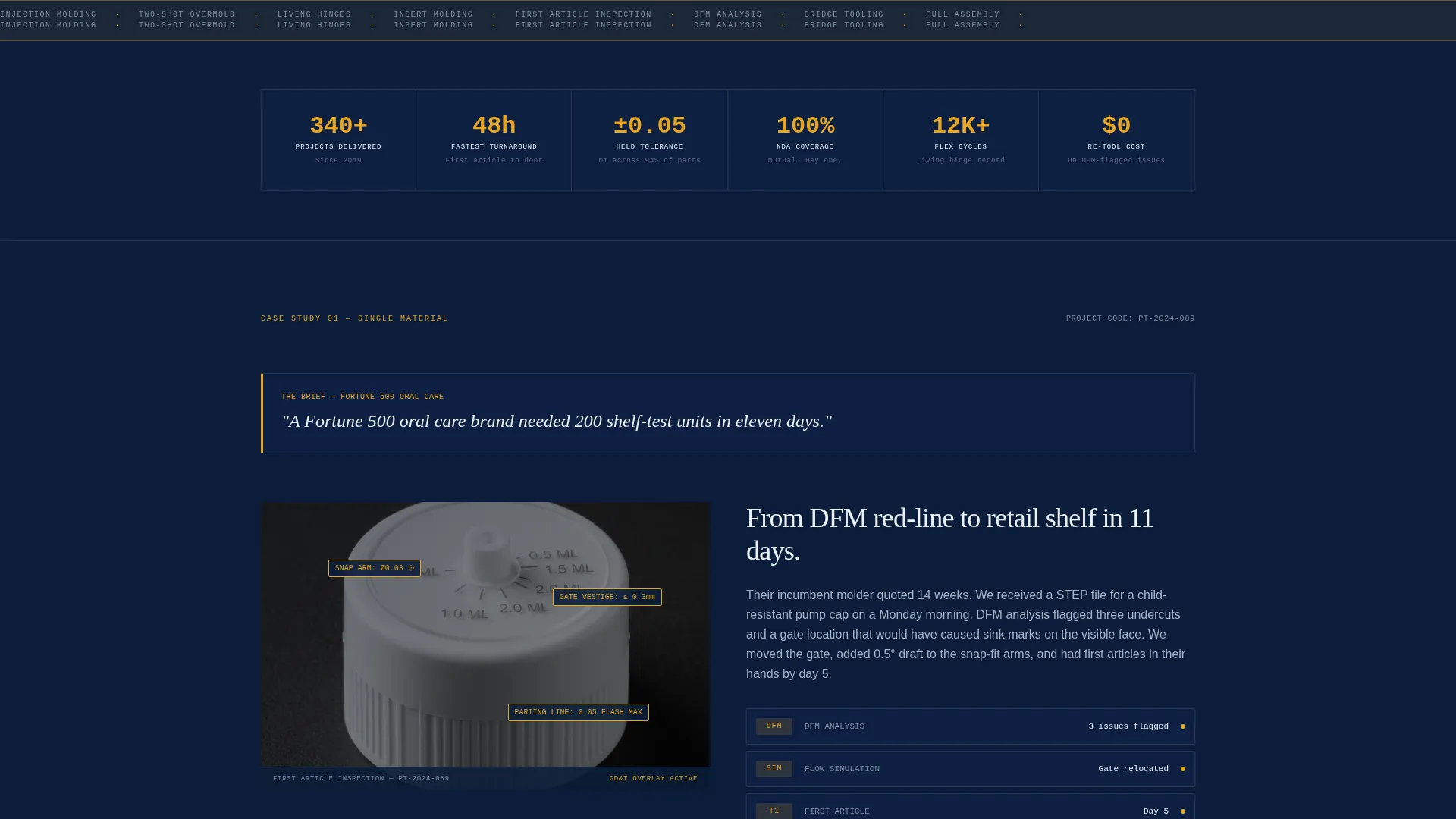
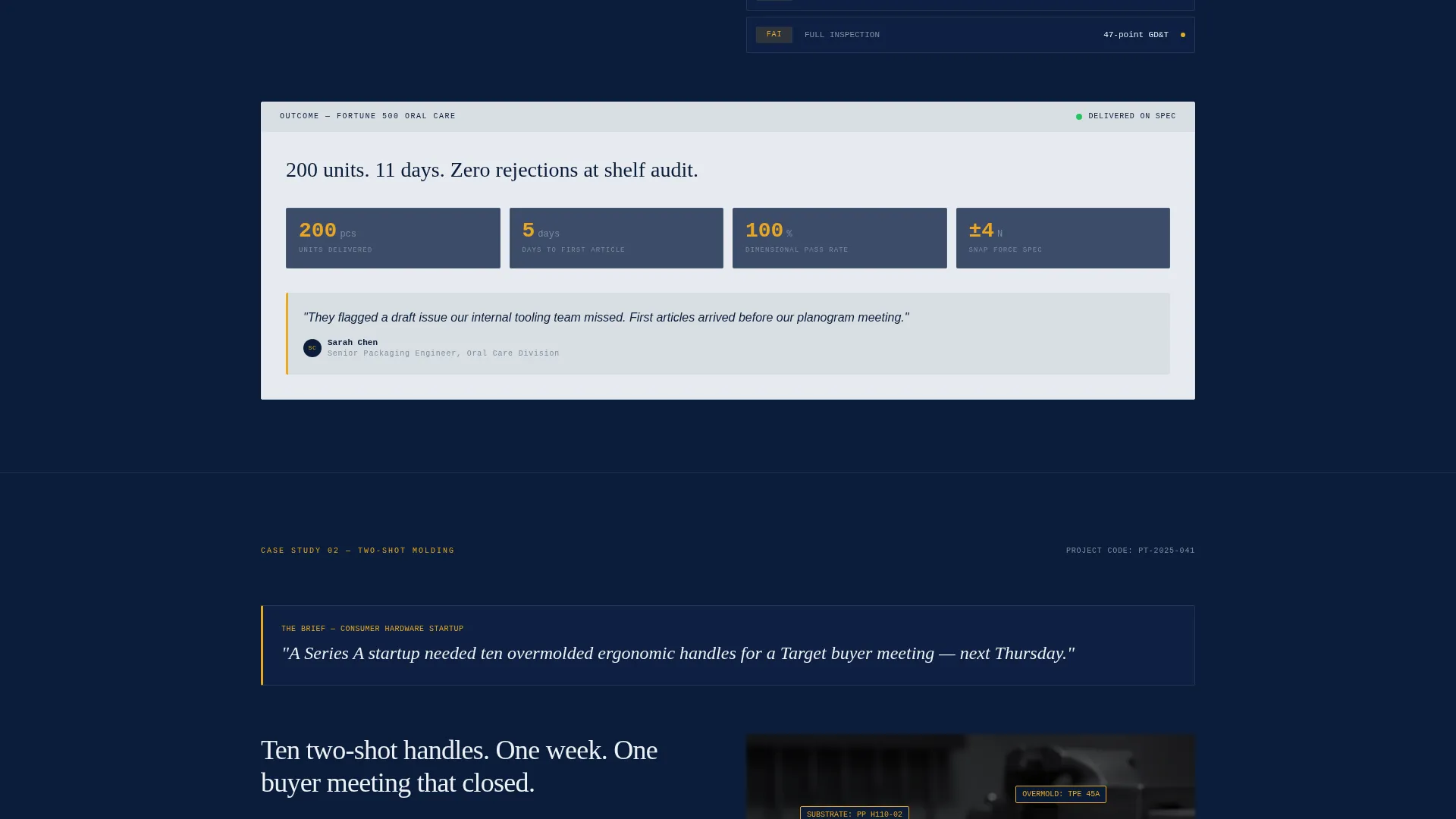
- A zigzag alternating case study layout that escalates in complexity from single-material to full assembly
- A dual conversion system with a primary CAD file upload form and a secondary design-for-manufacturability checklist lead capture
Feature list
This template is built around six core capabilities that work together to move a technical buyer from curious to convinced.
Animated Isometric Blueprint Header
The header renders a consumer product, such as a pump bottle, child-proof cap, or ergonomic handle, as a crisp exploded isometric diagram in blueprint line art. Signal amber dimension callouts animate in one by one, covering wall thickness, draft angle, gate location, and material specification. The part rotates five degrees on scroll to reveal internal geometry, signaling engineering fluency before any copy is read.
Zigzag Case Study Narrative Layout
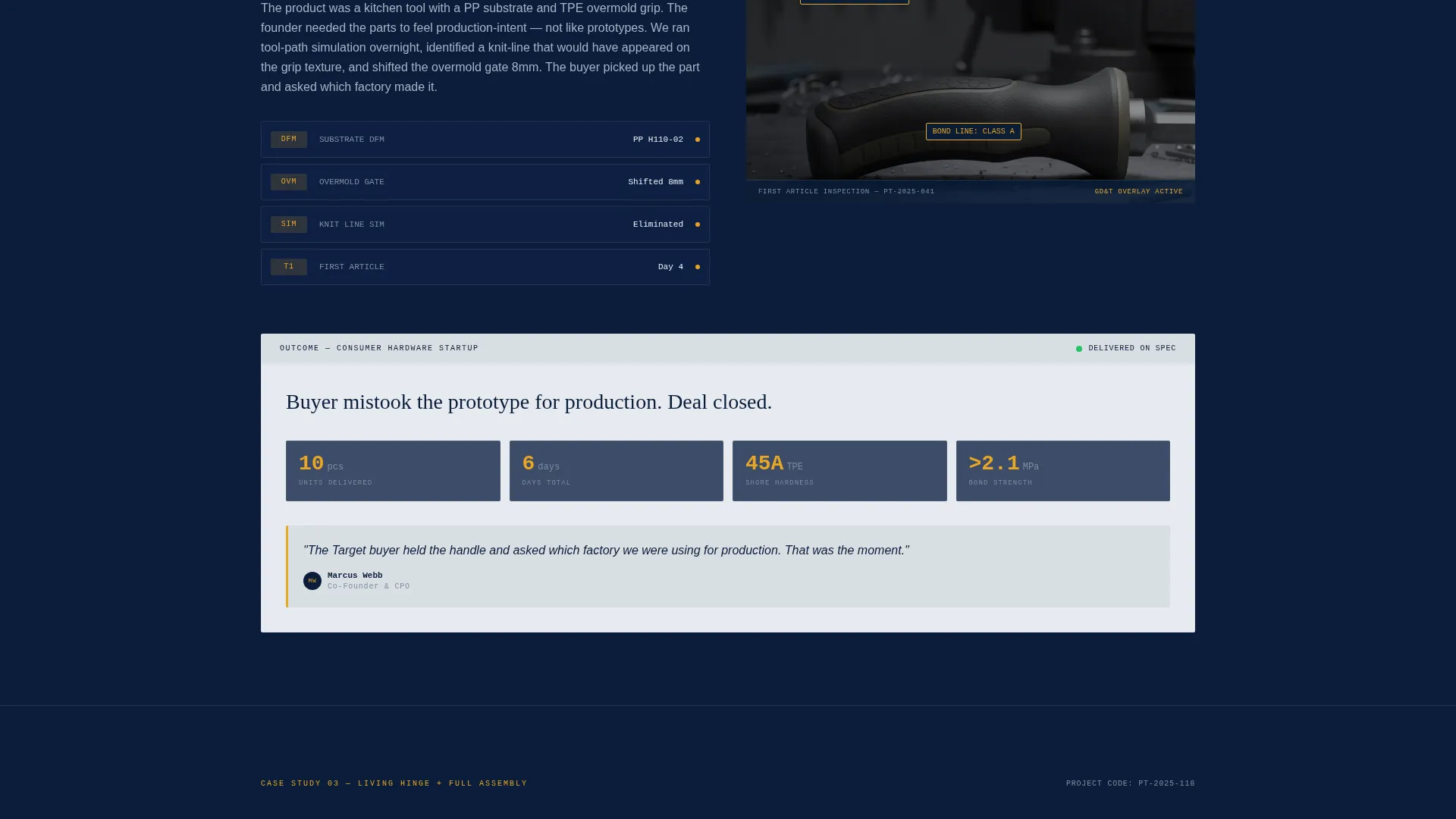
Each alternating section tells one complete client story. It opens with the brief, moves through the process including design-for-manufacturability analysis and first-article inspection imagery with geometric dimensioning and tolerancing overlays, and closes with a measurable outcome. The sequence escalates from single-material molding to multi-shot and overmold to full assembly, so each section quietly answers the next objection in the buyer's mind.
Dual-Path Conversion System
The primary call to action, "Send Us Your CAD File," appears after the second case study once credibility has been built. The form collects company name, project stage, estimated annual volume range, and a drag-and-drop STEP or IGES file upload field. A secondary path, "Download Our DFM Checklist," captures earlier-stage leads with just an email and job title.
Engineering Blueprint Visual Theme
The Navy Authority color system uses deep technical navy as the primary background, precision white for content panels, machined silver on secondary type and divider lines, and signal amber exclusively for calls to action and interactive highlights. The palette is deliberately stripped of ornament, reflecting the precision of a metrology lab environment.
Escalating Complexity Story Arc
The case studies are ordered by manufacturing complexity. The first covers a straightforward single-material molded part, the next introduces multi-shot tooling, and subsequent sections cover overmolding and full product assembly. This arc doubles as a capability demonstration, showing breadth without a single claim of expertise.
B2B Partnership Conversion Flow
The page is structured around a Partnership and B2B conversion intent. Trust is built through documented outcomes, real tolerances, and realistic timelines before any form is shown. The form placement is intentional: it appears only after two full case studies have been presented.
Page sections overview
| Section | Purpose |
|---|---|
| Isometric Blueprint Header | Establishes technical authority with animated dimension callouts and scroll rotation |
| Case Study One | Presents a single-material molding brief, process, and outcome |
| Case Study Two | Escalates to multi-shot tooling with process documentation |
| Primary call to action Form | Captures qualified leads with CAD file upload and project stage detail |
| Case Study Three | Introduces overmolding complexity and assembly scope |
| Secondary Lead Capture | Collects early-stage leads via DFM Checklist download |
| Final Conversion Section | Reinforces credibility and closes with a clear next step |
Design & branding system
The visual identity follows an Engineering Blueprint theme built for technical buyers who distrust decoration. Every color choice has a function, and no element exists purely for aesthetics.
- Deep technical navy (#0B1D3A) backgrounds anchor authority; precision white (#EDF1F5) panels carry content clearly
- Machined silver (#7B8FA1) handles secondary type and divider lines, keeping hierarchy clean without noise
- Signal amber (#E8A624) appears only on calls to action and interactive highlights, making every conversion point unmissable
Mobile & speed optimization
The layout is built with a mobile-first reading experience in mind. The zigzag structure collapses cleanly into a single-column flow on smaller screens without losing narrative order.
- Isometric header art and animated callouts are designed to remain legible at phone screen widths
- The drag-and-drop file upload form adapts to touch interaction for field-level usability on mobile devices
- Section spacing and type scale are calibrated for comfortable reading across screen sizes
How this template helps you convert
The conversion strategy is built on showing evidence first and asking for commitment second. The page earns the click before it makes the ask.
- The case study narrative builds trust progressively, with each story answering a likely buyer objection and escalating in complexity to demonstrate full manufacturing range
- The dual-path lead capture meets buyers at different stages of readiness, offering a low-friction checklist download for early-stage visitors and a structured CAD file submission for production-intent prospects
Other information about this template
This template is a strong fit for consumer goods prototype and rapid prototyping services operating in competitive B2B markets. It is especially useful for shops that regularly handle consumer product development across multiple manufacturing processes.
- The case study arc covers injection molding, overmolding, living hinge design, and multi-shot tooling scenarios drawn directly from the template brief
- The page's visual identity and narrative structure position the service as a precision manufacturing partner, not a commodity vendor
- The DFM Checklist secondary path is designed to capture product managers and packaging engineers who are still in early design iteration
- The template works for any prototyping or manufacturing studio whose clients include CPG brands, retail buyers, and startup founders with tight go-to-market timelines
Theme
Engineering Blueprint
Creative direction
Case Study Narrative
Color system
Navy Authority
Style
Zigzag/Alternating
Direction
Partnership/B2B
Page Sections
Animated Isometric Blueprint Header
Zigzag Case Study Narrative Layout
Dual-path Lead Capture System
Engineering Blueprint Visual Theme
Escalating Complexity Story Arc
B2B Partnership Conversion Flow
Related questions
What types of manufacturing services does this template suit best?
Can I replace the case study content with my own client projects?
Who is the primary conversion target for this landing page?
What does the primary contact form collect from visitors?
Is there a lower-commitment path for visitors not ready to share a CAD file?