Complete Eating Disorder Care Appointment Booking Website Template
Pulse is a hub and spoke landing page template built for an eating disorder wearable monitor. It guides three distinct audiences through a calm, trust-building scroll, from a quiet testimonial header to a role-adaptive booking form. The Organic Flow visual style and Alpine Fresh color palette make every section feel grounded, warm, and far from clinical.
by Rocket studio
Quick summary
Pulse is a single-page, anchor-navigated landing page template for an eating disorder wearable monitor. It follows a Problem to Solution Arc, moving visitors from the emotional weight of the therapy gap to a confident, caring call to book a fit consultation. The design breathes in mist white, pine, and glacial blue, with coral reserved for moments of action.
Who this template is for
This template is built for health and wellness brands operating at the careful intersection of wearable technology and eating disorder recovery care. It speaks directly to three audiences who each carry a different relationship with the recovery journey.
- Parents of teenage daughters recently discharged from residential treatment programs
- Outpatient therapists managing large client caseloads who need visibility between sessions
- Adult self-referrals who are actively rebuilding their relationship with food one meal at a time
What problem this template solves
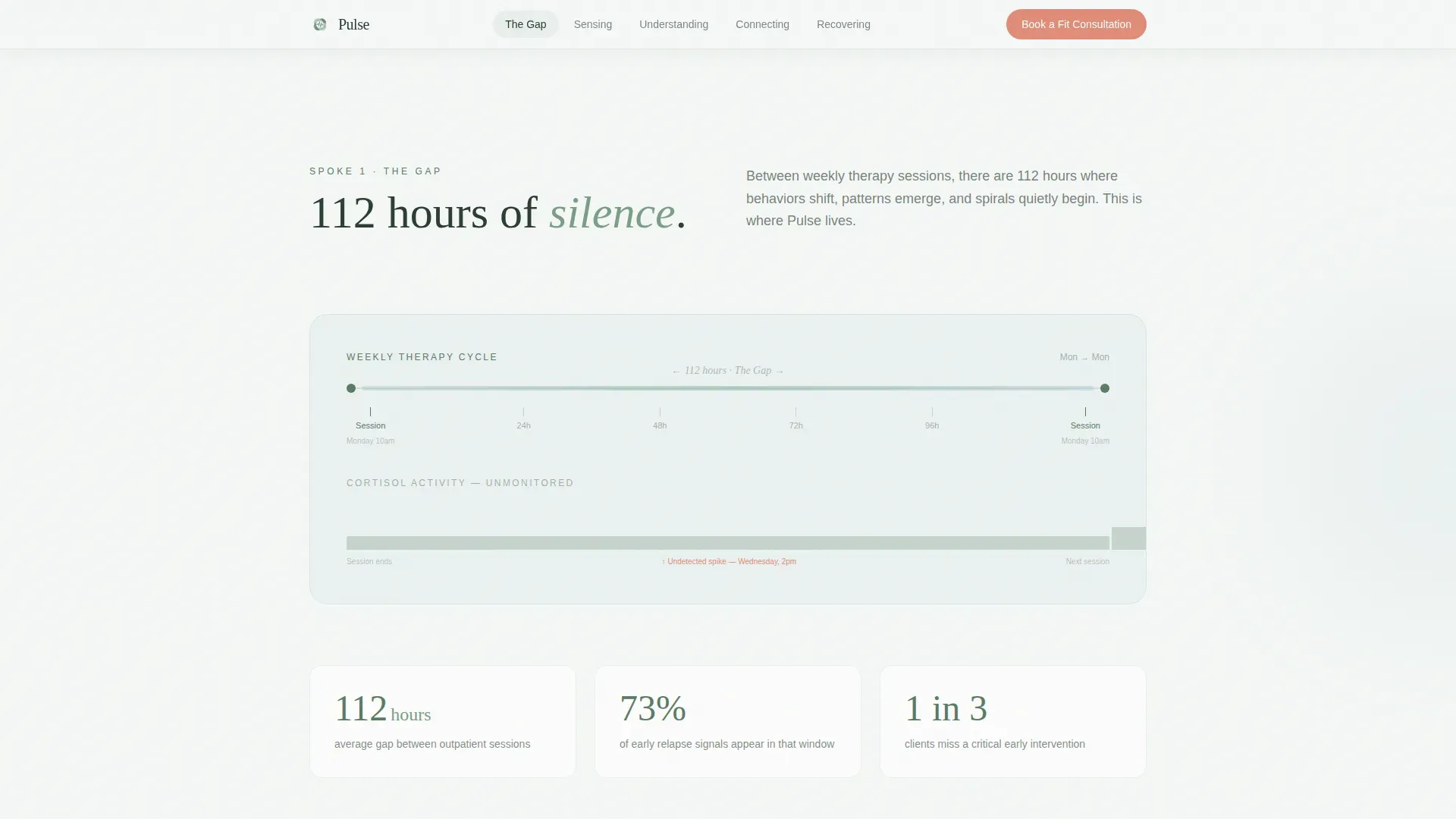
There are roughly 112 hours between weekly therapy sessions. That silence is where 73% of relapse behaviors begin. Standard landing page templates cannot hold the emotional complexity of this product. They feel either too clinical or too vague, losing trust before it is ever built.
- Generic health templates fail to distinguish between multiple care-relationship audiences
- Most booking flows treat every visitor the same, losing the nuance that parents, therapists, and self-referrals each need
- Cold or corporate visual styles actively undermine trust for a product built around vulnerability and recovery
What you get with this template
You get a fully structured, single-page landing page with anchor navigation connecting five purpose-built content spokes. Every section is designed to carry a specific emotional and functional weight in the visitor's journey toward booking a consultation.
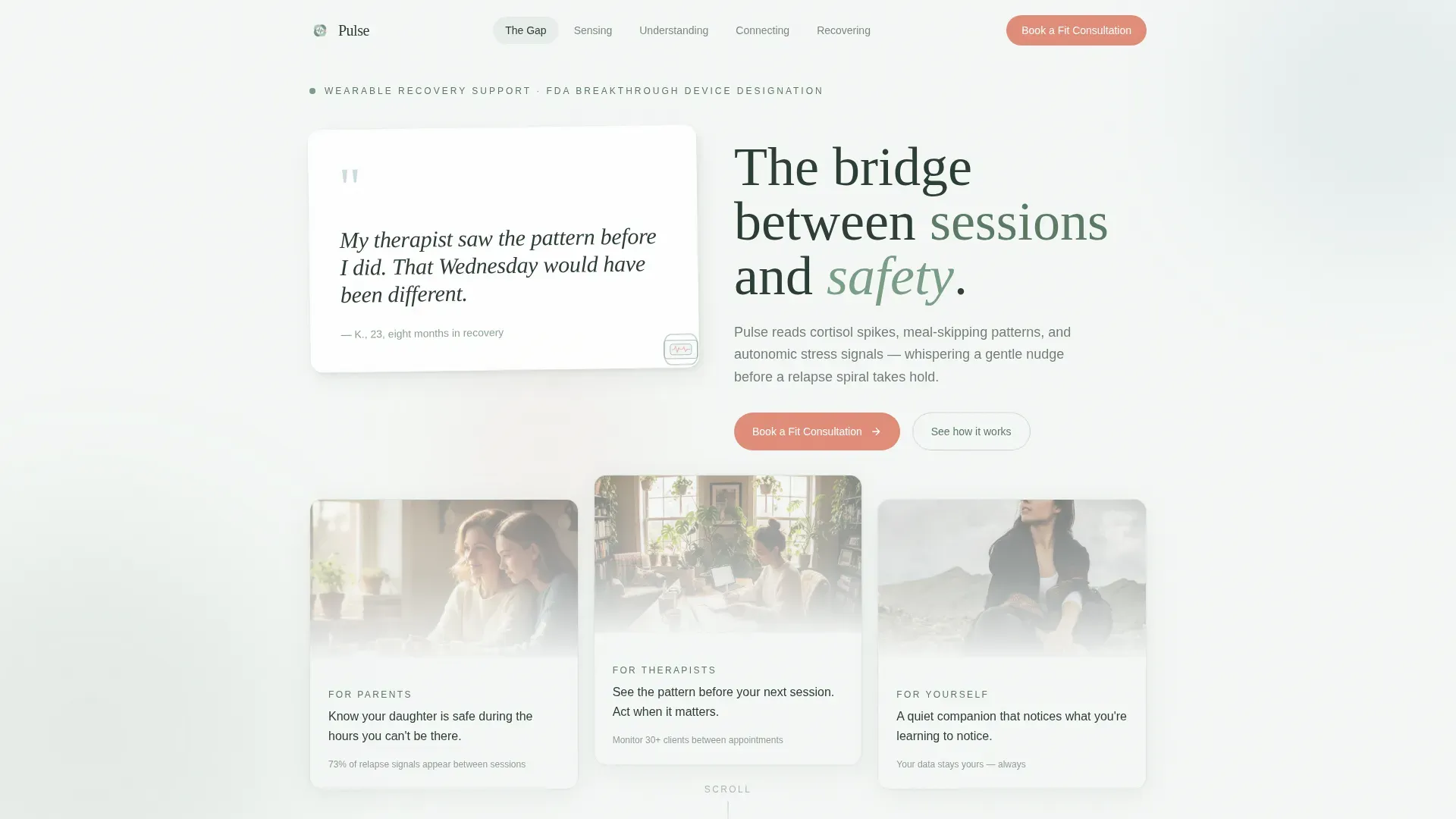
- A testimonial-led hero with three floating persona cards styled in glassmorphism on a mist-white field
- A Problem to Solution Arc spanning five anchor-linked spokes: The Gap, Sensing, Understanding, Connecting, and Recovering
- A role-adaptive two-step booking form and a gated PDF secondary path for visitors not yet ready to commit
Feature list
This template includes components designed specifically for the emotional and functional demands of eating disorder wearable care marketing.
Testimonial-First Hero Section
The hero opens with a handwritten-style testimonial card floating on a mist-white background. A thin wrist outline illustration sits quietly beside it. The product arrives second; the human story arrives first, setting a tone of trust before any feature claim is made.
Five-Spoke Anchor Navigation
A central hub connects five named content spokes: The Gap, Sensing, Understanding, Connecting, and Recovering. Each spoke builds naturally on the last, guiding visitors through the full arc without requiring them to scroll blindly or lose context.
112-Hour Gap Visualization
The Gap section presents a quiet timeline visualization showing the empty space between weekly therapy sessions. This single visual anchors the entire product argument without a single word of hyperbole.
Waveform and Topographic Data Panels
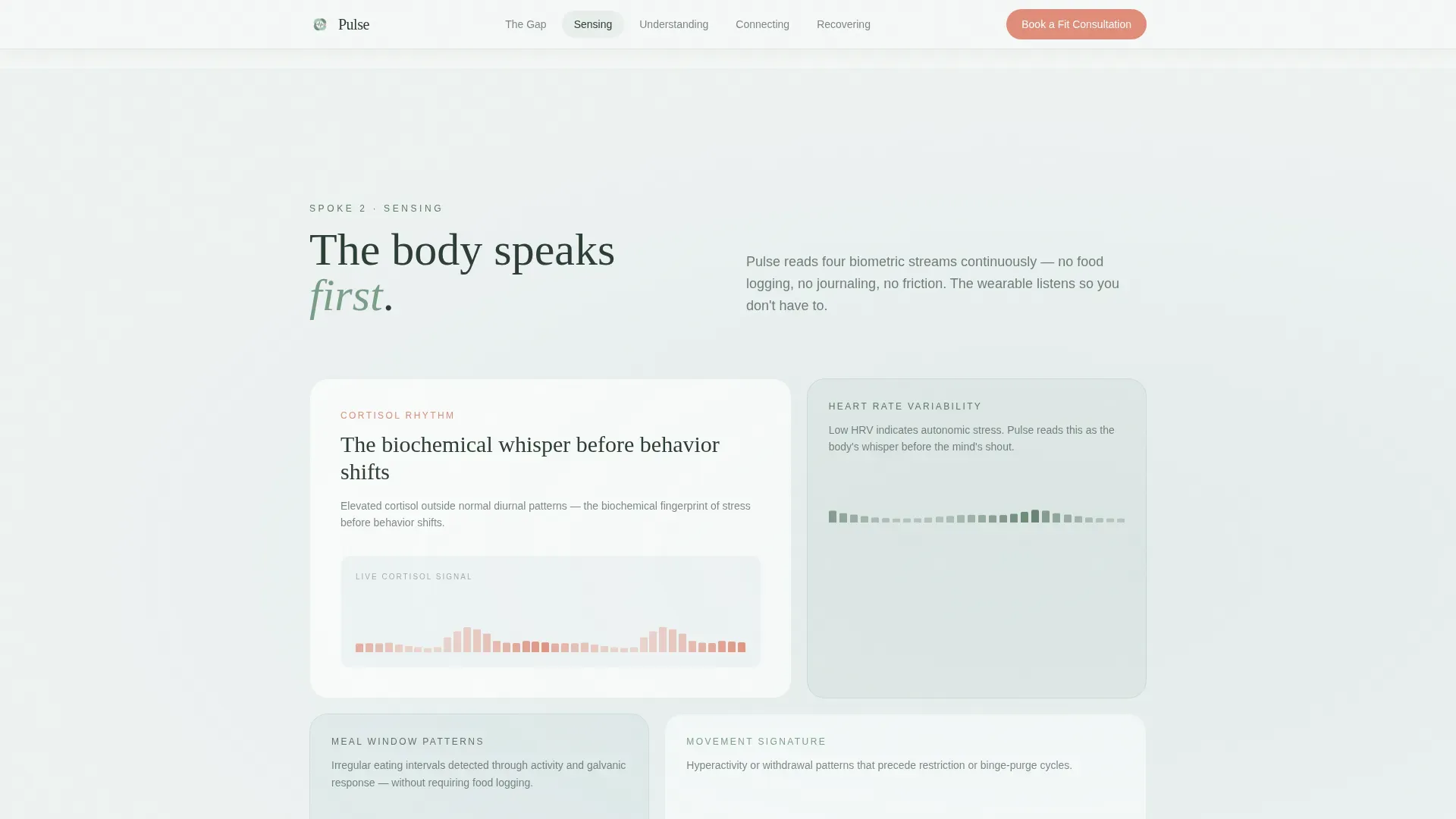
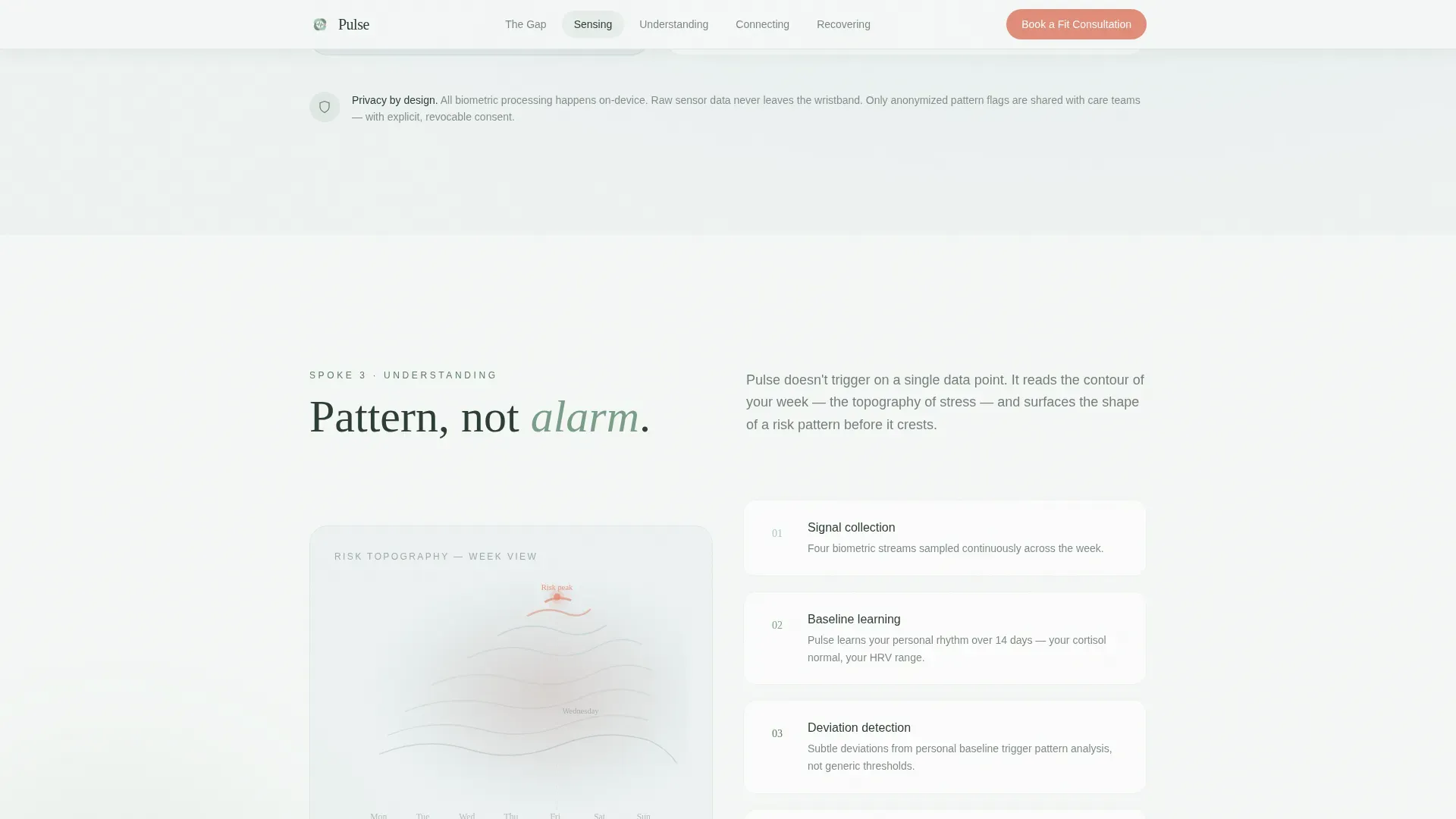
Biometric data appears as gentle animated waveforms. Pattern recognition is illustrated as soft topographic contour lines. Both treatments keep data readable and reassuring rather than technical or alarming.
Role-Adaptive Booking Form
The two-step consultation form opens with a role selector: parent, therapist, or self. Each role triggers a tailored second step. Parents see fields for treatment center name and preferred call window. Therapists see practice name and caseload size. Self-referrals see current care provider and a comfort-level slider for data sharing.
Gated Care Team Guide Download
A secondary conversion path offers a downloadable Care Team Guide as a gated PDF. It captures email address and role without applying pressure, serving visitors who are not yet ready to book a consultation.
Page sections overview
| Section | Purpose |
|---|---|
| Hero Testimonial Card | Opens with human story and three persona cards |
| The Gap Timeline | Visualizes 112-hour therapy silence and relapse risk |
| Sensing and Understanding | Shows biometric waveforms and AI pattern contours |
| Connecting Alert Moment | Illustrates simultaneous care team and wearer notification |
| Booking and Recovery | Role-adaptive form and gated PDF download path |
| Footer Linear Row | Single-row footer with minimal navigation links |
Design & branding system
The visual identity follows an Organic Flow theme built on the Alpine Fresh color palette. Every color is drawn from nature, and nothing reads as synthetic or clinical. Fraunces, a display serif, leads headlines. DM Sans handles all body copy for clean, approachable readability.
- Mist white (#F4F7F5) forms the page background, giving every section room to breathe
- Soft pine (#5B7B65) anchors headlines and navigation; glacial stream blue (#A3C4CB) washes data visualization panels
- Wildflower coral (#E08D79) appears only on calls to action and alert-state illustrations, reserving its warmth for moments of invitation
Mobile & speed optimization
The template is built desktop-first with deliberate mobile adaptation across all five content spokes. Animation layers use GSAP ScrollTrigger, clip-path reveals, and waveform SVG animation with staggered entrances designed to scale down gracefully on smaller screens.
- Static sections use server components to reduce load burden on the interactive parts of the page
- The role-adaptive form and all animation logic run as client components, keeping interactive behavior smooth without affecting static render
- Anchor navigation collapses cleanly for mobile visitors, keeping the five-spoke structure navigable on any screen width
How this template helps you convert
The entire page is structured around a single primary conversion goal: booking a fit consultation. A secondary path captures visitors who need more time before committing.
- The role selector at the top of the booking form immediately personalizes the experience, making every visitor feel the product was built for their specific situation rather than for a general audience.
- The gated Care Team Guide PDF gives hesitant visitors a low-pressure next step, collecting email and role data while delivering genuine value before a booking conversation begins.
Other information about this template
This template is category-coded under Health and Medical, with a subcategory of Eating Disorder Care and a niche focus on eating disorder wearable monitoring. It is designed as a hybrid business-to-consumer and business-to-business conversion page, serving both individual users and professional care providers.
- The Intersection Match Score for this template context is 13, reflecting strong alignment between niche, subcategory, and template style
- The lp_direction is Booking and Scheduling, meaning every design and copy decision ladders up to the consultation form as the primary goal
- The template ships with English (United States) localization and no currency references, keeping it appropriate for care providers across practice types
- The header concept is a standalone Testimonial Card with no product photography or logo dominance, a deliberate choice that prioritizes emotional safety over brand assertion
Theme
Organic Flow
Creative direction
Problem→Solution Arc
Color system
Alpine Fresh
Style
Hub & Spoke (Anchor Nav)
Direction
Booking/Scheduling
Page Sections
Testimonial-first Hero with Persona Cards
Five-spoke Anchor Navigation Hub
Hour Gap Timeline Visualization
Waveform and Topographic Data Display
Role-adaptive Two-step Booking Form
Gated Care Team Guide Download
Related questions
Can I customize the booking form for my specific care model?
Is this template suitable for both individual users and clinical practices?
What happens when a visitor is not ready to book a consultation?
Can the waveform animations be simplified for a less complex build?
Does the five-spoke anchor navigation work on mobile screens?