Hospital & Health System Booking Website Template
Pulse is a single-column cardiac center landing page built for interventional cardiology practices. It leads with three oversized performance stats, guides visitors through a scroll-driven cardiac risk self-assessment, and closes with a dual-path lead capture form. The design is clinical yet calming, using soft sky gradients and confident typography to earn trust before asking for a booking.
by Rocket studio
Quick summary
Pulse is a lead generation landing page designed for interventional cardiology centers. It opens with animated performance metrics, walks visitors through a four-question cardiac risk self-assessment, then presents credentials and patient outcomes before delivering a clear call to action. The layout earns clinical authority and patient trust in a single, focused scroll.
Who this template is for
This template is built for cardiac care providers who need to convert anxious patients and referring physicians into booked consultations. It speaks directly to the clinical stakes of the specialty and the emotional weight visitors carry when they arrive.
- Interventional cardiology centers and cardiac cath labs promoting their services online
- Hospital-based heart programs that receive referrals from general practitioners
- Cardiac care marketers who need a high-trust, lead-focused page without a complex multi-page build
What problem this template solves
Patients researching cardiac care arrive frightened and uncertain. A generic clinic page with stock photography and vague reassurances does not convert them. Referring physicians need to see competence immediately. This template addresses both audiences in one structured scroll.
- Removes the gap between "I think I have a heart problem" and "I know where to go"
- Replaces hollow trust signals with verifiable outcome data presented at the top of the page
- Captures leads from two different audience mindsets: those ready to book and those still deciding
What you get with this template
You get a fully structured, single-column landing page with every major section pre-built and purposefully ordered. Each section is designed to move a visitor one step closer to submitting the lead form.
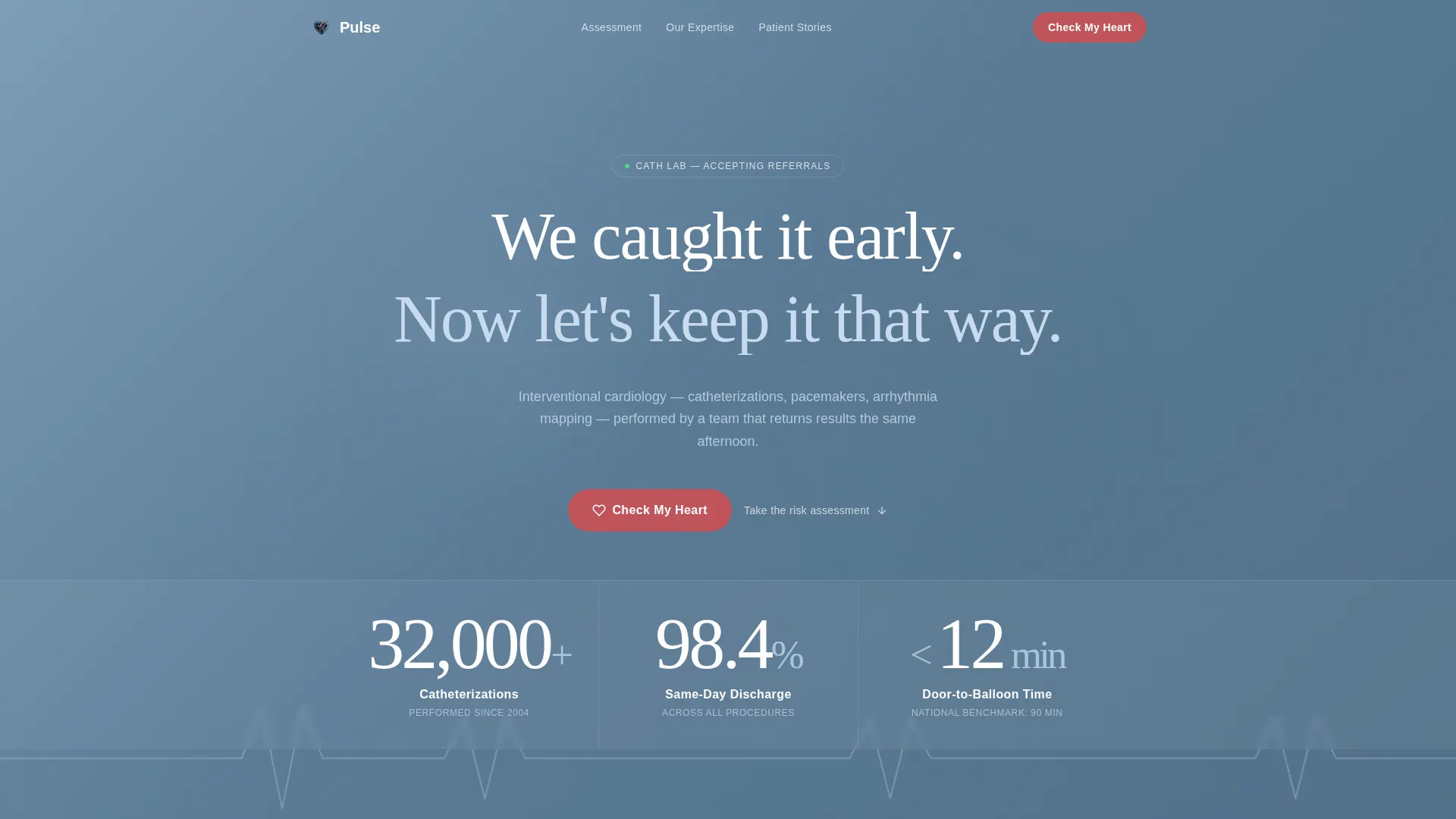
- A hero section with animated count-up stats on a slate-to-sky gradient background
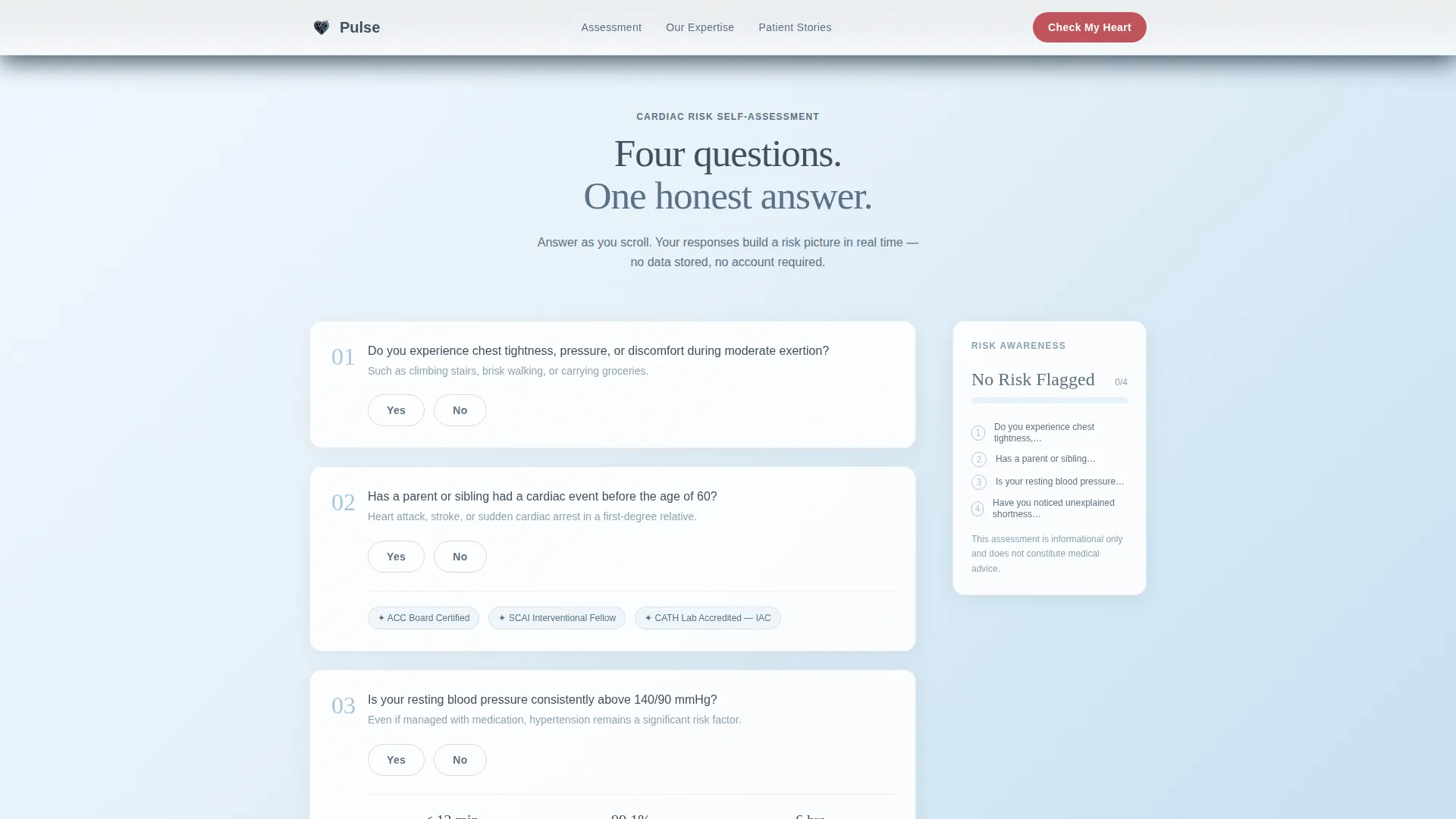
- A four-question cardiac risk self-assessment with a live risk-awareness meter in a sidebar rail
- An asymmetric credentials bento grid, three spotlight testimonial cards, and a dual-path lead capture form with PDF download gate
Feature list
This template is built with purpose-specific components that reflect the clinical context of interventional cardiology.
Animated Stats Hero
Three oversized numerals count up on scroll-in: 32,000 plus catheterizations performed, 98.4 percent same-day discharge rate, and under 12 minutes average door-to-balloon time. Each stat sits on a soft slate-to-sky gradient, set in a thin sans-serif typeface that communicates precision without a single word of marketing copy.
Scroll-Driven Risk Self-Assessment
A four-question cardiac risk checklist unfolds as the visitor scrolls. Each question occupies a full-width card with a yes/no toggle interaction. A persistent sidebar rail builds a soft risk-awareness meter as answers are recorded, creating a personalized sense of urgency tied to the visitor's own responses.
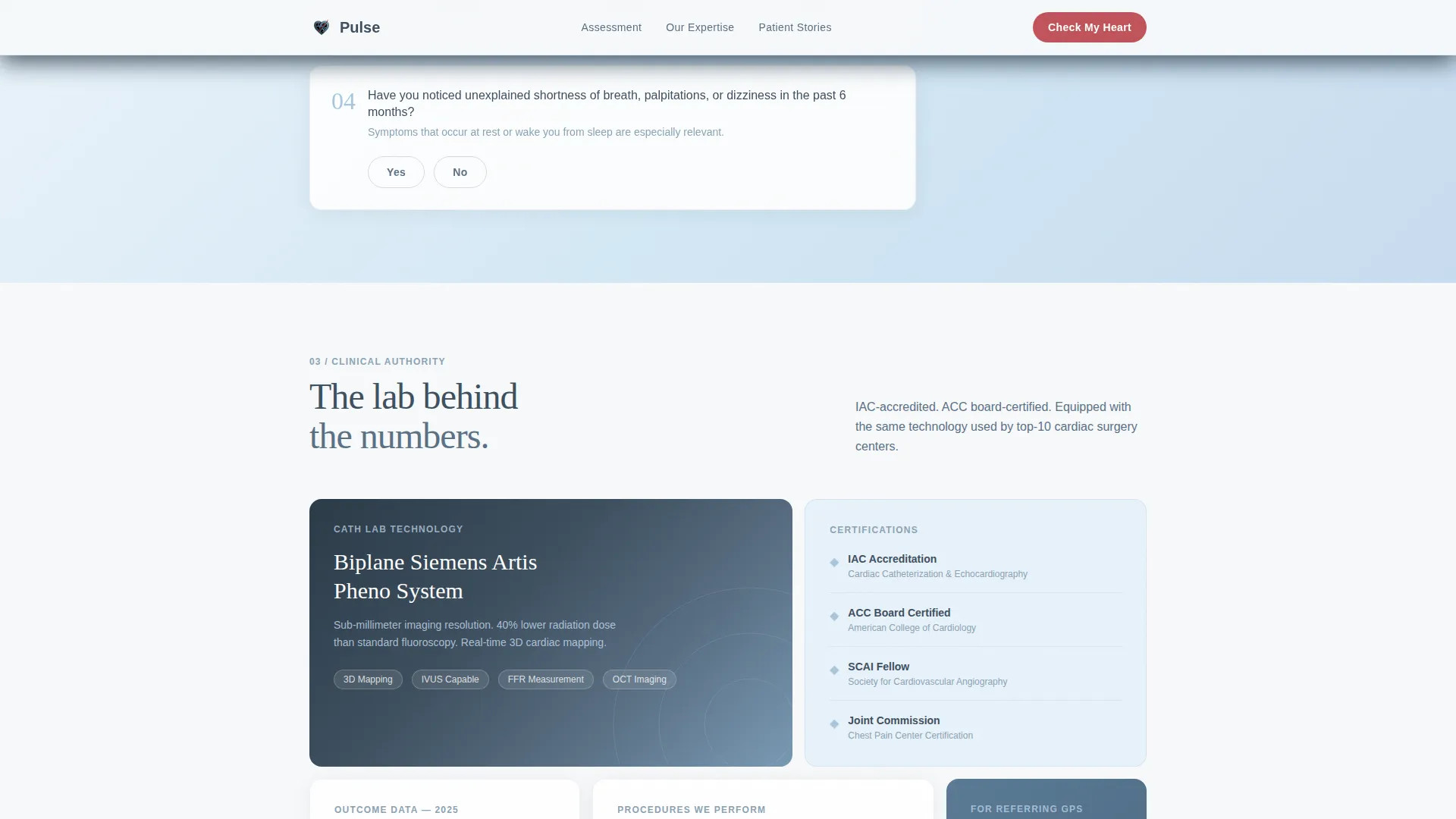
Credentials and Outcomes Bento Grid
An asymmetric bento grid section presents board certifications, cath lab technology specifications, and procedure outcome data in a visually structured layout. Clinical authority is displayed between checklist questions so visitors evaluate the center while evaluating themselves.
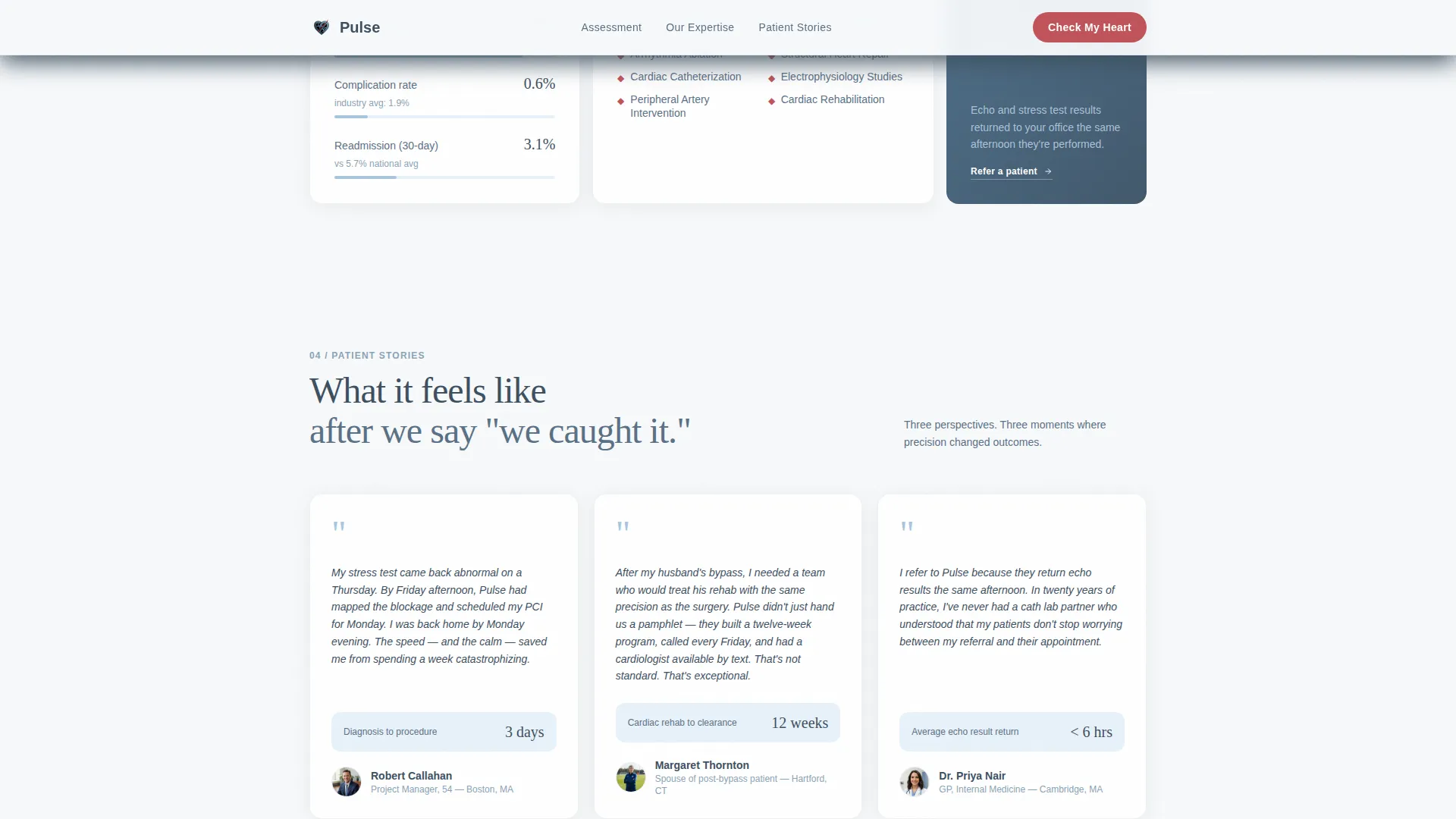
Spotlight Testimonial Cards
Three patient testimonial cards are presented in a spotlight format, each tied to a specific procedure or outcome. Concrete patient stories reinforce the trust built by statistics and credentials.
Dual-Path Lead Capture Form
The primary call-to-action form collects name, phone number, insurance carrier, and a dropdown reason for the visit. A secondary path offers a downloadable "Know Your Numbers" PDF guide in exchange for an email address, capturing visitors who are not yet ready to book.
Persistent Floating Call-to-Action Button
After the third checklist question, a floating "Check My Heart" button appears and remains accessible as the visitor continues to scroll. This removes friction between the moment of decision and the act of reaching out.
Page sections overview
| Section | Purpose |
|---|---|
| Hero Stats Banner | Display three animated performance metrics to establish clinical authority immediately |
| Cardiac Risk Checklist | Guide visitors through a four-question self-assessment with a live risk sidebar |
| Credentials Bento Grid | Present board certifications, cath lab specs, and outcome data in a structured grid |
| Patient Testimonial Cards | Reinforce trust with three specific patient outcome stories |
| Lead Capture Form | Convert ready visitors with the "Check My Heart" form and insurance dropdown |
| PDF Download Gate | Capture not-yet-ready visitors with a "Know Your Numbers" guide email exchange |
| Footer Row | Provide single-row navigation and contact anchors in a linear layout |
Design & branding system
The visual identity uses a Soft Gradient theme built on a Slate and Sky color system. Every color choice has a clinical rationale: sterile white as the canvas, sky blue as a calming wash, slate for text, and arterial red used only where action is required.
- Primary palette: clinical slate (#3D4F5F) for body text, morning sky (#A8C6DF) for gradient section backgrounds, and sterile white (#F7F9FB) as the page canvas
- Accent color: calm arterial red (#C0535A) appears exclusively on call-to-action buttons and critical stat highlights, never decoratively
- Typography pairing: Fraunces serif for display headings and oversized numerals, DM Sans for body text and interface elements
Mobile & speed optimization
The template is built desktop-first to serve the primary audience of patients researching on laptops and referring physicians reviewing cath lab data at their desks. It remains fully responsive across smaller screen sizes.
- Interactive components including the checklist toggles, risk meter, and lead form are built as client-side components for smooth interaction
- Static sections such as the stats hero, credentials grid, and testimonial cards are structured as server-rendered components to keep initial load lean
- The single-column layout adapts cleanly to tablet and mobile viewports without restructuring the content hierarchy
How this template helps you convert
The layout is engineered around a specific conversion insight: a cardiac patient who has self-identified a risk is more likely to act than one who has simply read a brochure. Every section moves the visitor toward that self-identified moment.
- The animated stats section builds immediate clinical credibility before any copy is read, reducing the friction of trust-building that normally takes multiple page visits.
- The checklist self-assessment creates personal relevance. When a visitor answers yes to two or three risk questions, the risk meter responds visually, making the call to action feel necessary rather than promotional.
- The dual-path form captures both conversion-ready visitors with the "Check My Heart" booking form and early-stage visitors with the PDF guide, so no lead is lost to hesitation.
Other information about this template
This template is a strong fit for cardiac care digital marketing programs that need one focused page rather than a full website. It is particularly useful for centers running paid search or referral-based campaigns where every visitor has a specific intent.
- The footer uses a Pattern 1 linear single-row layout, keeping the bottom of the page clean and focused on the primary conversion path
- Animation intensity is high throughout: count-up numbers, text reveals, checklist toggle interactions, risk meter builds, and spotlight card transitions are all included in the design spec
- The "What prompted your visit today?" dropdown includes preset options such as "Abnormal test result," "Family history concern," "Referred by my doctor," and "Just want peace of mind," making form completion feel guided rather than clinical
- The page uses Fraunces and DM Sans as its type system, a pairing chosen to balance editorial warmth with interface clarity
Theme
Soft Gradient
Creative direction
Checklist & Audit
Color system
Slate & Sky
Style
Single Column Flow
Direction
Lead Generation
Page Sections
Animated Count-up Stats Hero
Scroll-driven Cardiac Risk Checklist
Credentials and Outcome Bento Grid
Spotlight Patient Testimonial Cards
Dual-path Lead Capture Form
Persistent Floating Call to Action Button
Related questions
Who is this landing page template designed for?
Can I customize the checklist questions and risk meter labels?
What does the dual-path lead capture form include?
Does this template include the actual PDF guide content?
Is this template suitable for a referring physician audience as well as patients?