Silica Sand Mining Landing Page Template
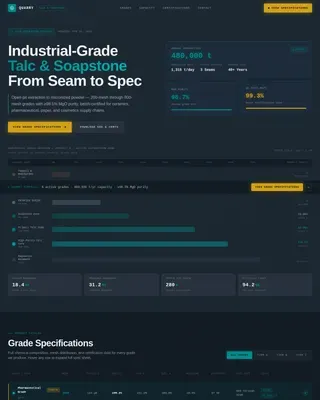
Quarry is a modular card grid landing page built for high-purity silica sand mining operations. It guides procurement managers, plant engineers, and oilfield logistics coordinators through every phase of the silica lifecycle, from geological survey to delivered product, using a timeline-driven layout, a map-based hero, and a gated spec library as the primary conversion path.
by Rocket studio
Quick summary
Quarry is a single-page, card grid template designed for silica sand mining businesses that sell graded, washed, and spec-ready product to foundries, glass plants, and oil and gas operations. The layout follows a timeline progression structure, walking technical buyers through each phase of silica production while building credibility at every scroll step.
Who this template is for
This template is built for silica sand producers who sell to technically demanding buyers. It works best when the sales conversation is driven by data, specifications, and documented performance rather than general marketing claims.
- Silica sand mining operations supplying foundries, float glass lines, and frac proppant customers
- Sales and marketing teams that need to present AFS grain fineness numbers, mesh distributions, and silicon dioxide purity data in a structured, scannable format
- Operations with a library of spec sheets, safety data sheets, and case studies ready to gate behind a lead capture form
What problem this template solves
Technical buyers in glass manufacturing, metal casting, and oil and gas completions do not respond to generic product pages. They need to verify specifications before they will engage with a supplier. Most mining company websites fail to present that data in an organized, trustworthy format.
- Procurement managers waste time hunting for particle size distribution charts and crush resistance values across disorganized PDF directories
- Plant engineers specifying mesh distributions for float glass lines need clear, phase-by-phase proof of quality control before they request a sample
- Oilfield logistics coordinators confirming 40/70 mesh proppant availability before a spud date need fast, scannable answers, not a long brochure page
What you get with this template
The template delivers a full single-page layout built around a content and resource hub model. Every section is designed to earn trust progressively, so the visitor is already convinced by the time they reach the download form.
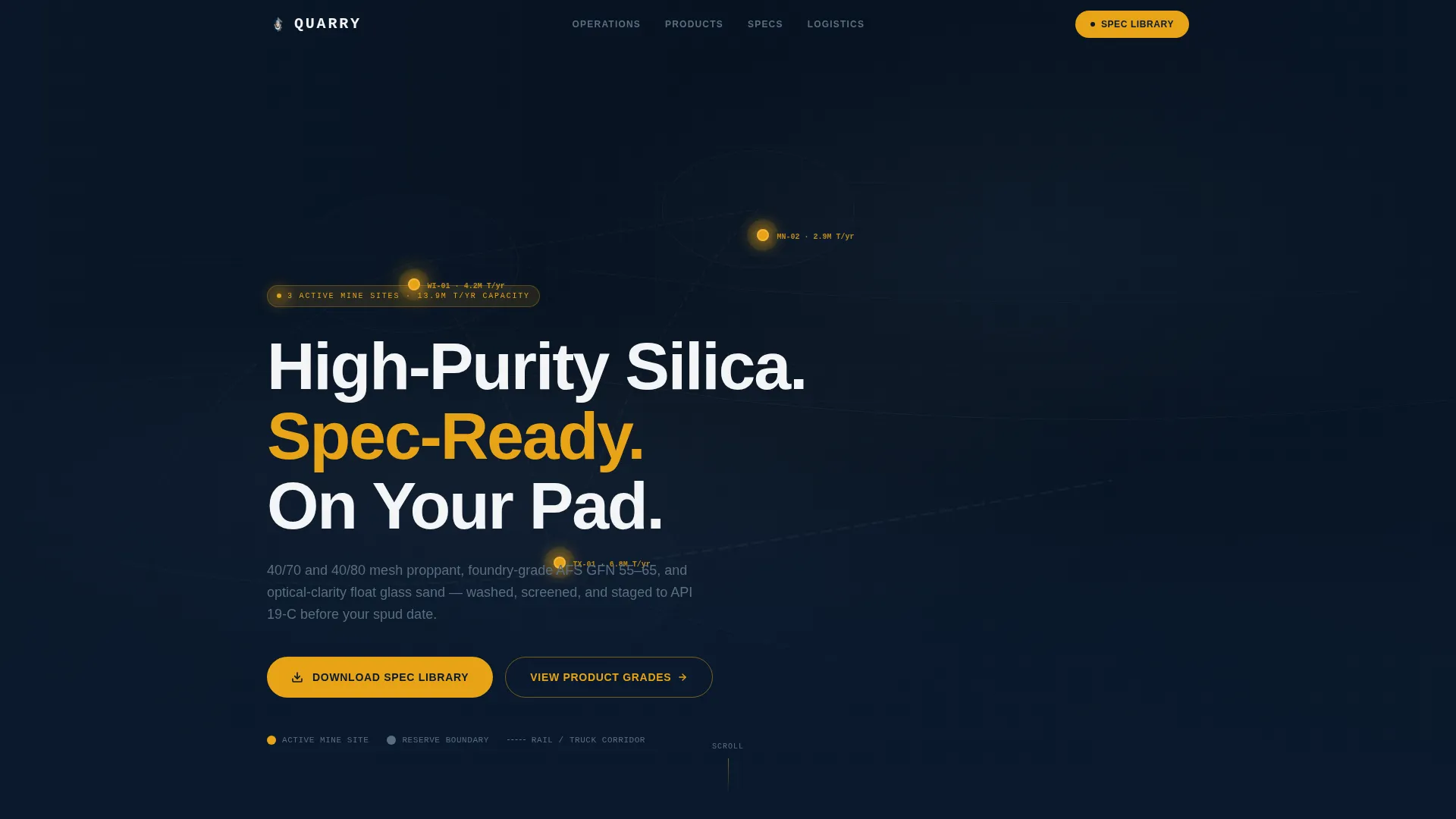
- A map-based hero section showing active mine sites, reserve boundaries, and logistics corridors as an operational dashboard
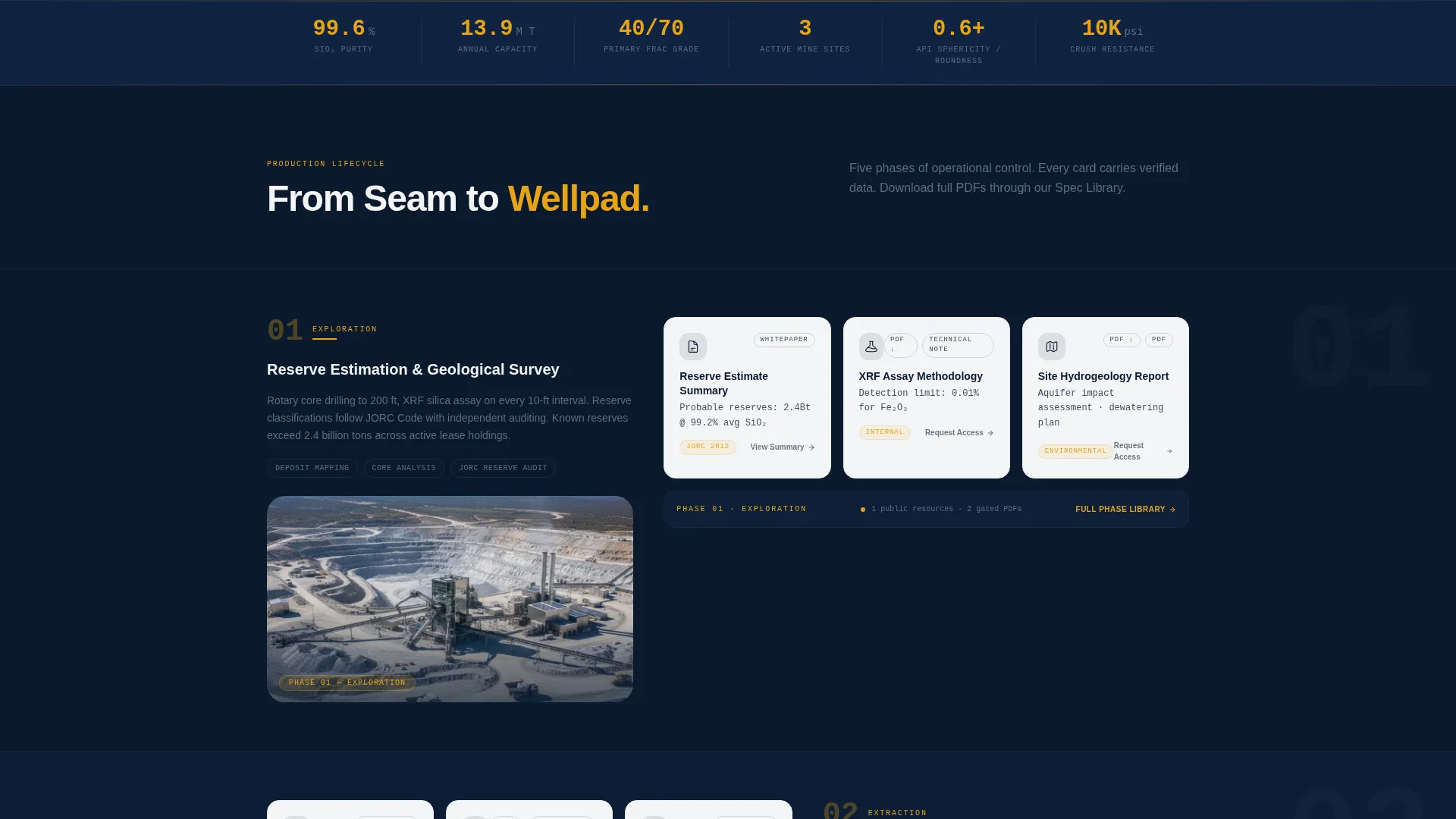
- A timeline-driven card grid that moves through exploration, extraction, washing and screening, grading and quality assurance, and logistics phases
- A primary call-to-action gated form for downloading a full spec library, plus a secondary path for requesting a custom gradation analysis
Feature list
This section describes the core functional and visual components built into the Quarry template.
Map-Based Hero Dashboard
The header uses a dark satellite-style terrain view rather than stock photography. Active mine sites appear as pulsing amber coordinates. Reserve boundaries are drawn in steel gray, and rail and trucking corridors are traced as faint white lines. Tonnage capacity labels hover beside each site. A subtle parallax shift on scroll gives the map dimensional weight.
Timeline Progression Card Grid
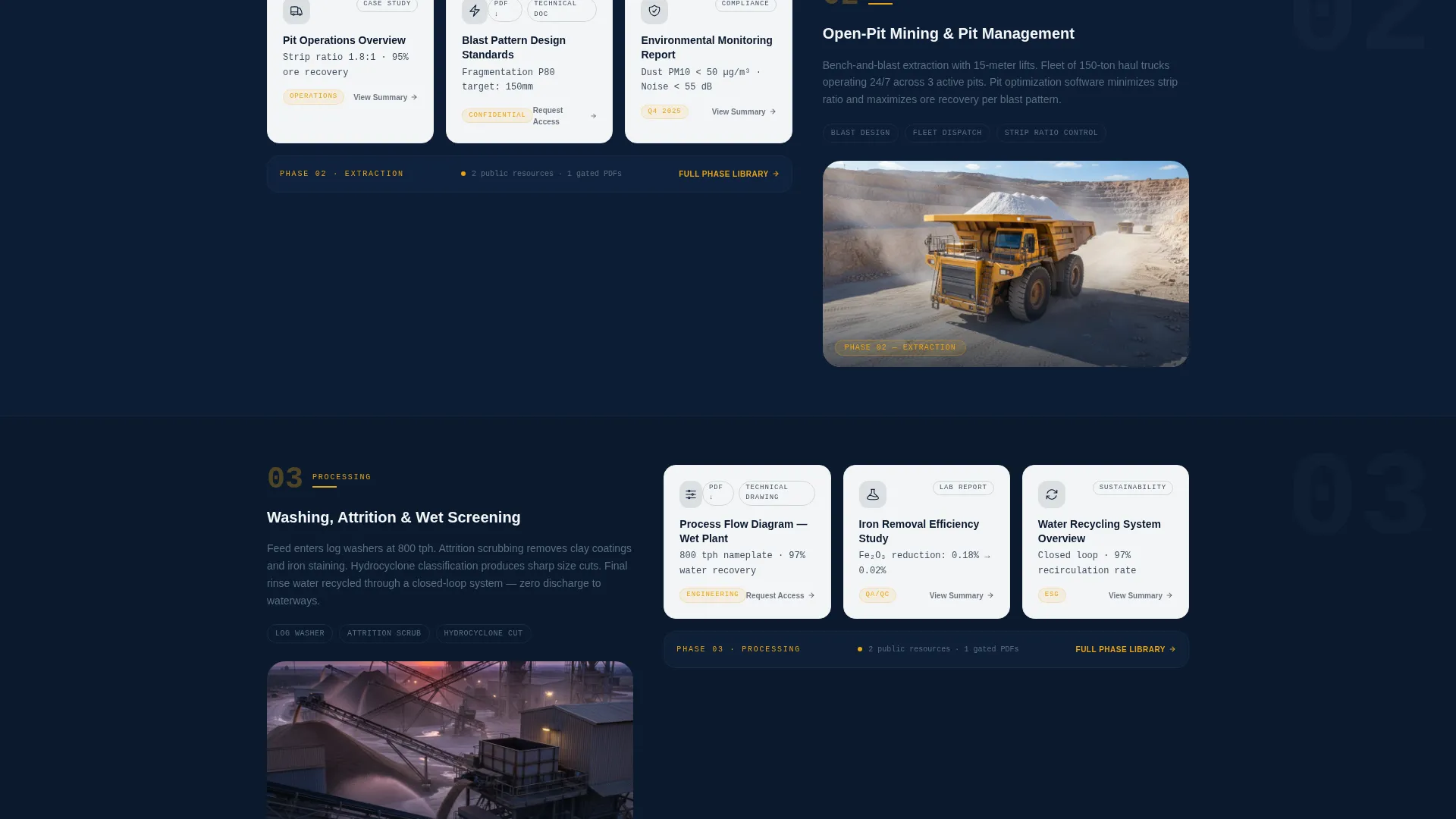
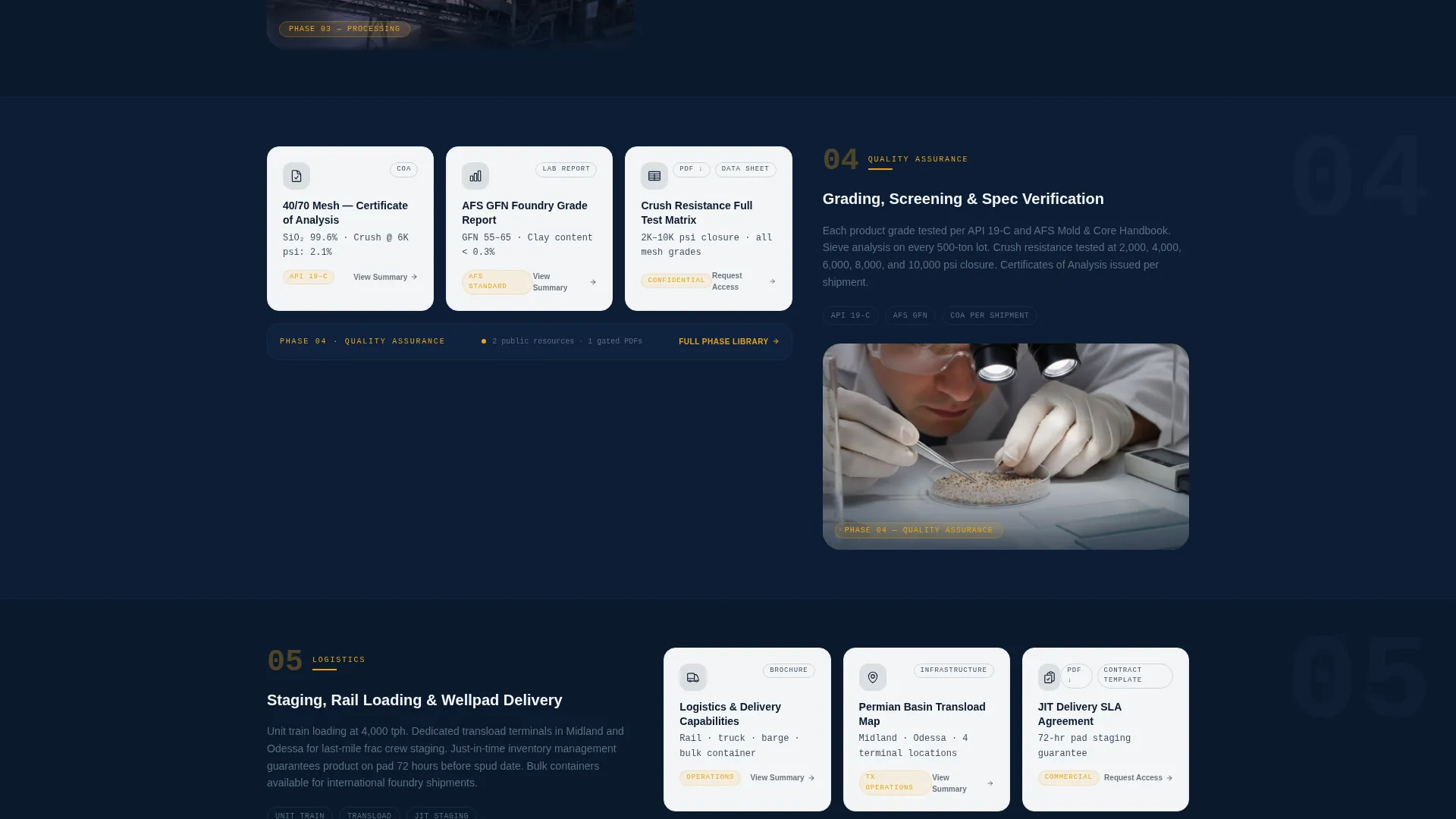
The page body is organized as a scrollable timeline. Each row of modular cards represents one phase of silica sand production: geological survey and reserve estimation, extraction and pit management, washing and screening, grading and quality assurance, and logistics and delivery. The structure escalates technical credibility with each phase.
On-Card Specification Previews
Each resource card surfaces key data points directly on its face, including particle size distribution charts, silicon dioxide purity percentages, and crush resistance values. Visitors can assess the depth of each resource before deciding to download it, which reduces friction and increases form completion intent.
Gated Spec Library Form
The primary conversion path is a short lead capture form placed behind the "Download Our Spec Library" call to action. It collects name, company, industry segment (glass, foundry, oil and gas, or specialty), and specific product grade of interest. Full PDFs require form completion; summary-level data remains visible on-card.
Custom Gradation Analysis Request
A secondary conversion path lets visitors enter their target mesh range and request a custom gradation analysis. This path captures buyers who have a specific technical requirement and are not yet ready to download general documentation.
Navy Authority Color System
The visual identity uses a four-color palette: deep command-center navy for backgrounds, reinforced steel gray for structural elements, high-visibility safety amber for accents and interactive states, and clean quartz white for card surfaces and data labels. The palette is designed to be read clearly under any screen condition.
Page sections overview
| Section | Purpose |
|---|---|
| Map-Based Hero | Show mine sites, reserve boundaries, and logistics corridors as an operational dashboard |
| Exploration Phase Cards | Present geological survey data and reserve estimation resources |
| Extraction Phase Cards | Cover pit management details and extraction process documentation |
| Processing Phase Cards | Display washing, screening, and grading quality assurance resources |
| Logistics Phase Cards | Outline delivery capabilities and proppant staging information |
| Spec Library Download | Gate full PDF resources behind a short lead capture form |
| Custom Gradation Request | Capture buyers with specific mesh range requirements |
Design & branding system
The template follows a Data Command visual theme. The design feels like the control room of a mineral processing plant, built for clarity and fast comprehension under any lighting condition.
- Four-color Navy Authority palette: deep navy (#0B1A2E) for backgrounds, steel gray (#3D4F5F) for structure, safety amber (#E8A317) for interactive states and alerts, and quartz white (#F4F5F7) for card surfaces and data labels
- No stock photography anywhere in the layout; all visual elements are operational or data-driven, including the satellite-style terrain header and on-card specification charts
- Modular card grid layout keeps each phase of the silica lifecycle visually distinct, making the page easy to scan in sections without losing the overall timeline narrative
Mobile & speed optimization
The card grid layout is built to reflow cleanly on smaller screens. Technical buyers often check supplier specifications on mobile devices while on-site or in transit, so readable card formatting at every viewport size is a practical requirement for this template.
- Modular card structure adapts naturally to single-column stacking on mobile without losing the phase-by-phase timeline sequence
- On-card data previews, including particle size distribution charts and purity percentages, remain legible at reduced sizes
- The parallax map header is designed to maintain visual weight on scroll without creating performance-heavy load behavior on mobile connections
How this template helps you convert
The template is built around a progressive trust model. Visitors are given enough technical detail at each scroll step that the decision to submit the form feels like a logical next action, not a leap of faith.
- The map-based hero establishes operational scale immediately, showing mine locations, tonnage capacity, and logistics reach before the visitor reads a single word of body copy.
- The timeline card grid moves buyers through each production phase with documented proof points, so by the time they reach the spec library form, they have already verified the depth of the operation across five distinct stages.
- The two-path conversion structure captures both ready buyers (spec library download) and evaluating buyers (custom gradation analysis request), reducing the number of visitors who leave without engaging.
Other information about this template
This template is built specifically for the silica sand mining niche within the broader mineral and ore mining category. It is a strong fit for operations where the sales cycle is technical and documentation-heavy.
- The template style is a card grid (modular) layout, meaning individual cards can be updated or reordered as product grades or resource documents change over time
- The content and resource hub direction means the page functions as a living sales tool, with the spec library form and gradation analysis request acting as persistent lead capture mechanisms
- The Data Command theme and Navy Authority color system were selected to match the visual expectations of industrial procurement environments, where clarity and data legibility take priority over decorative design
Theme
Data Command
Creative direction
Timeline Progression
Color system
Navy Authority
Style
Card Grid (Modular)
Direction
Content/Resource
Page Sections
Map-based Operational Hero
Timeline Progression Card Grid
On-card Specification Previews
Gated Spec Library Download
Custom Gradation Analysis Request
Navy Authority Visual System
Related questions
Who is the primary audience for the Quarry template?
What types of resources can be featured in the card grid?
How does the gated spec library work?
Can the template support more than one conversion path?
Does the template use stock photography?