Marble Products & Blog Website Template
The Quarry landing page template is built for marble and natural stone suppliers who sell direct from the source. It uses a single-column flow layout, a draggable before-and-after hero, a four-panel documentary scroll, a lead-generation consultation form, and an inventory download gate, all styled in a warm, editorial Pastoral Calm palette that makes every slab feel worth the investment.
by Rocket studio
Quick summary
Quarry is a single-column flow landing page template designed for direct-from-quarry marble and natural stone suppliers. It walks every visitor through the full journey a slab takes, from rough extraction to polished installation, before asking for anything. The result is a website that earns trust visually, then converts it through a focused dual call-to-action system.
Who this template is for
This template is built for suppliers, showrooms, and family-run stone operations that want to close the gap between raw material and finished room. It works equally well for business-to-business and business-to-consumer audiences in the marble and natural stone market.
The ideal users of this template include:
- Interior designers sourcing statement countertops who need provenance, variety, and fast quote access
- General contractors bidding on boutique hotel renovations who need volume options and pricing clarity
- Homeowners mid-renovation who need guidance, inspiration, and a supplier they can trust
What problem this template solves
Most marble supplier websites look like commodity catalogs. They show product photos and a phone number, but they do nothing to explain why one slab is worth choosing over another. Visitors arrive curious and leave unconvinced, because nothing on the page tells the story behind the stone.
This template solves that problem directly:
- It replaces static product grids with a documentary-style scroll that shows the quarry, the cutting floor, the selection room, and the installation, building trust at every stage
- It gives designers a fast path to browse inventory without committing to a call, reducing friction for the research-phase visitor
- It captures consultation leads through a structured form that qualifies project type, square footage, and stone preference before a single phone call happens
What you get with this template
You get a fully structured single-page layout with every section already planned, sequenced, and styled. No guesswork about what goes where. No placeholder sections that require invention.
The template delivers:
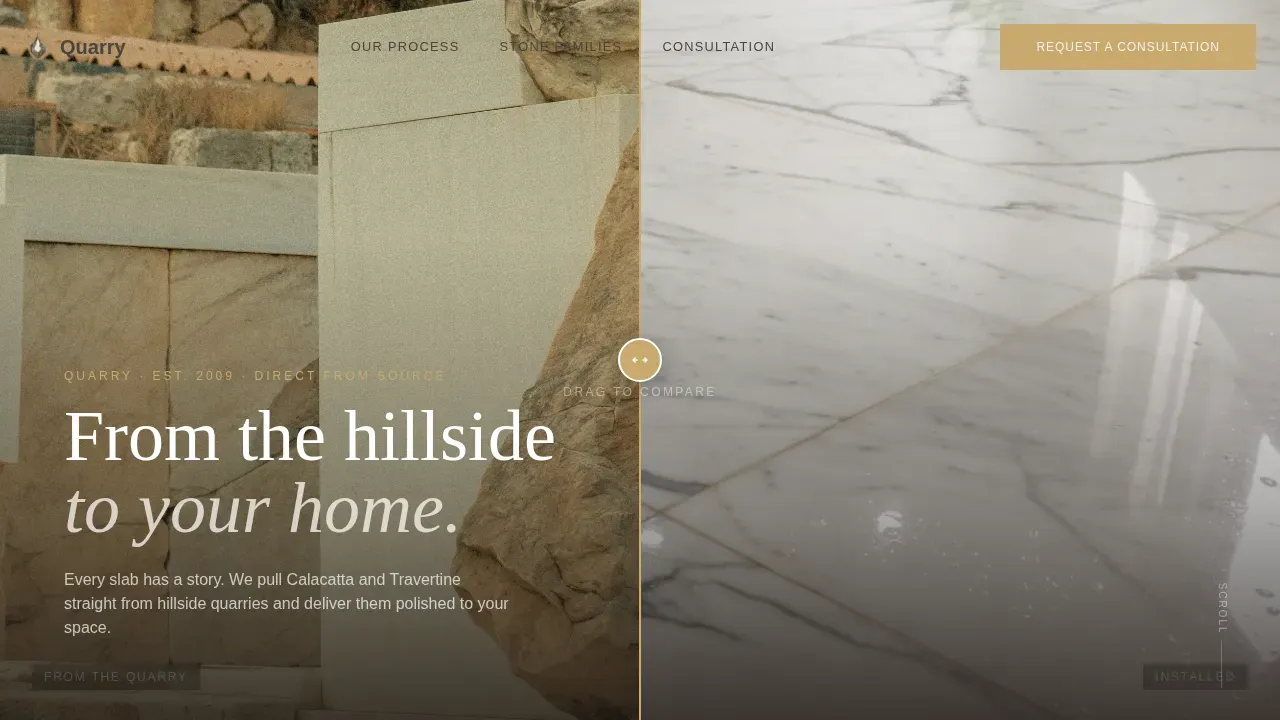
- A draggable before-and-after hero showing a raw quarry block beside its finished book-matched installation
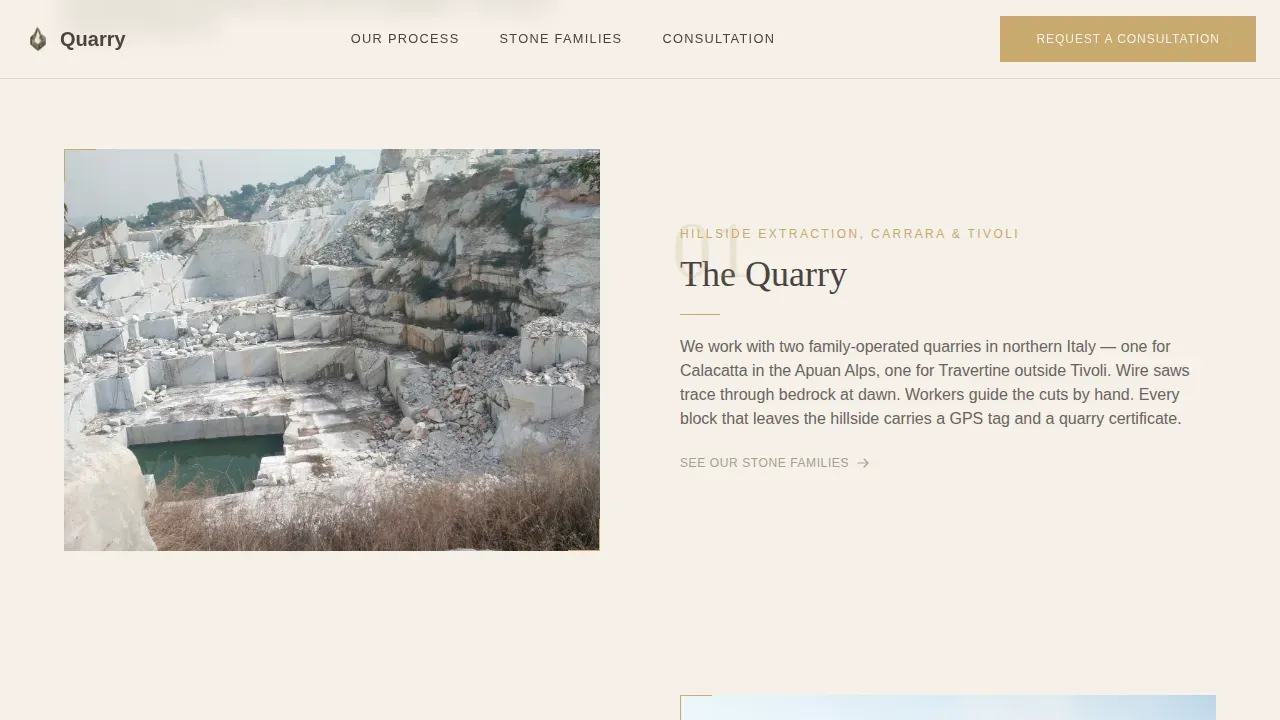
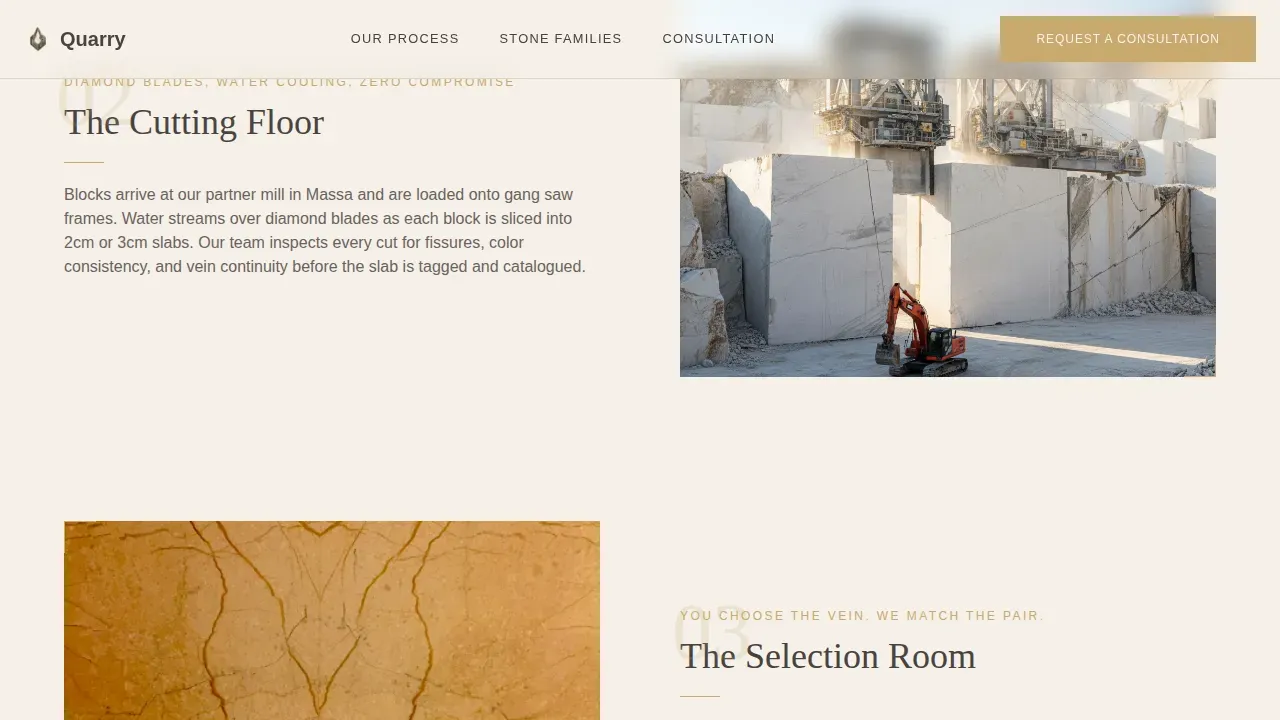
- A four-panel documentary scroll covering The Quarry, Selection and Extraction, Processing and Artistry, and The Home
- A dual conversion system with a full lead-generation form and a gated inventory download for email capture
Feature list
This template is purpose-built for the marble and natural stone market. Every component is grounded in what the brief specifies.
Draggable Before-and-After Hero
The header opens as a full-width split image. A rough-cut marble block sits on the left, dust still on its surface. The same stone appears on the right as a book-matched kitchen island. A brass slider line at the center is draggable, letting the user reveal the transformation at their own pace. A single headline fades in below: "From the hillside to your home. Every slab has a story." This section sets the tone for everything that follows.
Documentary Scroll Journey
The journey section moves like a short film. Four panels walk the visitor through the quarry landscape, the cutting floor where diamond blades work through huge blocks of stone, the selection room where veining is compared under real light, and finally the installation where a craftsman fits an edge with precision. Each panel uses one image and one short paragraph. By the time the visitor reaches the form, they have already watched the stone travel from earth to room. Trust is stored in that experience.
Stone Families Bento Grid
A structured bento-style grid showcases the four stone families available: Calacatta marble, Travertine, Quartzite, and Onyx. Each category gets its own visual tile with a description of color range, typical use, and character. White marble options like Calacatta are shown alongside warmer honey-toned stones, giving designers a quick visual reference. This section helps the user determine which stone family fits their project before they ever fill out a form.
Lead Generation Consultation Form
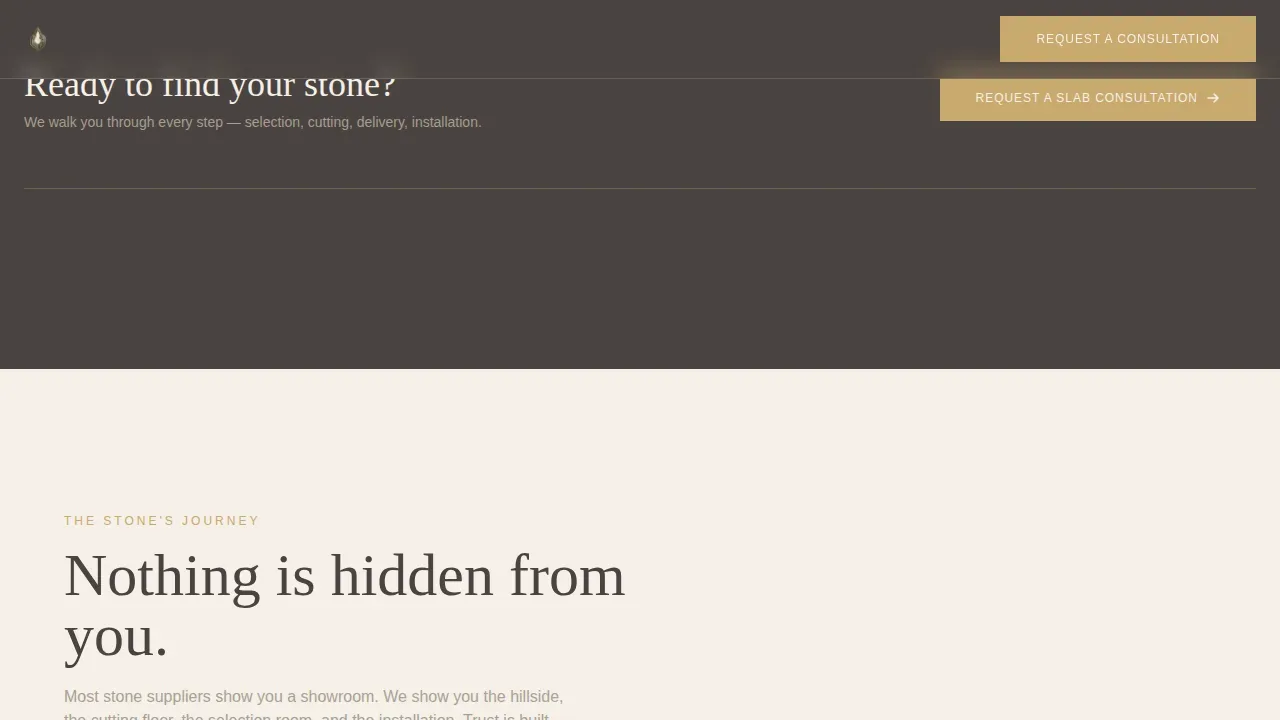
The primary conversion section includes a structured form that asks for project type (kitchen, bathroom, commercial, flooring, or custom), approximate square footage via a range input slider, preferred stone family, and a free-text field labeled "Tell us about your space." The call-to-action reads "Request a Slab Consultation" and appears first after the hero, then again anchored at the bottom of the page. The form is designed to qualify leads before they reach the supplier.
Gated Inventory Download
A secondary conversion path is available for designers who are not ready to book a consultation. An email-gated download gives access to the current slab inventory, including dimensions and pricing tiers. This path keeps research-phase visitors in the funnel and ensures the website continues working even when a visitor is not ready to talk.
Testimonial Section with Social Proof
Three client testimonials are displayed with named attribution, project type, square footage completed, and specific stone used. These are not generic quotes. Each one describes a real outcome, a boutique hotel lobby, a residential kitchen renovation, a commercial flooring project. Including testimonials from designers, contractors, and homeowners helps provide visitors with the confidence that the supplier can deliver at every scale.
Page sections overview
| Section | Purpose |
|---|---|
| Before-After Hero | Show raw-to-finished transformation with draggable brass slider |
| Call-to-Action Strip | First consultation call to action appearance with trust signals below hero |
| The Journey Scroll | Four-panel documentary covering Quarry, Cut, Select, Install |
| Stone Families Grid | Bento showcase of Calacatta, Travertine, Quartzite, and Onyx |
| Client Testimonials | Named social proof with project type, stone used, square footage |
| Consultation Form | Full lead-gen form with project qualifier fields and call to action |
| Inventory Download Gate | Email-gated PDF access for designers browsing current stock |
| Footer Arc Split | Logo and tagline left, navigation links right |
Design & branding system
The visual identity follows a Pastoral Calm theme using the Warm Stone color system. The palette feels like a farmhouse kitchen where the countertop has been there longer than anyone can remember, sun-warmed, tactile, and quietly permanent.
The branding system is built on four specific values:
- Quarry cream (#F5F0E8) dominates backgrounds, giving the website an open-air, unhurried feel throughout every session
- Wet limestone (#A89F91) handles secondary text, borders, and divider lines, keeping the page grounded without competing with the imagery
- Deep vein gray (#4A4340) anchors headlines and navigation, and polished brass (#C9A96E) is reserved sparingly for buttons, hover states, and the hero slider line, the way a brass door handle catches afternoon light
Mobile & speed optimization
This template is designed desktop-first, because interior designers and contractors typically work on large screens when specifying stone for a project. Full mobile responsiveness is built into the layout so that homeowners browsing from a phone get the same editorial experience.
Key optimization details:
- Images are lazy-loaded so the website's performance stays consistent as the visitor scrolls through the heavy visual sections
- Server-side components are used for static sections to keep load behavior smooth across devices and browsers
- The before-and-after slider, the square footage range input, and the form fields are all tested to function properly on touch screens and desktop environments alike
How this template helps you convert
The page earns the click before it asks for anything. By the time the consultation form appears, the visitor has already watched the stone travel from earth to room. That sequence is intentional.
- The documentary scroll shows the quarry, the machines, the dust, and the hands behind every slab, nothing is hidden, and that radical transparency builds trust in a category where provenance is everything. Visitors interact with content that makes the process visible, and visible process reduces hesitation.
- The dual conversion system serves two types of buyers at once. The consultation form captures ready-to-buy leads from contractors and designers with active projects. The gated inventory download captures research-phase visitors who want to browse before committing, keeping them in the funnel and giving the supplier a second touchpoint via email.
Other information about this template
This template is the Quarry from hillside to home marble supplier landing page template, a fully scoped single-column flow layout for the marble and natural stone supply market. Below are additional details that support working with this template in a real production context.
- Marble is a metamorphic rock formed when limestone, dolomite, and similar sedimentary rocks are exposed to heat and pressure over time. It is used across interior surfaces, exterior cladding, flooring, and landscaping. It typically comes in white, pink, red, and gold colors, and is rated about 3 or 4 on the Mohs hardness scale with a compressive strength of 7,500 psi. Because marble is vulnerable to acids, its surface requires sealing to protect against staining.
- Most quarries are open-pit operations, though shelf quarries also access stone through a hillside or ledge. Upper layers of earth and vegetation are removed first, then stone is assessed and removed in benches, large rectangular blocks extending 20 feet or more. Diamond wire saws, hydraulic splitters, or small explosive charges are used to loosen the stone. Primary processing cuts the huge blocks into thinner slabs; secondary processing finishes them to specific dimensions. The route stone takes from processing to site can vary from a few miles to thousands of miles.
- American quarries supply a significant portion of marble for building purposes. Vermont has a notable quarrying history: the introduction of railroads in 1851 allowed the marble business there to begin taking on larger proportions. Isaac Markham in Middlebury, Vermont, was credited with re-inventing the method of sawing marble with strips of soft iron, sand, and water. The Rock of Ages quarry in Barre, Vermont, has been working for 128 years and is now nearly 600 feet deep.
- Marble quarrying has significant environmental impacts, though these may not be as severe as those associated with other materials like steel and concrete. Transportation from quarry to jobsite contributes to the embodied carbon footprint of any natural stone project. Many quarries are adopting new technologies to reduce waste and improve efficiency. Marble is a durable building material that can last for decades, which can offset its initial environmental impact over time.
- When the website is live and working with third-party services, the following context applies. Google Analytics is commonly used to track site usage and generate an analytics report covering traffic source, bounce rate, and key performance indexes. The site's analytics report can help determine how visitors interact with each section. Google Analytics uses a randomly generated number to recognise unique visitors across sessions and can calculate visitor behavior across the funnel. Analytics analytical cookies store information about how unique visitors use the site and can be set to let visitors visit anonymously. Collected data includes session-level behavior; collected data is stored and used to understand website performance.
- Google Tag Manager is used by many website operators to manage tracking scripts without editing code directly. It can store campaign data and help experiment advertisement efficiency across channels. When enabled, it can support social media platforms tracking alongside other analytics tools.
- The Google reCAPTCHA service is used on forms to identify bots and protect against malicious spam attacks. The Google reCAPTCHA service helps identify bots by assigning a score based on user behavior during a session. This is absolutely essential for any website that uses lead generation forms, because malicious spam attacks can corrupt a lead database quickly. Security features like reCAPTCHA are absolutely essential for contact forms to function properly.
- Cloudflare bot management is used by website operators to identify trusted web traffic and filter out automated threats. Support cloudflare bot management tools can help protect the site from malicious spam attacks and identify bots before they reach the form. Cloudflare bot management works alongside security features to ensure that basic functionalities like form submission and process payments flows function properly for real users.
- Cookies are used to enable basic functionalities on this type of website. A cookie stores information about the current session and helps the browser deliver a better user experience on return visits. When a cookie stores information anonymously, it can be used to provide visitors with a personalized experience without exposing personal data. Certain functionalities, such as the form, the gated download, and the before-and-after slider, require session cookies to function properly. Other third party features embedded in the website may also store information via the browser. These basic functionalities are absolutely essential for the website to function properly across all devices. Security features tied to cookies are absolutely essential and help close the privacy overview gap between what is collected and what is disclosed. A close privacy overview policy page should be linked in the footer so that users understand what is stored and enabled.
- The "close privacy overview" control is a standard element in cookie consent banners. It allows a user to close the privacy overview panel after reviewing cookie categories. This is absolutely essential for compliance with cookie disclosure requirements. Basic functionalities, security features, and analytics are the three standard cookie categories that should be enabled and described clearly so that the user understands what is stored during their session. When enabled, these categories let the website function properly, provide visitors with relevant content, and keep security features working across every browser session.
- The template supports paving, walls, and flooring use cases in the stone family section, since Travertine is commonly used for exterior paving and interior walls in addition to countertops. Natural stone like quartzite and onyx can also be used for furniture inlays and decorative surface applications beyond standard countertop or flooring category placements. Brick and sand are referenced in historical quarrying accounts, as early marble sawing techniques used strips of soft iron, sand, and water before modern diamond-wire methods replaced them. Rocks extracted from the quarry are assessed for quality before any blocks are cut. The company supplying the stone is a family-run operation, and the template is designed to reflect the character of that kind of company.
Theme
Pastoral Calm
Creative direction
Transparent Process
Color system
Warm Stone
Style
Single Column Flow
Direction
Lead Generation
Page Sections
Draggable Before-and-after Hero Slider
Four-panel Documentary Journey Scroll
Stone Families Bento Grid
Dual Conversion System
Named Client Testimonial Section
Warm Stone Editorial Visual System
Related questions
Who is this template designed for?
What sections are included in the layout?
Can I use this template for both marble and other natural stone types?
How does the lead generation system work?
Is the template suitable for desktop and mobile users?