Specialist Latin American Community Professional Website Template
The Raíces landing page template is built for Cuban American organizations that want to turn digital visitors into active community members. It combines a warm masonry layout, a Hero's Journey scroll narrative, and two culturally resonant calls to action. The result is a single-page experience that feels like a family gathering, not a form.
by Rocket studio
Quick summary
The Raíces template is a single-page, masonry-style landing page designed for Cuban American nonprofits and community organizations. It leads visitors through a Hero's Journey narrative, from arrival and cultural identity to challenge, action, and belonging. Every scroll reveals warmer tones and denser tile arrangements, mimicking the feeling of a room filling with people. Two clear calls to action drive clicks toward a membership and involvement hub.
Who this template is for
This template was built for organizations that hold the Cuban American diaspora together. It suits teams who want a visually rich, emotionally resonant landing page without sacrificing clarity or click-through focus.
- Cuban American nonprofits running festivals, advocacy campaigns, youth mentorship programs, or community dinners
- Organizations serving Cuban immigrants, Cuban exiles, and foreign born Cubans spread across south Florida, New York, and beyond
- Community leaders who want to welcome abuelas, first-generation students, small business owners, and young families in one shared digital space
What problem this template solves
Many community organizations struggle to present their full identity online without either losing emotional warmth or burying their call to action under too much content. Cuban Americans have a long history of building tightly knit enclaves, from Little Havana to Union City to Ybor City, and a landing page that feels cold or generic will not earn their trust. This template solves that tension directly.
- It replaces generic nonprofit layouts with a family-album aesthetic that speaks to Cuban American culture
- It structures the scroll as a story, so visitors feel welcomed and understood before they are ever asked to act
- It keeps a single, high-visibility call to action front and center throughout the page, preventing distraction and driving focused click-throughs
What you get with this template
You get a fully designed, single-page layout that delivers a complete storytelling experience from hero image to footer. The template is built around five narrative sections, a masonry card system, a warm editorial color palette, and two conversion-focused buttons. No forms appear on this page; every element funnels toward one destination.
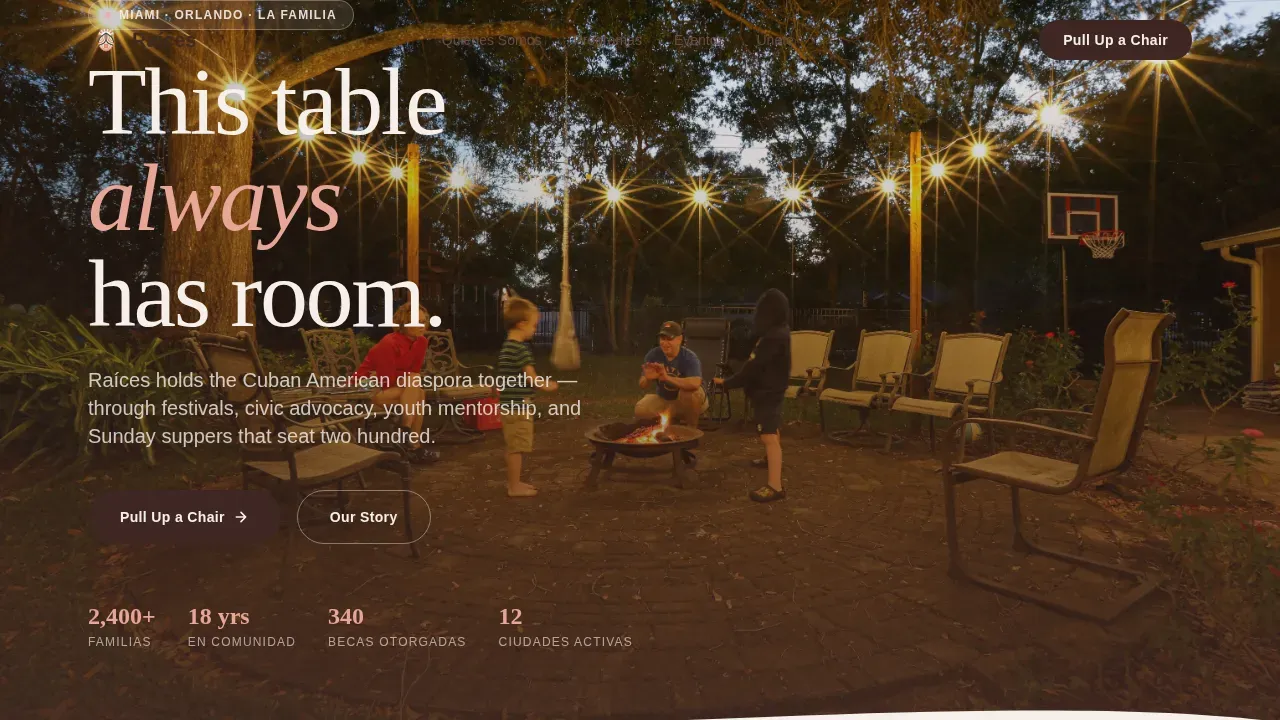
- A full-bleed golden-hour hero section with a parallax photo, a fade-in headline, and a primary "Pull Up a Chair" call to action button
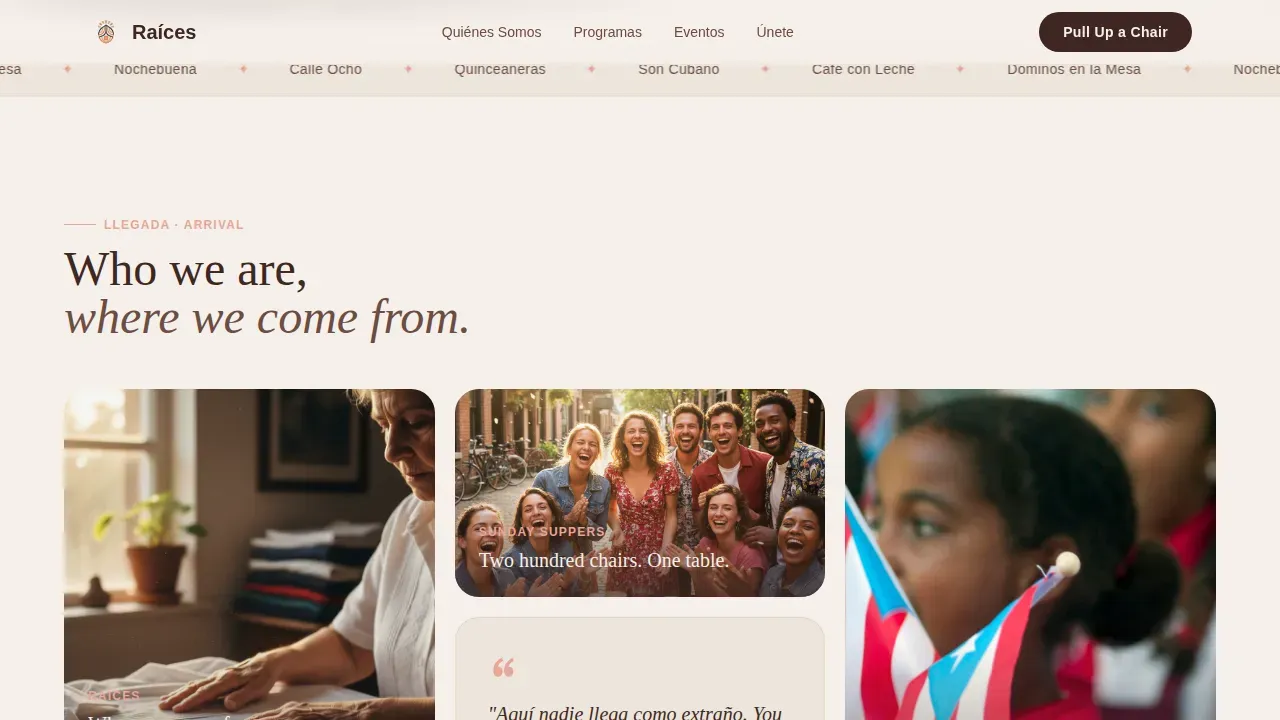
- A masonry tile system organized into Arrival, Challenge, Action, and Belonging scroll chapters, with staggered entry animations and coral pink hover states
- A footer using a linear single-row pattern, alongside a secondary "Send a Plate" donor link anchored beside the final call to action
Feature list
This section describes the core designed capabilities delivered by the Raíces template.
Full-Bleed Parallax Hero
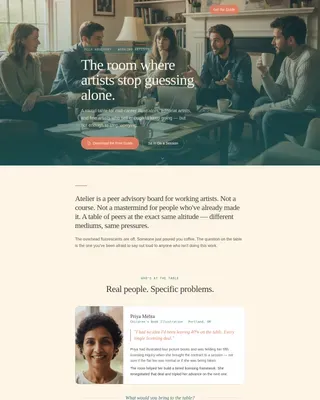
The header opens with a candid, golden-hour family photograph shot from the empty chair at the table, placing the viewer in the scene immediately. A fade-in headline reads "This table always has room" over the lower third in deep tobacco leaf type. The "Pull Up a Chair" primary call to action sits directly beneath, giving visitors an immediate path forward without scrolling.
Hero's Journey Scroll Narrative
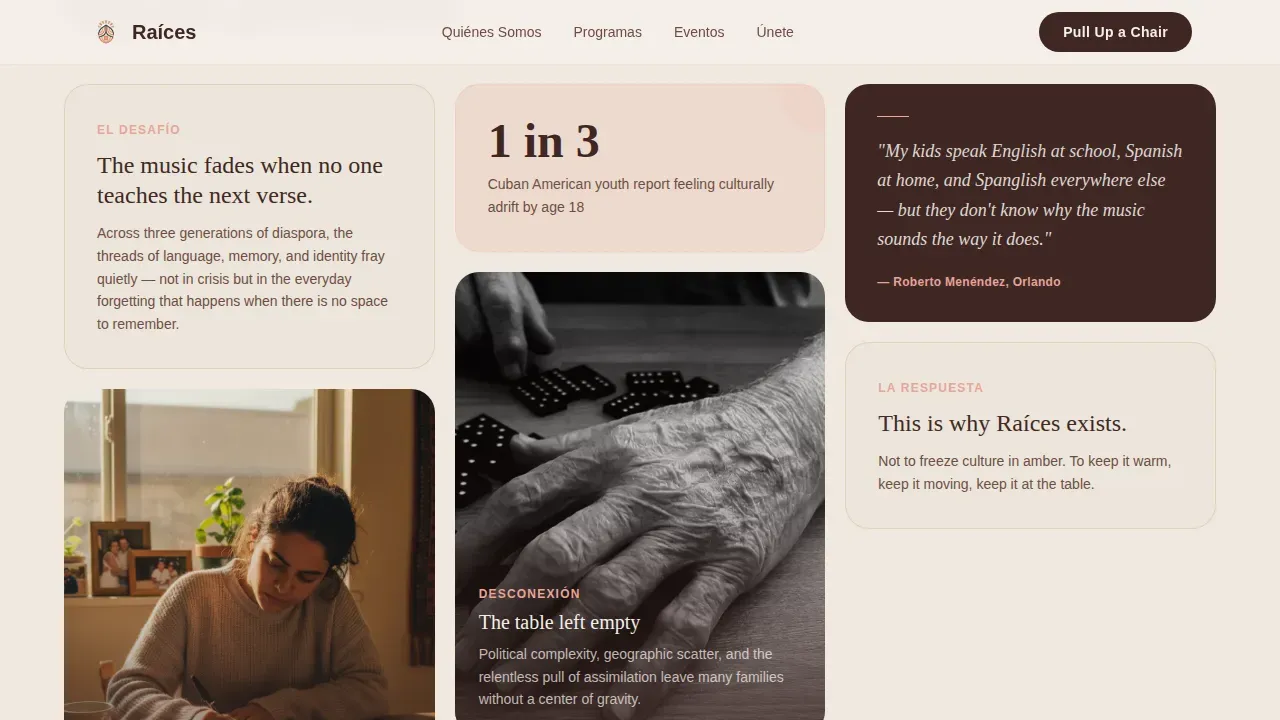
The page is structured as a four-chapter story. It opens with Arrival, moves into the Challenge of cultural erasure and generational disconnect, rises through Action featuring programs, scholarships, and advocacy victories, and resolves in Belonging. As visitors scroll, masonry tiles grow warmer in tone and denser in arrangement, producing a feeling of a community filling a room.
Masonry Tile Card System
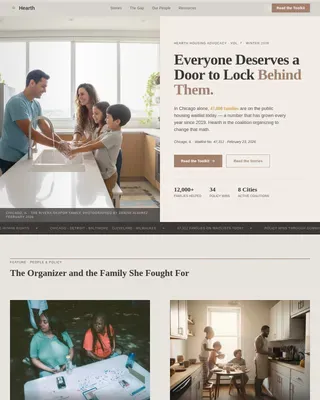
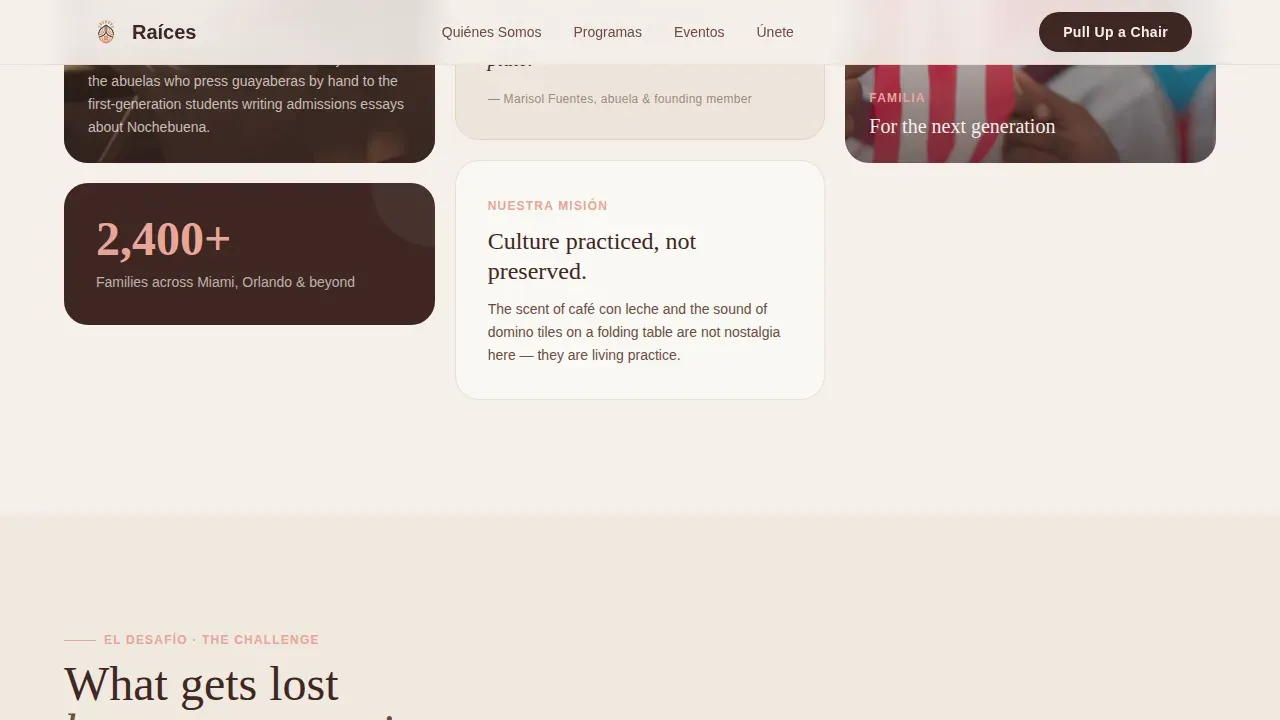
Each chapter card in the masonry grid is an individual photo tile. A quinceañera here, a voter registration drive there, a child holding a Cuban flag at a school parade. Tiles reveal through staggered scroll-linked animations. Hover states shift the tile border to coral pink, creating gentle interactivity without disrupting the editorial calm.
Dual Call to Action Architecture
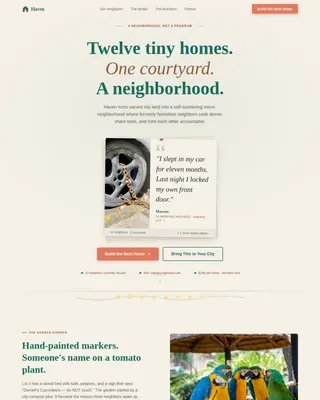
The primary button, "Pull Up a Chair," appears three times: beneath the hero, midway through the page after the advocacy victories section, and anchored at the bottom. A secondary link, "Send a Plate," appears beside the final button for donors who want to fund programs without joining. Both buttons use magnetic hover behavior and route visitors to a separate membership and involvement hub.
Soft Mist Color and Type System
The Soft Mist palette uses faded linen white for backgrounds, café con leche tan for card borders, weathered coral pink for event dates and hover states, and deep tobacco leaf for headlines and anchoring text. Fraunces serif handles all display headlines. DM Sans handles body copy. The combination reads like a stack of sun-touched old photographs, warm and unhurried.
CSS-First Animation Layer
Scroll-linked tile reveals, staggered masonry entry, and a parallax hero are all driven through CSS-first animation logic. Images are lazy-loaded to support mobile performance. The animation layer uses medium intensity, enough to feel alive, but not enough to distract from the story.
Page sections overview
| Section | Purpose |
|---|---|
| Full-Bleed Hero | Opens with golden-hour family photo, fade-in headline, and primary call to action |
| Arrival: Who We Are | Introduces origin story, community warmth, and masonry tiles with stats |
| The Challenge | Addresses cultural erasure and generational disconnect with deeper-toned cards |
| Action: Programs | Showcases festivals, scholarships, advocacy victories, and warming tile arrangement |
| Belonging: Final call to action | Delivers "Pull Up a Chair" and "Send a Plate" buttons alongside community testimonials |
| Linear Footer | Single-row footer pattern anchoring navigation and organizational identity |
Design & branding system
The visual identity follows a Family First theme built on the Soft Mist color system. Every color choice references warmth, time, and memory. Nothing in this palette reads cold or clinical.
- Colors: linen white #F5F0EB for backgrounds, café tan #D4B896 for masonry card borders, coral pink #E8A598 for event dates and hover states, tobacco leaf #3E2723 for headlines and body anchors
- Typography: Fraunces serif for display headlines, DM Sans for all body copy, producing a warm editorial contrast between old-world and modern
- Visual style: family-album masonry aesthetic with editorial warmth, candid photography direction, and a compositional approach that places the viewer inside the scene
Mobile & speed optimization
The template is built mobile-first. Cuban Americans and Cuban migrants alike browse on phones, and this layout accounts for that behavior at every layer of the design.
- Masonry tiles reflow gracefully for single-column mobile display, preserving the scroll narrative and staggered reveal animations on smaller screens
- Images are lazy-loaded and animations are CSS-first, reducing render-blocking behavior and keeping the page responsive across devices
- Magnetic call to action buttons are sized and spaced for comfortable thumb interaction on mobile, supporting direct access to the membership hub without friction
How this template helps you convert
The page earns the click by making visitors feel they have already been welcomed before the call to action appears. This is by design.
- The Hero's Journey structure builds emotional investment across each scroll chapter, so by the time visitors reach the final "Pull Up a Chair" button, they feel they belong rather than feel they are being sold to
- Dual calls to action serve two distinct visitor types: those ready to join the community and donors who want to support programs financially through "Send a Plate," widening the conversion funnel without adding form friction
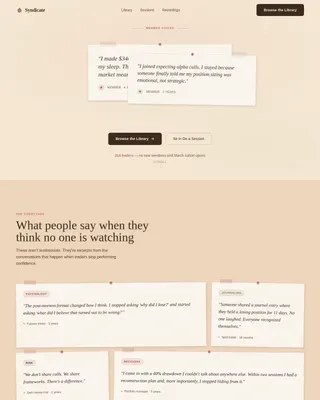
- Social proof is woven into the masonry tiles themselves, with community stats, advocacy victories, and testimonial quotes appearing as chapter cards throughout the scroll, demonstrating tangible results and reinforcing trust before the ask
Other information about this template
The Raíces template draws on the real social and economic characteristics of the Cuban American community. Understanding this context helps communicators adapt the template messaging to feel genuinely resonant rather than generically multicultural.
- Cuban migration to the United States can be described as having four distinct waves. The first wave of Cuban migration, the Golden Exile, ran from 1959 to 1962 following the rise of Fidel Castro and saw roughly 250,000 Cubans arrive. The freedom flights of 1965 to 1973 brought approximately 300,000 more Cuban refugees. The Mariel boatlift in 1980 was a chaotic Cuban exodus that added around 125,000 Cuban migrants. The fourth wave, the balsero crisis of 1994, involved about 36,000 rafters attempting to reach U.S. shores. Throughout all four phases, U.S. policy treated Cuban immigrants more favorably than most other migrants from Latin America.
- Fidel Castro's rise to power and the Cuban revolution reshaped Cuban society permanently. Most Cubans who left in the early years were political exiles and middle class professionals who had opposed castro's cuba. Many Cuban Americans carried their political identity into U.S. civic life, and most cubans who arrived as political refugees or political exiles shaped a community with a high degree of civic participation.
- The Cuban community in Miami, particularly in Little Havana and across Miami Dade county, represents the largest concentration of Cubans in the United States. South Florida remains the geographic heart of the Cuban American population. Foreign born Cubans settled heavily in south Florida, but Cuban migrants also built significant communities in New York, New Jersey, Union City, Ybor City in Tampa, and Key West.
- Cuban cigar workers in Key West and Ybor City were among the earliest Cuban immigrants to establish organized communities in the United States. Labor strife and labor migrants shaped those early settlements, and the long history of Cuban cigar workers in Tampa is well documented in sources including sage publications research on Cuban American labor history. The ten years war in Cuba, which ran from 1868 to 1878, also contributed to early Cuban migration to Key West and New York.
- According to the census bureau and current population survey data, the Cuban American population shows distinct economic characteristics compared to the broader hispanic population. Cuban Americans have a median household income of $38,000, higher than the $36,000 median for other Hispanics. Around 61% of Cuban Americans own their home, compared to 47% of all other Hispanics. The poverty rate for Cuban Americans under 18 is 13%, less than half the 27% rate for other Hispanics. Among U.S.-born Cuban Americans, 36% hold a college degree or higher, compared to 30% for the overall U.S. population. Foreign born cubans show a median annual personal income of $25,000, which is lower than the $30,000 U.S. average, reflecting the economic challenges faced by foreign born arrivals.
- Cuban Americans make up about 6% of the latino population eligible to vote in the United States. In the 2006 National Survey of Latinos, 28% of Cubans identified as Republicans, a higher share than among Puerto Ricans or other latinos. Cuban Americans have historically leaned toward the Republican Party due to its anti-communist stance, especially those whose families fled directly from castro's cuba as political exiles or political refugees. Cuban Americans are more likely than other Latino groups to identify the United States as their homeland, with 52% considering the U.S. their real home.
- More than half of Cubans in the United States are U.S. citizens, a higher share than most other Hispanic groups. The Cuban refugee program offered direct access to legal residency for many arrivals. Born abroad or not, Cuban Americans show a strong sense of U.S. civic identity. Homeland security policy changes over the decades have affected the flow of Cuban immigrants significantly.
- The social integration of foreign born Cubans into American culture is reflected in community institutions across all fifty states. Cuban Americans have established cuban owned businesses, cultural festivals like Calle Ocho in Little Havana, and civic organizations that serve the entire community. Non hispanic whites, Puerto Ricans, and other latinos have all participated in metropolitan areas shaped heavily by Cuban American culture. Non cubans living in these communities often participate in Cuban cultural life through Calle Ocho festivals, cafecito counters, and neighborhood events.
- The Census Bureau classifies Cuban Americans within multiple racial groups. Most identify as white in census categories, though Cuban ancestry spans many backgrounds within Cuba itself. Cuban origin respondents represent one of the largest national-origin groups within the broader hispanic population. Census bureau data and the current population survey show the Cuban American population concentrated in a handful of metropolitan areas, especially those in south Florida, New York, and New Jersey.
- Casa Cuba as a concept, the idea of a cultural home built in diaspora, is the emotional foundation this template is designed to serve. Whether visitors come from south Florida, New York, West Virginia, or any of the fifty states, the Raíces template gives the Cuban diaspora a digital gathering place that honors the long history of cuban community building in the United States. Organizations using this template can incorporate Spanish-language phrases naturally, display impact metrics, and show social proof through testimonials to build immediate trust with the Cuban American community.
- The miami herald has long covered the social and economic characteristics of Cuban Americans in south Florida, and the kind of culturally specific storytelling this template enables mirrors the community journalism that Cuban Americans have always valued. Sage publications research and census bureau reports both confirm that Cuban Americans show a high degree of civic engagement, home ownership, and educational attainment relative to other Hispanics, facts that organizations can reference when populating masonry tiles with community statistics.
- Many cuban organizations that operate across the fifty states find that culturally tailored design, warm imagery of Cuban families, and Spanish phrases woven into English copy all raise engagement significantly. Most cubans who encounter a landing page that reflects their real cultural identity, including the sights, sounds, and food of Cuban life, respond with a high degree of trust and willingness to act.
Theme
Family First
Creative direction
Hero's Journey
Color system
Soft Mist
Style
Masonry/Pinterest
Direction
Click-Through
Page Sections
Full-bleed Parallax Hero Section
Hero's Journey Scroll Structure
Masonry Tile Card System
Dual Call to Action Button Architecture
Soft Mist Color and Type System
Css-first Animation and Lazy Loading
Related questions
Who is the Raíces template designed for?
Does the template include a form or sign-up field?
Can I adapt the color palette and typography for my organization?
What kind of images work best with this template?
Is this template suitable for a donor-focused campaign?