Public Transportation Blog & Content Website Template
Railhead is a sidebar companion landing page template built for rail transit discovery and network intelligence. It pairs a fixed navigation rail with a scrollable content panel to surface live departure stats, corridor performance data, and summit registration in one focused flow. The design feels editorial and data-forward, built for daily commuters, transit planners, and rail enthusiasts who need answers fast.
by Rocket studio
Quick summary
Railhead is a sidebar companion landing page template for regional rail networks. It leads with a giant live departure counter, carries visitors through cascading network stats, and drives two conversion paths: summit seat registration and a network performance report download. The concept is data as design, and the execution is crisp, confident, and built to impress everyone from daily commuters to transit planners.
Who this template is for
This template works for organizations that run, manage, or promote rail transit services at a regional or national level. It is equally useful for event organizers building a registration site around a rail industry summit. The design concept surfaces live data first, making it feel authentic to the rail world in real life.
- Transit agencies and operators that need a public-facing site to surface timetables, route maps, and live service alerts across their rail network.
- Rail summit organizers and industry associations that want a high-impact registration landing page to convert planners, operators, and enthusiasts into confirmed attendees.
- Rail enthusiasts and heritage railway groups looking to build a discovery platform that covers rolling stock catalogs, scheduled excursions, and route stories.
What problem this template solves
Rail transit websites often bury the information passengers need most. Timetables are hard to find, service alerts arrive late, and registration forms feel disconnected from the network data that motivates sign-ups. Visitors arrive early in their decision process and leave before they find value. This template solves that by making data the hero of every scroll.
- Information overload and disorientation are handled by a persistent fixed sidebar that lists regions, railway lines, and service types so visitors never lose their place, even as the main panel scrolls through maps and performance charts.
- Low conversion from passive browsing is addressed by embedding the "Reserve Your Seat" call to action directly beneath the header stats and again in the sidebar after the second scroll, so commitment feels like a natural next step.
- Missed lead capture for hesitant visitors is solved by the secondary "Download the Network Report" path, which gates a performance data report behind an email field and turns the stats themselves into the conversion engine.
What you get with this template
You get a fully structured, single-page layout built around a two-column sidebar companion concept. Every section is designed to carry visitors from system-wide awareness down to granular corridor details, mimicking the experience of zooming into a transit map. The template ships with all the sections, components, and design tokens needed to launch a rail transit discovery platform or summit registration site without starting from scratch.
- Five pre-built content sections covering the hero departure counter, network pulse stats, audience use-case cards, summit registration form, and report download capture, plus a footer in Vercel Horizontal Flow pattern.
- A fixed sidebar navigation rail listing regions, line colors, and service types, with the "Reserve Your Seat" call to action recurring after the second scroll to keep conversion always within reach.
- An event registration form with a segmented role-type toggle (operator, planner, advocate, enthusiast) and session-track chip selectors, making it easy for visitors to self-identify and register in one smooth process.
Feature list
This template is built around ideas that work in real life for rail transit discovery and event conversion. Each feature is grounded in the brief and designed to deliver measurable results for the organizations that build with it.
Giant Headline Departure Counter
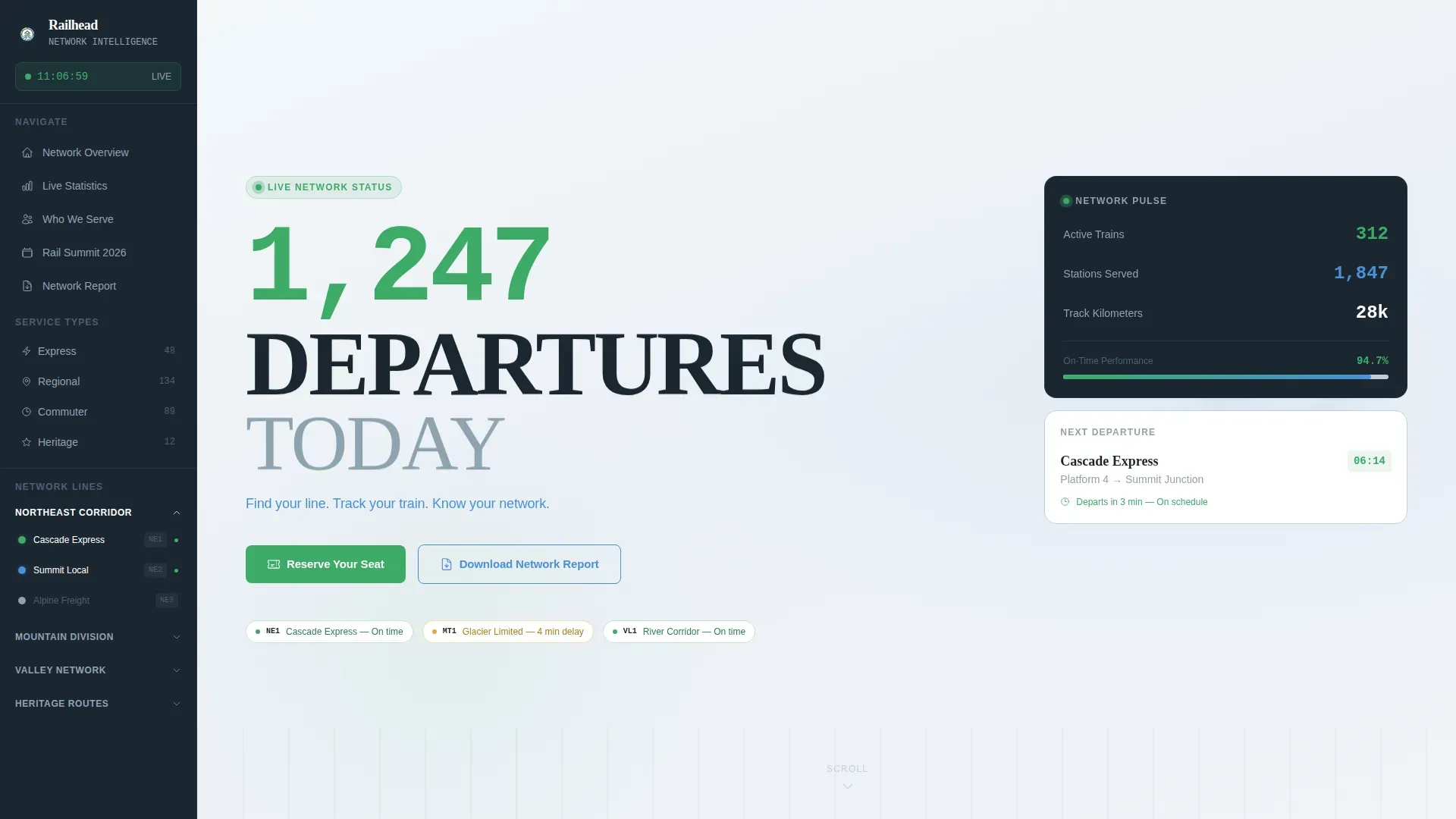
The hero section leads with an enormous condensed headline reading "1,247 DEPARTURES TODAY" pinned to the left two-thirds of the viewport. The numeral renders in signal green at a scale that reads like a real station departures board. To the right, an animated counter ticks through active trains, stations served, and kilometers of track. The data is the visual, and it sets the tone for everything that follows.
Fixed Sidebar Navigation Rail
The sidebar is persistent and charcoal-anchored throughout the entire scrolling experience. It lists regions, railway lines, and service types so visitors can jump to any part of the network without losing orientation. The "Reserve Your Seat" call to action appears in the sidebar after the second scroll, creating a soft but consistent reminder to register. This concept keeps conversion pressure low while keeping the option always visible.
Network Pulse Stats Cascade
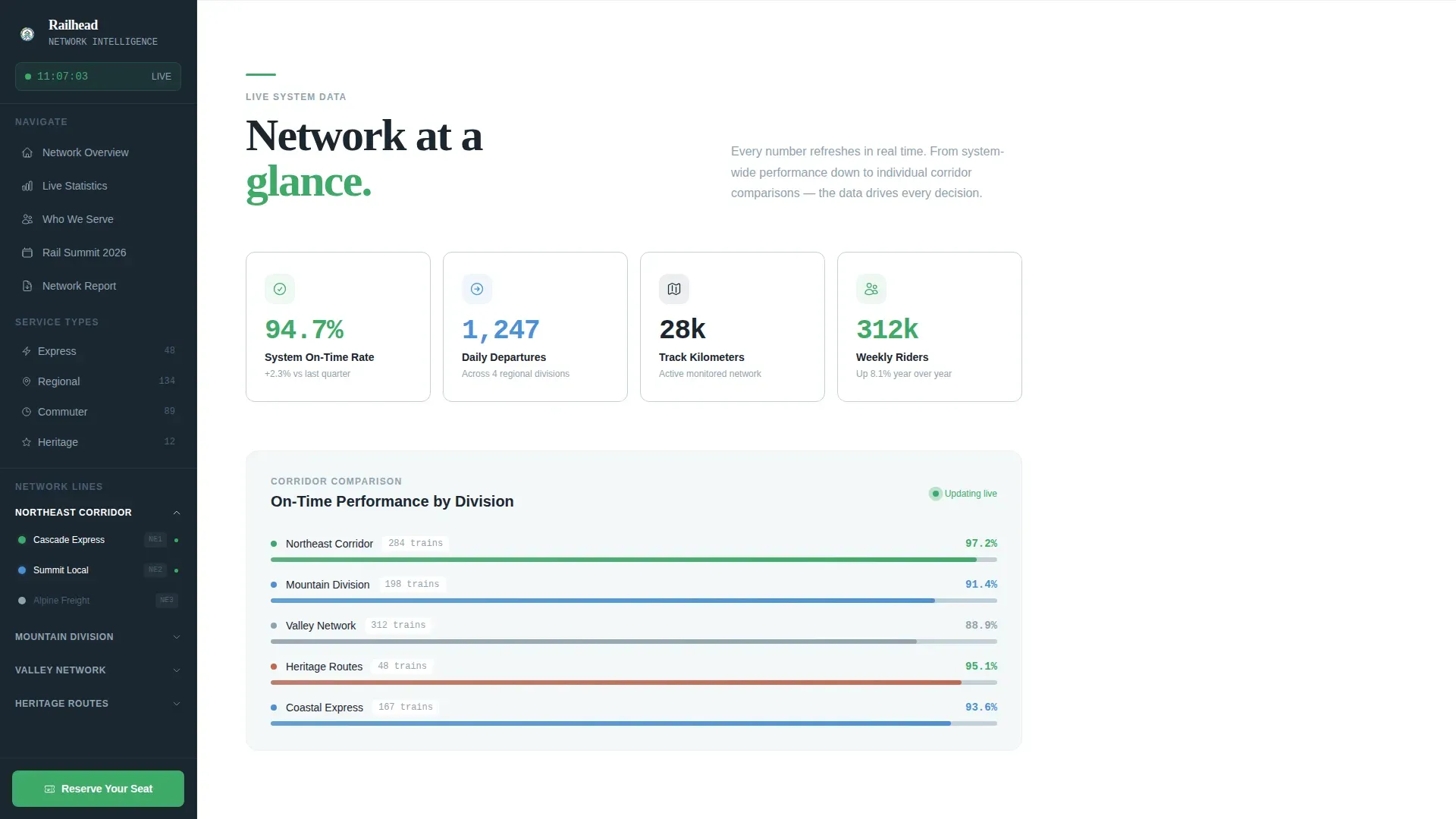
The second section opens with ridership figures that dissolve into route-level breakdowns. On-time performance percentages cascade into interactive corridor comparisons. Every scroll transition opens with a number before a narrative, following the Stats-First Impact creative direction. This approach helps transit planners benchmark performance across corridors and helps daily passengers understand how the network is performing on any given day.
Summit Registration Form with Segmented Toggle
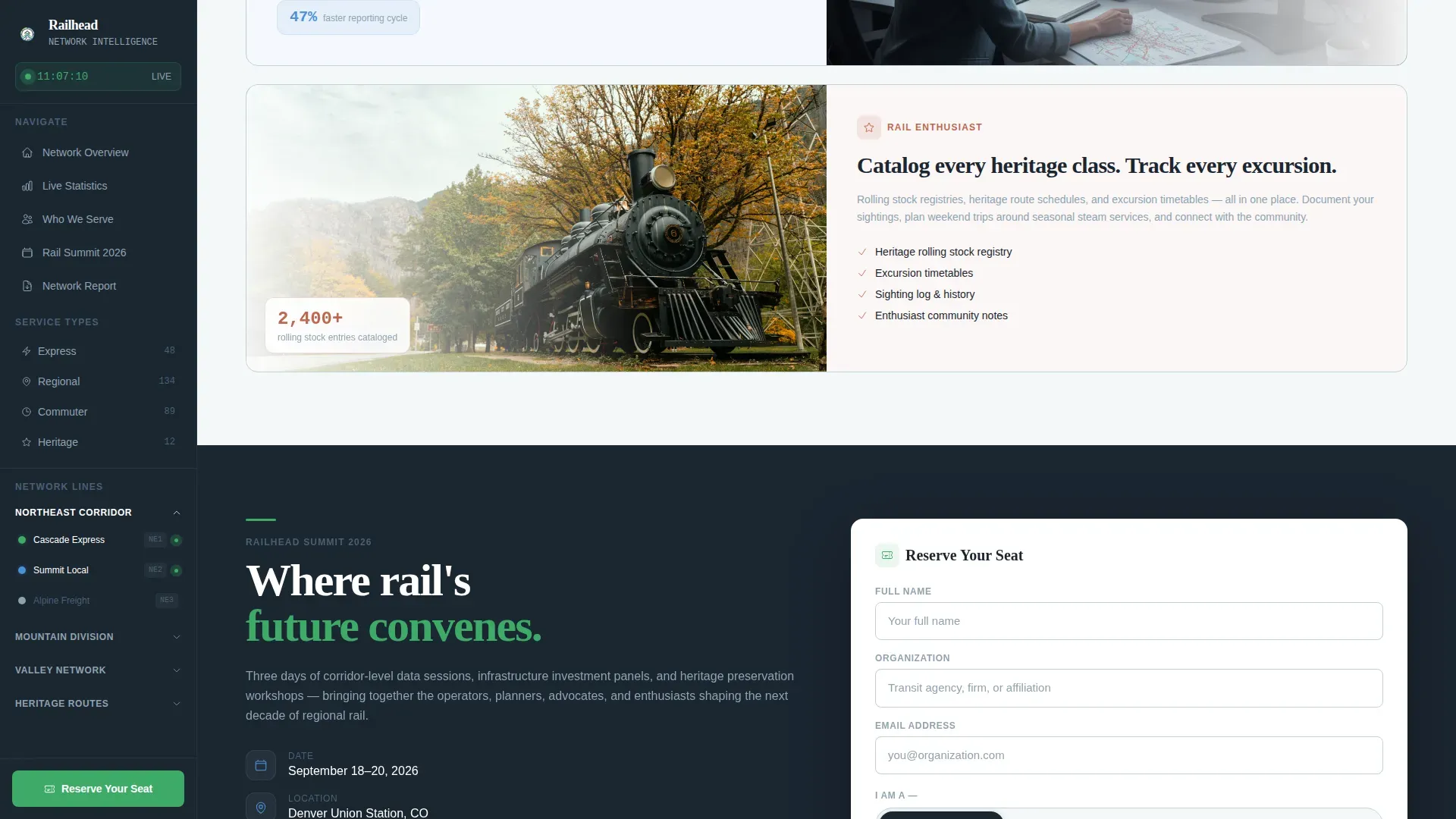
The registration section collects name, organization, and role type using a segmented toggle rather than a dropdown. Session-track preferences are selectable as chip components. This design makes the sign-up process feel lighter and faster, which matters when your audience includes busy operators and planners working through a full day of tasks. A streamlined lead capture form like this is known to enhance conversion rates on landing pages.
Network Report Email Capture
The secondary conversion path gates a downloadable network performance report behind a single email field. Visitors who are not ready to register for the summit can still find value by downloading the data they just scrolled through. This approach turns the stats content itself into the conversion engine and helps organizations build a qualified contact list of rail professionals, freight operators, researchers, and advocates.
Audience Use-Case Cards
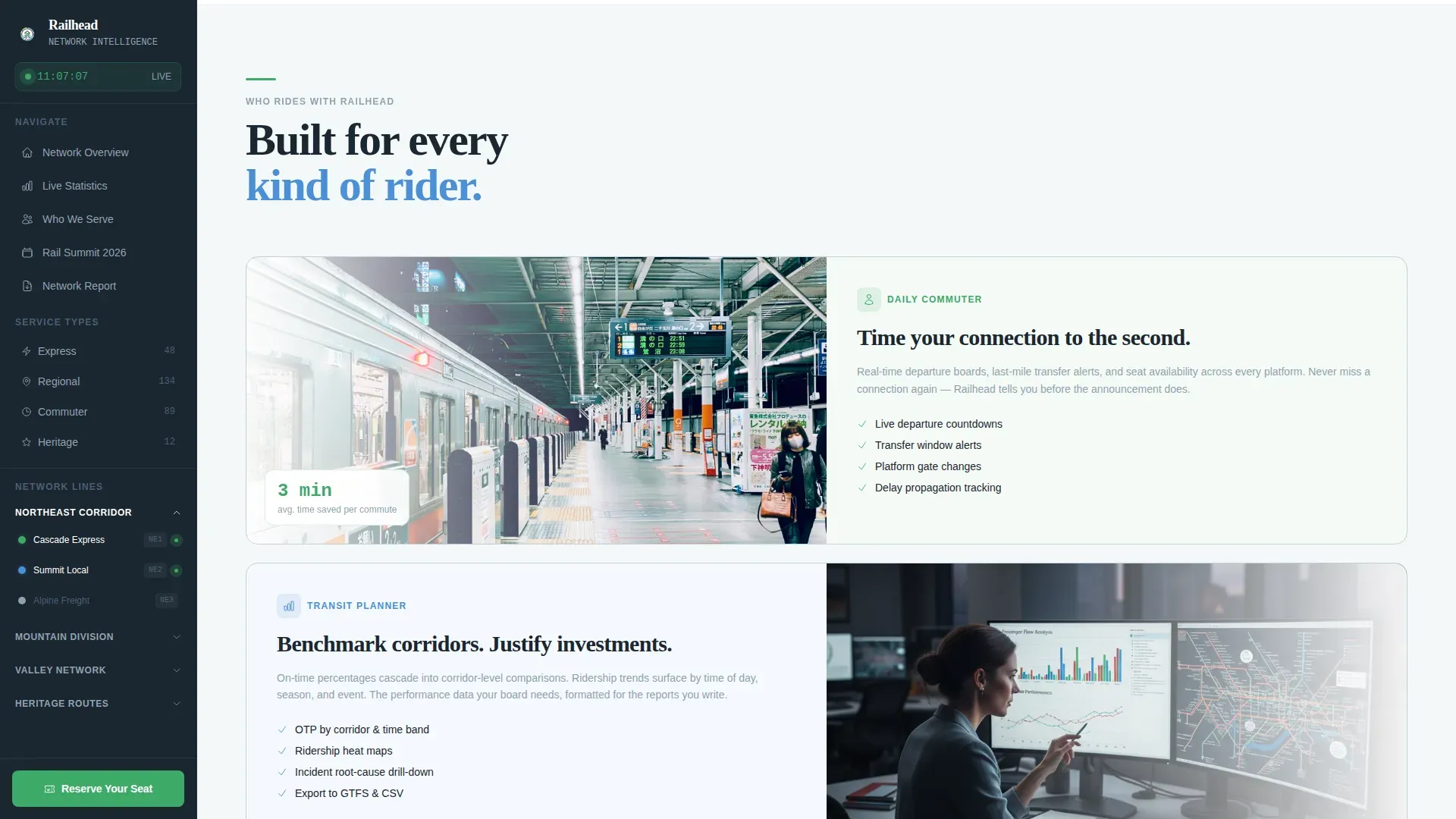
The "Who Rides With Railhead" section presents three audience cards in an asymmetric bento layout. Each card surfaces a distinct use case: the daily commuter timing last-mile connections, the transit planner benchmarking corridor performance, and the rail enthusiast cataloging heritage rolling stock on weekend excursions. These cards help visitors self-identify quickly, which builds trust and makes the registration form feel personally relevant rather than generic.
Page sections overview
| Section | Purpose |
|---|---|
| Hero departure counter | Anchors attention with a live "1,247 DEPARTURES TODAY" headline and animated stats rail |
| Network Pulse stats | Cascades ridership, on-time rates, and corridor comparisons in a scroll-triggered sequence |
| Audience use-case cards | Presents three bento-layout cards for commuters, planners, and enthusiasts |
| Summit registration form | Collects role type and session preferences via segmented toggle and chip selectors |
| Report download capture | Gates a performance report PDF behind a single email field for secondary lead capture |
| Footer layout | Closes the page in a Vercel Horizontal Flow pattern with nav links and legal copy |
Design & branding system
The visual identity follows a Directory and Discovery theme using an Alpine Fresh color system. The aesthetic is editorial and data-forward, described in the brief as breathing mountain air through an open train window. Typography pairs DM Sans for interface and data display with Fraunces for editorial headlines, creating a contrast between utility and character.
- Color palette: Glacier white (#F4F7F9) dominates content panels; deep tunnel charcoal (#1B2631) anchors the sidebar and typographic hierarchy; signal green (#3DAA68) pulses on live indicators and active call-to-action elements; altitude blue (#4A90D9) traces every link, route line, and interactive map overlay like railway lines on a network diagram.
- Animation and interactivity: GSAP line-reveal transitions, scroll-triggered number counters, and sidebar fixed-position behavior are all built into the concept, giving the site a high level of motion that matches the energy of a live rail network.
- Typography system: DM Sans handles timetable data, labels, and interface copy with clean legibility; Fraunces carries the editorial weight of headlines and section introductions, making the page feel like a publication as much as a product.
Mobile & speed optimization
The template is built desktop-first because the sidebar companion layout requires a wide viewport to work at full effect. On smaller screens, the layout responsively stacks into a single-column flow so the content remains readable and functional. Performance is addressed at the component level to keep the high-animation experience from slowing load times.
- Server Components handle static sections such as the hero headline block, audience cards, and footer, keeping the base page fast even before interactive elements load.
- Client Components are scoped to animated counters and the registration form, so the interactive elements that need JavaScript are isolated from the static layout, reducing unnecessary overhead on initial load.
How this template helps you convert
The conversion strategy is woven into the layout itself rather than bolted on at the end. Every design decision, from the opening departure counter to the sidebar call to action, is oriented toward two outcomes: summit seat registration and report download lead capture.
- The header stats create immediate credibility. Arriving at a page that shows thousands of active departures, live train counts, and kilometers of track managed by a real network tells visitors they are in the right place. That credibility makes the "Reserve Your Seat" button feel like a logical next step, not a cold ask.
- The fixed sidebar keeps the call to action always within reach. After the second scroll, the registration prompt lives in the sidebar permanently. Visitors who are deep in the network stats or corridor comparisons never have to scroll back up to find a way to register, which reduces friction and helps achieve higher form completion rates.
- The report download path captures visitors who are not ready to commit. By gating a PDF of the performance data behind an email field, the template creates a second conversion moment that feels genuinely useful rather than manipulative, building the kind of feedback loop that successful lead-generation sites run on.
Other information about this template
This template is designed to work well for a broad range of rail industry contexts, from busy urban railways to regional freight corridors and heritage excursion routes. It is built with the concept that data transparency builds trust, and trust builds registration. The design ideas explored here connect real-life rail network intelligence with modern web interaction patterns, making it one of the more ambitious rail transit landing page designs available for organizations that want to impress their audience from the first scroll.
- No-code friendly: No-code tools allow users to create websites without traditional programming skills. AI-powered platforms can help users build production-ready apps and websites from natural-language prompts, and this template is structured to work well within those platforms. Drag-and-drop builders make it easier to customize sections without touching code.
- Weblium compatibility and context: Weblium offers free templates specifically designed for creating rail websites, and templates like this one are designed to cater to the needs of rail companies and related businesses. Rail website templates on such platforms are mobile-friendly and optimized for search engine visibility, which helps organizations discover new audiences and run successful campaigns.
- Rail safety context: Asset Protection and Optimisation teams, known as ASPRO, provide expert railway assistance and support to those planning activities on or near the railway. It is important to contact your local ASPRO team when working on or near the railway to ensure safety and compliance. Network Rail is committed to safety and aims to help deliver works safely and securely. If your site covers construction, engineering, or infrastructure access topics, ASPRO provides rail safety assurance services that are worth referencing in your blog or resource section.
- Rail data and monitoring background: Railhead Live Network Discovery is a critical management tool for modern locomotives and passenger cars. It refers to the automated, real-time identification and mapping of networked devices within rail transit infrastructure. Railhead Corporation specializes in solutions for video and data recording in rail transit systems. The technology enables faster data downloads and supports live streaming of video from trains to a central office. Automated device mapping uses a neighbor-walking method to discover all connected onboard hardware. Live discovery keeps track of dozens of IP cameras on a train, ensuring communication with the main recorder. The system can detect unauthorized or rogue devices and monitor for vulnerabilities, and automation minimizes manual configuration time when new devices are added or existing devices fail in large fleets.
- Creative and storytelling potential: The concept of using trains as a means of travel has always produced compelling stories. Incorporating trains into a sci-fi setting, for example, can create a relatable experience for readers, as most people have traveled by train at some point. Using trains as a central theme in any narrative can evoke nostalgia and personal memories. If your site includes a blog or editorial section, these kinds of stories can add depth and bring in readers beyond the core transit audience.
- Trust signals and marketing visuals: Trust signals such as client logos and testimonials build credibility for rail industry technologies. High-quality visuals or screen recordings should be used in marketing materials to demonstrate live monitoring capabilities. The template's Stats-First Impact direction already does a great deal of this work by surfacing real-time network data as the primary visual party piece on every section.
Theme
Directory & Discovery
Creative direction
Stats-First Impact
Color system
Alpine Fresh
Style
Sidebar Companion
Direction
Event Registration
Page Sections
Giant Live Departure Headline
Fixed Sidebar Navigation Rail
Stats-first Scroll Cascade
Summit Registration Form
Secondary Report Download Capture
Audience Use-case Bento Cards
Related questions
Who is this landing page template designed for?
Can I customize the color palette and typography?
Does the template include a secondary lead capture path?
How does the sidebar navigation work on mobile devices?
Is this template suitable for freight rail or heritage railway organizations?