Round-The-Clock Fleet Collision Landing Page Template
The Dent 24/7 Fleet Partnership Auto Body Shop Landing Page Template is built for collision repair shops that serve fleet managers, insurance adjusters, and towing companies around the clock. It leads with hard operational data, certification proof, and a B2B conversion form before a single line of sales copy appears. The result is a page that earns trust before it asks for a click.
by Rocket studio
Quick summary
This template gives a professional auto body repair shop a single, high-converting landing page designed entirely around fleet and insurance partnerships. It opens with a cinematic dark bay photograph and a glowing headline. Then it walks prospective partners through real operational questions, certification credentials, and a focused partnership request form. Every section is built to turn cautious adjusters and busy fleet managers into long-term shop accounts.
Who this template is for
This landing page is built for repair shop owners and operators who want to win B2B contracts rather than walk-in retail customers. It speaks directly to the decision-makers who manage fleets, process claims, and coordinate vehicle recovery at scale. If your shop runs bays around the clock and you want the page to reflect that capability, this template was designed with your customers in mind.
- Fleet managers running rosters of sixty or more vehicles who need a reliable auto body repair partner with transparent cycle times and priority scheduling.
- Insurance adjusters who prefer a direct repair program shop with documented certifications, supplement process clarity, and zero cycle time overruns.
- Towing company operators looking for a drop-point location that answers immediately, accepts vehicles at any hour, and carries a professional service record.
What problem this template solves
Most auto body shop pages are built for retail walk-ins. They focus on before-and-after photos and discount offers. That approach fails completely when your real target is a fleet manager sitting at a desk, auditing a potential shop partner before committing a sixty-vehicle roster. The gap between a generic shop website and a credible B2B landing page costs shops real revenue every month.
This template closes that gap by restructuring the entire page around the questions fleet professionals actually ask before they decide to partner with a repair shop.
- Fleet managers and adjusters visit a shop website and immediately look for hard data: cycle time averages, certification status, parts procurement strategy, and supplement processing tools. Generic pages fail to provide any of that.
- Without a structured B2B contact form and a clear partnership call to action, qualified leads leave the page without converting. This template anchors the form at every section break and in a persistent bottom bar so the path to contact is always visible.
- Towing operators and fleet account managers need to feel confident that the shop can handle after-hours drops. The page's 24/7 positioning and editorial frequently asked question structure address those concerns directly and systematically.
What you get with this template
You get a complete, single-page layout structured as a long-form editorial feature. The page reads like a well-reported trade article, with each scroll section answering a question a real fleet professional would type into a search bar. The design carries the weight of industrial precision while staying clean enough to build trust with insurance providers and corporate account managers.
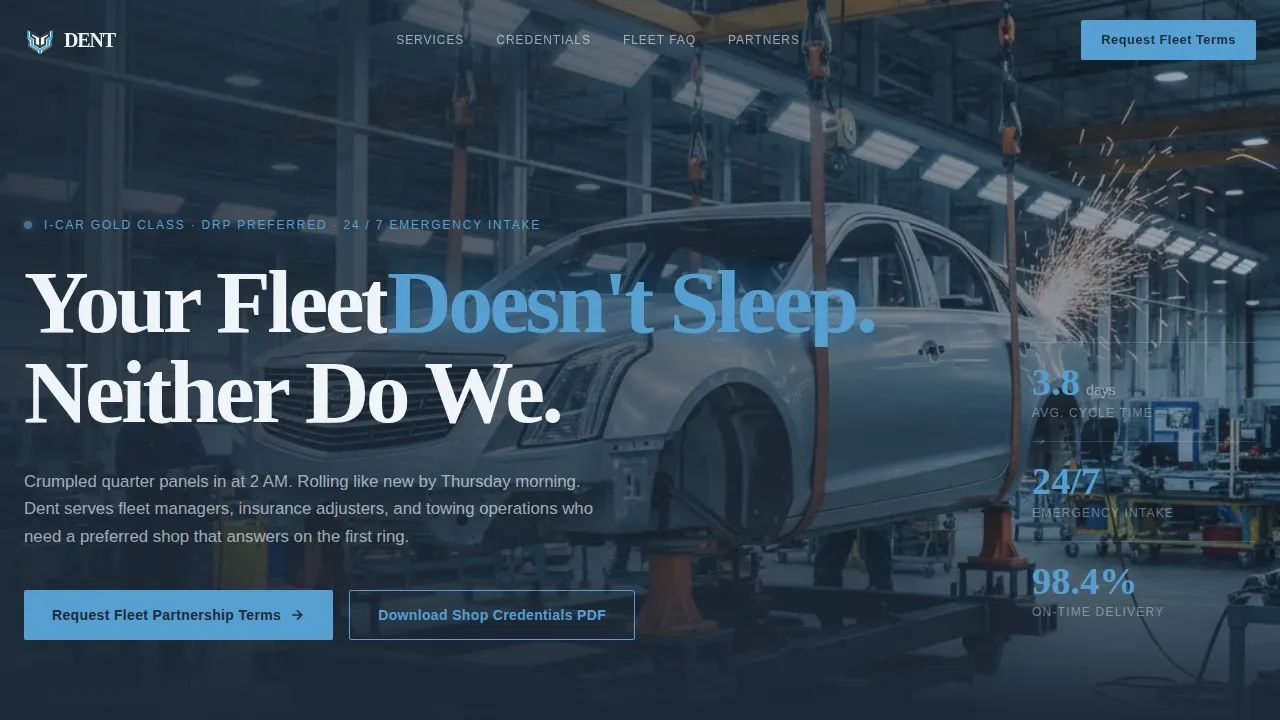
- A cinematic hero section with a dark full-bleed shop bay photograph, a glowing headline, and a stats column that front-loads key performance figures before any descriptive copy appears.
- Five fully structured content sections covering the first 60 minutes of intake, certifications and direct repair program affiliations, parts and supplement process, a B2B partnership form, and a linear single-row footer, all built with scroll-triggered reveals, parallax effects, and frequently asked question accordion interactivity.
- Two conversion paths: a primary "Request Fleet Partnership Terms" form collecting company name, fleet size range, primary insurance carrier, and work email, plus a secondary "Download Our Shop Credentials PDF" path gated behind email only, giving cautious adjusters a low-commitment entry point.
Feature list
This section describes the specific built-in capabilities of the Dent landing page template. Each feature reflects what is explicitly included in the design and structure of the template.
Cinematic Dark Hero with Glowing Headline
The hero section uses a full-bleed photograph of a shop bay at night. Overhead LEDs cast a sharp downward glow onto a vehicle on the frame rack, with sparks frozen mid-grind in the background. A single headline fades in over the image with a glow effect that mirrors the practical light of the bay. This opening sets the tone immediately: industrial competence, not retail charm. The hero also includes a stats column that surfaces hard performance figures before any descriptive copy loads. Visitors see proof before they see persuasion.
frequently asked question-Driven Editorial Scroll Structure
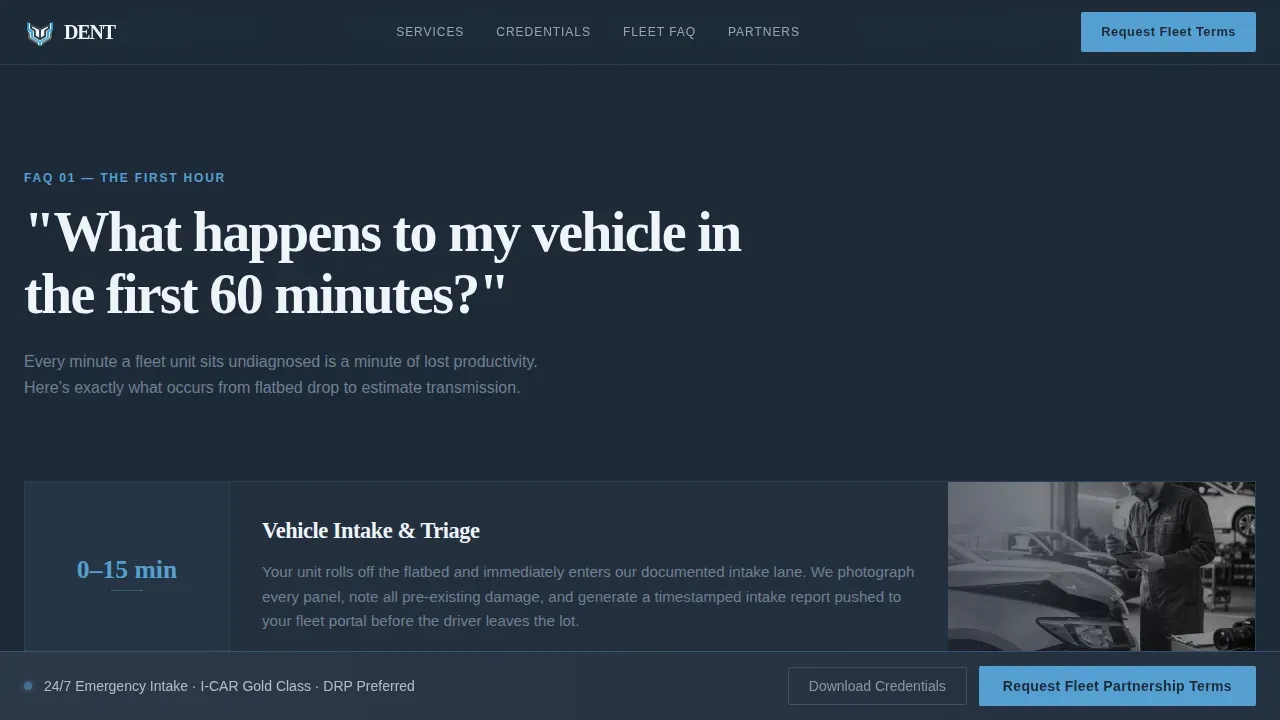
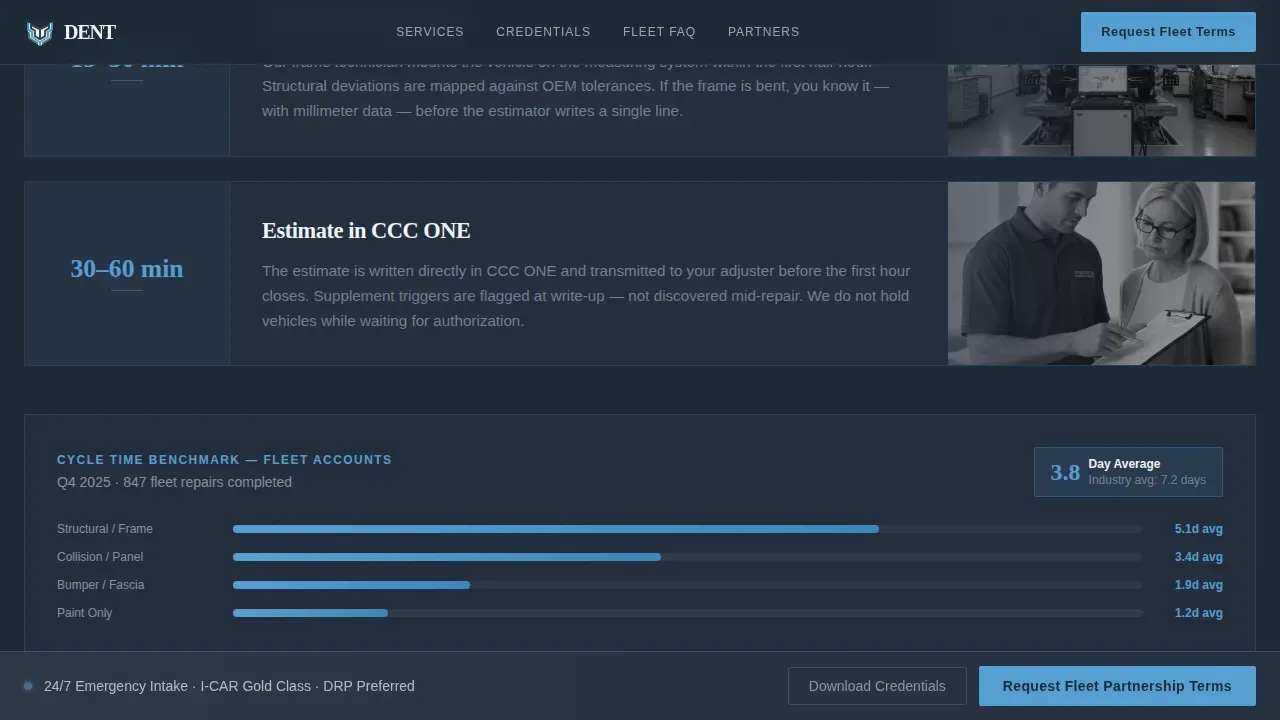
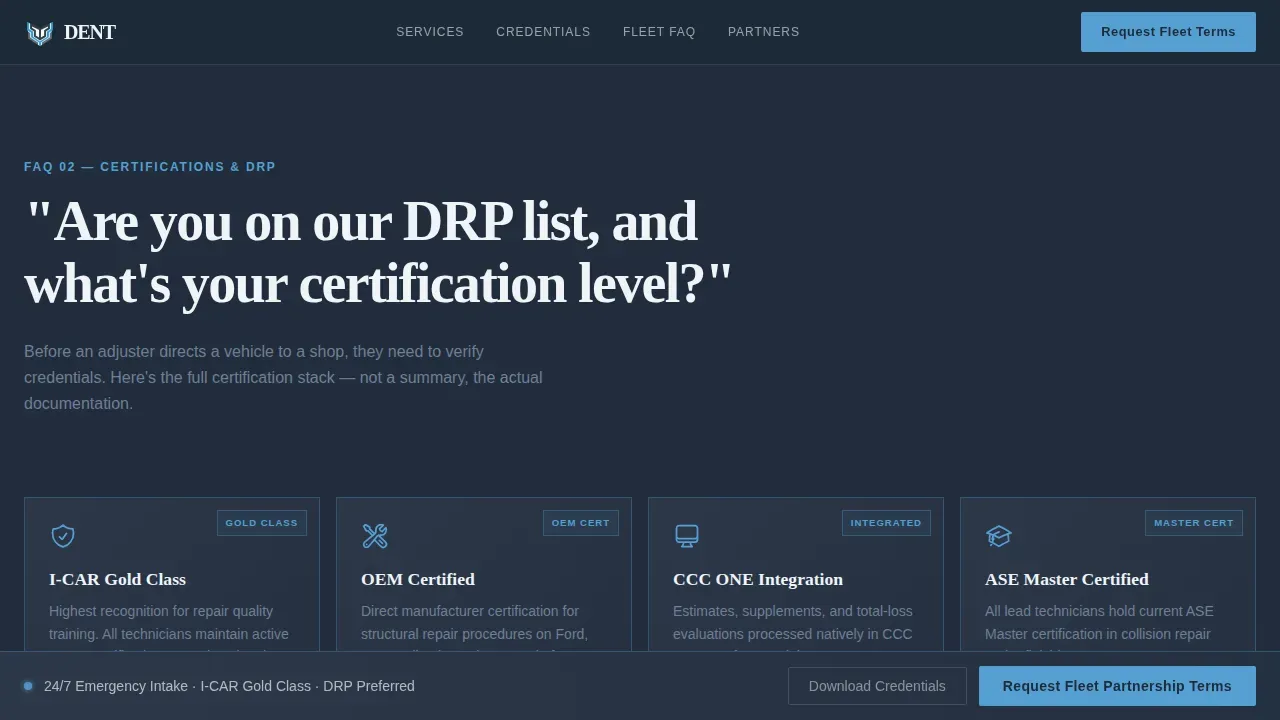
The page is organized as a long-form magazine feature rather than a standard service page. Each scroll section is built around a question that a fleet manager or insurance adjuster actually types into a search bar. The first frequently asked question section covers what happens to a vehicle in the first 60 minutes of intake. The second covers certifications, I-CAR Gold Class status, and direct repair program affiliations. The third covers OEM versus aftermarket parts decisions and supplement request processing. Each section unfolds with photojournalistic imagery, cycle-time charts, and certification badge callouts. The scroll feels like reading a well-reported trade article, and that tone builds the trust a repair shop needs to win large fleet accounts.
Dual B2B Conversion Paths
The primary conversion path is a partnership request form that asks for company name, fleet size range via a dropdown selector with three tiers, primary insurance carrier, and work email. This form appears at section breaks and anchors in a persistent bottom bar throughout the full page scroll. The secondary path offers a shop credentials PDF download gated behind email only. That lower-commitment option gives cautious insurance adjusters a way to access supporting materials without filling out a full partnership form. Both paths work together to capture leads at different stages of the decision process.
Persistent Call-to-Action Bar
A fixed bottom bar stays visible as visitors scroll through every section of the page. It carries the primary call to action and a phone contact option. This means the path to conversion is always one click away regardless of where a person is on the page. Fleet managers working at their desks can initiate contact without scrolling back to the top. The persistent bar is built with form validation and scroll-triggered display behavior.
High-Animation Editorial Layer
The template includes scroll-triggered text reveals, parallax image scrolling, and a marquee ticker element. These animations are implemented using native CSS scroll behavior and an Intersection Observer pattern, meaning no heavy external libraries are required. The animation set is designed to feel like a premium editorial platform, not a standard service site. Each animation triggers at the right moment to reinforce the information hierarchy of the section it accompanies.
Slate and Sky Design System
The entire template is built on a four-color palette: deep shop-floor charcoal (#1E2A38), tool-steel gray (#4A5568), open-sky blue (#56A0D3), and arc-weld white (#F0F4F8). Charcoal dominates backgrounds. Sky blue marks every clickable element and key statistic. Steel gray holds body copy. Arc-weld white opens generous margins between editorial sections. The typography pairing uses Fraunces for editorial headlines and DM Sans for body copy and interface elements. The result is a design system that feels like industrial precision softened by editorial clarity.
Page sections overview
| Section | Purpose |
|---|---|
| Hero Bay Shot | Opens with cinematic dark shop photo, glowing headline, and hard performance stats |
| frequently asked question: First 60 Minutes | Answers what happens during vehicle intake with photojournalistic repair stage imagery |
| frequently asked question: Certifications and DRP | Displays I-CAR Gold Class status, certification badges, and direct repair program affiliations |
| frequently asked question: Parts and Supplements | Explains OEM versus aftermarket decisions and supplement request processing tools |
| Fleet Partnership Form | Captures partnership leads via a structured B2B form with fleet size and insurance fields |
| Persistent call to action Bar | Keeps the primary call to action and phone contact visible at the bottom of the page |
| Footer Pattern | Delivers a clean linear single-row footer with essential contact and location information |
Design & branding system
The Slate and Sky color system is the visual foundation of this template. It was chosen to carry the weight of an industrial repair environment while projecting the clarity and trustworthiness that insurance providers and fleet account managers expect from a professional service partner. The palette does not feel promotional. It feels competent.
- Four-color palette: charcoal (#1E2A38) for backgrounds, sky blue (#56A0D3) for interactive elements and statistics, steel gray (#4A5568) for body copy, and arc-weld white (#F0F4F8) for breathing room between sections. Sky blue appears on every clickable element so visitors always know where the action is.
- Typography pairing: Fraunces serif for editorial headlines, DM Sans sans-serif for body copy and interface labels. This combination gives the page a magazine quality that reinforces the long-form frequently asked question-driven editorial structure.
- Animation and interactivity layer: scroll-triggered text reveals, parallax image sections, marquee ticker, frequently asked question accordion expand and collapse, and form validation. All implemented with native CSS and Intersection Observer so no heavy libraries affect the page experience.
Mobile & speed optimization
The template is designed desktop-first because the primary audience, fleet managers and insurance adjusters, typically review vendor pages from a desk browser. However, towing operators and field staff often visit from mobile devices, so the layout is fully responsive across screen sizes. Fleet managers and drivers often search on the go, and the page accommodates that behavior without sacrificing the editorial depth that makes the desktop experience compelling.
- The layout reflows cleanly for mobile users, preserving the frequently asked question accordion interactivity, the persistent call-to-action bar, and the contact form across all screen widths. A prominent, clickable phone contact element is always accessible on mobile.
- Animations are built with native CSS scroll and Intersection Observer rather than heavy JavaScript libraries, keeping the experience smooth on both desktop and mobile devices without introducing unnecessary rendering overhead.
- The persistent bottom bar ensures that mobile visitors always have a direct path to the partnership form or phone contact without needing to scroll back to the hero section.
How this template helps you convert
This template is structured to move fleet managers and insurance adjusters from skeptical visitors to qualified leads by proving competence before asking for a commitment. Every layout decision serves that sequence. The page earns the click rather than demanding it.
- Front-loaded proof: The hero section surfaces hard performance data, I-CAR Gold Class status, and direct repair program affiliations before any descriptive copy appears. This immediately separates the shop from generic competitors and gives a fleet manager a reason to keep reading. Visitors who arrive on the page and see specific numbers rather than generic claims are far more likely to scroll to the form.
- frequently asked question editorial structure builds audit confidence: Each scroll section answers a real question a fleet professional asks when evaluating a repair shop. The structure mirrors the mental checklist an adjuster uses when vetting a preferred shop. By the time a visitor reaches the partnership form, they feel confident they have already completed their due diligence. That confidence converts to form submissions and PDF downloads at a meaningfully higher rate than a standard service page.
- Dual conversion paths reduce friction: The primary form captures high-intent fleet managers ready to request terms. The PDF download captures cautious adjusters who prefer to review credentials before making contact. Having both paths on the same page ensures that no qualified lead leaves without a next step that matches their readiness to engage.
Other information about this template
The Dent landing page template sits within the broader category of professional auto body shop marketing and specifically addresses the niche of auto body shop emergency service pages. It is built for the intersection of editorial/magazine template style, frequently asked question-driven creative direction, dark full-bleed header concept, and partnership-focused B2B landing page direction. Understanding that intersection helps clarify what makes this template distinct from a general repair shop page.
- This template is designed for a USA market context with USD pricing references, 12-hour time format, and imperial measurements, making it immediately practical for domestic fleet operators and insurance providers without localization adjustments.
- The contact form is built with fleet-specific fields, including a fleet size range dropdown with three tiers covering 10 to 25, 25 to 75, and 75 or more vehicles. This specificity signals to fleet managers that the page was built for their business, not adapted from a retail template. It also helps the shop qualify inbound leads by fleet scale before a first conversation.
- Auto body shop marketing strategies that work alongside this template include loyalty programs to reward repeat fleet customers, seasonal promotions for storm damage repair cycles, and referral programs that incentivize existing fleet clients to refer new accounts. These marketing tactics pair naturally with the template's B2B positioning. Loyalty programs in particular can encourage repeat business by rewarding customers for their continued patronage.
- The template supports a comprehensive service positioning strategy. It can carry messaging around storm damage response, hail repair, and minor dents alongside structural collision repairs. Paintless Dent Repair (PDR) removes minor dents without needing new paint and works best for shallow dents with undamaged paint caused by hail or light contact. For fleets that accumulate minor dents from everyday use, PDR is a fast-turnaround service that this page can feature alongside full collision work.
- Professional PDR services use advanced tools and experience to ensure flawless results. Choosing professional auto body repair over improvised DIY methods leads to better long-term satisfaction and protects the resale value of fleet vehicles. Improper DIY repairs can worsen the damage or leave visible flaws, creating additional cost for fleet operators down the line.
- The editorial frequently asked question structure of this template is itself a content strategy asset. Each question-and-answer section targets the specific language fleet managers and adjusters use when they visit a repair shop website. That language alignment makes the page more relevant to the audience it serves and helps the shop position itself as the most credible option among competing providers.
- Partnerships in the auto repair industry can enhance service offerings significantly. Collaborating with local towing businesses leads to mutual referrals and expands the customer base for both parties. Partnerships with towing services specifically improve customer satisfaction by ensuring prompt vehicle recovery after accidents. Working with trusted local businesses also enhances the credibility of the auto body repair shop and builds the kind of loyalty that drives long-term account retention.
- For shops considering the full scope of digital visibility, optimizing a Google Business Profile, encouraging customer reviews on review platforms, and running pay-per-click advertising campaigns can increase traffic to the landing page itself. Text message marketing is also an effective strategy for auto repair services given its high open rates. Content marketing through video walkthroughs and technical blog posts can position the repair shop as an industry leader over time.
- The dent 24 7 fleet partnership auto body shop landing page template is the named product this page describes. It is the single-page template built from all the brief details outlined above, and it is available as a ready-to-customize design on the platform.
- Bot traffic and web security are practical concerns for any business running a high-visibility landing page. While this template does not include a built-in security service, shop owners deploying it on a public platform should be aware that web security tools help protect the page from malicious bots that can distort form submission data and inflate traffic figures. A security service typically runs a security verification process that verifies whether a visitor is a real person or an automated bot. When verification is successful, the real visitor is allowed through and the bot is blocked. A respond ray ID is often assigned to each verification event, giving site operators a reference point for troubleshooting. This kind of bot protection verifies legitimate visitors while blocking malicious bots that would otherwise waste sales team resources on fake leads. Platforms that carry out security verification protect form inboxes from noise, ensuring that every account that submits a partnership request is a real business contact. Security verification tools and security service providers play an important role in keeping landing page data clean. When verification successful events are logged consistently, fleet partnership teams can trust their lead data and invest resources in follow-up with confidence. Protecting form submissions from malicious bots means the shop can respond ray id genuine inquiries rather than sifting through bot-generated noise. The security service verifies each submission and protects the pipeline. A well-configured security verification layer ultimately means fewer wasted follow-up calls and more productive outreach. Teams that protect their forms with a security service verifies process consistently win more productive conversations from their landing page traffic.
Theme
Educational Guide
Creative direction
FAQ-Driven
Color system
Slate & Sky
Style
Editorial/Magazine
Direction
Partnership/B2B
Page Sections
Cinematic Dark Hero with Stats Column
Faq-driven Editorial Scroll
Dual B2B Conversion Paths
Persistent Bottom Call-to-action Bar
Slate and Sky Editorial Design System
High-animation Scroll Layer
Related questions
Who is this landing page template designed for?
What sections are included in the template?
Can the form fields be customized for my shop?
Does the template include mobile-responsive design?
Is this template suitable for shops that also offer paintless dent repair?