Complete Specialty Construction Portfolio & Case Study Website Template
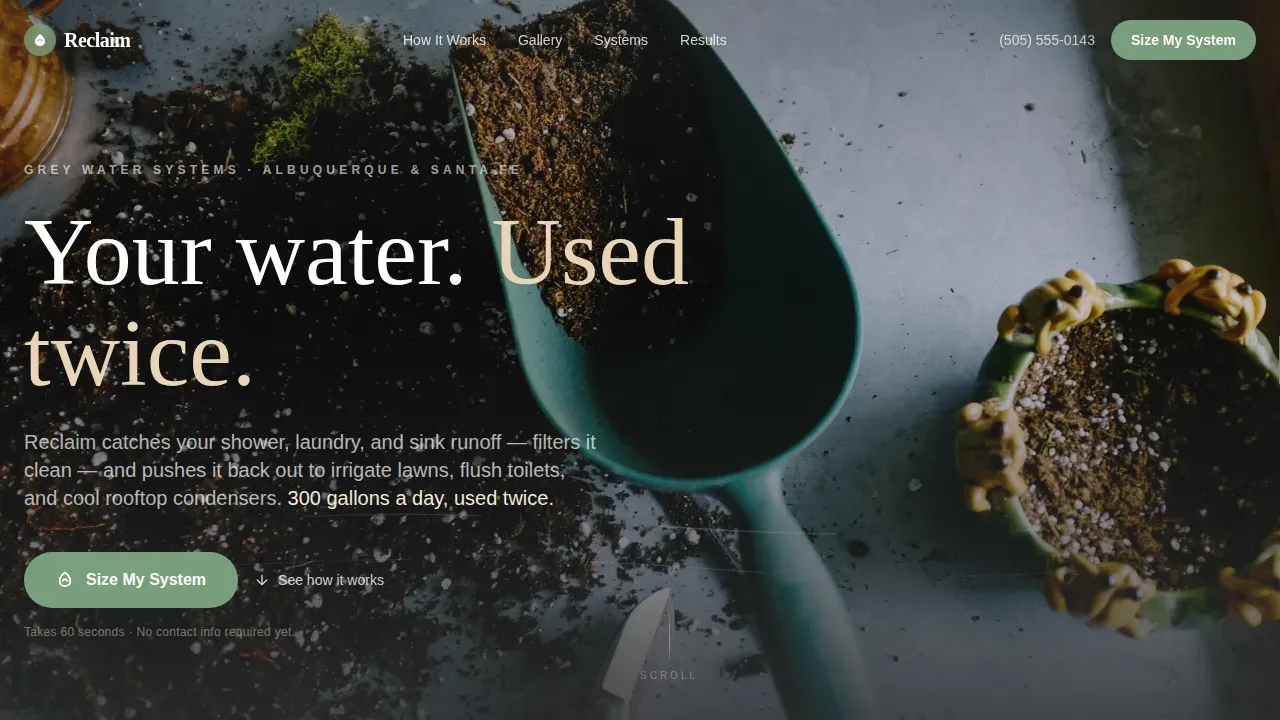
The Reclaim grey water system landing page template is built for installers who need to turn technical complexity into confident buyer action. It combines a full-screen video hero, a click-expand gallery of real installation photos, and a staged system walkthrough that guides visitors from curiosity to the "Size My System" estimate configurator. Warm Southwest earth tones make every detail feel grounded and trustworthy.
by Rocket studio
Quick summary
This is a gallery-plus-detail landing page designed for a grey water system installer. It guides drought-conscious homeowners, custom builders, and commercial property managers from first impression through to a low-friction estimate configurator. The design uses a Sunset Mesa color system and Transparent Process creative direction to make a permitted, inspectable greywater system feel as clear as filtered water running through clean pipe.
Who this template is for
This template suits businesses that install or spec greywater systems and need to earn trust before asking for a phone number. It works equally well for residential installers and commercial operators.
- Drought-conscious homeowners watching utility costs rise who want to recycle wastewater from their shower, sinks, and washing machines
- Custom home builders working on net-zero projects who need a page that can stand up to technical scrutiny
- Commercial property managers under municipal reuse mandates who require a permitted, inspectable system
What problem this template solves
Most greywater installer pages drop visitors into a wall of jargon or a generic contact form. Visitors leave before they understand the system, let alone trust it. This template solves that by building progressive confidence through visual storytelling and real installation detail.
- Visitors can read the system from simple sink diverters all the way through to whole-house recirculation, at their own pace
- A contextual call-to-action with supporting text reduces friction at every stage
- The gallery-to-detail flow replaces guesswork with specifics: component, function, lifespan, maintenance note
What you get with this template
You get a fully structured landing page that moves visitors through a transparent technical story and funnels them to a step-one configurator. Every section is designed to build trust and answer the next logical question.
- Full-screen video hero with overlay type and a primary sage-green call-to-action button
- A scrollable gallery grid of installation photos that expand on click into detail panels
- Stats bar, system-stage walkthrough, social proof section, and a Vercel Horizontal Flow footer
Feature list
This template includes six purpose-built sections and a cohesive design system. Each feature listed below is grounded in the source brief.
Full-Screen Video Hero with Overlay Type
The header uses aerial drone footage that dissolves through an exterior wall into a cutaway animation showing lavender-tinted water flowing from washing machines through a filter tank and back out to the garden. The loop is seamless. A single white utility line fades in: "Your water. Used twice." The primary call-to-action button appears directly beneath.
Click-Expand Installation Gallery
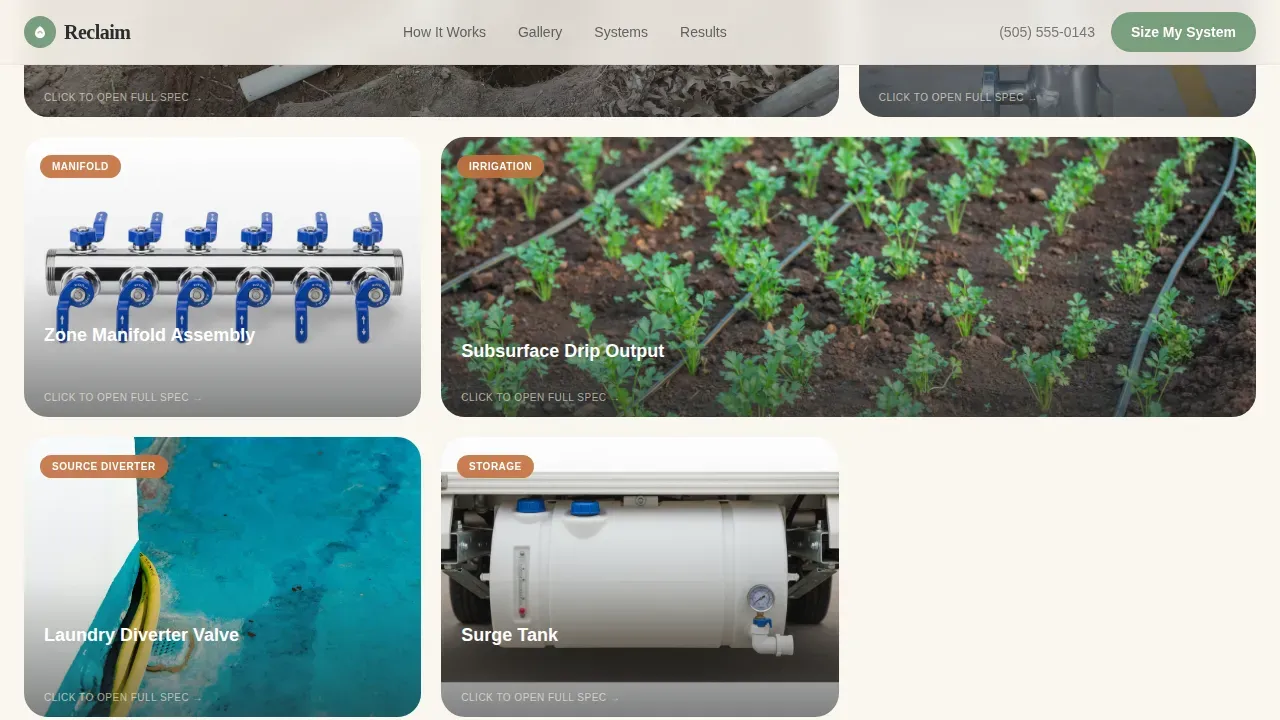
A grid of real installation photos covers trenches, filter housings, tank connections, and manifold assemblies. Clicking any image opens a detail panel showing the specific component, its function in plain language, estimated lifespan, and a maintenance note. This turns the gallery into an open permit file that visitors can read at their own pace.
Progressive System-Stage Walkthrough
Each scroll section reveals the next stage of complexity, from simple Laundry-to-Landscape diverters through to whole-house recirculation with a pump, storage tank, and multi-stage treatment filters. Visitors find their comfort level without feeling overwhelmed.
Repeating Contextual Call-to-Action
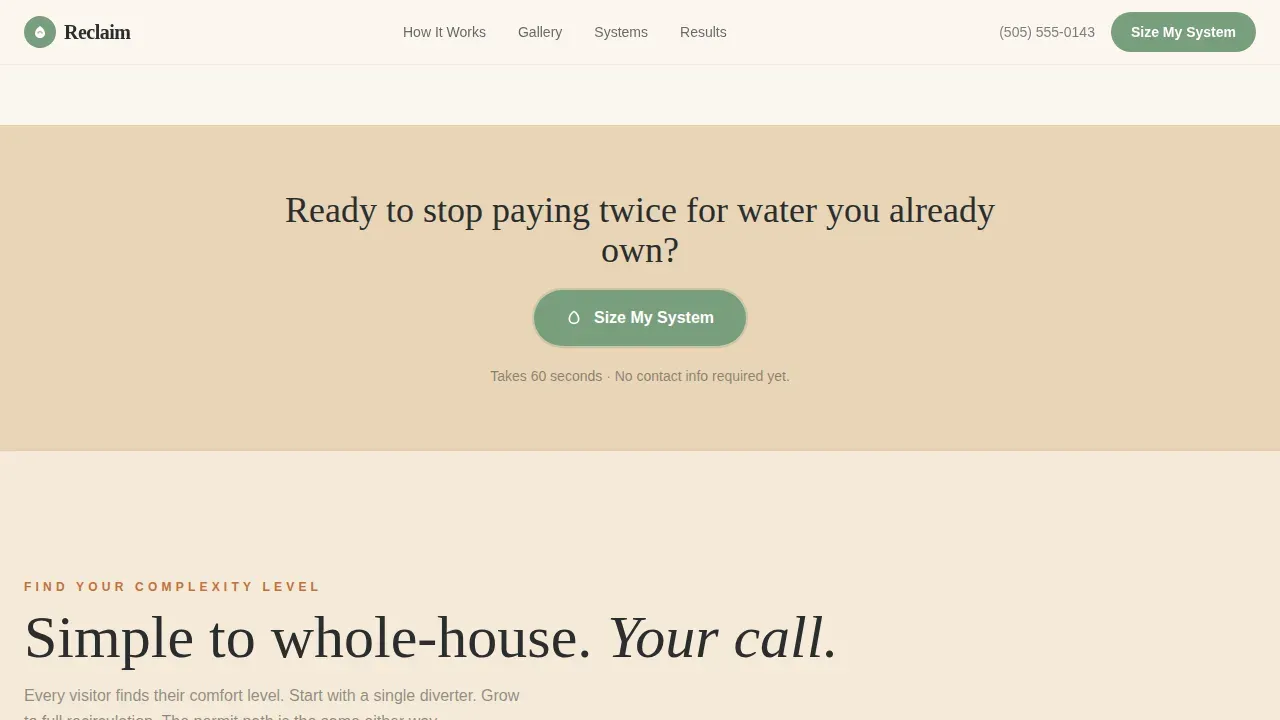
The "Size My System" button in sage green repeats after every third gallery row. The supporting text beneath each button changes contextually. For example: "Takes 60 seconds. No contact info required yet." Clicking lands on a step-one page asking only home square footage, bathroom count, and irrigation area.
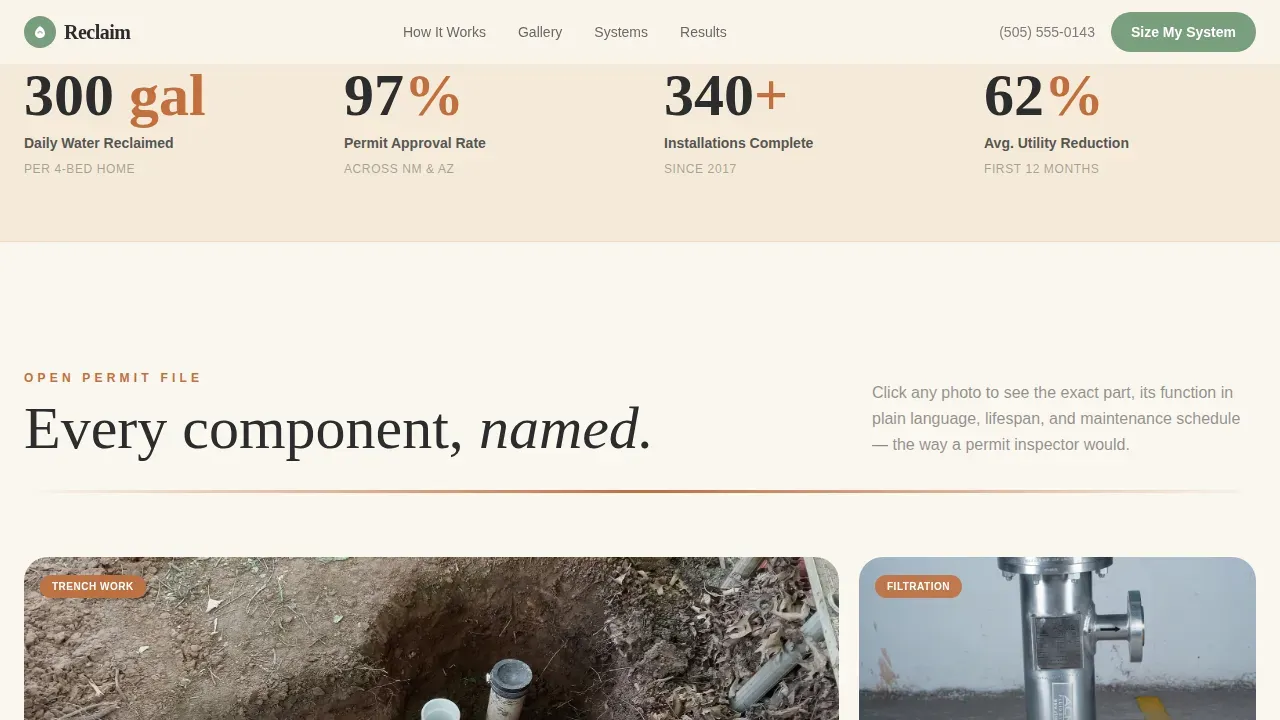
Stats Bar with Key Metrics
A dedicated stats bar displays key figures: up to 300 gallons of reusable water per day, permit success rate, install count, and water savings percentage. These numbers help visitors understand the tangible benefits before scrolling further.
Social Proof Section
Testimonials from homeowners, builders, and property managers with Southwest regional authenticity give the page credibility. Roles and metrics accompany each testimonial, reinforcing the system's track record across different building types and use cases.
Page sections overview
| Section | Purpose |
|---|---|
| Hero Video | Establish brand and show the greywater system in motion |
| Stats Bar | Display water savings, permit rate, and install count |
| Installation Gallery | Expand on click to reveal component detail panels |
| System Stage Walkthrough | Progress from simple to whole-house greywater system complexity |
| Social Proof | Build trust with role-specific Southwest testimonials |
| Footer | Horizontal flow pattern with navigation and contact links |
Design & branding system
The Sunset Mesa color system gives this template a visual identity that feels like standing at the edge of a New Mexico mesa at dusk. Sand dominates backgrounds, charcoal carries body text, and terracotta marks section transitions and icon strokes.
- Sage green (#7A9E7E) appears only on interactive elements: call-to-action buttons, toggles, and active states, making every clickable surface feel alive
- Typography pairs Fraunces serif display headings with DM Sans utility body text, balancing warmth with technical clarity
- Terracotta (#C2703E) outlines icons and section dividers, reinforcing the Southwest earth tone throughout the design
Mobile & speed optimization
The template is designed desktop-first with strong mobile adaptation. The video hero includes a lazy-load fallback so visitors on slower connections still get a fast first render.
- Server Components handle static sections to keep the page performing well under real-world conditions
- Scroll-triggered gallery expansions and stage reveals use animation that degrades gracefully on smaller screens
- The step-one configurator is intentionally low friction, asking only for data the visitor already knows
How this template helps you convert
The entire page is structured as a click-through funnel. Each section earns the next click before asking for anything personal.
- The video hero and stats bar establish credibility in the first scroll, so visitors understand the system's benefits before they read a word of copy
- The gallery and stage walkthrough answer technical questions in plain language, reducing the concern that greywater systems are too complex or risky
- The repeating "Size My System" call-to-action with contextual subtext collects low-friction data first, moving the visitor to a configurator rather than a contact form
Other information about this template
This template is built specifically for the Reclaim sustainable grey water system landing page template use case. Here is additional context that helps you decide if this template fits your project.
- Greywater is wastewater generated from non-toilet sources: showers, bathroom sinks, and washing machines. It excludes blackwater and kitchen sink water due to higher contaminant levels.
- A typical residential greywater system can save 10,000 to 50,000 gallons of water per year, reducing household potable water consumption by 35% to 50%.
- Rainwater collection and greywater reuse work well together. Rainwater harvesting is most effective when integrated into new buildings, while greywater reuse is suitable for retrofitting existing houses. The simplest rainwater option for most householders is a large water butt on a down-pipe roof downspout.
- Gravity-fed systems move water using the natural slope of the property, keeping pump energy costs low. A pump-based system is used when the garden sits at a higher elevation than the water source.
- Effective greywater treatment systems include screening units, sedimentation tanks, and filtration units to remove debris, hair, and large particles, and to reduce pathogens before reuse.
- A surge tank acts as a temporary holding container, buffering flow between collection and distribution. A separate storage tank holds treated water ready for toilet flushing, irrigation, car washing, or roof cooling.
- Monitoring treatment processes is essential to ensure recycled water is treated safely. Life cycle costs and impacts must be assessed when building the business case for any onsite reuse system.
- Using low-sodium detergents is recommended when reusing greywater for irrigation. Shower water is easy to reuse because shampoos and soaps are mild and well diluted, making it suitable for direct garden irrigation without long-term storage.
- This page template can be downloaded or shared as a PDF reference during client presentations or permit-review meetings.
- The landing page design supports car washing supply lines and roof condenser cooling as additional reuse outputs, depending on system configuration.
Theme
Service Utility
Creative direction
Transparent Process
Color system
Sunset Mesa
Direction
Click-Through
Page Sections
Full-screen Video Hero with Call to Action
Click-expand Installation Gallery
Progressive System-stage Walkthrough
Repeating Contextual Call-to-action
Stats Bar with Key Metrics
Role-specific Social Proof Section
Related questions
What types of grey water sources does this system design account for?
Can this landing page support both residential and commercial projects?
How does the "Size My System" configurator work?
Does the template show how the greywater treatment process works?
Is this template suitable for net-zero or green-certified building projects?