Soil & Water Conservation Professional Website Template
Reclaim is a single-column landing page template built for land reclamation services. It walks visitors through a seasonal scroll narrative, from contamination mapping in winter to a thriving native habitat in autumn. The layout serves land trusts, municipal planners, and developers who need a credible, lead-generating web presence for environmental remediation work.
by Rocket studio
Quick summary
Reclaim is a nature-journal-style landing page template for professional land reclamation services. It uses a four-season scroll structure to demonstrate process, build trust, and convert visitors into leads. Two conversion paths are built in: a downloadable site assessment guide and a site walk request form with a date picker.
Who this template is for
This template is designed for environmental services firms that work with institutional and municipal clients. It speaks directly to decision-makers who manage contaminated land and need a service provider they can trust before committing budget.
- County land trust managers holding contaminated or brownfield parcels
- Municipal planners and brownfield program officers with long remediation timelines
- Developers who need documented environmental sign-off before breaking ground
What problem this template solves
Many land reclamation firms struggle to communicate process complexity to non-technical clients. A generic services page does not earn trust from a land trust manager or a municipal planner who has already watched remediation budgets stall for a decade.
- Clients cannot see your methodology, so they hesitate to make contact
- Brownfield and post-mining site leads need proof of regulatory fluency before committing
- A brochure-style layout fails to demonstrate the seasonal, iterative nature of reclamation work
What you get with this template
You get a fully structured, single-column landing page built around a four-season narrative scroll. Every section is designed to move a cautious institutional buyer from awareness to action.
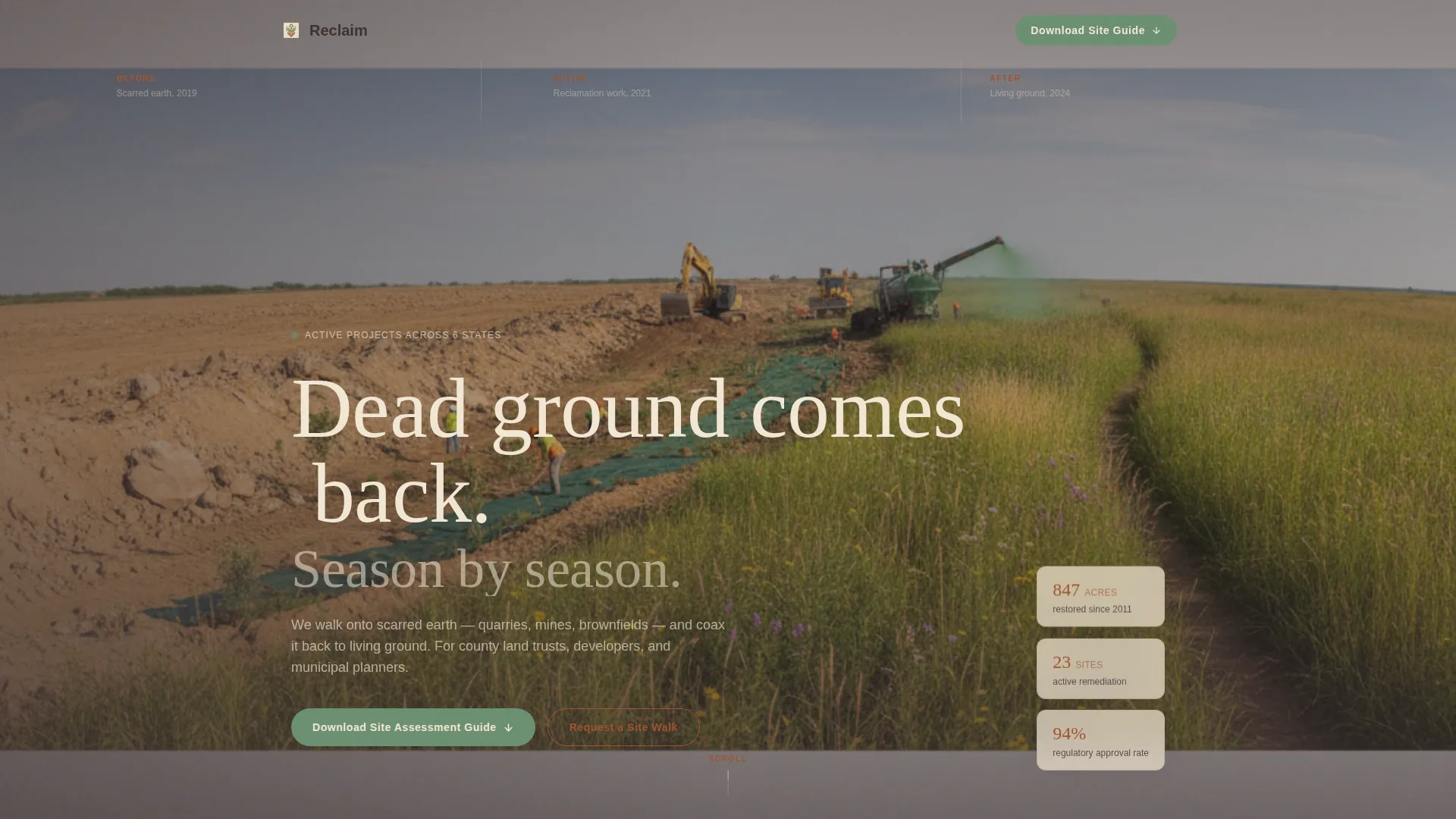
- A panoramic hero section showing before, during, and after states in one cinematic frame
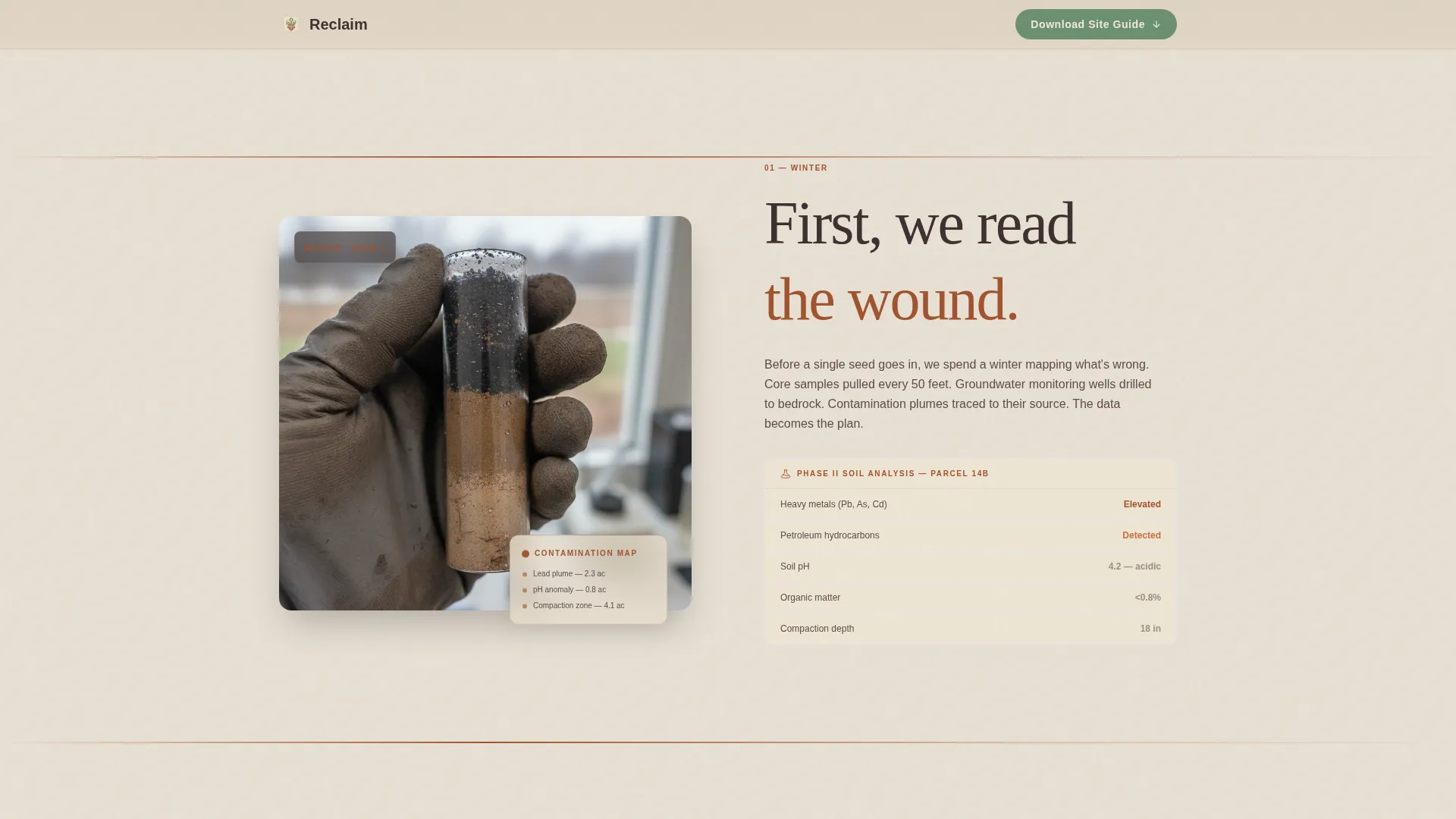
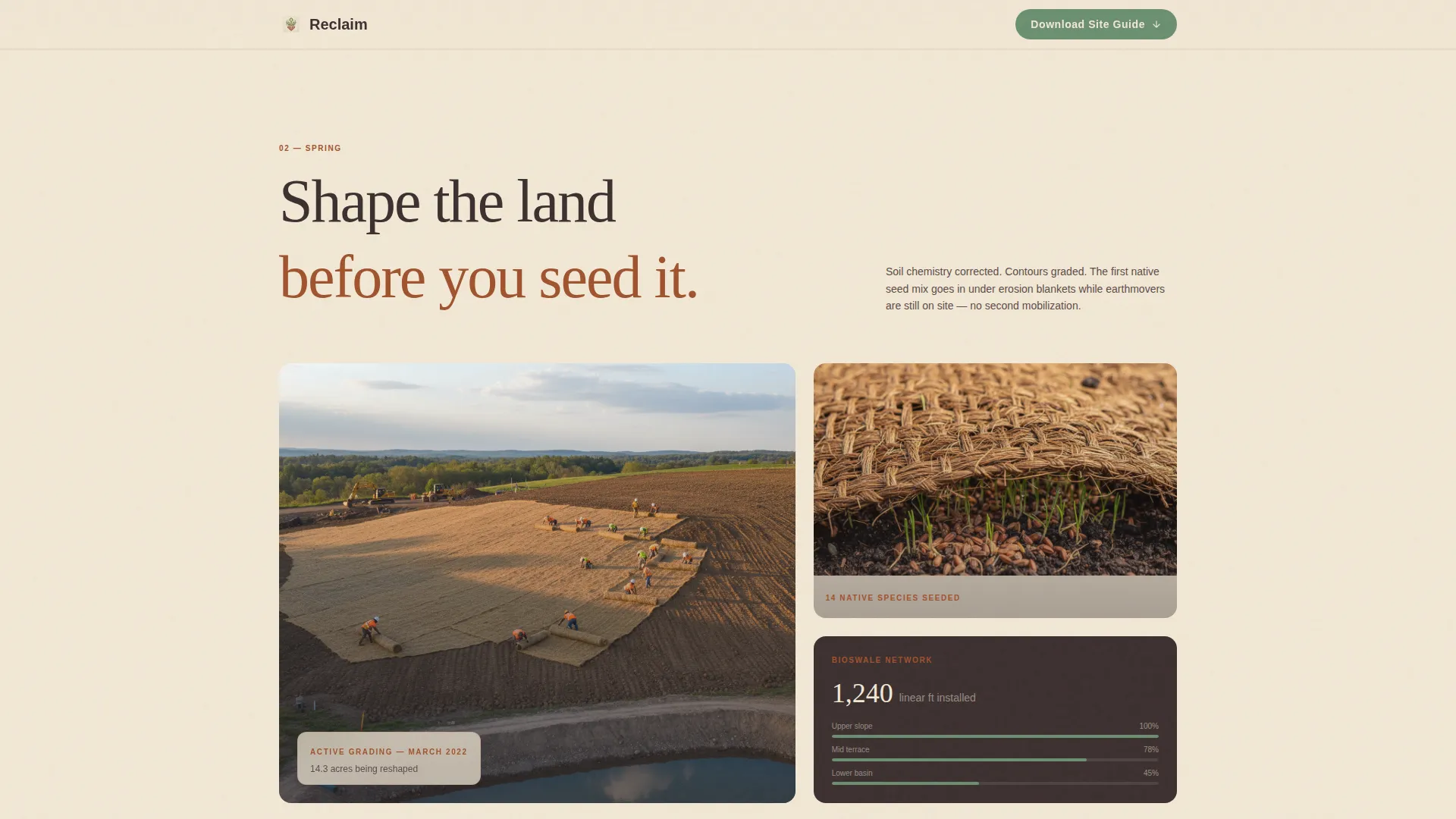
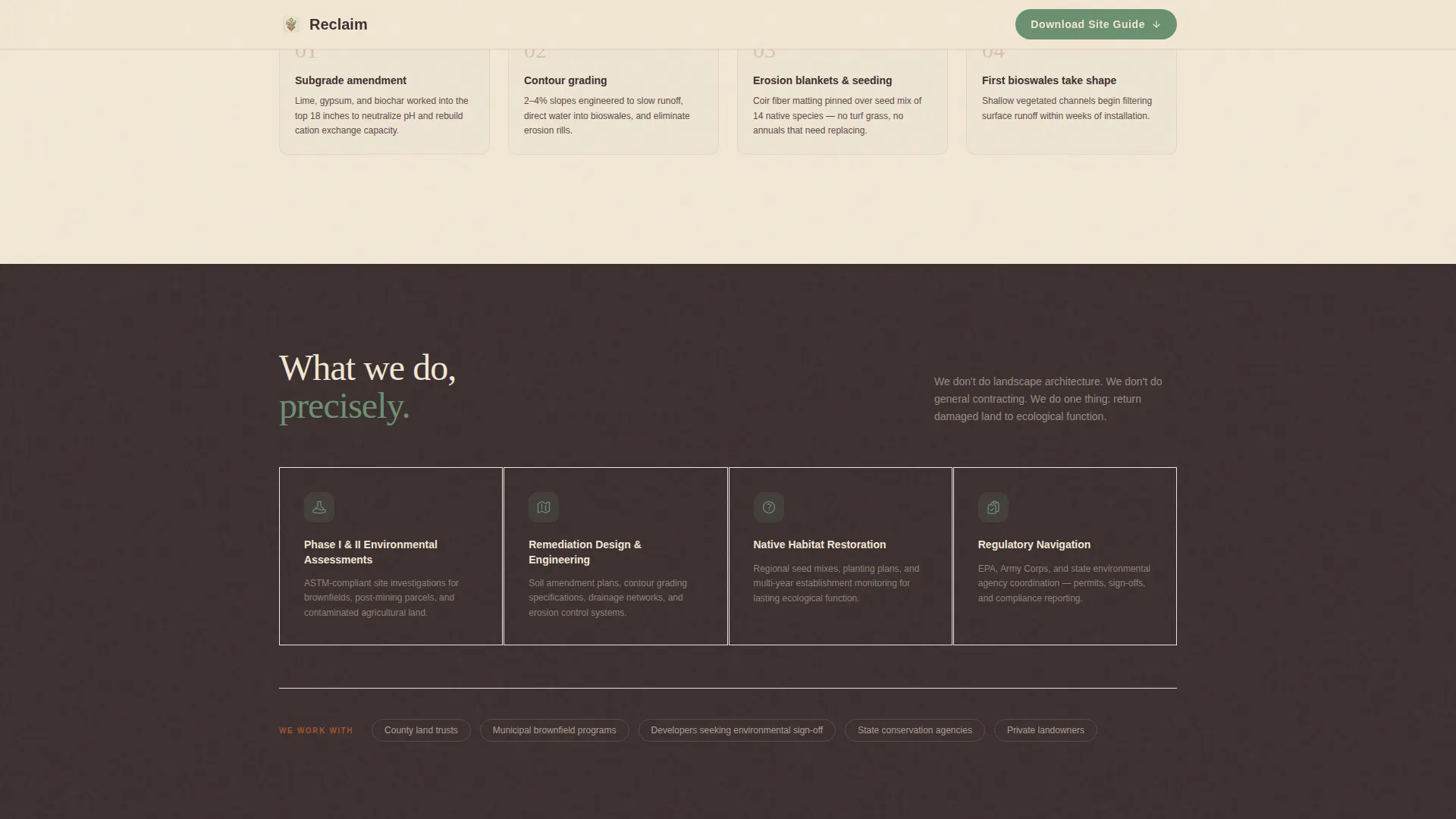
- Four seasonal content sections (Winter, Spring, Summer, Autumn) with distinct visual tones and scroll-triggered transitions
- Two lead capture paths: a guide download form and a site walk request form with a date picker and parcel address field
Feature list
A brief overview of the key built-in capabilities that make this template work for land reclamation service marketing.
Panoramic Timeline Hero
The header stretches edge to edge and shows three states of a single landscape in one uninterrupted frame: raw and wounded land on the left, active reclamation in the middle, and a recovered native habitat on the right. No slider, no animation, the full timeline is visible at a glance.
Seasonal Scroll Narrative
The page is structured as four distinct seasonal sections. Each season introduces new visual cues, background temperature shifts, and a growing presence of lichen green, so the page itself visually "greens" as the visitor scrolls toward the call to action.
Dual Conversion Path Layout
A primary call to action offers a 12-page site assessment guide covering Phase I and Phase II environmental assessments, soil classification, and regulatory timelines. A secondary call to action targets warmer leads with a site walk request form that includes a date picker and parcel address field.
Scroll-Triggered Section Transitions
Section backgrounds alternate between weathered parchment and clay white to signal seasonal progression. Scroll-triggered reveals and intersection observer animations bring data cards, imagery, and text into view as the visitor moves through each season.
Editorial Data Overlays
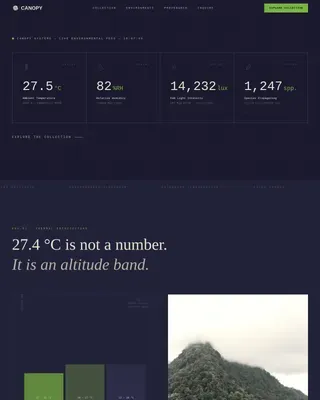
The Summer section presents monitoring data visually, including water quality readings and root depth references, laid over a drone-footage aesthetic. Floating data cards appear in the Winter and Spring sections to reinforce the firm's measurement-driven approach.
Low-Friction Lead Form
The guide download form collects only three fields: name, email, and site type (brownfield, post-mining, agricultural, or other). Floating labels keep the form clean and unintimidating for first-time visitors.
Page sections overview
| Section | Purpose |
|---|---|
| Hero Panoramic | Show full reclamation timeline in one frame |
| Winter: Soil Testing | Establish scientific credibility through contamination mapping |
| Spring: Grading & Seeding | Demonstrate active site preparation and bioswale formation |
| Summer: Monitoring Data | Present measurable ecological progress with visual metrics |
| Autumn: The Reveal | Deliver emotional payoff with before-and-after panoramic and dual call to action |
| Footer | Provide linear single-row navigation and contact essentials |
Design & branding system
The visual identity uses a Nature-Inspired theme rooted in a Parchment and Rust color system. The overall feel is editorial and organic, precise enough for institutional clients, warm enough to feel human.
- Core palette: weathered parchment (#F2E8D5) backgrounds, iron-oxide rust (#A0522D) for headlines and accents, deep loam brown (#3B2F2F) for body text, and lichen green (#6B8F71) for calls to action and progress indicators
- Typography pairs Fraunces serif headlines with DM Sans for body text and interface elements, reinforcing the nature-journal aesthetic
- Section dividers bleed rust tones like water staining old paper, and background warmth shifts slightly between sections to mark seasonal transitions
Mobile & speed optimization
The template is designed desktop-first to serve land trust managers and municipal planners who typically work from office environments. A strong mobile fallback is built in for secondary access.
- Server components handle all static sections to reduce unnecessary client-side load
- Parallax layers, noise textures, and stagger grid animations are client-side only where interaction requires it
- The single-column flow translates cleanly to narrower screens without restructuring the seasonal narrative
How this template helps you convert
The seasonal scroll does the persuasive work before any call to action appears. By the time a visitor reaches the Autumn section, they have already watched a full reclamation cycle unfold.
- The panoramic hero establishes immediate credibility and positions the firm as one that documents outcomes, not just intentions.
- Each seasonal section layers in process detail and measurable results, so the guide download feels like a natural next step rather than a cold ask.
- The secondary site walk request form appears after the Summer section, targeting visitors who already know they need help and are ready to name a parcel and pick a date.
Other information about this template
This template is built within the Agriculture and Environment category, specifically for soil and water conservation and land reclamation service providers in the United States. It uses imperial measurements and references EPA and state regulatory language throughout the copy framework.
- The site assessment guide offer (a 12-page PDF) is the primary content asset driving lead capture
- Social proof elements such as acreage numbers, regulatory milestones, and ecological metrics are built into the layout to support institutional buyer confidence
- The template style is Single Column Flow with medium-to-high animation complexity, including character reveal effects, intersection observer reveals, parallax layers, and hover effects on project cards
- Char-reveal headline animations and blur-reveal effects are used in the hero section to give the opening a cinematic, unhurried quality
Theme
Nature-Inspired
Creative direction
Seasonal/Moment
Color system
Parchment & Rust
Style
Single Column Flow
Direction
Content/Resource
Page Sections
Panoramic Timeline Hero Section
Four-season Scroll Narrative
Dual Lead Capture Forms
Scroll-triggered Season Transitions
Editorial Monitoring Data Overlays
Low-friction Three-field Form
Related questions
Who is this landing page template designed for?
What are the two conversion paths built into this template?
Can I adapt this template for different types of contaminated sites?
What does the four-season scroll structure do for conversion?
What typography and color system does this template use?