Rehabilitation & Therapy Professional Website Template
The Ascend spinal cord injury rehabilitation center landing page template is a soft-gradient, zigzag-layout page built for specialty rehabilitation centers. It guides newly injured patients, searching families, and clinical case managers through a transparent six-phase care journey. With a "Download the Family Guide" lead-capture form and a persistent admissions callback button, the template earns trust before it asks for anything.
by Rocket studio
Quick summary
Ascend is a single-page rehabilitation center landing page template designed specifically for spinal cord injury centers. It uses a zigzag alternating layout, floating clinical statistics, a three-field Family Guide form, and a persistent admissions sidebar button. The result is a page that feels calm and authoritative from the first scroll, giving families and case managers the clarity they need to take the next step.
Who this template is for
This template is built for rehabilitation centers that specialize in spinal cord injury recovery. It speaks clearly to both the emotional and clinical audiences that land on these pages under pressure.
- Newly injured patients and their families searching for answers at any hour of the day or night
- Trauma center case managers who need clinical credibility and evidence of competence with complex, incomplete cord injuries
- Rehabilitation center directors who want a page that earns trust before asking visitors to call
What problem this template solves
Families facing a spinal cord injury diagnosis are often overwhelmed within days of a hospital discharge. They need reassurance and structured information at the same time. Generic healthcare pages fail them because those pages are either too clinical or too vague. Case managers, on the other hand, need fast evidence that a center understands the full pathophysiology of cord damage and can handle patients with significant complications.
- Vague or jargon-heavy pages lose emotional visitors before they ever reach a call-to-action
- Pages without clear process transparency leave case managers uncertain about clinical depth and rehabilitation outcomes
- Standard templates do not address the unique trust gap that spinal cord injury families face in the early weeks after injury
What you get with this template
You get a fully structured rehabilitation center landing page built around six transparent care phases, a Family Guide lead-capture section, and a visual identity that feels like light through gauze rather than a clinical brochure. Every section is purposeful and prompt-built.
- A zigzag alternating layout with six care-phase blocks, floating stat dividers, and a half-page photo-and-text hero section
- A three-field "Download the Family Guide" form collecting first name, email, and injury level, with no phone number required
- A persistent sticky sidebar button offering a scheduled admissions callback on every scroll position
Feature list
This template includes six core capabilities drawn directly from the source brief. Each one serves a specific function in moving visitors from uncertainty toward action.
Six-Phase Transparent Process Layout
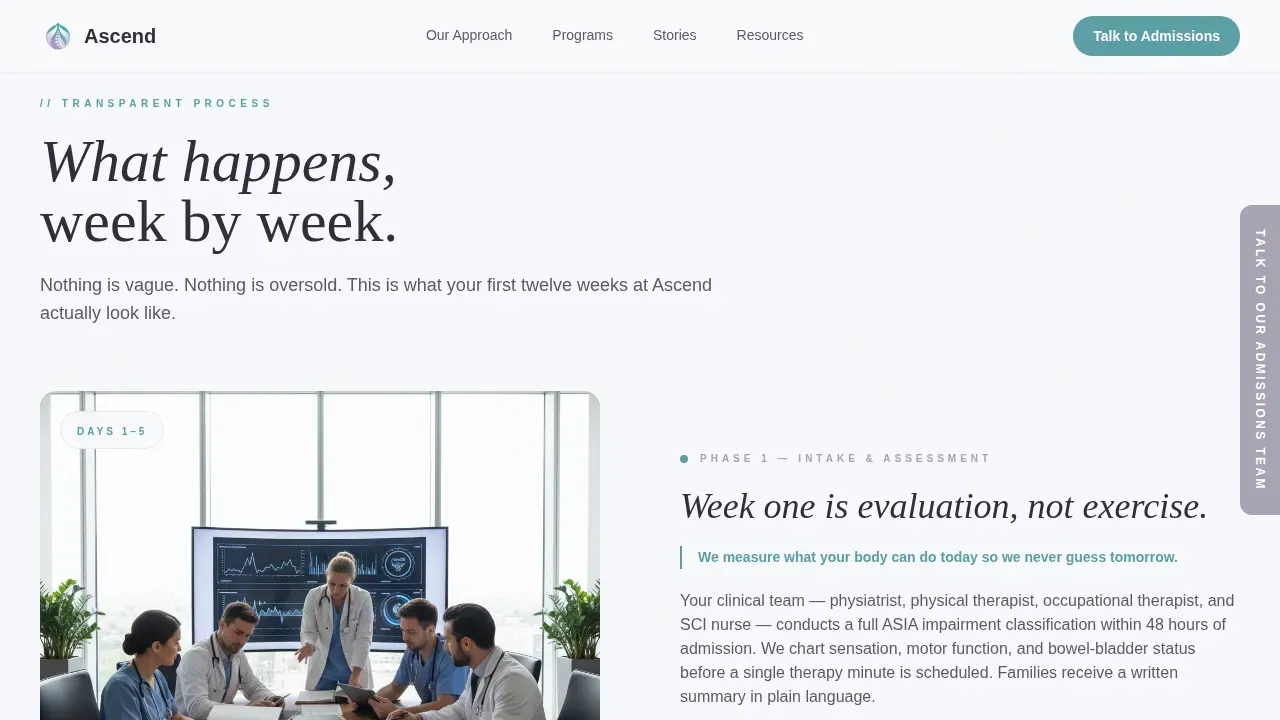
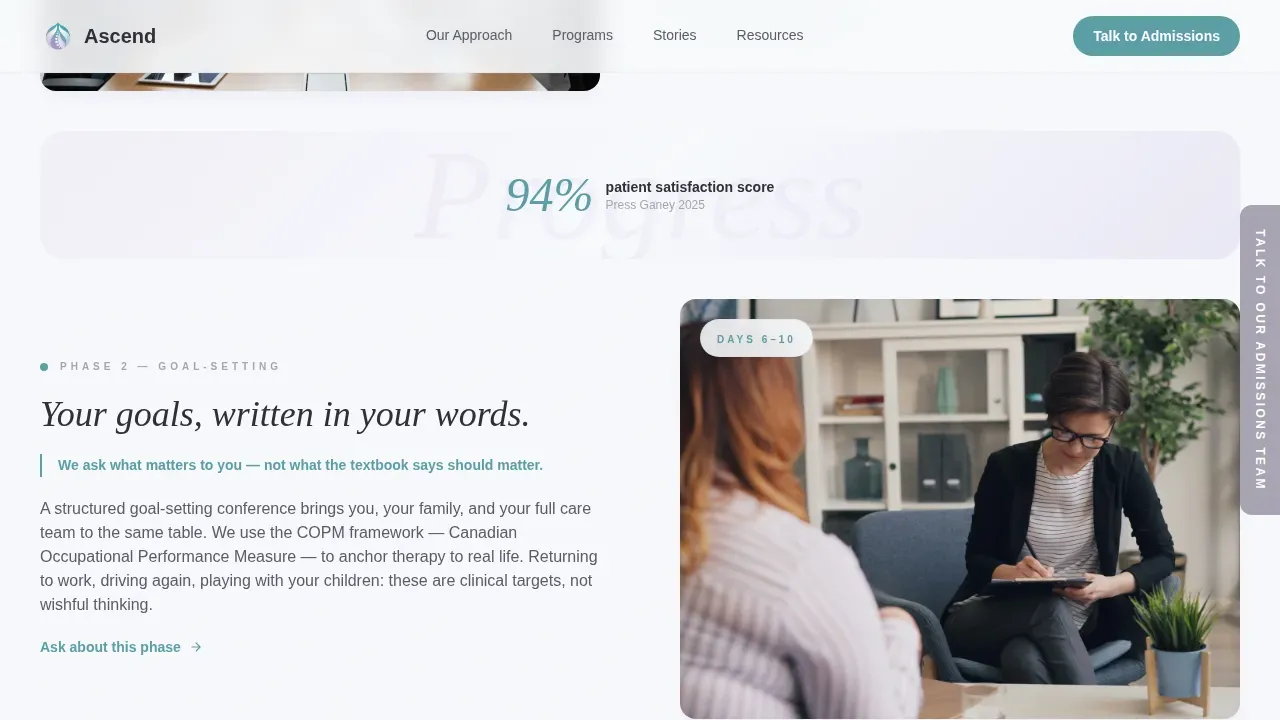
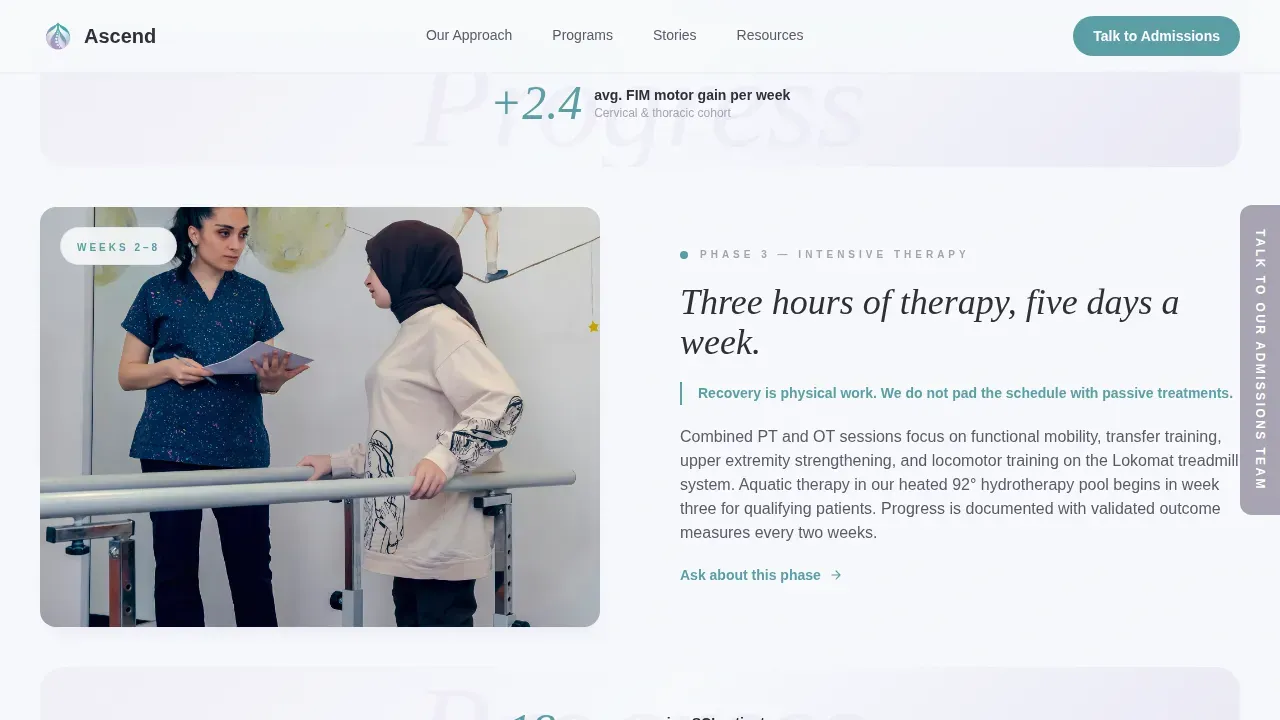
The zigzag section is the heart of the page. It walks visitors through intake assessment, individualized goal-setting, intensive therapy, adaptive skills training, discharge planning, and lifelong follow-up. Each alternating block opens with a specific, honest detail about what that phase actually involves. Floating gradient dividers between phases carry clinical statistics in teal on lavender, turning clinical data into quiet confidence rather than a sales pitch.
Half-Page Photo and Text Hero Section
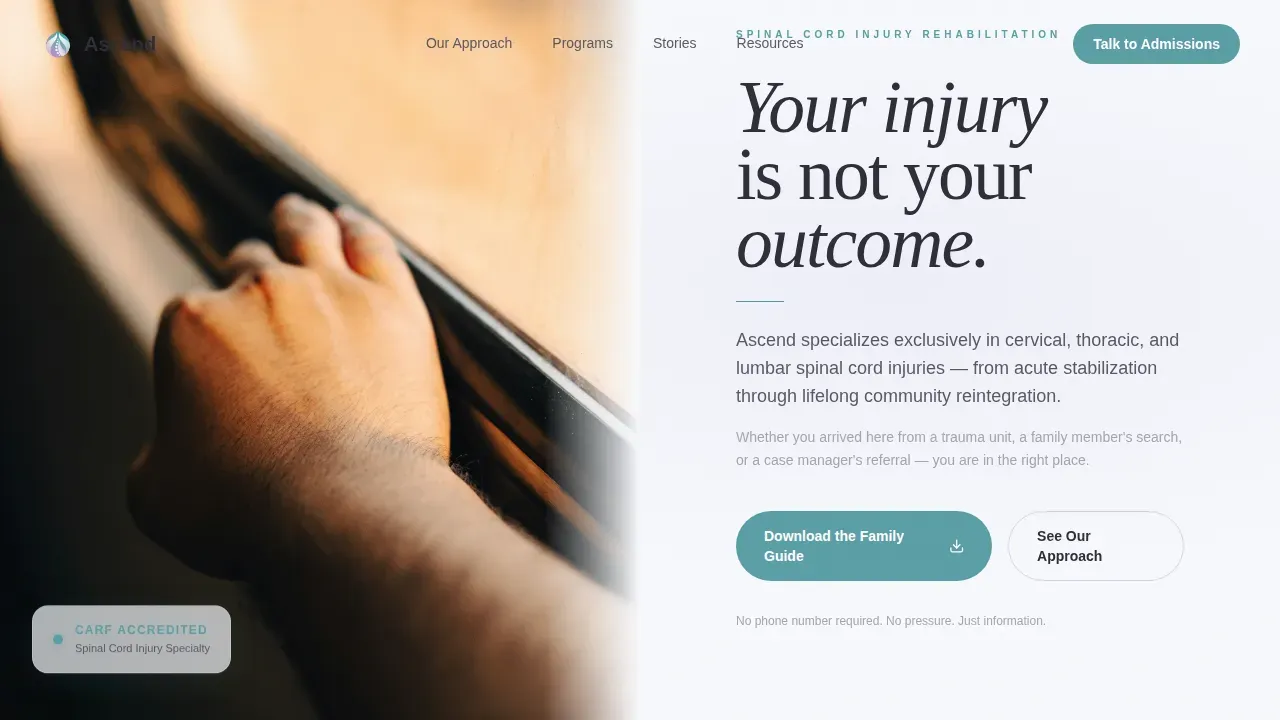
The hero uses a split composition. The left side holds a shoulder-height photograph of a patient's hands gripping a walking frame, lit by natural window light, with a therapist's steadying hand visible beneath the elbow. The right side carries the headline "Your injury is not your outcome." in generous white space, followed by a single sentence naming the center's specialty across cervical, thoracic, and lumbar cord injuries, and a soft teal call-to-action button.
Family Guide Lead Capture Form
The primary conversion section is a three-field form offering a downloadable PDF guide covering what to expect in the first 90 days after injury, what questions to ask insurance, and how to prepare a home for discharge. The form collects only first name, email address, and the patient's injury level. No phone number is requested. The low barrier is intentional: the page gives clinical knowledge freely before asking for any personal detail.
Persistent Admissions Callback Sidebar
A secondary conversion path runs along the right margin of every zigzag section. The "Talk to Our Admissions Team" button sits in warm breath gray and transitions to teal on hover. It offers a scheduled callback rather than a cold call. This persistent element means no scroll position is ever more than one click from a direct admissions contact.
Alternating Testimonial Marquee
Below the process zigzag, the template includes an alternating marquee layout for patient, family, and case manager testimonials. The marquee format keeps social proof visible without interrupting the page rhythm. Real recovery stories and voices from families and referring clinicians supply the emotional credibility that statistics alone cannot.
Cloud Canvas Color and Typography System
The visual system uses four values: sky white (#F7F9FC) for backgrounds, healing lavender (#D6CFEA) for accents, warm breath gray (#A8A4B3) for secondary interactive elements, and steady teal (#5B9EA6) for buttons, timeline markers, and clickable resource links. Deep graphite (#2E2E38) grounds all body text. Headlines use DM Serif Display in italic. Body copy uses Plus Jakarta Sans for clean, unhurried readability.
Page sections overview
| Section | Purpose |
|---|---|
| Hero: Photo + Text | Opens with the walking-frame hand photograph and the headline "Your injury is not your outcome." alongside a teal call-to-action |
| Phase 1: Intake Assessment | Explains Week 1 evaluation process honestly and sets expectation that measurement comes before exercise |
| Phase 2: Goal Setting | Shows how individualized goals are co-created with the patient rather than assigned by the clinical team alone |
| Phase 3: Intensive Therapy | Describes the active rehabilitation work, parallel bars, hydrotherapy, and motor function rebuilding |
| Phase 4: Adaptive Skills | Covers the practical daily-living training that prepares patients for life outside the center |
| Phase 5: Discharge Planning | Addresses home preparation, family readiness, and coordination with outside care teams |
| Phase 6: Lifelong Follow-Up | Closes the zigzag by naming the center's ongoing commitment after formal discharge |
| Floating Stat Dividers | Gradient cards between phases carry clinical statistics in teal on lavender mist |
| Testimonial Marquee | Alternating columns of patient, family, and case manager voices scroll continuously |
| Family Guide Form | Three-field lead capture offering the 90-day PDF guide with no phone number required |
| Footer: Single Row | Linear minimal footer with essential navigation links |
Design & branding system
The Ascend template uses a Soft Gradient theme built on the Cloud Canvas color system. Every design choice pushes toward calm clarity. Nothing is harsh and nothing hides. The palette feels like gauze held against a window: light passes through, soft edges prevail, and teal appears only where action lives.
- Backgrounds drift between sky white (#F7F9FC) and a faint lavender wash (#D6CFEA), with teal (#5B9EA6) reserved strictly for buttons, timeline markers, and clickable resource links
- Typography pairs DM Serif Display in italic for headlines with Plus Jakarta Sans for body copy, creating a warm editorial voice that reads as both credible and approachable
- Scroll-reveal animations, float keyframes on stat cards, and hover zoom on images provide medium-level motion that stays calm rather than distracting
Mobile & speed optimization
Over 70 percent of healthcare searches happen on mobile devices. Families searching for spinal cord injury rehabilitation at late hours are typically on phones, not desktops. The Ascend template addresses this reality through its responsive structure and restrained motion approach.
- The zigzag layout reflows cleanly on smaller screens, keeping each care-phase block readable without horizontal scrolling or content overlap
- Native CSS smooth scroll and Intersection Observer-driven reveal animations replace heavy JavaScript libraries, keeping page motion light and responsive on lower-powered devices
How this template helps you convert
The page earns the click by giving away real clinical knowledge before asking for any commitment. Two distinct conversion paths run in parallel so that emotional visitors and clinical decision-makers each have a route that matches their readiness.
- The "Download the Family Guide" form converts high-intent visitors who are not yet ready to call. They receive a comprehensive 90-day PDF covering expected treatment milestones, insurance questions, and home preparation, in exchange for only three fields and no phone number.
- The persistent "Talk to Our Admissions Team" sidebar button converts case managers and families who are ready for direct contact. The hover-state color change from warm breath gray to teal makes the button feel active without feeling urgent, and the scheduled callback framing removes the pressure of a cold call.
Other information about this template
The Ascend trusted spinal cord injury rehabilitation center landing page template is built on a clinical foundation as well as an emotional one. Understanding the medical landscape helps rehabilitation center teams use this template with full confidence in its content depth.
- Spinal cord injury is a neurologic condition that disrupts motor, sensory, and autonomic pathways. Common causes include motor vehicle collisions, falls, malignancies, and degenerative disorders. The majority of injuries occur in individuals younger than 30, creating long-term economic impact estimated at $2 to $4 billion per case in lifetime costs.
- The pathophysiology of cord damage involves a primary mechanical event followed by a cascade of secondary processes including ischemia, excitotoxicity, and inflammation. Maintaining spinal cord perfusion is a critical priority in acute care. Mean arterial pressure targets, cerebrospinal fluid drainage, and hypothermia protocols are all studied methods for reducing secondary cord damage in surgical and post-operative contexts.
- Blood supply to the cord arrives through the anterior spinal artery and contributions from the vertebral arteries. Disruption of circulation along thoracic segments is particularly dangerous due to limited collateral supply. Dorsal columns, which carry sensory signals, and the white matter tracts surrounding the cord are especially vulnerable during ischemia-reperfusion events.
- In surgical contexts, spinal cord injury can occur as a complication of aortic procedures. Maintaining adequate arterial pressure post operatively, monitoring for epidural hematoma, and using intraoperative neuromonitoring to detect early neurologic deficits are all part of responsible surgical planning. Early surgical decompression, when indicated, may significantly improve outcomes. Anti inflammatory pharmacologic interventions and research into biomarkers of secondary cord damage are active areas of clinical investigation.
- Complications of spinal cord injury extend beyond paralysis. Neurogenic bladder, bowel dysfunction, pressure injuries, and chronic pain all increase the severity of long-term disability and the burden placed on caregivers. A systematic review of rehabilitation outcomes confirms that timely intervention and interprofessional team coordination significantly improve functional outcomes.
- The incidence of incomplete cord injuries is clinically significant. Patients with preserved motor function below the injury level have measurably better rehabilitation trajectories. Imaging studies and careful evaluation of injury anatomy help determine prognosis and guide the treatment method selected at intake.
- The template's page design aligns with best practices for rehabilitation center landing pages: compassionate yet authoritative copy, easy navigation to admissions and specific cord injury conditions, color palette choices that evoke hope and renewal, and section structure that highlights treatment programs, clinical staff, and facility information. The hero section features a clear call-to-action, and the page is built to present trust signals, accreditation visibility areas, and a patient-centered approach throughout.
- Caregivers of individuals with spinal cord injuries report moderate to severe care burden. The Family Guide PDF is designed with caregivers in mind, covering home preparation and practical next steps so families feel less alone in the first 90 days after discharge.
- Exposure to factual, non-vague clinical content increases visitor trust. This template builds that trust through transparent process language, floating statistics, and a lead-capture offer that delivers real value before any sales interaction begins. The presence of real clinical context throughout the page is what separates this template from general healthcare page designs.
Theme
Soft Gradient
Creative direction
Transparent Process
Color system
Cloud Canvas
Style
Zigzag/Alternating
Direction
Content/Resource
Page Sections
Six-phase Zigzag Care Process
Half-page Hero with Clinical Headline
Three-field Family Guide Form
Persistent Admissions Callback Sidebar
Alternating Testimonial Marquee
Cloud Canvas Visual Identity System
Related questions
Who is the primary audience for this template?
What sections come pre-built in this template?
How does the Family Guide form work?
Does the template support mobile visitors searching at night?
Can this template serve both emotional families and clinical case managers?