Rehabilitation & Therapy Professional Website Template
Recover is a single-column landing page template built for inpatient rehabilitation facilities. It opens with a raw, typographically bold hero, guides visitors through a compassionate Problem-to-Solution scroll, and converts with a private five-question guided assessment. The design uses soft organic colors and trauma-informed copy to help individuals and families take the first step without fear.
by Rocket studio
Quick summary
Recover is a landing page template for residential addiction treatment centers. It pairs clinical credibility with genuine human warmth. The scroll moves visitors from crisis recognition through a day-by-day treatment timeline, ending in a private guided assessment that replaces the terror of calling a stranger with a quiet, self-directed first step.
Who this template is for
This template is built for residential rehabilitation and addiction treatment facilities that serve both individuals in active crisis and the family members supporting them. It works best when the facility offers evidence-based clinical care alongside a warm, human environment.
- Inpatient rehab facilities that need to convert late-night, high-emotion visitors into assessment completions
- Treatment centers whose audiences include spouses, adult children, and individuals at a personal turning point
- Rehabilitation programs that want to replace a generic "call us now" approach with a private, guided intake experience
What problem this template solves
Most treatment center pages feel clinical, cold, or overwhelming. They list credentials before they acknowledge pain. They ask visitors to call a phone number before they feel safe enough to speak. The result is friction at exactly the moment a person needs the least resistance.
- Visitors arrive in crisis and leave because the page feels like a brochure, not a hand extended in help
- Family members searching after a relapse cannot find language that matches what they are actually experiencing
- The standard "contact us" form demands too much too soon, causing hesitation before any real connection is made
What you get with this template
You get a complete single-column landing page built around emotional clarity and a conversion flow that respects the visitor's pace. Every section moves from acknowledgment to hope in a deliberate sequence, and the primary call to action lets visitors engage privately before committing to a conversation.
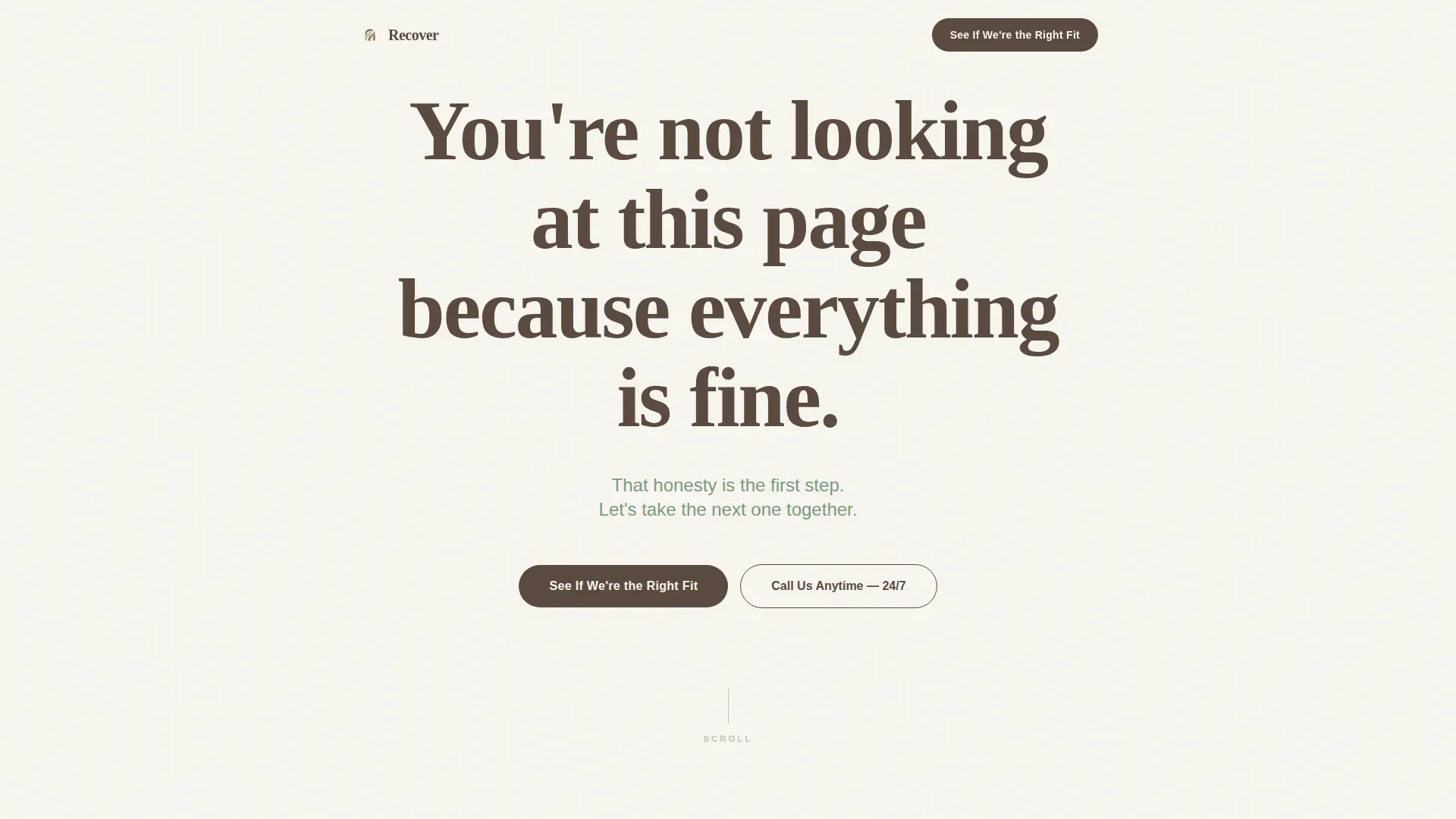
- A typographic hero section that opens with honest, direct language and intentional white space
- A second-person Problem Arc, a day-by-day treatment timeline, and a staff and outcomes trust section
- A five-question guided assessment modal with large tap-friendly buttons and a minimal final step for name and phone number
Feature list
A brief paragraph introduces this section: each feature below reflects a specific, built-in capability of this template, drawn directly from its design and functional brief.
Giant Centered Hero Headline
The hero uses enormous serif typography set in deep clay on a plain white field with no imagery. The surrounding emptiness is intentional. It gives the visitor space to feel the words without being rushed into an action.
Problem Arc Copy Section
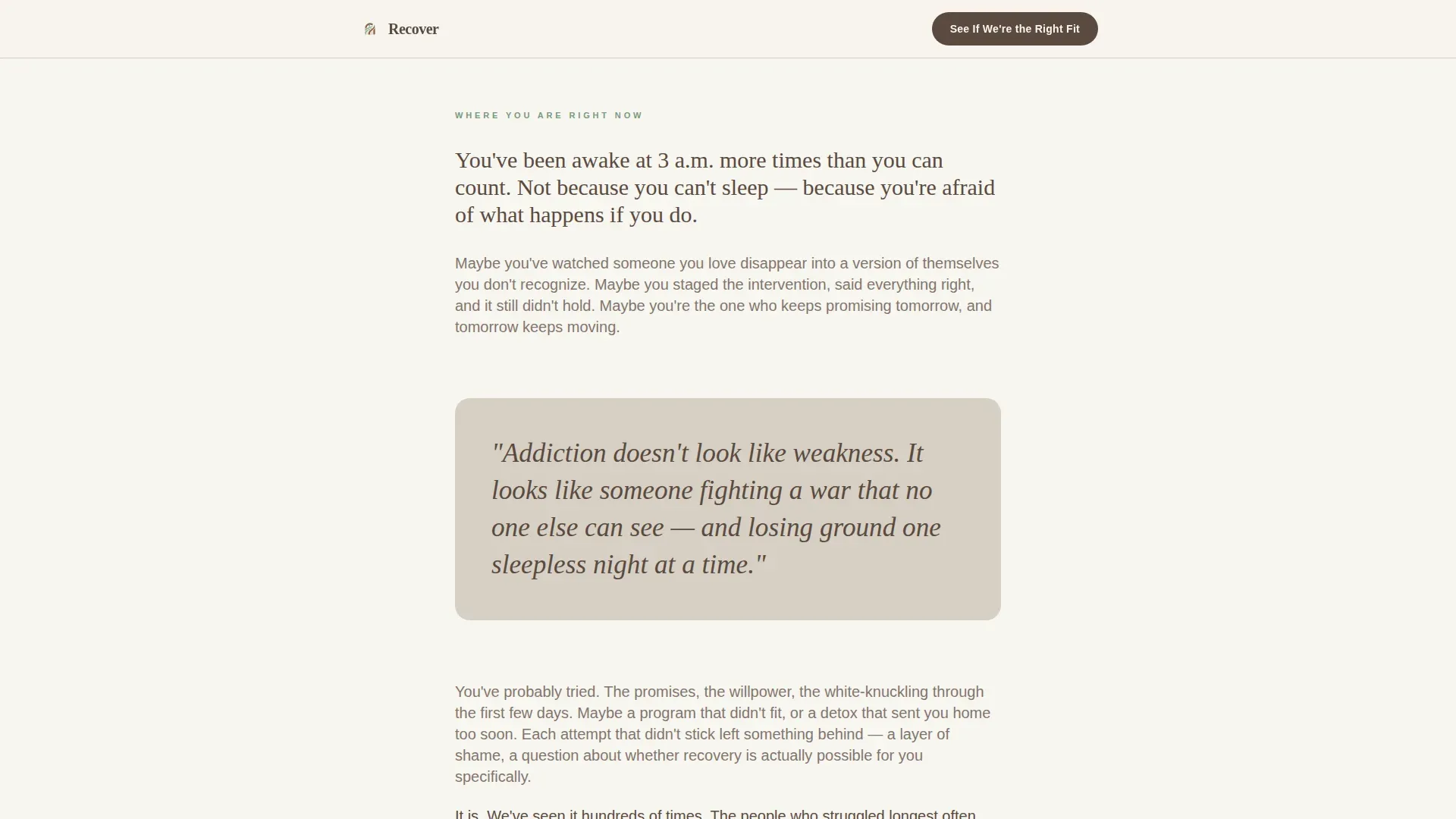
A dedicated section written in the second person addresses the visitor's current reality with specific, unflinching language. It covers sleepless nights, broken trust, and failed solo attempts to stop. The goal is recognition, not diagnosis.
Day-by-Day Treatment Timeline
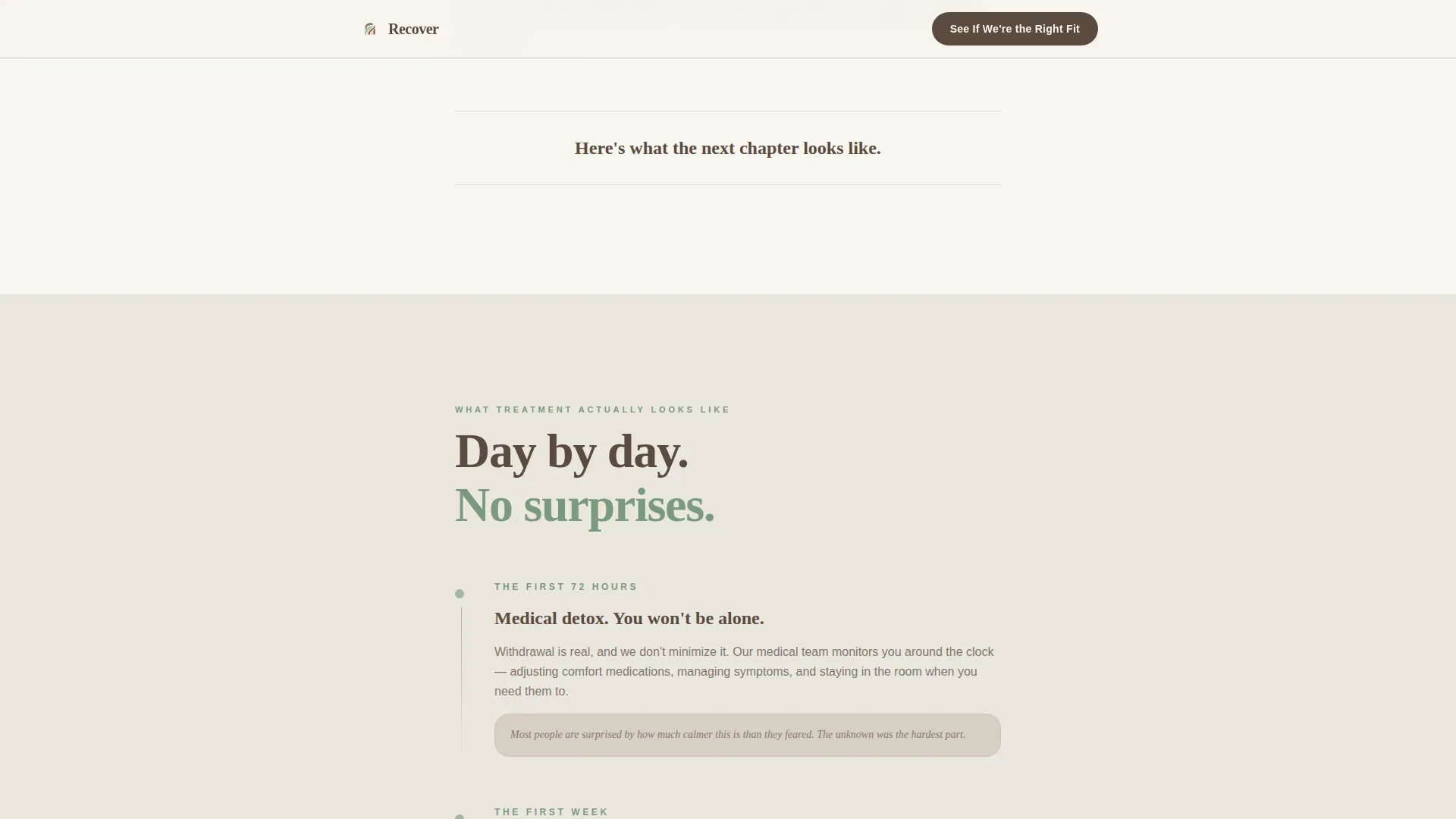
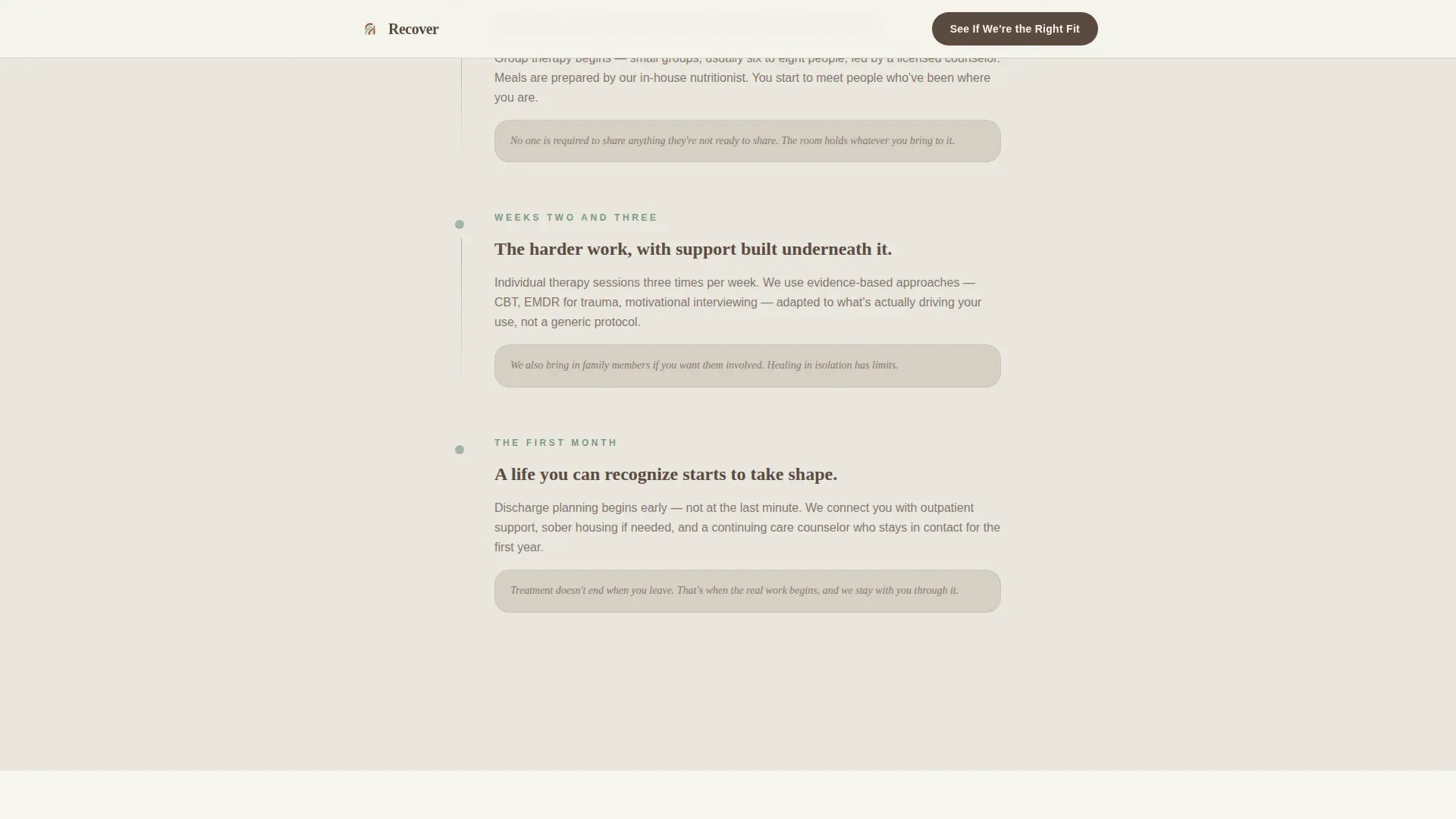
A structured timeline walks visitors through the first 72 hours, the first week, and the first month of treatment. This feature replaces fear of the unknown with a concrete, human picture of what actually happens after arrival.
Trust and Proof Section
Credentialed staff cards, outcome statistics, and pull-quote testimonials appear in linen-card blocks. A 24-hour, seven-day availability indicator communicates that support is always reachable, including at 2 in the morning.
Five-Question Guided Assessment Modal
The primary call to action opens a private assessment. Questions appear one at a time with large, tap-friendly answer buttons. Topics cover substance type, duration of use, previous treatment history, insurance carrier, and whether the visitor is seeking help for themselves or for someone else. Free-text input appears only at the final step.
Organic Flow Visual Progression
Section backgrounds shift subtly from clean white toward warmer linen as the visitor scrolls. Gentle fade-in animations accompany each section. The visual warmth increases as emotional weight lifts, reinforcing the page's Problem-to-Solution arc at a design level.
Page sections overview
| Section | Purpose |
|---|---|
| Hero Headline | Opens with bold, honest typography that creates immediate emotional recognition |
| Problem Arc | Reflects the visitor's current crisis in second-person language to make them feel seen |
| Treatment Timeline | Replaces fear with a concrete day-by-day picture of the recovery journey |
| Trust and Proof | Builds confidence through staff credentials, outcome stats, and pull-quote testimonials |
| Assessment Call to Action | Converts visitors with a private, five-question guided quiz before asking for contact details |
| Minimal Footer | Closes with a clean single-row layout and essential facility information |
Design & branding system
The visual identity follows an Organic Flow theme built on the Cloud Canvas color system. The palette was chosen to feel soft, breathable, and completely without judgment, like a room with open windows and no pressure to perform.
- Background uses soft cumulus white (#F7F5F0), with warm linen (#D6CFC4) for card blocks and pull-quote panels that appear to float on the page
- Deep clay (#5B4A3F) anchors all headlines and primary text, while muted sage (#A3B5A6) handles section dividers, supportive text, and trust badge accents
- Typography pairs Fraunces serif for headlines with DM Sans for body text, creating contrast between emotional weight and readable clarity
Mobile & speed optimization
The template is designed with mobile visitors as the primary audience. The typical visitor is on a phone late at night, often on a stressed or slower network, and needs the page to load and respond without delay or distraction.
- Single-column layout removes horizontal complexity and keeps the scroll linear and uninterrupted on any screen size
- The five-question assessment uses large tap-friendly buttons and avoids free-text fields until the final step, reducing friction for touchscreen users
- Animations are kept low to medium in intensity, using gentle fade-ins rather than motion that could feel jarring or disorienting
How this template helps you convert
This template is built around one specific conversion goal: getting a hesitant, emotionally exhausted visitor to complete the guided assessment. Every design and copy decision points toward that moment.
- The Problem Arc copy uses second-person recognition to establish trust before any ask is made, so the visitor feels understood rather than sold to
- The day-by-day timeline reduces the primary objection of fear of the unknown, replacing anxiety with a clear and human picture of what treatment actually involves
- The assessment modal lets the visitor take action privately and at their own pace, removing the barrier of having to speak with a stranger before they are ready
Other information about this template
This template is part of the Organic Flow theme family within the Cloud Canvas color system. It is designed for the Health and Medical category, specifically the Rehabilitation and Therapy subcategory, with a niche focus on inpatient rehab facility landing pages.
- The creative direction follows a Problem-to-Solution Arc, a structure proven effective in direct-response healthcare contexts where the visitor arrives in an emotionally activated state
- The header concept is Giant Headline Centered, a typographic approach that uses scale and white space as emotional tools rather than imagery
- The landing page direction is Quiz and Assessment, making this template especially suited to facilities that want a private, low-barrier entry point before a phone consultation
- The footer follows a Linear Single-Row pattern, keeping the close of the page clean and minimal without distracting from the primary conversion path
Theme
Organic Flow
Creative direction
Problem→Solution Arc
Color system
Cloud Canvas
Style
Single Column Flow
Direction
Quiz/Assessment
Page Sections
Giant Centered Hero Headline
Second-person Problem Arc Section
Day-by-day Treatment Timeline
Trust and Proof Section
Five-question Guided Assessment Modal
Organic Flow Visual Progression
Related questions
Who is this landing page template designed for?
Can I customize the assessment questions?
Does this template work well on mobile devices?
Is the guided assessment modal included in the template?
Can I update the colors and fonts to match my facility's existing brand?