Intensive Rehabilitation Therapy Landing Page Template
Stride is a dynamic, card-grid landing page template built for post-surgical rehabilitation centers. It pairs cinematic hero imagery with a staggered Testimonial Mosaic, a Recovery Workshop registration form, and a Forest Trust color system to guide patients from their first search to a booked assessment. Every design decision is set to move people forward.
by Rocket studio
Quick summary
Stride delivers a single-page, modular design that turns a post-surgical rehab center's story into a clear conversion path. The template combines a lifestyle hero shot, a scroll-driven Testimonial Mosaic, clinical team profiles, and a workshop registration form. It is built to save clinics time on design while giving patients the confidence to click "Reserve Your Assessment" and take that first stride forward.
Who this template is for
This template is made for physical therapy clinics and post-surgical rehabilitation centers that want a landing page as purposeful as their care. It suits practices serving patients recovering from knee, hip, shoulder, and spine surgeries, as well as pre-surgical patients in the planning window. If your team guides people from the operating room to full function, Stride was designed with you in mind.
Use this template if you are:
- A post-surgical rehab clinic running a free monthly Recovery Workshop or assessment event
- A physical therapy practice ready to provide a compelling online presence that reflects clinical credibility
- A care team looking to follow up with pre-surgical patients before they are ready to book in person
What problem this template solves
Most rehabilitation landing pages fail at the moment they matter most. They are either too clinical and cold, or too vague to earn trust. Patients searching for post-surgical care are already anxious. They need empathetic messaging, clear services information, and a low-friction path to action, all at the same time.
Stride resolves these issues by:
- Replacing paper-thin generic layouts with a dynamic, story-driven design that follows a trust-funnel structure from hero to registration
- Giving each patient type a clear entry point, whether they are six days out from surgery or six months into planning
- Embedding urgent, action-oriented calls to action at natural stopping points so users do not have to search for the next step
What you get with this template
Stride is a fully structured, modular landing page template that a clinic can tailor to its own patient population, care philosophy, and location. Every section is set up and ready to populate, so your team spends time on content, not construction. The design system, animations, and registration flow are already in place.
You get:
- A complete five-section layout: hero, Testimonial Mosaic, clinical team profiles, facility and methodology showcase, and a Recovery Workshop registration section with a linear single-row footer
- A Forest Trust color system with deep evergreen, warm bark brown, morning fog, and new-growth chartreuse applied precisely across backgrounds, borders, card faces, and active call-to-action elements
- A dual conversion path: primary "Reserve Your Assessment" registration and a secondary email capture for patients still in the pre-surgery planning process
Feature list
This section covers the core design functionalities and interactive capabilities built into the Stride template. Each feature is grounded in the template's brief and delivers a specific role in the user journey.
Cinematic Hero Section with Fade-In Headline
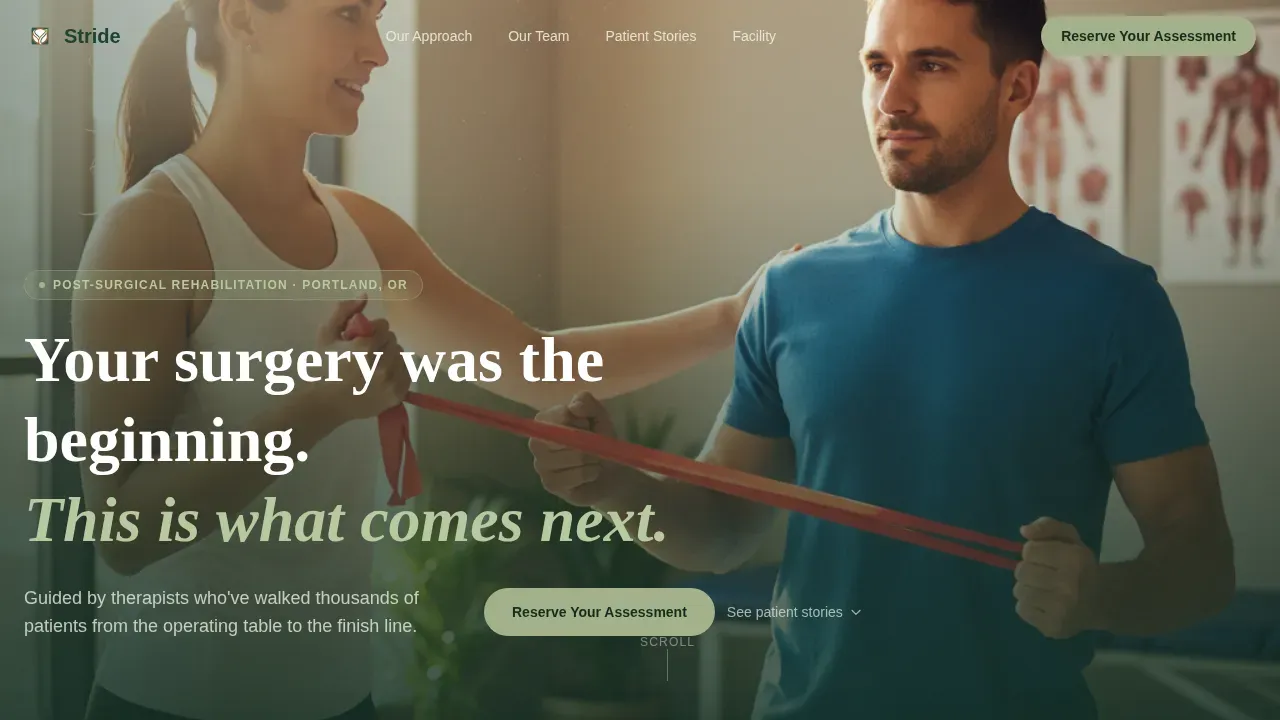
The hero opens with a lifestyle shot of a physical therapist steadying a patient mid-exercise, natural window light hitting from the left, the clinic's parallel bars and gait track visible in soft focus behind them. A headline fades in over the lower third of the image. The "Reserve Your Assessment" call to action sits directly below, visible above the fold so users can act the moment they land on the page. Above-the-fold placement of the offer, image, and call to action is essential for high-converting rehabilitation landing pages, and Stride follows that structure precisely.
Staggered Testimonial Mosaic Card Grid
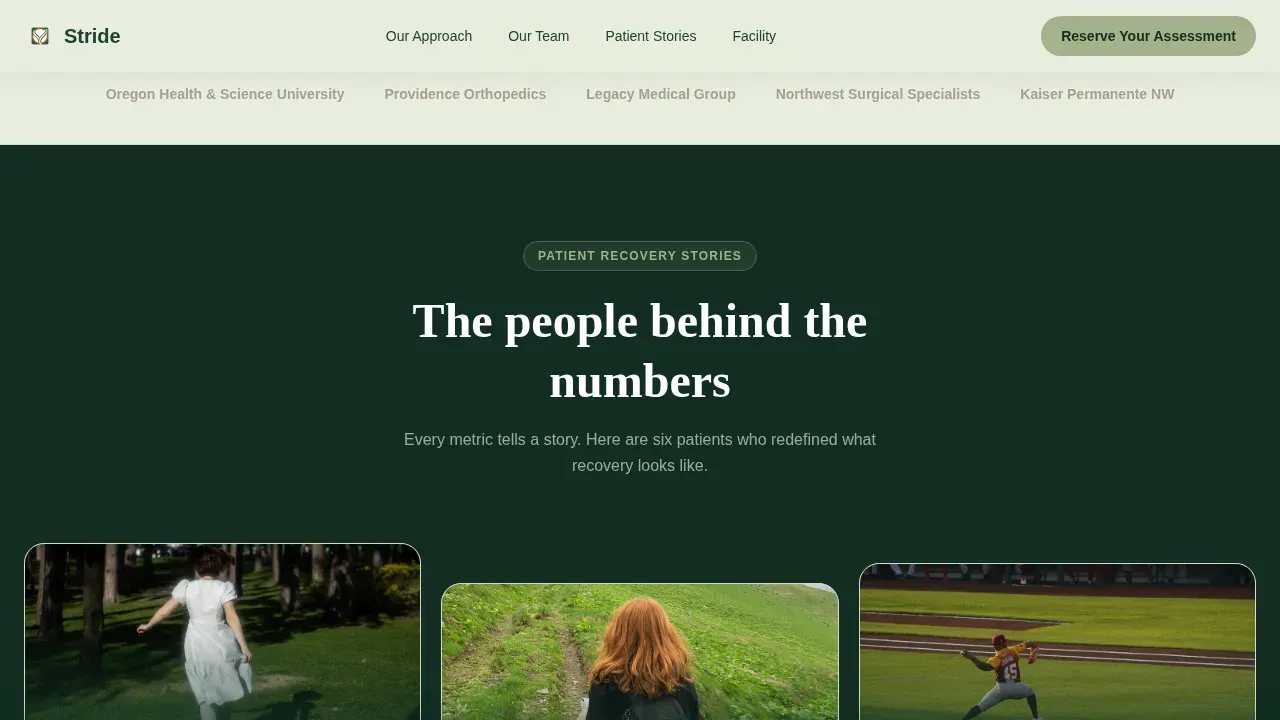
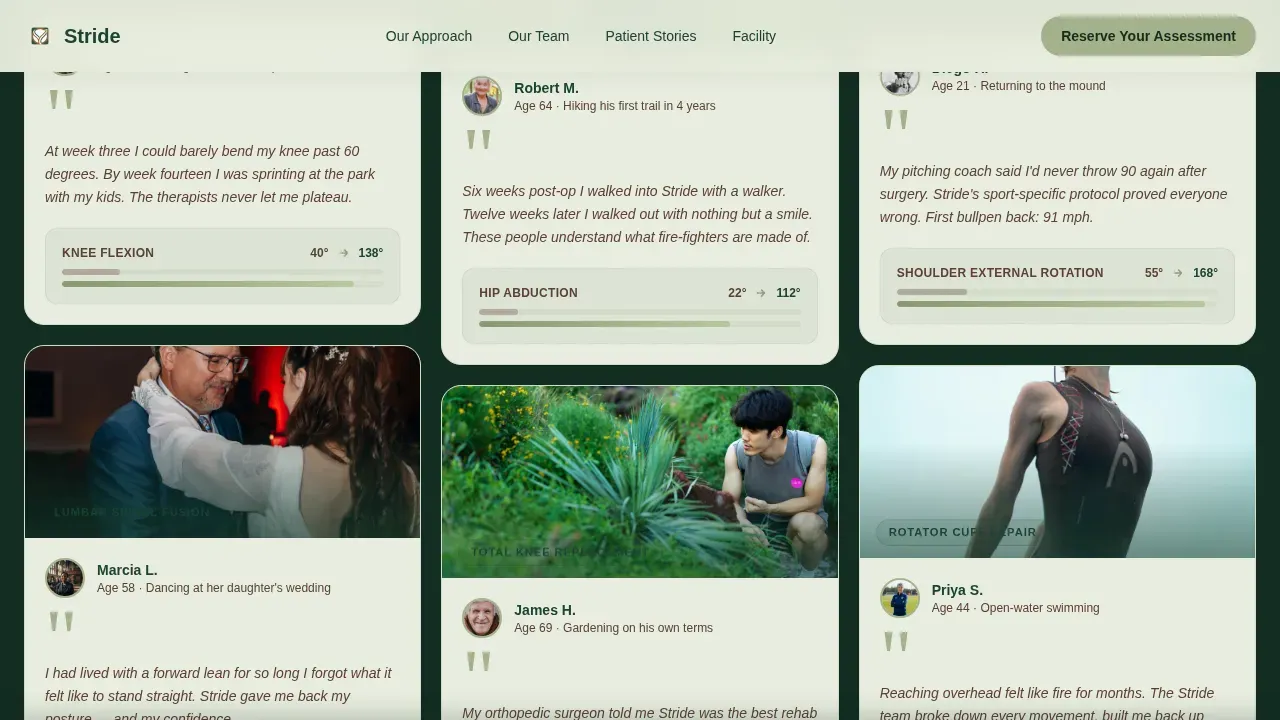
The Testimonial Mosaic is the emotional engine of the page. Each modular card holds a surgery type label, a patient pull quote, a before-and-after mobility metric such as "Range of motion: 40 degrees to 138 degrees," and a photo of the patient doing the activity they recovered for. Cards are set at staggered heights to create visual rhythm. As the user scrolls, each card animates upward with a subtle drift, reinforcing the idea of rising and forward motion. Patient success metrics highlighted in this way help prospective patients determine whether the clinic is right for their recovery goals.
Scroll-Triggered Animations and Sticky Registration Bar
Stride uses scroll-triggered reveal animations throughout the page to keep the experience dynamic and active. Cards drift in as the user reaches them. After the third card row, a sticky registration bar appears at the top of the screen, keeping the "Reserve Your Assessment" call to action available at all times. This approach places interactive calls to action at natural stopping points, which is one of the most effective techniques for driving form submission from engaged users.
Recovery Workshop Registration Form
The registration section includes a structured form that collects the surgery type via dropdown (knee, hip, shoulder, spine, or other), the surgery date or estimated date, an optional referring surgeon name, and a preferred workshop date selected through a visual calendar picker. Form validation is built in. The form is completed with clear field labels and required indicators so users know exactly what information to provide before they click submit. A secondary path, "Not sure yet? Download our Post-Op Recovery Timeline," captures email addresses for patients who are not ready to register for a session but are actively researching their options.
Clinical Team and Facility Showcase Sections
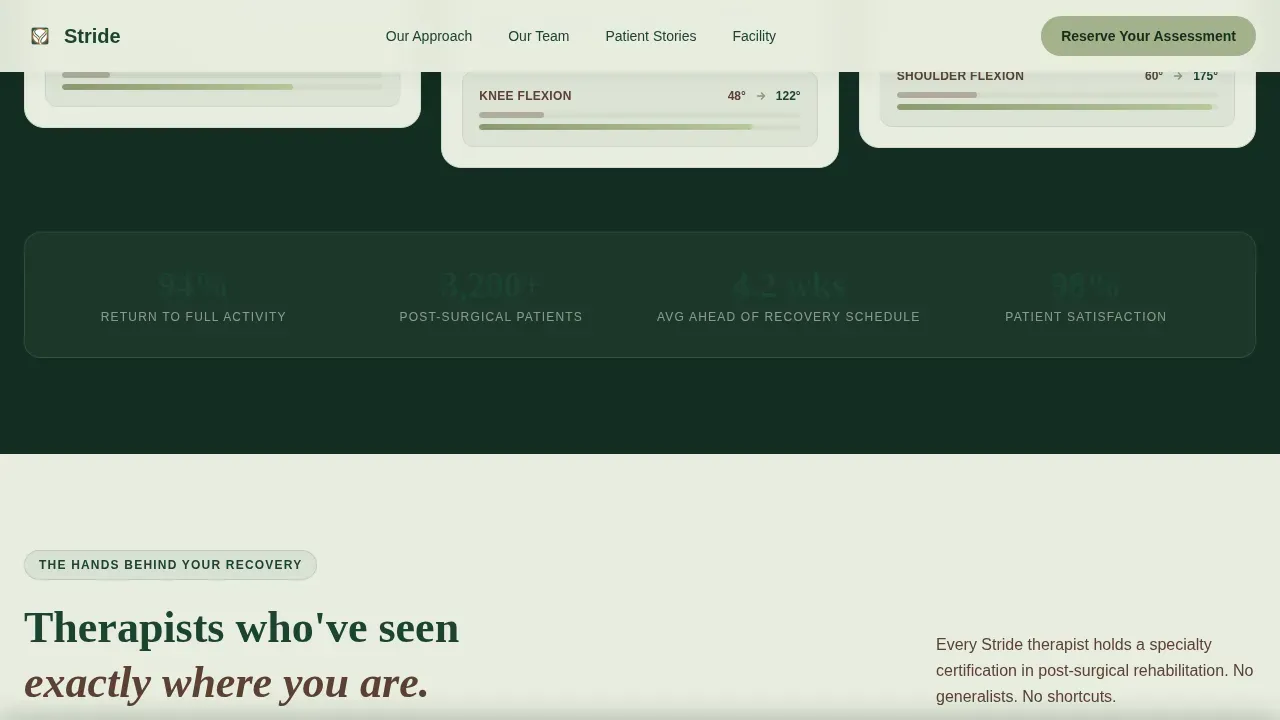
Between card clusters, full-width breathing sections introduce the clinical team with asymmetric therapist profiles and outcome statistics. A separate facility and methodology section displays the treatment philosophy alongside equipment highlights and specific recovery data. These sections provide the clinical authority that post-surgical patients need to feel confident. Dynamic patient engagement delivered through well-placed team and facility content helps users follow the trust funnel from emotion to evidence to action.
Forest Trust Design System with Dynamic Motion Theme
The color system is applied with precision across every element. Deep evergreen anchors backgrounds and primary typography. Warm bark brown warms secondary text and card borders. Morning fog fills card faces and section breaks. New-growth chartreuse activates only on buttons, progress indicators, and hover states, so the eye is drawn to the right place at the right time. Fraunces serif handles headlines with weight and gravitas. DM Sans handles body copy with clinical clarity.
Page sections overview
| Section | Purpose |
|---|---|
| Hero Lifestyle Shot | Opens with a cinematic image, fade-in headline, and primary call to action above the fold |
| Testimonial Mosaic Grid | Staggered patient story cards with surgery labels, pull quotes, mobility metrics, and recovery photos |
| Clinical Team Profiles | Asymmetric therapist cards with credentials and outcome statistics to build clinical trust |
| Facility and Methodology | Equipment showcase and treatment philosophy section grounded in specific recovery outcome data |
| Workshop Registration Form | Primary conversion form collecting surgery type, date, surgeon, and calendar-picked workshop session |
| Secondary Email Capture | "Download our Post-Op Recovery Timeline" path for pre-surgical patients not yet ready to register |
| Linear Footer | Single-row footer following Pattern 1 for a clean, uncluttered page end |
Design & branding system
Stride's visual identity follows the Dynamic Motion theme built on the Forest Trust color system. Every color choice, type pairing, and animation serves a specific purpose in guiding the user's eye and building trust. The palette feels like a trail through old-growth forest at dawn: grounded, oxygen-rich, and quietly alive.
Key design details include:
- Colors: deep evergreen (#1B4332) for backgrounds and primary text, warm bark brown (#5C4033) for secondary text and card borders, morning fog (#E8EDDF) for card faces and section breaks, and new-growth chartreuse (#A3B18A) reserved exclusively for active buttons, progress indicators, and hover states
- Typography: Fraunces serif for headlines (weight and gravitas), DM Sans for body copy (clean, clinical precision)
- Illustrations and visual rhythm: staggered card heights, scroll-triggered upward drift animations, hero headline fade-in, and shallow depth-of-field lifestyle photography create a page that feels like bodies in motion
Mobile & speed optimization
Mobile-first design is essential for healthcare landing pages. Research indicates that 63% of healthcare searches occur on mobile devices. Stride's layout is built desktop-first with strong mobile optimization, so the page reads and performs well across every screen size. Thumb-friendly button sizing and readable type scales are part of the design foundation.
Performance considerations built into the template include:
- Intersection Observer used for scroll animations so the browser only renders what the user can see, keeping the page feeling fast on any device
- CSS transforms only for all motion effects, avoiding layout repaints that can slow down the experience on mobile
- Lazy image loading for the mosaic cards and lifestyle photography so the page does not wait on heavy assets before the user can interact
How this template helps you convert
Effective post-surgical rehabilitation landing pages require empathetic messaging, clinical authority, and clear action-oriented design working together. Stride is structured as a trust funnel, guiding potential patients from the emotional hook of the hero through clinical evidence and into a low-friction registration process.
Three specific ways the template drives conversions:
- The sticky registration bar appears after the third card row and stays active for the duration of the user's scroll session, so the call to action is never more than one click away regardless of how long the user has been on the page
- The dual conversion path captures patients at two different stages of readiness: those ready to book a workshop session now, and those who need to follow the pre-surgical planning path by downloading the Recovery Timeline via email
- Before-and-after mobility metrics set inside each Testimonial Mosaic card give prospective patients a concrete way to determine whether the clinic's services match their recovery goals, turning social proof into decision-making data
Other information about this template
The Stride Dynamic Motion Post Surgical Rehab Landing Page Template sits in the Wellness and Fitness category under the Rehabilitation and Recovery subcategory. It is a single-page, card grid template built for the post-surgical rehab center niche. Below are additional context points that may be useful as you set up and launch the page.
Additional context for this template:
- This template can support clinics interested in connecting the page to documentation systems. Research shows that AI-powered software can streamline the documentation process in healthcare settings, allowing providers to focus more on patient care. Clinics that use capable software report therapists completing notes up to 60% faster, gaining back an average of 2 hours per day, with daily notes taking 1 to 2 minutes and evaluations completed in under 10 minutes.
- The template's registration form is designed to collect the minimum required information to confirm a patient's rehabilitation context before their first session, following the principle that collected data should be purposeful and specific to the care pathway.
- IoT-enabled wearables and wearable devices that collect real-time data are becoming increasingly popular in healthcare monitoring applications. The template's clinical team and methodology sections provide placeholder areas where clinics can add information about monitoring services, including systems that track patient progress remotely.
- Home-based exercise programs and continuous long-term monitoring are essential parts of post-surgical recovery. The template's secondary email capture path enables clinics to follow up with pre-surgical patients and deliver relevant information over time, including home exercise guidance.
- Rehabilitation for hip fracture patients, for example, involves three phases: supervised rehabilitation at a clinical location, unsupervised rehabilitation at home, and unsupervised rehabilitation outdoors. The template's structure can reflect that three-phase journey in the content you add to the card grid.
- No-code platforms and specialized software tools such as Weave, E-rehab, and Unbounce provide website builders designed for physical therapy and medical rehabilitation contexts. Stride is built to work within those creation environments as a ready-to-populate template.
- Digital design resources such as Dribbble offer user interface and user experience design references tailored to rehabilitation centers. Stride's design system is aligned with current patterns in that space, including the use of illustrations and lifestyle photography to create emotional resonance on healthcare landing pages.
- The template's Intersection Match Score for this niche, creative direction, and color system combination is 13, indicating a strong alignment between the Dynamic Motion theme, Testimonial Mosaic creative direction, and the post-surgical rehabilitation audience.
Theme
Dynamic Motion
Creative direction
Testimonial Mosaic
Color system
Forest Trust
Direction
Event Registration
Page Sections
Cinematic Hero with Fade-in Headline
Staggered Testimonial Mosaic Card Grid
Sticky Registration Bar and Scroll Animations
Dual-path Recovery Workshop Form
Clinical Team and Facility Showcase
Forest Trust Color System and Dynamic Motion Theme
Related questions
Can I change the color system to match my clinic's existing brand?
Does the registration form support different surgery types out of the box?
How does the sticky registration bar work?
Is this template suitable for patients who are not yet post-surgical?
How do I add my own patient testimonials and mobility metrics to the mosaic?