Sports Medicine Research Center Landing Page Template
Recover is a sidebar companion landing page template built for sports medicine research centers. It guides injured athletes through a six-phase methodology using a scroll-linked sidebar progress tracker and a twelve-question injury assessment quiz. The design pairs clinical teal with surgical navy and bone-white to feel precise, credible, and welcoming to patients who need more than a standard orthopedic referral.
by Rocket studio
Quick summary
Recover is a sidebar companion landing page template designed for sports medicine research centers treating athletes at every level. It pairs a six-phase scrolling methodology with a twelve-question progressive assessment quiz. The layout builds diagnostic trust section by section, then converts that trust into a gated recovery pathway summary delivered after email capture.
Who this template is for
This template is built for sports medicine research centers and specialized clinics that operate beyond standard orthopedic care. It suits organizations whose value comes from peer-reviewed protocols, motion-capture diagnostics, and outcome-backed treatment plans. If your center treats patients that conventional practices can no longer help, this template speaks their language.
- Collegiate athletic directors managing soft-tissue injury rosters for multiple athletes
- Professional and semi-professional athletes seeking one more competitive season
- Weekend warriors whose recent imaging results have changed what they thought they knew about their recovery
What problem this template solves
Most injured athletes arrive at a sports medicine research center already frustrated. They have seen a general orthopedist, tried conservative treatment, and still have no clear path forward. A generic clinic website does nothing to rebuild their confidence. This template solves that trust gap by walking visitors through a structured, research-backed process before they ever book an appointment.
- Visitors leave ordinary clinic pages without understanding the depth of available care
- Athletes need to feel triaged and heard before they commit to a new provider
- Athletic directors need credible, data-supported evidence before routing roster players to a new center
What you get with this template
You get a fully structured landing page that combines editorial depth with interactive conversion tools. The sidebar never disappears. The quiz never asks for more than it needs. Every section is built to move a skeptical, injured visitor one step closer to trusting your center.
- A sticky sidebar in surgical navy that tracks the visitor's scroll position through six clinical phases using a teal progress pip
- A twelve-question progressive disclosure quiz with a body map selector, injury mechanism dropdown, symptom duration, prior treatment history, and optional imaging upload
- A gated recovery pathway summary delivered after the visitor provides their name and email, with no phone number or insurance details required
Feature list
A paragraph introducing the feature set: Each component in this template was scoped to match the specific demands of a sports medicine research center serving high-stakes patients. The features below reflect the actual built capabilities described in the source brief.
Scroll-Linked Phase Sidebar
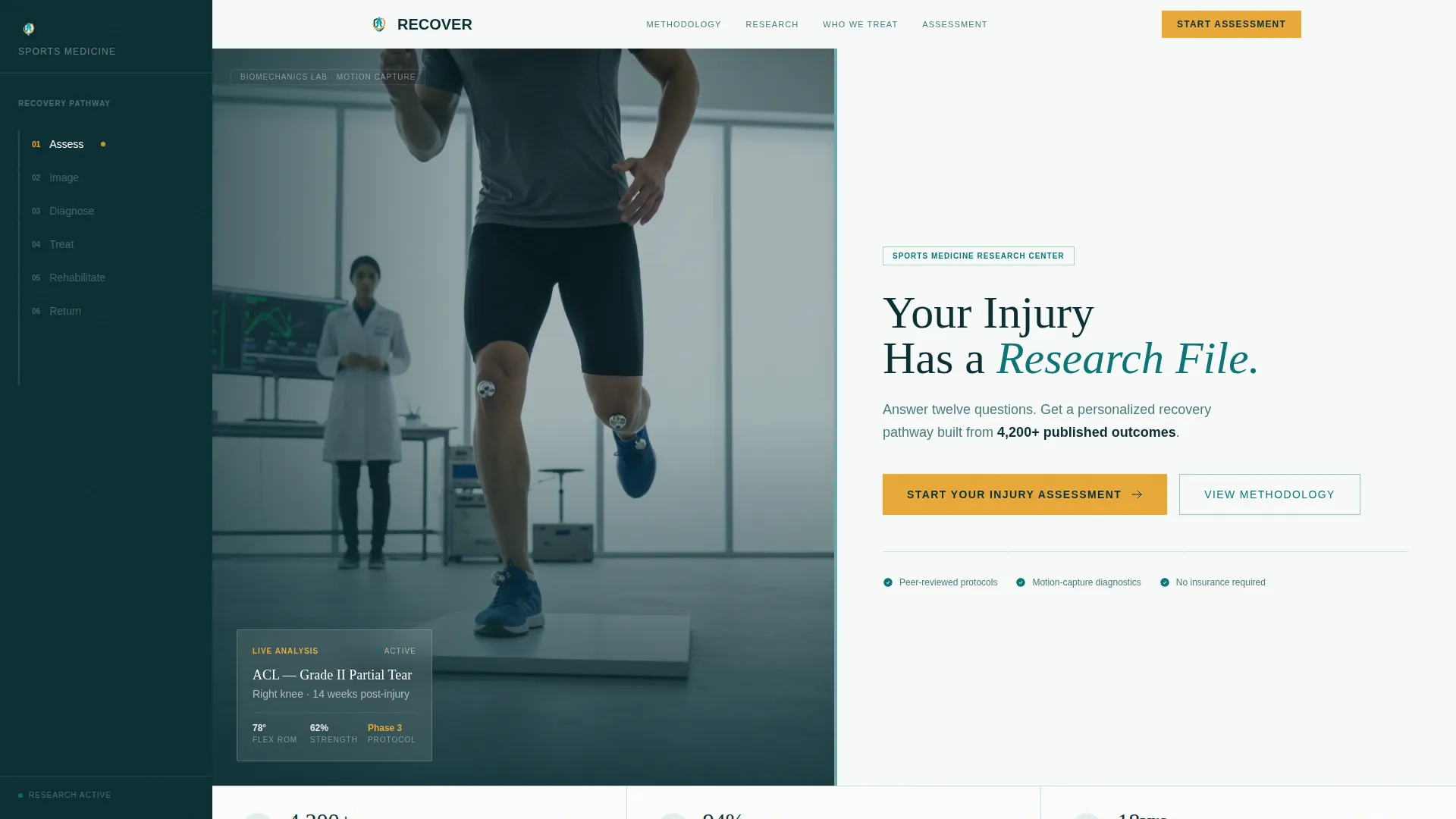
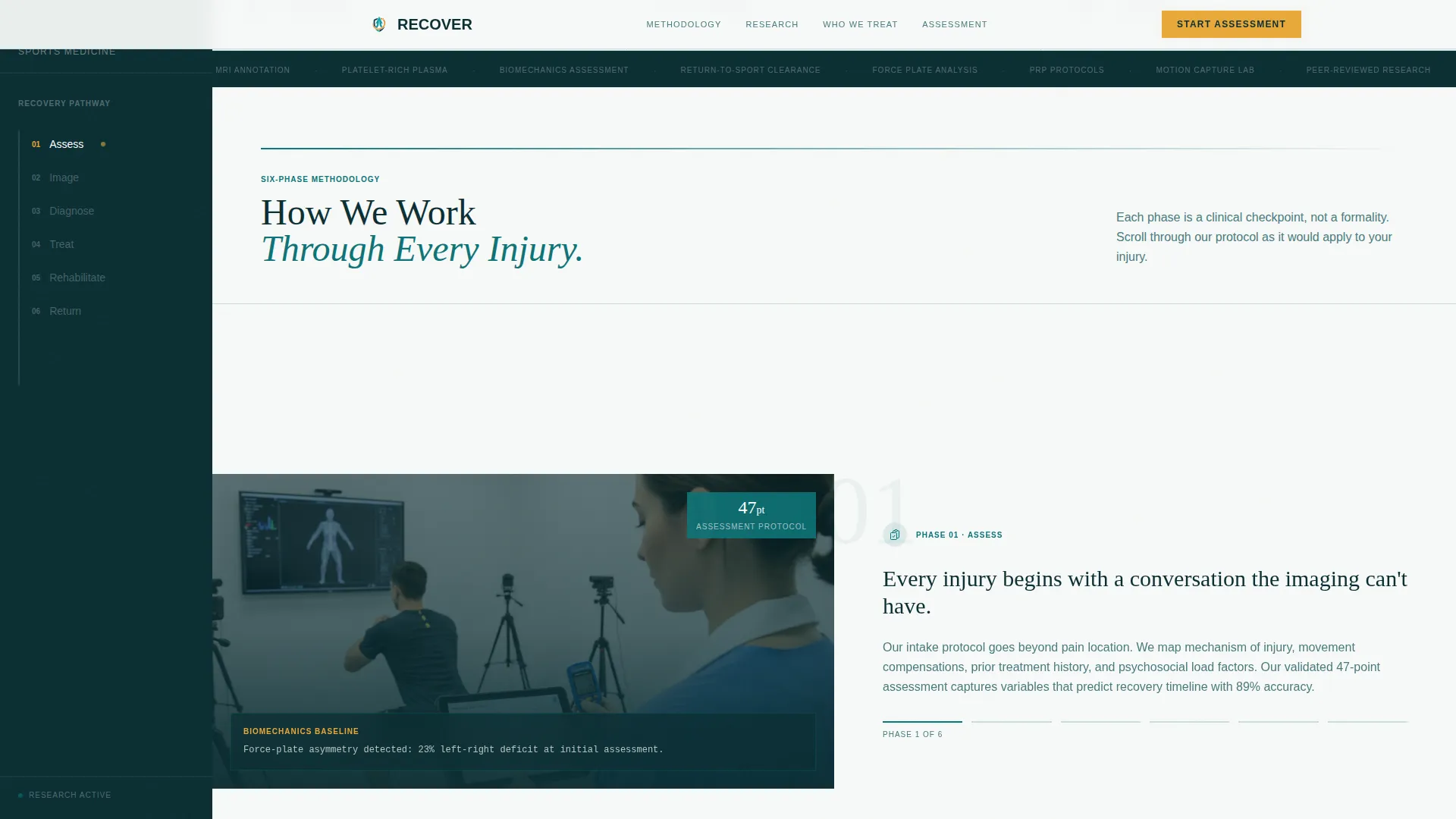
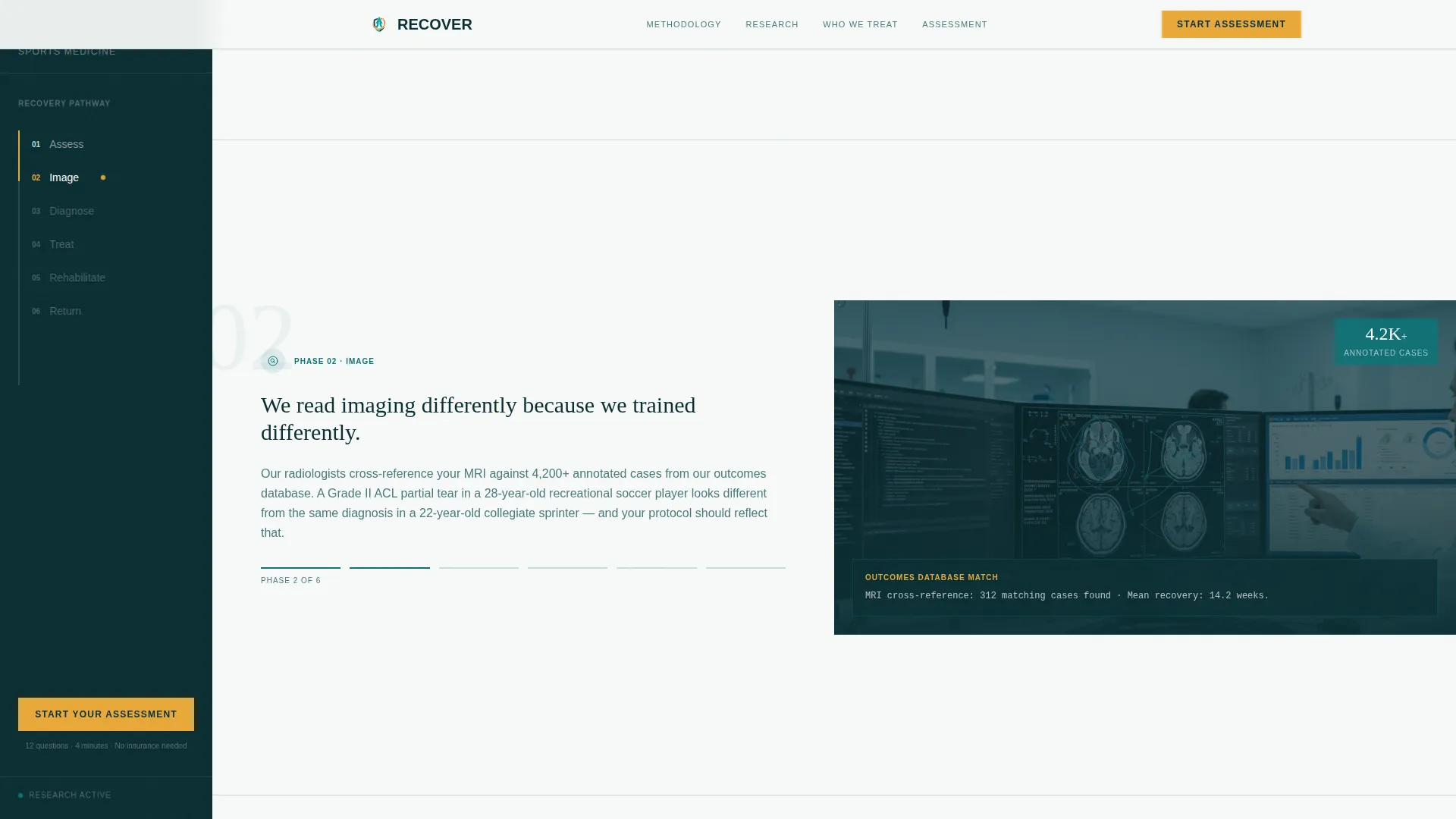
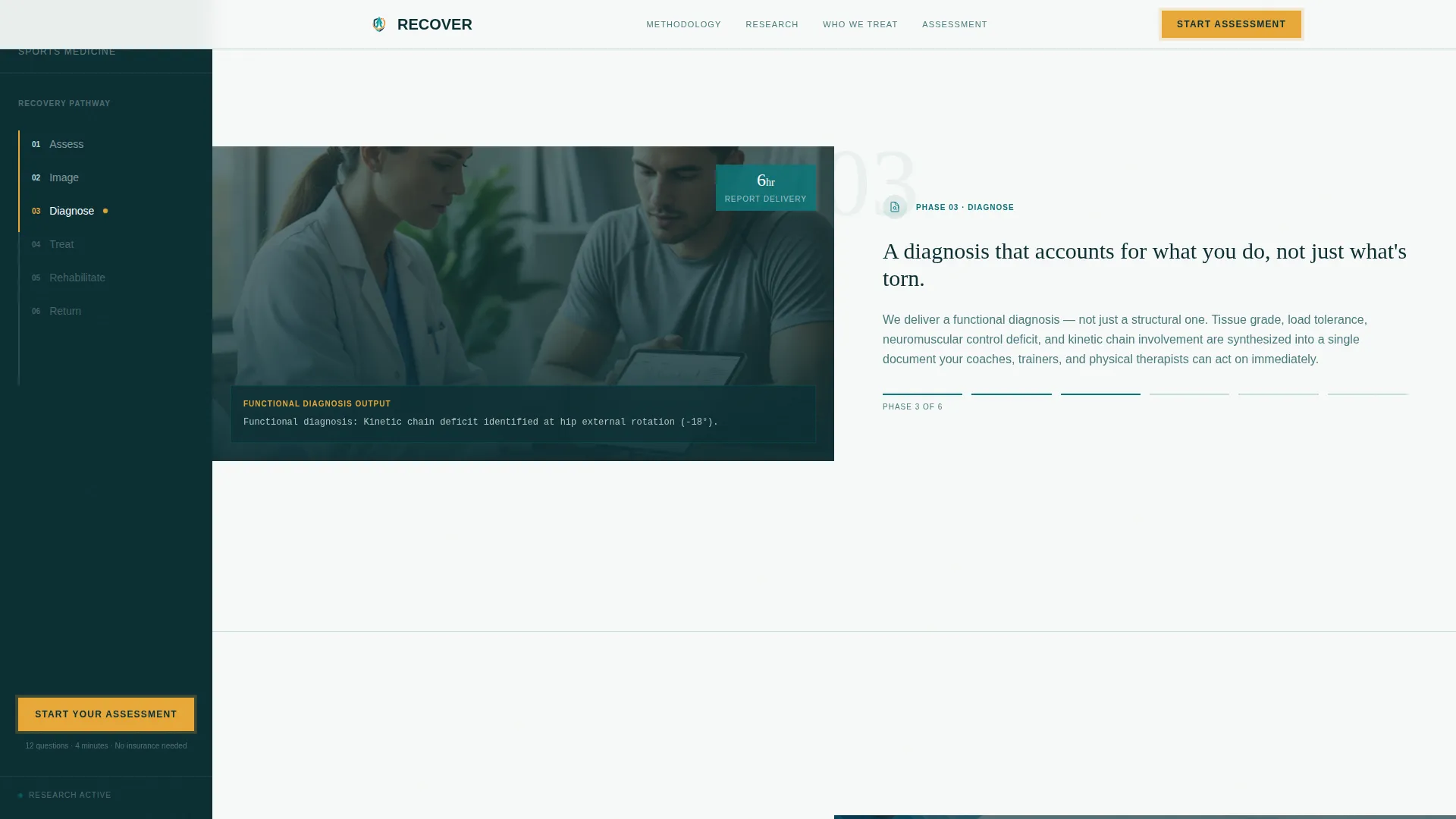
The sidebar lives in surgical navy and persists across all six methodology phases: Assess, Image, Diagnose, Treat, Rehabilitate, and Return. A teal progress pip descends as the visitor scrolls, creating the sensation of moving through a real clinical intake. After the visitor passes phase two, the primary call to action locks into the sidebar and stays visible.
Twelve-Question Injury Assessment Quiz
The assessment opens with a body map selector for injury location, then moves through mechanism of injury, symptom duration, prior treatments, and optional imaging upload. Each answer subtly updates the sidebar's phase indicators. The quiz uses progressive disclosure so visitors never feel overwhelmed by too many questions at once.
Gated Recovery Pathway Summary
On completing the quiz, visitors receive a personalized recovery pathway summary built from the center's published outcome data. The gate requires only a name and email address. No phone number, no insurance information. Friction is stripped to the minimum needed to deliver genuine clinical value first.
Half-Page Hero with Clinical Photography
The header uses a half-page photo and text layout. The left side holds a biomechanics lab photograph: an athlete mid-stride on a force plate with motion-capture markers visible. The right side carries the headline and a single subline referencing the assessment. A floating clinical data card and stats bar accompany the composition.
Six-Phase Methodology Sections
Each methodology phase pairs a specific clinical detail on the left side with a plain-language explanation on the right. Sample elements include an MRI annotation, a force-plate heat map, and a rehabilitation protocol timeline. The pairing builds diagnostic credibility one phase at a time.
Patient Profile Cards
A dedicated section presents three patient profile cards representing a professional athlete, a collegiate athletic director, and a weekend warrior. This gives each visitor a clear signal that the center understands their specific situation and pressures.
Page sections overview
| Section | Purpose |
|---|---|
| Hero Header | Introduce headline and start assessment call to action |
| Six-Phase Methodology | Walk visitor through Assess to Return phases |
| Research Credibility | Display published outcomes and peer-review proof |
| Who We Treat | Show three patient profile cards for audience recognition |
| Twelve-Question Quiz | Capture injury details through progressive disclosure |
| Linear Footer | Close with single-row link and contact pattern |
Design & branding system
The visual identity follows a Healing Space theme using the Teal Catalyst color system. The palette feels clinical and precise without becoming cold or intimidating. Fraunces handles display headings with a serif warmth that contrasts the data-forward layout, while DM Sans keeps body text and interface elements clean and legible.
- Clinical teal (#0D7377) anchors section dividers and progress indicators; surgical navy (#0B2E33) fills the sidebar and typographic weight; bone-white (#F7F9F8) opens the main content areas
- Catalyst amber (#E8A838) appears exclusively on interactive elements, progress pulses, and call-to-action buttons, making every actionable element visually distinct
- Animation includes scroll-linked phase tracking, counter animations on outcome stats, quiz progressive disclosure, and a blur-plus-translate entrance effect for incoming sections
Mobile & speed optimization
The template is designed desktop-first, prioritizing the sidebar companion layout on wider screens. On smaller devices, the sidebar collapses gracefully so the experience remains navigable without losing the phase-tracking context. Static sections use server components while the quiz and scroll tracker run as client components, keeping the interactive layer isolated.
- Desktop-first layout with a graceful mobile collapse for the sticky sidebar
- Server components power static content sections; client components handle the quiz and scroll-linked tracker
- High interactivity is scoped precisely: animations and real-time updates apply only to the components that need them
How this template helps you convert
The conversion architecture is built around one idea: earn trust before asking for commitment. Every scroll interaction, phase transition, and quiz answer moves the visitor deeper into a personalized experience that feels like care, not marketing.
- The assessment call to action appears in the hero header first, then locks into the sidebar after phase two so it is always reachable without interrupting the reading flow.
- The twelve-question quiz builds perceived investment: as visitors answer each question, the sidebar updates in real time, making them feel they are already inside the diagnostic process.
- The gated recovery pathway summary delivers a concrete, personalized output in exchange for name and email only, lowering friction to the minimum required for a meaningful first conversion.
Other information about this template
This template is specifically built for the sports medicine research center niche within the broader health and medical category. It sits at the intersection of clinical authority and athlete-focused empathy, which makes it suitable for both direct patient acquisition and institutional outreach to athletic programs.
- The template style is Sidebar Companion, with a sticky sidebar that serves as both a navigation aid and a real-time progress tracker
- The landing page direction is Quiz and Assessment, making the twelve-question tool the primary conversion mechanism rather than a secondary feature
- The header concept is Half-Page Photo and Text, pairing clinical photography with a research-credibility headline and a subline tied directly to the assessment
- Creative direction follows a Step-by-Step Guide structure, so each methodology phase feels like a logical, trust-building progression rather than a list of services
Theme
Healing Space
Creative direction
Step-by-Step Guide
Color system
Teal Catalyst
Style
Sidebar Companion
Direction
Quiz/Assessment
Page Sections
Scroll-linked Phase Sidebar
Twelve-question Injury Assessment Quiz
Gated Recovery Pathway Summary
Half-page Hero with Clinical Photography
Six-phase Methodology Layout
Patient Profile Cards
Related questions
Who is this landing page template designed for?
What does the twelve-question assessment quiz actually do?
Can this template support both individual patients and institutional clients like athletic programs?
What information does the recovery pathway summary require from visitors?
How does the sidebar behave as visitors scroll?