Sports Medicine Clinic Landing Page Template
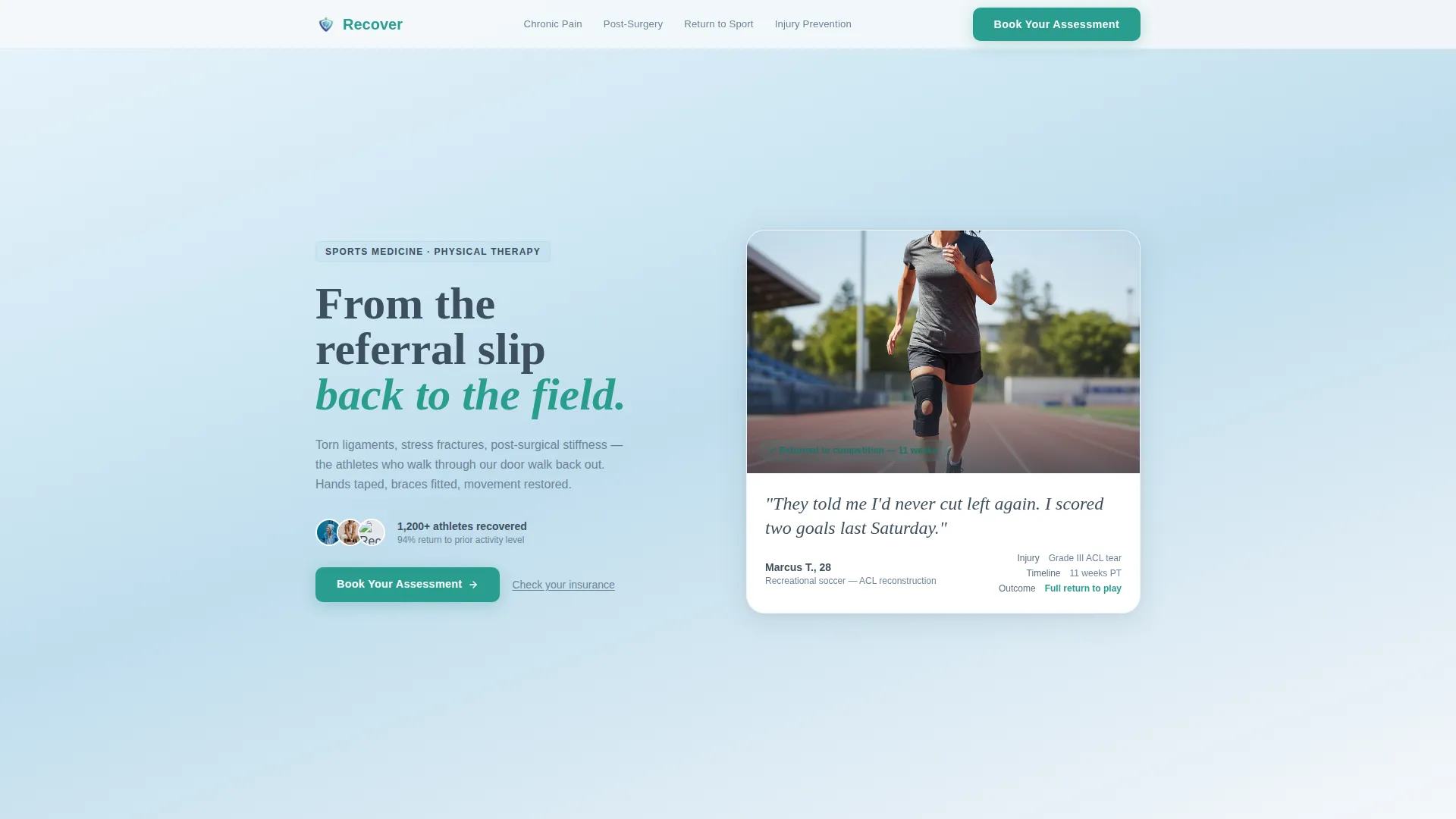
Recover is a hub and spoke landing page template built for sports medicine clinics. It opens with a floating patient testimonial card, then guides visitors through four pain-point spoke sections: Chronic Pain, Post-Surgery, Return to Sport, and Injury Prevention. Each section pairs the patient's problem with the clinical solution, closing with a "Book Your Assessment" call to action.
by Rocket studio
Quick summary
Recover is a single-page sports medicine landing page template built around a Problem to Solution Arc. Five stacked patient stories mirror the visitor's own injury at every scroll depth. A sticky anchor nav, teal call-to-action buttons, and an insurance-check text link reduce friction and move injured athletes toward a booked assessment appointment.
Who this template is for
This template is designed for sports medicine clinics and physical therapy centers that serve active patients. It works best when the practice wants to convert referral slips and web searches into scheduled appointments without a complex multi-page site.
- Clinics treating injured athletes, weekend warriors, and post-surgical patients
- Physical therapists and sports medicine specialists who need a credibility-first web presence
- Healthcare practices looking to replace a generic site with a patient story-driven landing page
What problem this template solves
Most clinic websites list services without speaking to how the patient actually feels. Injured people research late at night on their phones, skeptical and in pain, and a wall of credential text does not move them to call. Recover solves that gap by leading with the patient's language before introducing the clinical answer.
- Visitors leave generic clinic sites because nothing reflects their specific injury or situation
- The "call us to schedule" barrier stops patients who are unsure whether the clinic handles their case
- Lack of social proof makes it hard to trust a new practice with a serious injury
What you get with this template
Recover delivers a fully structured, single-page layout with five distinct content zones, each built around a resolved patient story. Every section is ready to customize with real patient photos, pull quotes, modality descriptions, and specialist credentials.
- A hero section with a floating testimonial card, oversized serif pull quote, and sticky pain-point anchor navigation
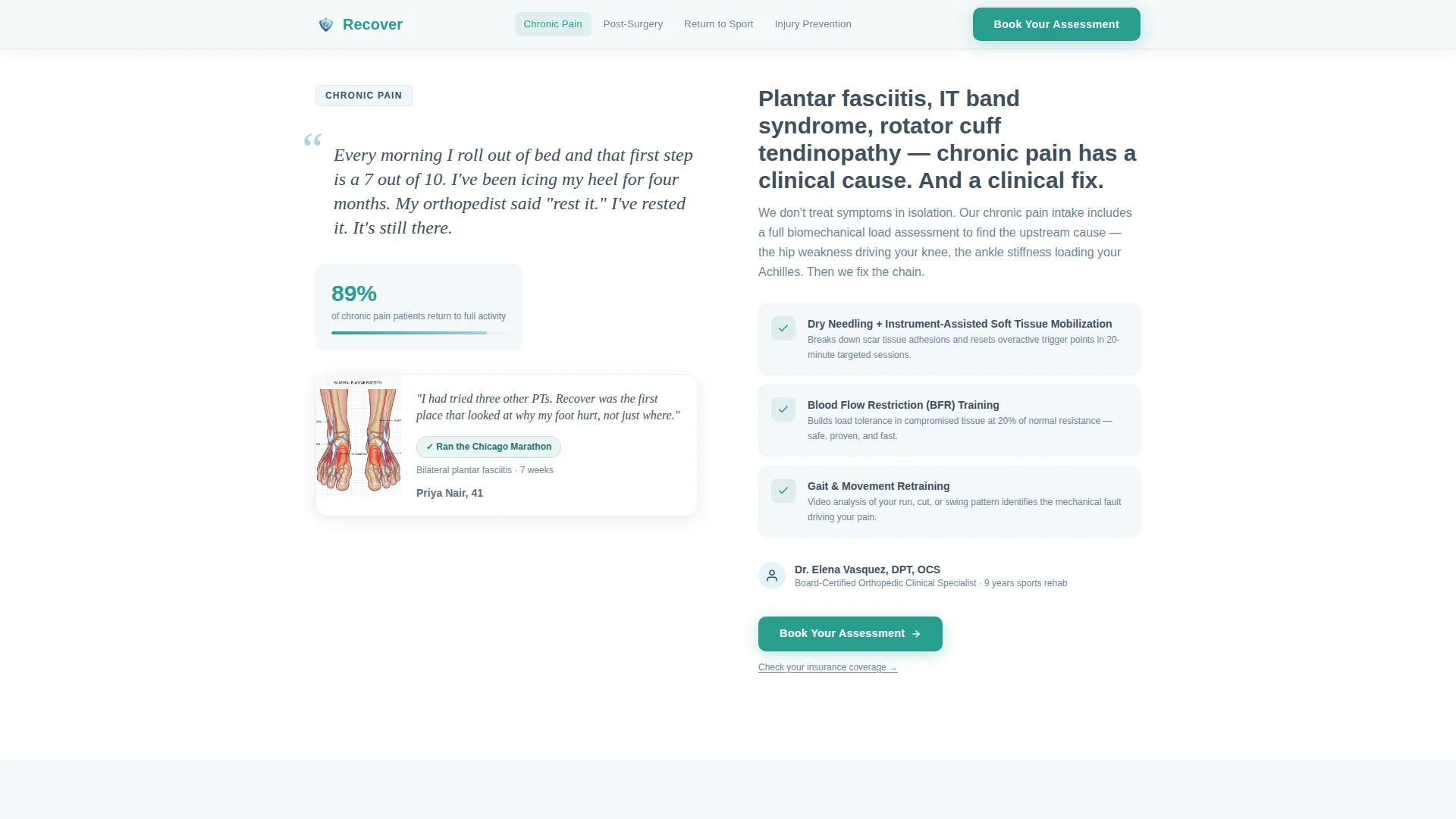
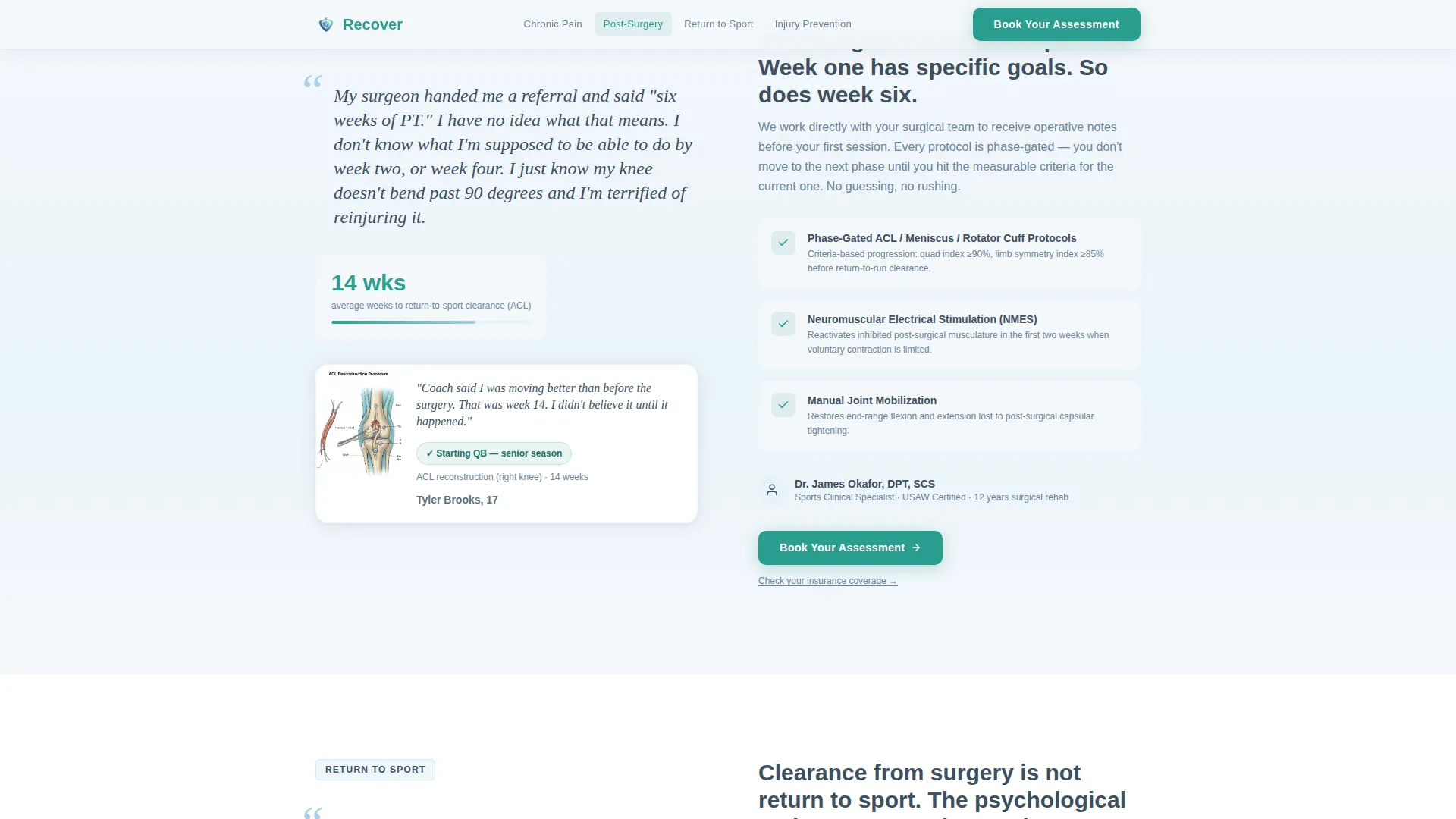
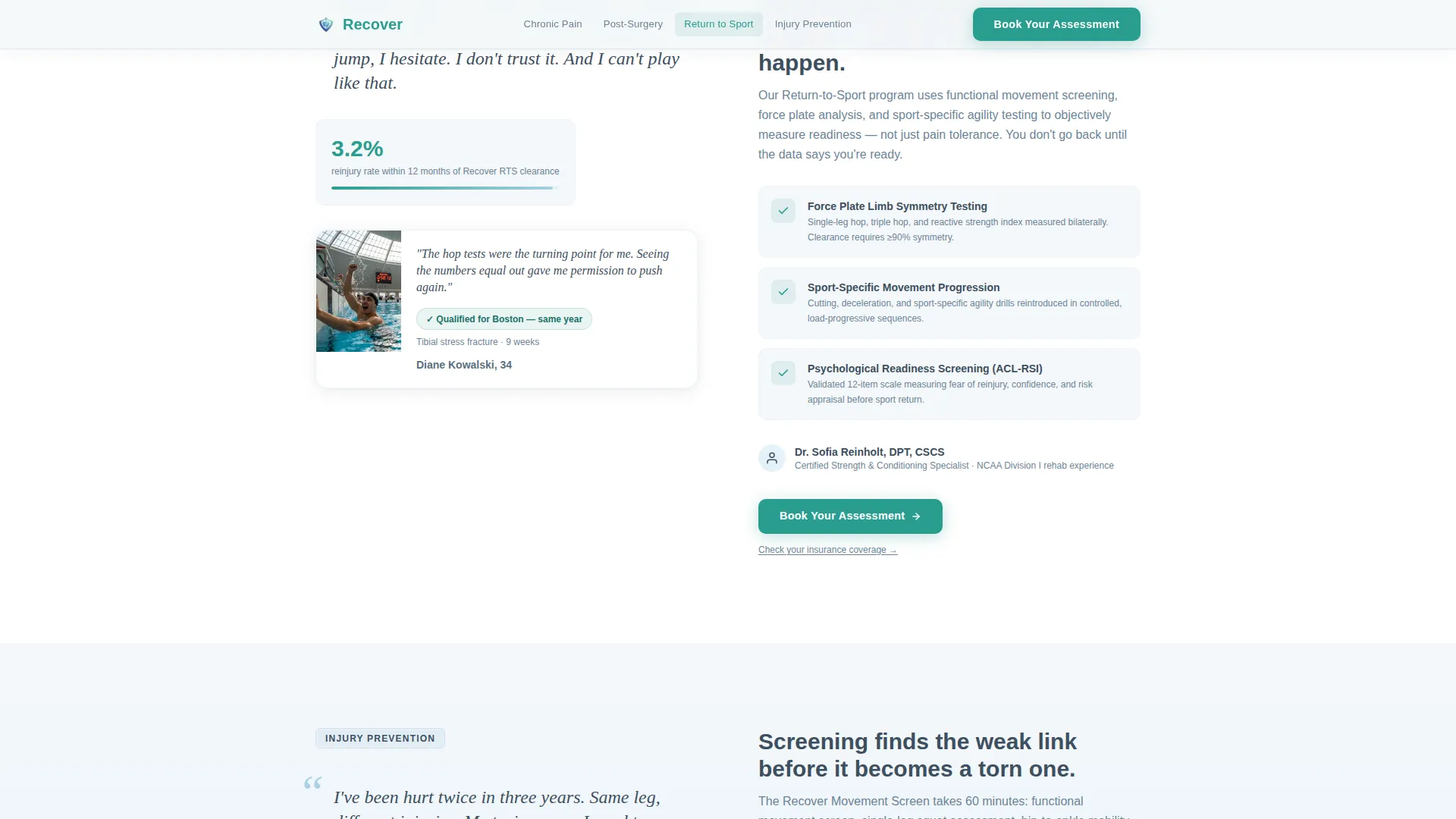
- Four spoke sections covering Chronic Pain, Post-Surgery, Return to Sport, and Injury Prevention, each with a micro-testimonial card
- A "Book Your Assessment" primary call to action and a secondary "Check Your Insurance" text link repeated at every section close
Feature list
Floating Hero Testimonial Card
The header opens with a single oversized card, softly shadowed against a pale gradient background. It holds a real patient photo, a large serif pull quote, and a compact label showing the injury, treatment timeline, and outcome. The card establishes proof before the clinic makes any promise.
Pain-Point Anchor Navigation
The sticky anchor nav lists patient pain points, not service names: Chronic Pain, Post-Surgery, Return to Sport, and Injury Prevention. This framing meets visitors where they are and scrolls them directly to the section that matches their situation. The "Book Your Assessment" button stays pinned inside the nav throughout the page.
Problem to Solution Spoke Sections
Each of the four spoke sections opens with the problem written in the patient's own language, then reveals the clinical solution with specific modality details and specialist credentials. Stakes escalate as the visitor scrolls, from nagging discomfort to career-affecting injury, and every section resolves with a micro-testimonial card.
Micro-Testimonial Cards
Five patient story cards appear across the page, each formatted with a photo, pull quote, injury label, timeline, and outcome. The consistent card format builds a cumulative case file effect, so by the final section the visitor has seen multiple resolved stories that resemble their own.
Dual Call-to-Action Path
Every spoke section closes with the primary "Book Your Assessment" button linking to an external scheduling platform. A secondary "Check Your Insurance" text link sits beneath it, directly addressing the cost hesitation that stops most patients from taking the first step.
Scroll-Linked Gradient and Animation System
Section backgrounds alternate between recovery white and a faint sky-wash blue, giving the eye a natural rest between content blocks. Scroll-linked gradient shifts, card float animations, and staggered section reveals add motion that mirrors the arc from injury to return-to-play without overwhelming the clinical tone.
Page sections overview
| Section | Purpose |
|---|---|
| Hero Testimonial Card | Opens with patient proof and sticky anchor nav |
| Chronic Pain Spoke | Matches visitor pain language to modality solution |
| Post-Surgery Spoke | Addresses post-op stiffness with clinical answer |
| Return to Sport Spoke | Outlines progressive loading protocol and outcome |
| Injury Prevention Spoke | Presents screening and prehab solution |
| Final Call-to-Action Stack | Closes page with booking button and insurance link |
| Footer | Single-row linear footer with practice info |
Design & branding system
The visual identity uses a Soft Gradient theme built on a Slate and Sky color system. Backgrounds shift vertically from clinical slate into sky-wash blue as the visitor scrolls, mirroring the emotional arc from injury to recovery. Typography pairs Fraunces serif for pull quotes with DM Sans for body text and navigation, keeping the page legible and trustworthy at every size.
- Slate (#3D4F5F) for primary text and navigation anchors, Sky-wash blue (#A8D0E6) for section background accents, and Recovery white (#F4F7FA) as the base canvas
- Teal (#2A9D8F) reserved exclusively for call-to-action buttons and progress indicators, making every next step visually distinct
- Spoke sections alternate between white and the faintest blue wash panels, so the eye rests between content blocks the way a body rests between sets
Mobile & speed optimization
This template is built mobile-first, reflecting the reality that injured patients often research clinics on their phones while icing an injury. The layout, card sizes, and button targets are all sized for thumb navigation on small screens.
- Static sections use server components to reduce load overhead for non-interactive content
- The sticky anchor nav and smooth scroll behavior are handled by client components, keeping interactive state isolated
- Card float animations and staggered reveals are calibrated at a medium intensity, active enough to feel polished without slowing the scroll
How this template helps you convert
Recover is structured around a deliberate click-through strategy. Every design and copy decision is aimed at reducing the steps between "I have this injury" and "I booked an appointment."
- The hero testimonial card delivers proof before any service claim, so trust is established in the first scroll position and skeptical visitors stay on the page longer
- Pain-point anchor labels in the nav let visitors self-select their situation and jump to the most relevant spoke section, shortening the path to the call to action
- The dual call-to-action model at every section close handles both the ready-to-book visitor and the cost-hesitant visitor in a single interaction, reducing drop-off at the decision moment
Other information about this template
Recover is categorized under Health and Medical, specifically the Sports Medicine Clinic and Center niche. The template is localized for United States audiences, using imperial measurements and 12-hour time formatting throughout. The footer follows a linear single-row pattern, keeping the bottom of the page clean and uncluttered.
- The page is designed for English (USA) audiences with copy conventions suited to American patients and referral workflows
- The template style is Hub and Spoke with anchor navigation, making it straightforward to adapt spoke sections for different injury specialties or seasonal clinic focus areas
- The Intersection Match Score for this template is 13, reflecting a precise alignment between the Health and Medical category, the Sports Medicine subcategory, and the Sports Medicine Clinic and Center niche
Theme
Soft Gradient
Creative direction
Problem→Solution Arc
Color system
Slate & Sky
Style
Hub & Spoke (Anchor Nav)
Direction
Click-Through
Page Sections
Floating Hero Testimonial Card
Pain-point Anchor Navigation
Problem to Solution Spoke Sections
Micro-testimonial Card System
Dual Call-to-action Path
Scroll-linked Gradient and Animation System
Related questions
Who is this landing page template designed for?
Can I customize the patient testimonial cards with my own photos and stories?
How does the Check Your Insurance link work in this template?
Does this template support multiple clinic locations or specialties?
What is the anchor navigation and how does it help patients find the right section?