Stroke Recovery Specialist Clinic Landing Page Template
Recover is a sidebar companion landing page template built for stroke recovery specialist clinics. It leads with clinical outcome statistics, guides visitors through therapy modalities and patient stories, and keeps a fixed assessment request form always visible in the sidebar. The design pairs sterile medical precision with genuine human warmth to serve families, survivors, and referring providers alike.
by Rocket studio
Quick summary
Recover is a single-page, sidebar companion layout designed for stroke recovery clinics that need to convert urgent, emotionally charged visitors into booked assessments. It opens with a clinical portrait and a bold outcome headline, then walks through therapy modalities, patient stories, and insurance clarity, all while keeping the assessment form fixed in the sidebar at every scroll position.
Who this template is for
This template is built for neurorehabilitation clinics that specialize in post-stroke care. It speaks equally well to the families searching for help and to the medical professionals writing referral lists.
- Adult children of stroke survivors who are searching late at night for credible, specialist care
- Hospital discharge planners who need a reliable specialist referral they can trust quickly
- Stroke survivors themselves who want to understand what structured recovery actually looks like
What problem this template solves
Finding a trustworthy stroke recovery clinic online is difficult. Visitors arrive frightened, time-pressured, and skeptical of generic marketing language. Most clinic pages fail to deliver clinical proof and emotional reassurance at the same time.
- Families need both hard outcome numbers and a sense that real, careful therapy happens here
- Discharge planners need fast proof of clinical credibility before they can write a referral
- Survivors need to see that specific, measurable progress is possible before they pick up the phone
What you get with this template
The template delivers a complete, structured landing page built around a persistent sidebar and a stats-first content flow. Every section earns trust before asking for action.
- A fixed sidebar with a scroll progress spine, a persistent call-to-action form, and a secondary PDF lead-capture path
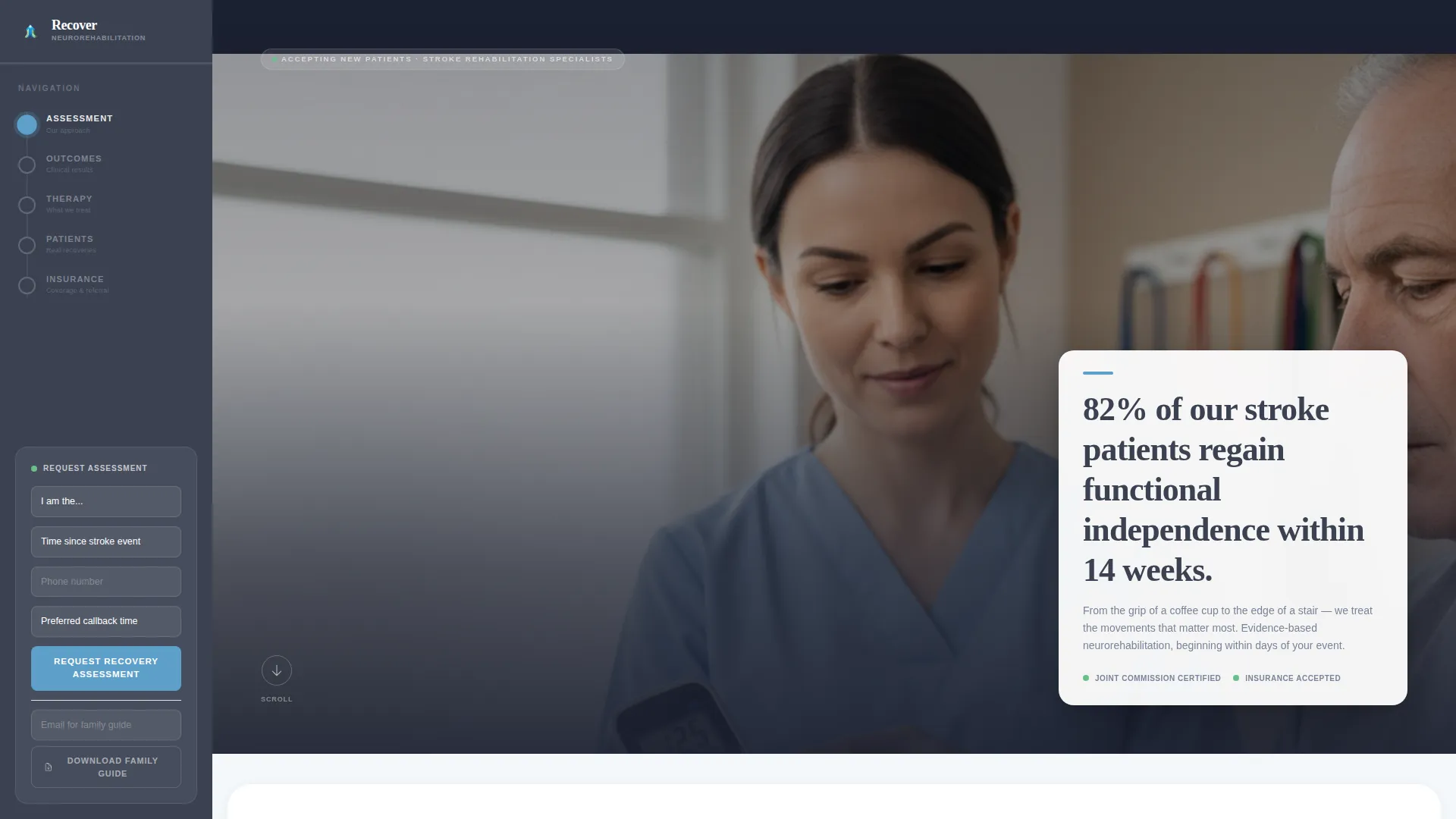
- A cinematic portrait hero section with a fade-in headline showcasing a clinical outcome statistic
- Five content sections covering outcomes, therapy modalities, patient stories, and insurance and referral information
Feature list
A paragraph introduces each built-in feature below. Together they form a coordinated system that supports clinical credibility and lead generation without requiring any extra components.
Persistent Sidebar with Fixed Assessment Form
The sidebar stays locked to the viewport as visitors scroll. It carries the primary call-to-action button labeled "Request a Recovery Assessment" and a compact three-field form capturing patient relationship, time since stroke event, and a phone number with a preferred callback window.
Stats-First Outcomes Dashboard
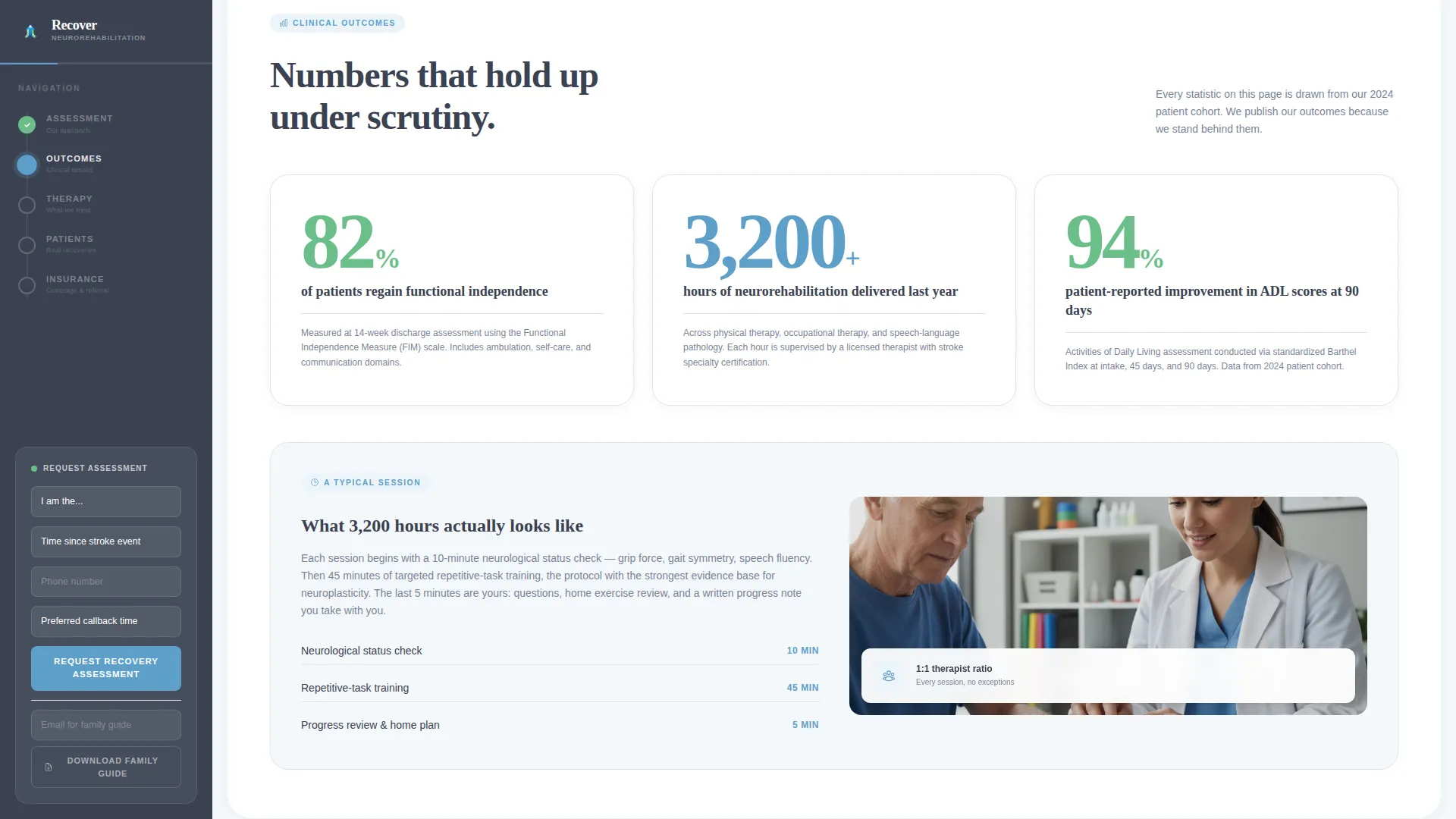
Each scroll event reveals a clinical number before its supporting narrative. Animated stat counters display figures such as 3,200 or more hours of neurorehabilitation delivered and a 94 percent patient-reported improvement in activities of daily living scores, building credibility before the reader reaches the human story beneath.
Scroll Progress Spine
The sidebar includes a subtle vertical progress tracker segmented into five labeled stages: assessment, therapy modalities, outcomes, insurance, and contact. Visitors can see exactly where they are on the page at any moment, making the experience feel navigable rather than overwhelming.
Portrait-Centered Hero Section
The header features a tightly composed photograph of a therapist guiding a patient through grip-strength work, shot with clinical north-facing light and shallow depth of field. A fade-in headline delivers the anchor statistic: 82 percent of stroke patients regain functional independence within 14 weeks.
Secondary PDF Lead Capture
Below the assessment form, a secondary conversion path offers a downloadable Family Guide to Stroke Recovery. It captures an email address for visitors who are not yet ready to call, delivering immediate value during the most urgent phase of a family's search.
FAQ Accordion Component
An interactive accordion section handles common questions about therapy timelines, insurance coverage, and what to expect at a first assessment. It reduces friction for hesitant visitors and gives discharge planners quick answers without a phone call.
Page sections overview
| Section | Purpose |
|---|---|
| Hero Portrait | Establish clinical credibility and present the primary outcome headline |
| Outcomes Dashboard | Display animated session volume and patient improvement statistics |
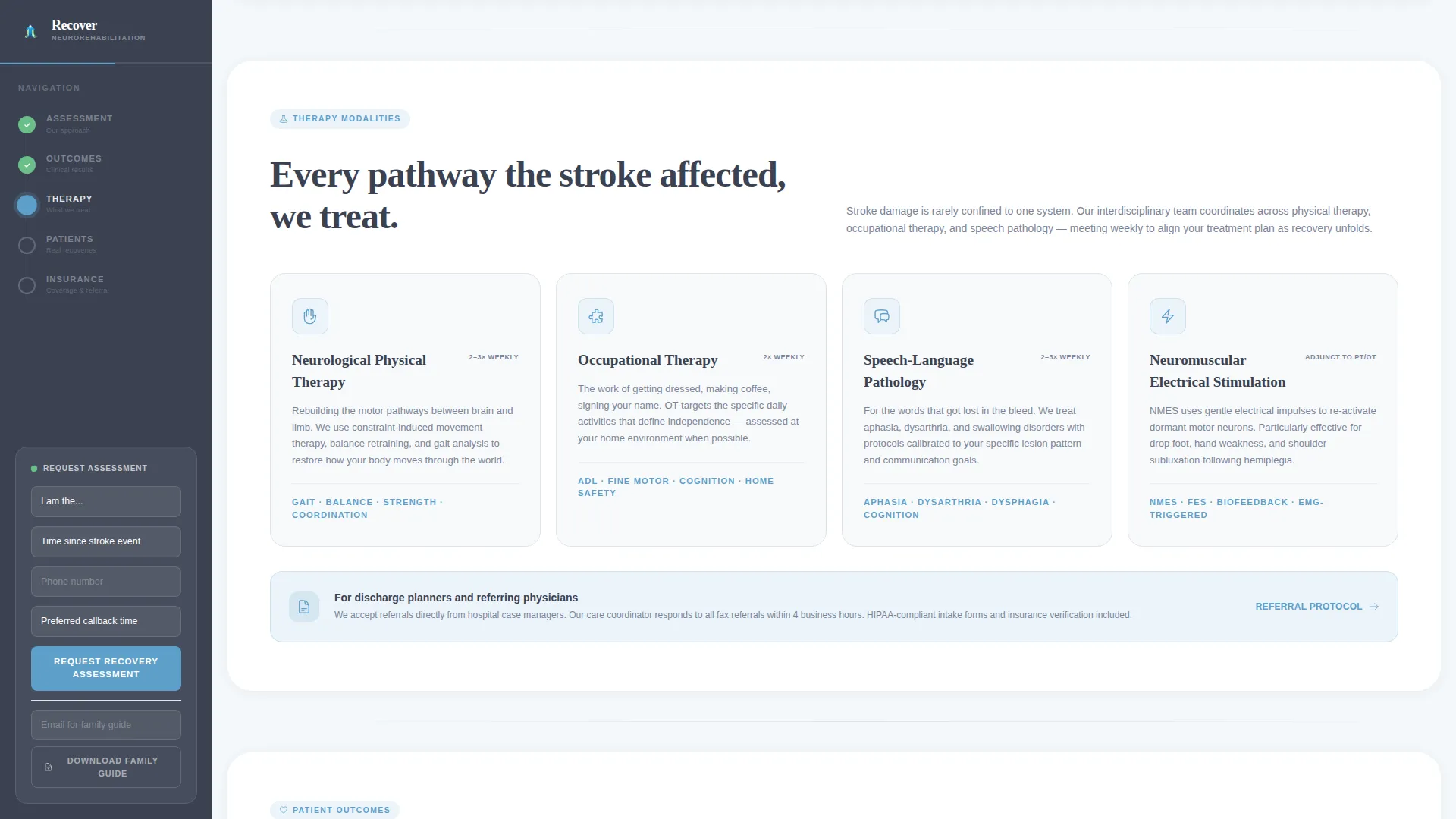
| Therapy Modalities | Describe what neuro physical therapy, occupational therapy, and speech sessions look like |
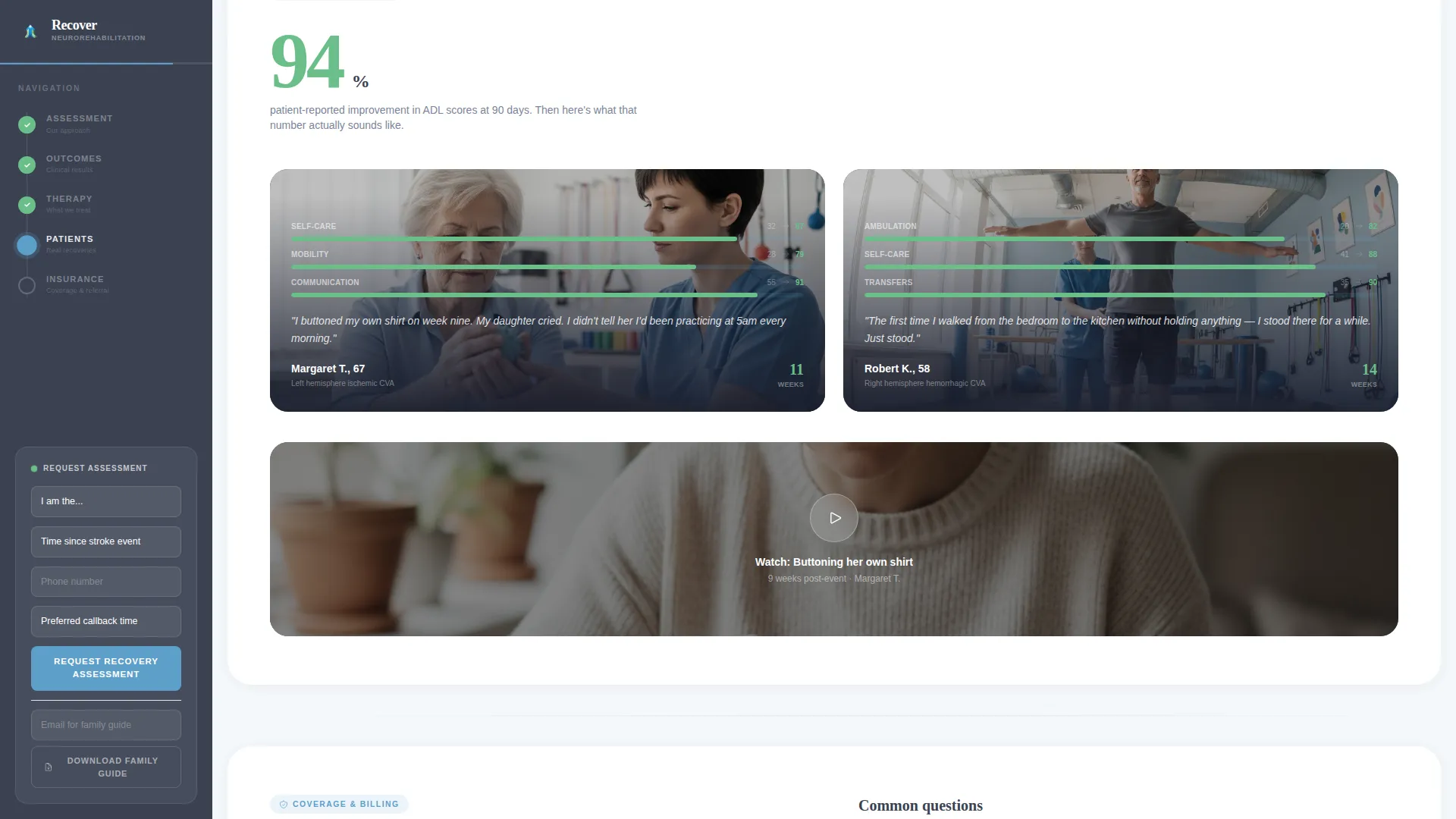
| Patient Stories | Deliver emotional proof through real recovery moments beneath the clinical numbers |
| Insurance and Referral | Clarify coverage options and provide a clear path for referring providers |
| Footer Row | Close with essential contact and navigation links in a single linear row |
Design & branding system
The visual identity follows a Medical Clarity theme that pairs controlled clinical precision with genuine warmth. The palette is called Slate and Sky, and every color has a defined role so the page never feels cluttered or confused.
- Clinical charcoal (#3B4252) is used for primary text and the sidebar background, giving the persistent navigation a grounded, trustworthy weight
- Recovery blue (#5E9FCA) drives progress indicators, interactive elements, and scroll spine highlights, keeping the page feeling active and forward-moving
- Open-sky white (#F4F7FA) fills the main content panels so each section breathes freely against the darker sidebar
- Vitals green (#6BBF8A) appears exclusively on outcome statistics and success markers, reserving its positive signal for moments that have earned it
- Typography pairs DM Sans for body text with Fraunces as a headline serif, giving clinical information an emotional undertone without softening its authority
Mobile & speed optimization
The template is built desktop-first to honor the sidebar companion layout, but it collapses responsively for mobile visitors. Scroll-dependent interactions are handled by client-side components while static sections use server-rendered markup.
- The sidebar collapses gracefully on smaller screens so the fixed call-to-action form remains accessible without obstructing content
- Stat counter animations, fade-in reveals, and the scroll progress spine are handled as client components, keeping static content lightweight
- The footer follows a single linear row pattern, keeping the mobile layout clean and uncluttered at the bottom of the page
How this template helps you convert
The entire page is designed around a single conversion goal: getting the right visitor to request a recovery assessment. Every structural choice supports that outcome.
- The fixed sidebar form is always one glance away, removing the need to scroll back up or hunt for a contact button at any point during the visit
- The stats-first content structure establishes clinical trust before any emotional appeal, so families and discharge planners feel confident rather than sold to
- The secondary PDF download captures email addresses from visitors who need more time, turning a hesitant browser into a warm lead without pressure
Other information about this template
This template is part of a broader set of Health and Medical layouts designed to address the specific trust and urgency dynamics that healthcare marketing requires.
- The template uses DM Sans and Fraunces typefaces, both loaded for web use, to balance clinical readability with headline warmth
- The Slate and Sky color system is documented with exact hex values so any designer can extend or adapt the palette consistently
- The sidebar companion layout structure is well suited to longer clinical content that needs persistent navigation, such as treatment program pages or specialist service pages
- The three-field assessment form is deliberately minimal, asking only for patient relationship, time since stroke event, and contact details, to reduce drop-off from visitors who are already overwhelmed
Theme
Medical Clarity
Creative direction
Stats-First Impact
Color system
Slate & Sky
Style
Sidebar Companion
Direction
Lead Generation
Page Sections
Persistent Sidebar with Fixed Call-to-action
Stats-first Outcomes Dashboard
Scroll Progress Spine
Portrait-centered Hero Section
Secondary PDF Lead Capture Path
Interactive FAQ Accordion
Related questions
Who is this landing page template designed for?
Can I replace the outcome statistics with my own clinic data?
What information does the sidebar assessment form collect?
Is the secondary PDF download included in the template?
Does the template address referring providers, not just families?