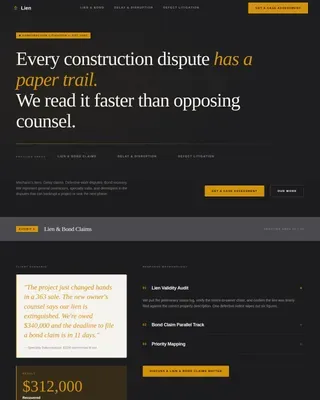
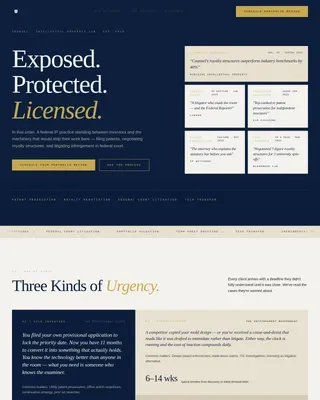
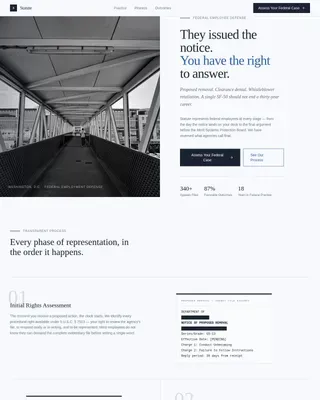
LegalTech & Compliance Software Reviews Website Template
The Redact Defensible Discovery Excellence landing page template is built for e-discovery and document review firms targeting litigation partners, general counsel, and compliance officers. It pairs an editorial magazine aesthetic with a Plum Executive color system, a testimonial mosaic, and a lead capture form, giving legal technology firms a focused, authoritative page that earns trust before it asks for contact details.
by Rocket studio
Quick summary
This template delivers a single-page editorial experience for firms operating in document review and e-discovery. It leads with a giant serif headline, moves through a staggered testimonial mosaic of real case outcomes, and closes with a gated lead capture form. Every section is calibrated to speak directly to the pressures that legal teams face when producing documents under deadline.
Who this template is for
This template was designed for legal technology firms and professional services organizations that help legal teams manage high-stakes document review. The audience on the other side of the screen is not a casual visitor. They are practitioners who understand privilege logs, discovery obligations, and the cost of getting redaction wrong.
- Litigation partners at Am Law 200 firms facing discovery deadlines and needing peer-validated methodology
- Corporate general counsel managing internal investigations with large data volumes across company email systems
- Compliance officers responding to DOJ second requests who need court-ready, defensible legal documents delivered on schedule
What problem this template solves
Many legal teams struggle to communicate the rigor behind their document redaction process to prospective clients who have already been burned by accidental disclosure or regulatory violations. A generic service page does not move a litigation partner. This template solves the credibility gap by letting peer case outcomes speak first.
- Improper redaction, under redaction, and manual redaction errors create legal consequences that erode client trust before a relationship even starts
- Legal teams need a page that leads with evidence, not sales language, to convert visitors who evaluate vendors the way they evaluate expert witnesses
- The absence of structured audit trails, chain of custody records, and privilege logs in marketing materials signals operational weakness to sophisticated buyers
What you get with this template
You get a fully structured editorial landing page built around five core sections: a hero block, a testimonial mosaic, a methodology and proof section, a lead capture form, and a minimal institutional footer. Each section is pre-designed to reflect the Institutional Authority theme and Plum Executive color system described in the brief.
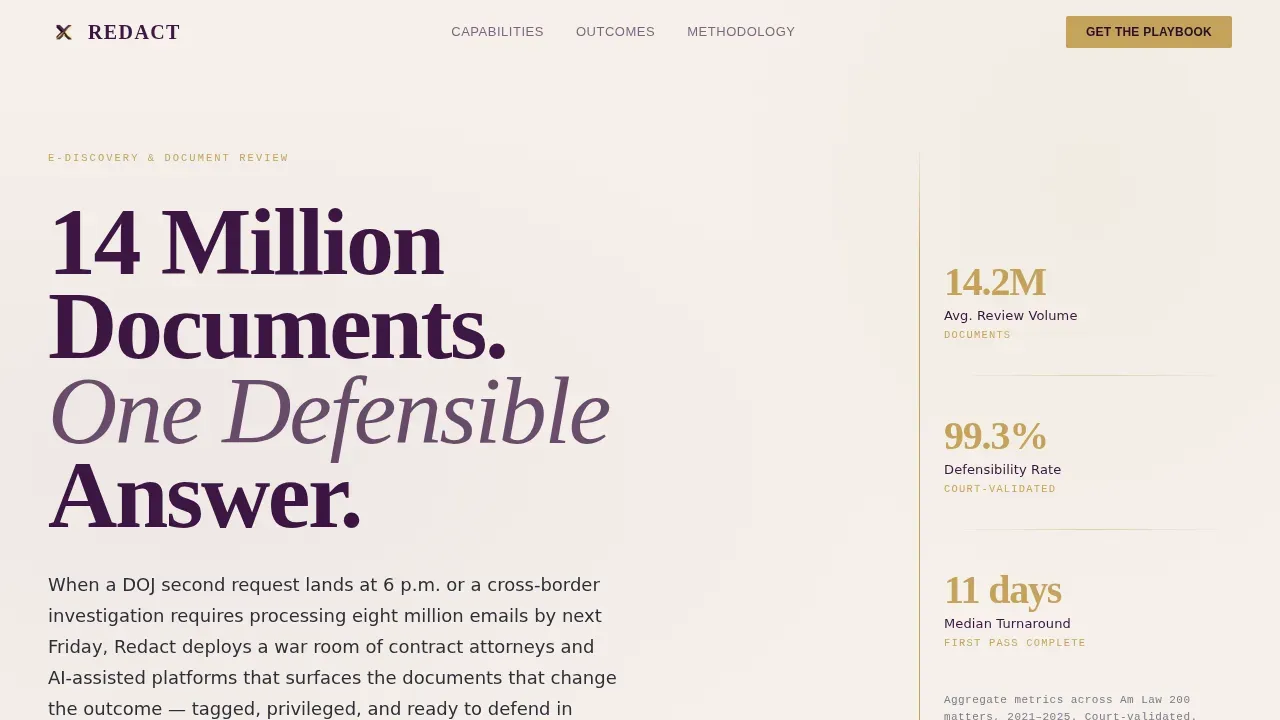
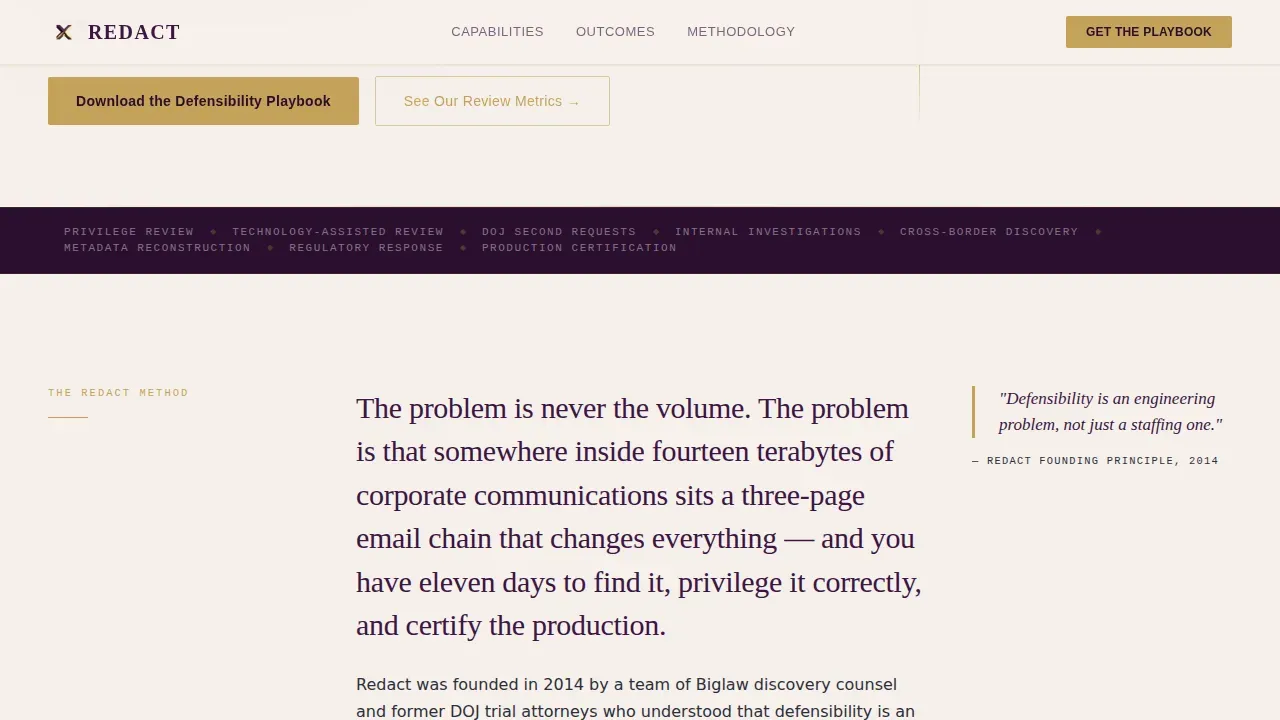
- Hero section with giant flush-left serif headline, gold vertical rule, and a precise stat block showing review volume, accuracy rate, and median turnaround
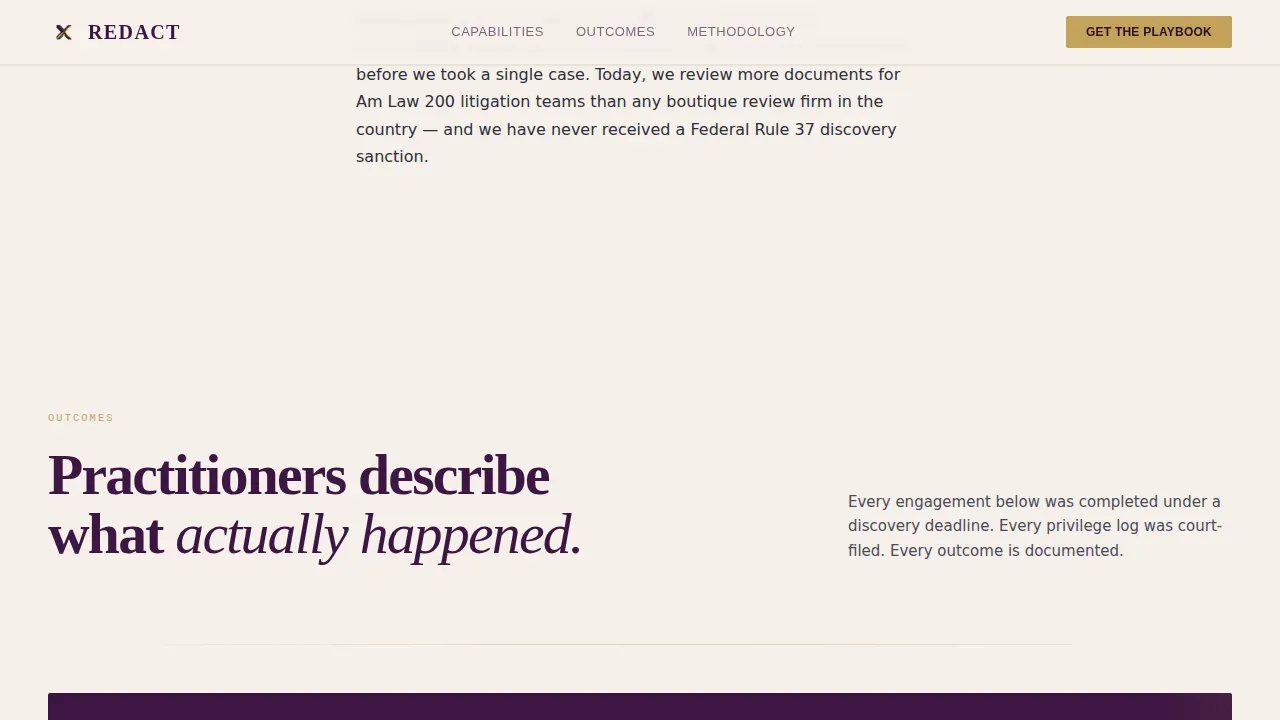
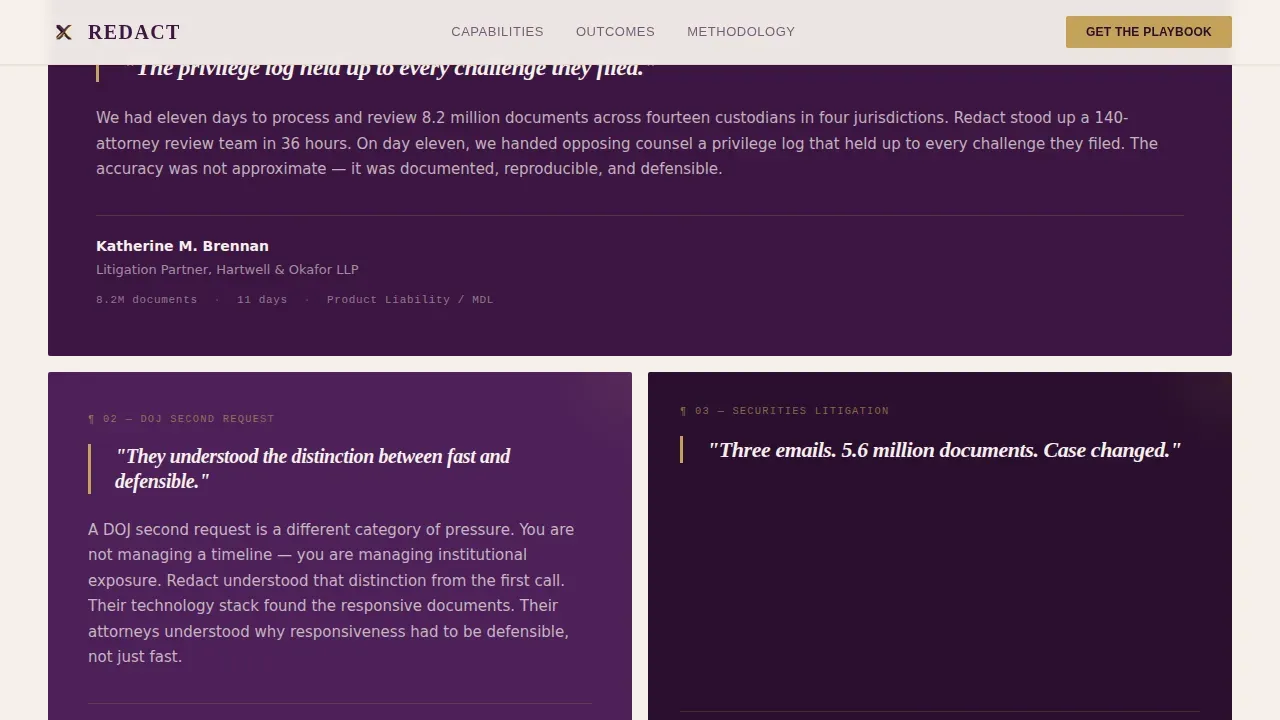
- Testimonial mosaic with staggered editorial grid cards, varied layouts, pull-quote styling in gold, and case metadata lines covering matter type, document volume, and review window
- Lead capture form gated behind earned credibility, requesting only work email and matter type, with a secondary path to a methodology white paper
Feature list
This template includes the following built-in design and structural capabilities drawn directly from the project brief.
Giant Headline Left Hero Block
The hero section uses massive Fraunces serif type set flush-left in deep plum against parchment ivory. A gold vertical rule divides the headline from a compact stat block on the right third of the viewport. No imagery competes for attention. The typography itself functions as the authority signal, weighted like the opening paragraph of a judicial opinion.
Staggered Testimonial Mosaic Grid
The mosaic drops the visitor into a scrolling editorial grid where every card tells a real case outcome through the client's voice. Cards alternate between wide horizontal pull-quotes, tall portrait-oriented stat panels, and compact two-line endorsements. Each card carries a different plum tint, a gold pull-quote border, and a metadata line showing matter type, document volume, and review window. No layout repeats, creating a rhythm that rewards continued scrolling.
Methodology and Proof Section
After the testimonial mosaic, a dedicated section surfaces the numbers that legal teams need to evaluate a vendor: accuracy rates, review throughput, and median turnaround. This section translates operational rigor into readable proof, covering the kind of data that supports careful redaction decisions and demonstrates defensible process to skeptical buyers.
Gated Lead Capture Form
The lead capture form appears after the third testimonial cluster, positioned only after credibility has accumulated. It asks for work email and matter type, keeping friction minimal. A secondary call-to-action links to a detailed methodology white paper, offering a lower-commitment path for visitors who are not yet ready to share contact details.
Scroll-Reveal Animations and Hover States
The template includes medium animation intensity: scroll reveals with stagger effects, a gold rule draw animation in the hero, and hover states on testimonial cards. Stat counters animate on entry. These interactions reinforce the editorial quality of the page without adding unnecessary visual noise.
Institutional Footer
The footer follows a linear single-row pattern. It is minimal and institutional, consistent with the letterhead-grade authority the rest of the page projects. No decorative elements compete with the content above.
Page sections overview
| Section | Purpose |
|---|---|
| Hero Headline Block | Establish authority instantly with serif type, gold rule, and a stat block |
| Testimonial Mosaic Grid | Build credibility through staggered peer case outcome cards |
| Methodology Proof Panel | Surface accuracy rates and throughput data for evaluating vendors |
| Lead Capture Form | Convert qualified visitors with a minimal gated download form |
| Institutional Footer | Close the page with a clean single-row minimal footer |
Design & branding system
The visual identity follows the Institutional Authority theme, using a Plum Executive color palette that reads like the endpapers of a bound case reporter. Typography is handled by three complementary typefaces, each assigned a specific role in the information hierarchy.
- Deep plum (#3C1642) anchors headers and section backgrounds; muted charcoal (#2E2E3A) carries body text; parchment ivory (#F5F0EB) serves as the primary reading surface; restrained gold (#C4A35A) appears on pull-quote borders, citation markers, and hover states
- Fraunces serif handles all display headlines; DM Sans manages body copy and interface elements; JetBrains Mono renders metadata lines and stat figures with monospaced precision
Mobile & speed optimization
The template is designed desktop-first, built for litigation partners reviewing materials on workstation monitors at irregular hours. Tablet responsiveness is included in the layout system so the page remains readable on secondary devices without losing its editorial weight.
- Scroll-reveal and stagger animations are implemented at medium intensity using minimal JavaScript, keeping the interactive layer light while preserving the draw and counter effects
- Server Components handle static content rendering, reducing the JavaScript payload for the testimonial mosaic and methodology sections
How this template helps you convert
The page earns the lead form before it shows it. Every structural decision is made to accumulate trust from the first scroll to the form field.
- The hero stat block establishes quantified authority immediately, giving technical evaluators a reason to keep reading before any testimonial or case study appears
- The testimonial mosaic lets practitioners hear their own anxieties spoken back through peer voices, covering matter types from product liability to cross-border investigations, which primes the visitor to see the lead capture form as a logical next step rather than an interruption
Other information about this template
This template is purpose-built for the legal technology and e-discovery niche, where the stakes of document redaction are high and the buyers are trained to spot weak methodology. Several operational and compliance concepts are embedded in the design logic of the page to keep the content honest and specific.
- The redact defensible discovery excellence landing page template is classified as a Content and Resource destination, meaning its primary conversion mechanism is a gated asset download rather than a direct service inquiry form
- Legal document redaction covers a broad range of material types: emails, Slack threads, financial spreadsheets, scanned documents, embedded files, and metadata-rich electronic data from company email systems and financial records
- Proper redaction means permanent redaction: a properly redacted file removes sensitive data so it cannot be searched, copied, or revealed later; visual-only black-box overlays are not sufficient and federal courts have sanctioned parties for exactly this kind of false redaction
- Automated redaction tools and ai redaction capabilities help legal teams process large data volumes with consistent redaction rules, reducing the risk of common redaction mistakes such as failing to strip hidden metadata or producing unredacted documents through oversight
- Irreversible redaction supported by full audit logs and redaction logs is the standard that privilege review demands; every redaction decision should be logged with a record of who approved it, maintaining a clear chain of custody and supporting audit trails that hold up if challenged
- Ai powered review workflows and natural language processing allow platforms to flag personally identifiable information, confidential business information, trade secrets, financial data, and medical records across mixed document sets including scanned documents and electronic data
- Legal discovery under the Federal Rules of Civil Procedure (FRCP) sets the framework for producing documents and maintaining discovery documents in a defensible state; the Electronic Discovery Reference Model (EDRM) provides industry-standard compliance benchmarks across the entire process
- Under the Health Insurance Portability and Accountability Act (HIPAA), covered entities must safeguard Protected Health Information (PHI) in medical records before disclosure; privacy laws and regulatory obligations also govern how sensitive information and confidential data are handled during data collection and legal hold phases
- Many legal teams manage discovery obligations across litigation, internal investigation, and regulatory compliance matters simultaneously; under redaction and improper redaction both create legal consequences, while over-redaction invites challenges from opposing counsel
- The page design supports client expectations for transparent methodology by surfacing the numbers that prove defensible process: accurate privilege logs, consistent audit trails, documented redaction rules, and clear labeling that helps courts assess why sensitive content was withheld
- Careful redaction means protecting confidential information and sensitive information without destroying relevant data or sacrificing document readability; the page communicates this balance clearly to law firms evaluating the service
- Human review and human oversight remain essential even when automated redaction tools handle volume; the template's methodology section is designed to show how ai redaction and human judgment work together to protect sensitive data and maintain data integrity across the entire review process
- Digital data and digital evidence require the same chain of custody discipline as physical evidence; this template gives e-discovery firms a way to communicate that discipline visually and through the words of clients who have experienced it firsthand
Theme
Institutional Authority
Creative direction
Testimonial Mosaic
Color system
Plum Executive
Style
Editorial/Magazine
Direction
Content/Resource
Page Sections
Giant Headline Left Hero Block
Staggered Testimonial Mosaic Grid
Methodology and Proof Section
Gated Lead Capture Form
Scroll-reveal Animations and Hover States
Institutional Single-row Footer
Related questions
Who is the primary audience for this template?
What sections come pre-built in this template?
How does the lead capture form work in this template?
Can this template support content about different matter types?
What typography and color system does this template use?