Glass Restoration Landing Page Template
Reglaze is a hero-dominant landing page template built for professional glass restoration services. It leads with a full-viewport damaged-glass hero and a zip code coverage field, then walks visitors through the restoration process section by section. The Engineering Blueprint visual theme and click-through structure guide commercial and residential prospects toward booking a restoration assessment instead of ordering a costly replacement.
by Rocket studio
Quick summary
Reglaze is a single-page, hero-dominant landing page template designed for glass restoration businesses. The page opens with a dramatic close-up of damaged glass and a zip code input field, then layers in technical process sections that build buyer confidence. Every section earns the final click: "Get a Restoration Assessment."
Who this template is for
This template suits any business or individual offering professional glass restoration as an alternative to full pane replacement. It is built for service providers who need to educate prospects before asking for a booking.
- Commercial property managers dealing with scratched or mineral-stained lobby glass
- Restaurant and hospitality owners whose floor-to-ceiling windows have clouded from hard-water runoff
- Homeowners quoted high replacement costs who need to see that restoration is a credible, engineered solution
What problem this template solves
Glass damage is often misread as a replacement problem when it is actually a restoration opportunity. Prospects arrive skeptical, unfamiliar with the process, and unsure whether a service like this can deliver optical-quality results. The template closes that gap methodically.
- It positions restoration as a science-backed process, not a cleaning job
- It filters unserved leads early through zip code coverage validation
- It removes the friction of an on-page form by routing qualified visitors to a dedicated assessment page
What you get with this template
You get a complete, single-page layout structured around a transparent, section-by-section reveal of the glass restoration method. Every element is designed to build technical credibility and push hesitant prospects toward a confident decision.
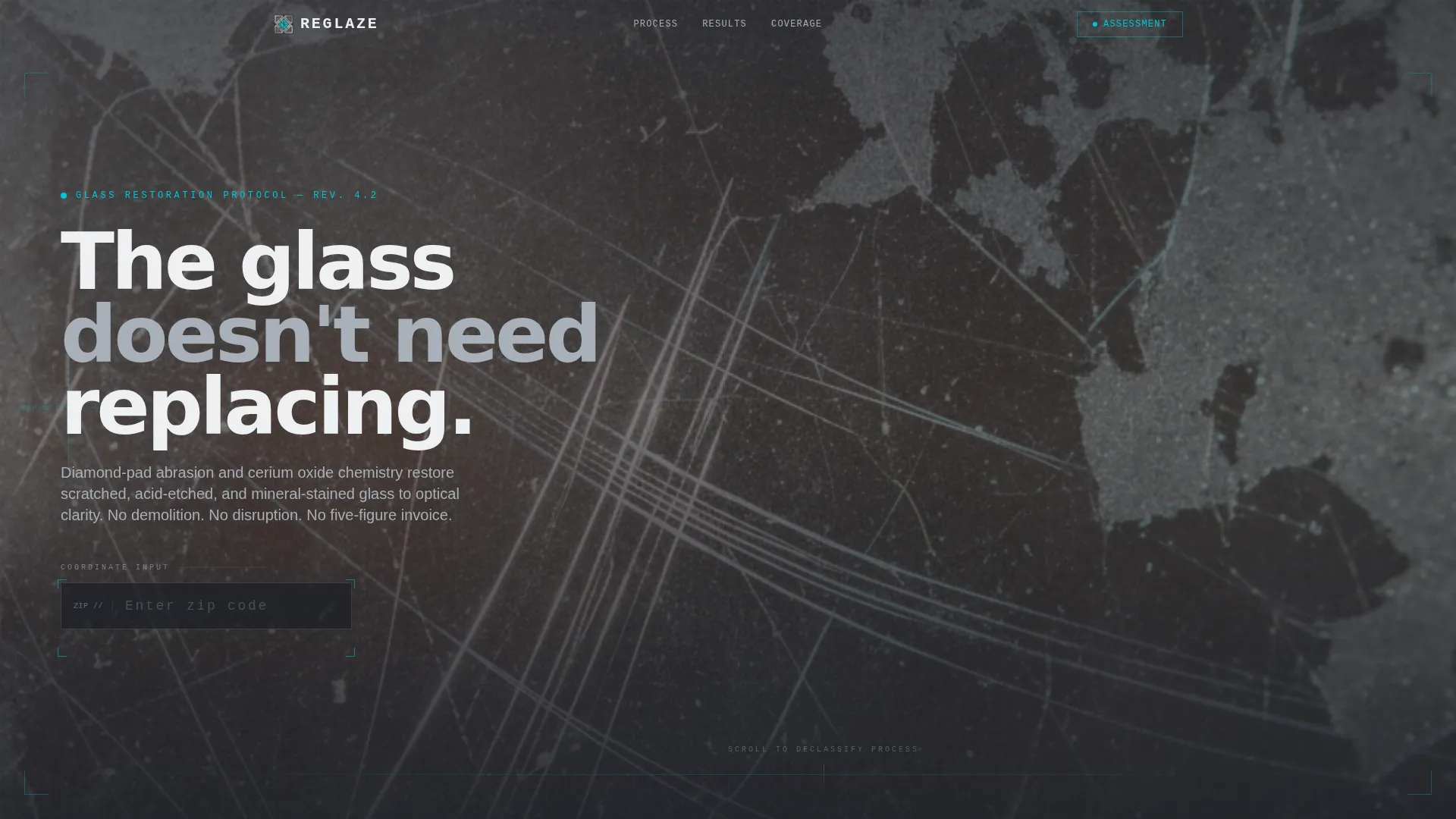
- A full-viewport hero with a damaged-glass background photograph and a styled zip code input field
- Three process-reveal sections covering glass anatomy, abrasive sequencing, and before-and-after light transmission results
- Repeating "Get a Restoration Assessment" calls to action anchored at the hero and at the bottom of each process section
Feature list
This template includes purpose-built layout features drawn directly from its Engineering Blueprint creative direction and click-through page strategy.
Full-Viewport Damaged-Glass Hero
The hero fills the entire browser viewport with a raking-light close-up photograph of scratched and mineral-hazed glass. The damage itself is the background. A single zip code input field, styled as a blueprint coordinate box, sits centered over the image. The cyan cursor blinks inside the field, signaling that the page is waiting for input before revealing coverage.
Zip Code Coverage Input
The location input field lets visitors confirm service availability before the primary call to action appears. Once a covered zip code is validated, the "Get a Restoration Assessment" button surfaces inside the hero. This flow filters unqualified leads and makes the call to action feel earned rather than generic.
Transparent Process Sections
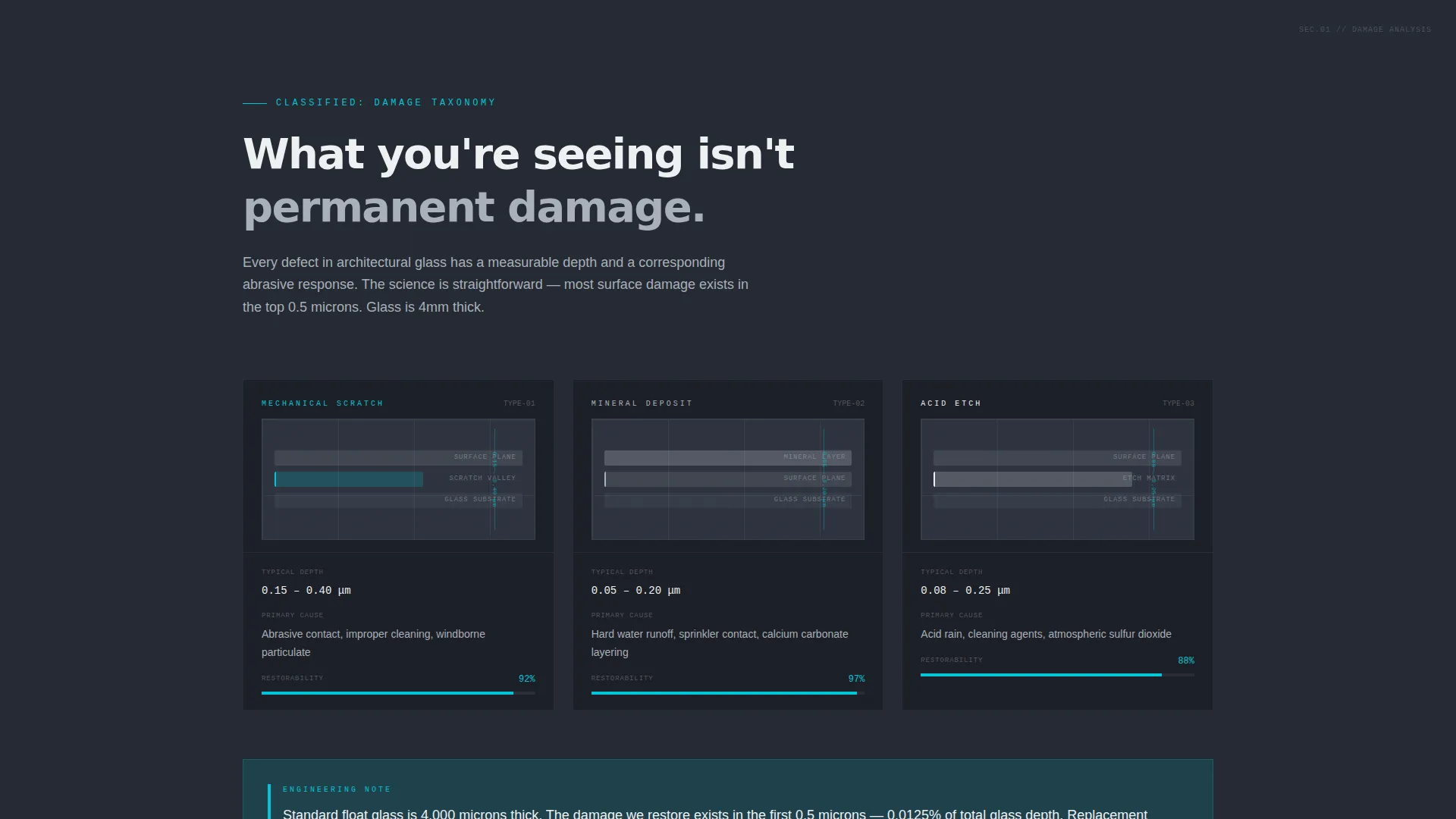
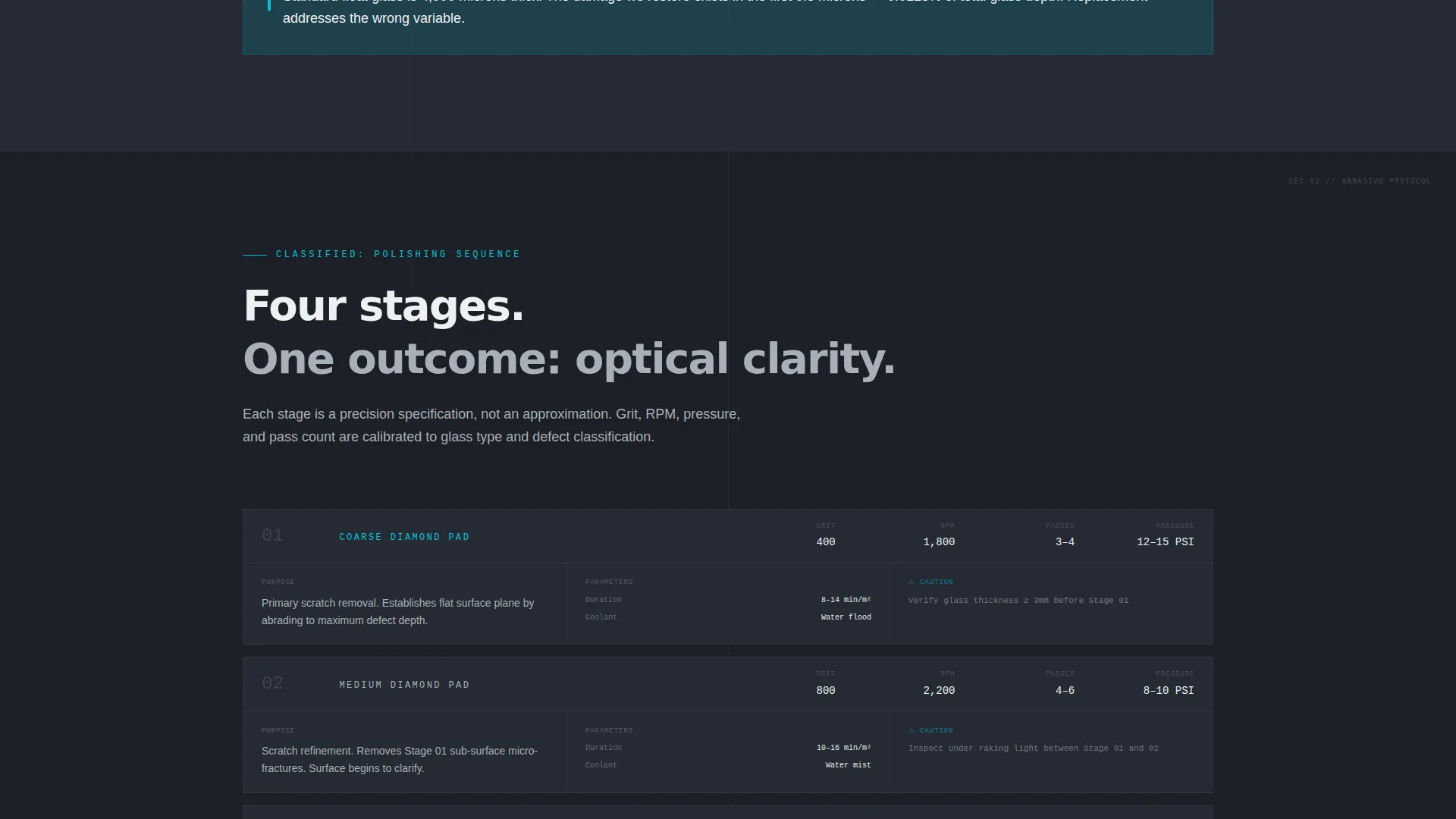
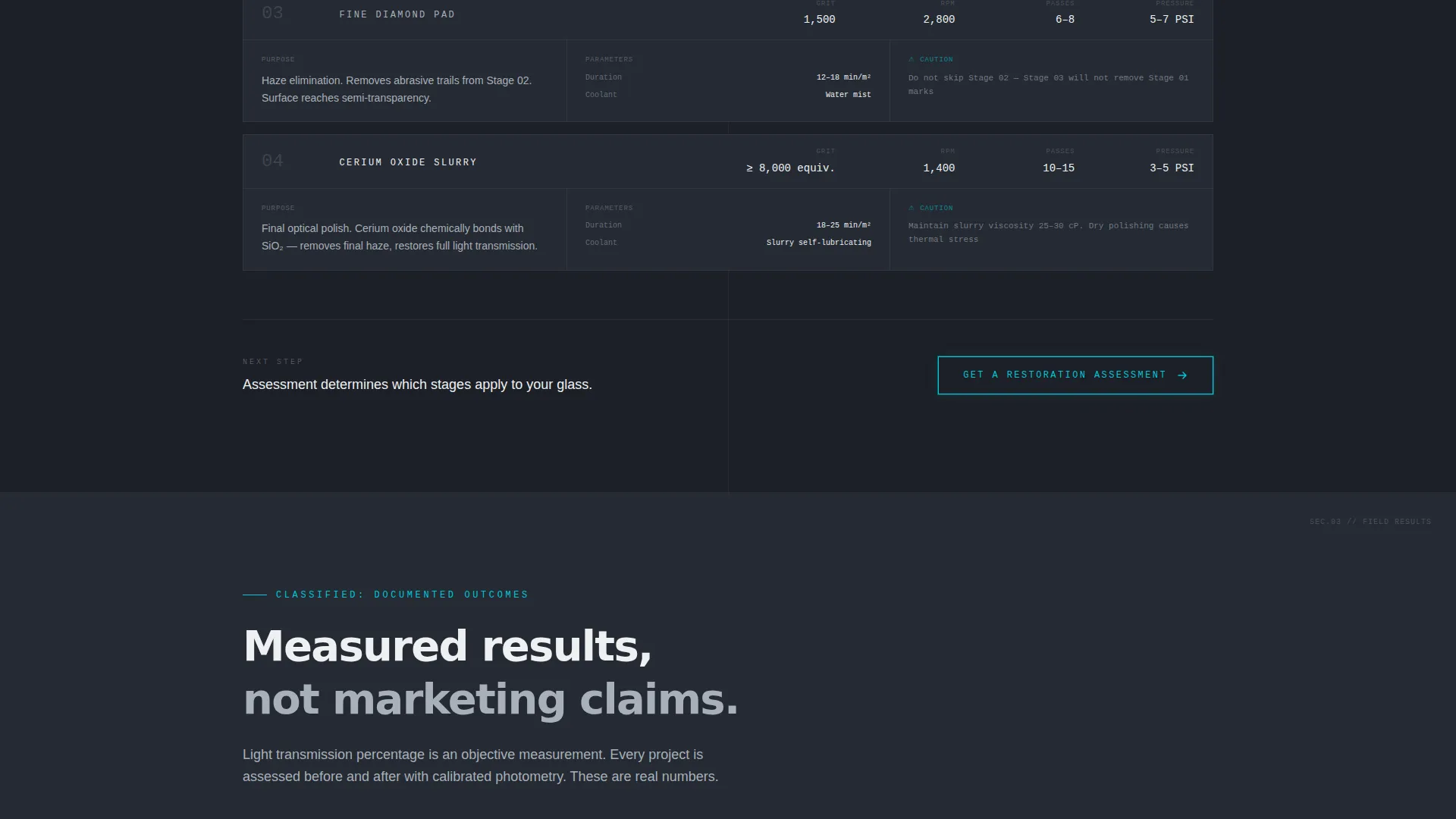
Three scroll-driven sections peel back the restoration method one layer at a time. Section one shows microscopic cross-section diagrams of how scratches sit at measurable depths in glass. Section two presents the abrasive sequence as a blueprint spec sheet listing grit size, rotations per minute, and pass count. Section three displays before-and-after macro photography with measurable light transmission percentages overlaid.
Blueprint Spec Sheet Layout
Each process section renders technical details in a blueprint spec sheet format. Grit grades, RPM values, and pass counts are displayed like engineering tolerances rather than marketing bullet points. This layout reinforces the message that restoration is a precise, repeatable procedure.
Repeating Anchored call to action
The "Get a Restoration Assessment" call to action appears first in the hero after zip code validation and then repeats at the bottom of each process section. The repetition is deliberate: by the third appearance, the visitor has consumed enough technical evidence to act without hesitation.
Monochrome Steel Design System
The entire page runs on a four-value color palette: structural charcoal, brushed aluminum, technical white, and laser-line cyan. Cyan appears only on interactive states, measurement annotations, and call-to-action borders. The restraint keeps every visual accent meaningful and prevents decoration from diluting the technical authority of the content.
Page sections overview
| Section | Purpose |
|---|---|
| Hero with Input | Establish damage reality and filter by service coverage |
| Glass Anatomy Diagrams | Show scratch depth as a measurable, solvable engineering problem |
| Abrasive Sequence Specs | Present the polishing process as a documented technical procedure |
| Before and After Results | Prove outcome quality with light transmission data overlaid on macro photography |
| Assessment call to action Footer | Convert informed visitors with a final, low-friction click-through prompt |
Design & branding system
The template uses an Engineering Blueprint theme rendered through a Monochrome Steel palette. The visual language is deliberately cold and precise, referencing a machinist's drafting table rather than a home services brand.
- Colors: structural charcoal (#1C1F26) for backgrounds, brushed aluminum (#A8B0B8) for mid-tone surfaces, technical white (#EDF0F2) for body text, and laser-line cyan (#00C6D7) reserved for interactive states, measurement annotations, and call-to-action borders
- Typography and layout follow blueprint drafting conventions, with measurement-style annotations and spec-sheet grids replacing conventional marketing copy blocks
- No warm tones, decorative gradients, or stock imagery of smiling technicians; the damaged glass itself serves as the primary visual statement
Mobile & speed optimization
The hero-dominant, single-section-flow layout is structured for clean vertical stacking on smaller screens. The 90/10 content ratio keeps the page lean, with most screen real estate dedicated to visual proof rather than text-heavy blocks.
- The full-viewport hero scales to fill mobile screens without cropping the critical glass-damage texture
- Blueprint spec sheet sections reflow into single-column layouts on narrow viewports, preserving readability of technical values
- The repeating call to action anchors remain visible at the bottom of each section on all screen sizes, reducing the distance a mobile visitor must scroll to reach an action point
How this template helps you convert
The page is engineered to move a skeptical, cost-conscious visitor from doubt to a deliberate click on "Get a Restoration Assessment." Every design and content decision serves that single conversion goal.
- The zip code validation step creates a micro-commitment before the call to action appears, making the visitor feel pre-qualified rather than cold-pitched.
- The three-section process reveal builds authority progressively, so by the time the visitor reaches the final call to action, the scientific case for restoration over replacement has already been made in full.
Other information about this template
This template is specifically designed for the glass restoration service niche within the broader Construction and Home category. It suits providers working across glass products and services who want a landing page that sells on expertise rather than price.
- The page type is a click-through landing page; there is no contact form on this page, keeping the layout focused and the path to conversion unambiguous
- The assessment page linked from the call to action is a separate build; this template covers the awareness and consideration stage only
- The Engineering Blueprint theme and Monochrome Steel palette are fully customizable to match a specific provider's brand colors and logo placement
- The template works for both residential glass restoration leads and commercial property glass restoration projects without requiring separate page versions
Theme
Engineering Blueprint
Creative direction
Transparent Process
Color system
Monochrome Steel
Style
Hero-Dominant (90/10)
Direction
Click-Through
Page Sections
Full-viewport Damaged-glass Hero
Zip Code Coverage Input Field
Three-stage Process Reveal Sections
Blueprint Spec Sheet Layout
Repeating Anchored Call to Action
Monochrome Steel Color System
Related questions
Is this template suitable for a residential glass restoration business?
Does this template include the assessment page linked from the call to action?
Can I customize the zip code input to connect to my actual service area?
Can I change the color palette if my brand uses warmer tones?
Does the template work for both commercial property and residential glass restoration leads?