PTSD Care Reviews Website Template
Regulate is a single-column landing page template built for trauma-informed fitness programs. It pairs a giant centered headline with a scrolling expert panel, peer-reviewed citation cards, and a five-question nervous system readiness assessment. Designed for PTSD care programs serving combat veterans, first responders, and assault survivors, it converts cautious visitors into program participants through clinical credibility and calm design.
by Rocket studio
Quick summary
Regulate is a focused single-column landing page template for trauma-informed fitness programs targeting PTSD recovery. It opens with a stark, typographically dominant hero, builds trust through a scrolling clinical expert panel, and closes with a five-question nervous system readiness assessment. Every section is designed to feel safe, credible, and quietly persuasive.
Who this template is for
This template is built for practitioners and program creators working at the intersection of clinical psychology and movement therapy. If your program serves people whose relationship with exercise is complicated by trauma, this layout gives you the professional foundation to reach them.
- Trauma-informed fitness programs serving combat veterans, first responders, or assault survivors
- Mental health professionals who want a structured referral page for movement-based PTSD care
- Strength coaches and kinesiologists working under clinical supervision on nervous system recovery programs
What problem this template solves
People living with post-traumatic stress disorder (PTSD) are often the hardest audience to reach with fitness content. Standard gym marketing triggers hypervigilance, not motivation. This template solves the trust and safety problem before it ever becomes a conversion problem.
- Generic fitness landing pages feel threatening to trauma survivors, creating friction before a single word is read
- Programs with strong clinical backing lack a page structure that communicates that credibility clearly and quickly
- The five-question assessment removes the pressure of a hard commitment, giving hesitant visitors a low-stakes entry point
What you get with this template
You get a complete single-column landing page flow designed specifically for a PTSD exercise program. Every section has a defined clinical purpose, and the layout guides the visitor from initial safety to confident action without crowding or overwhelming them.
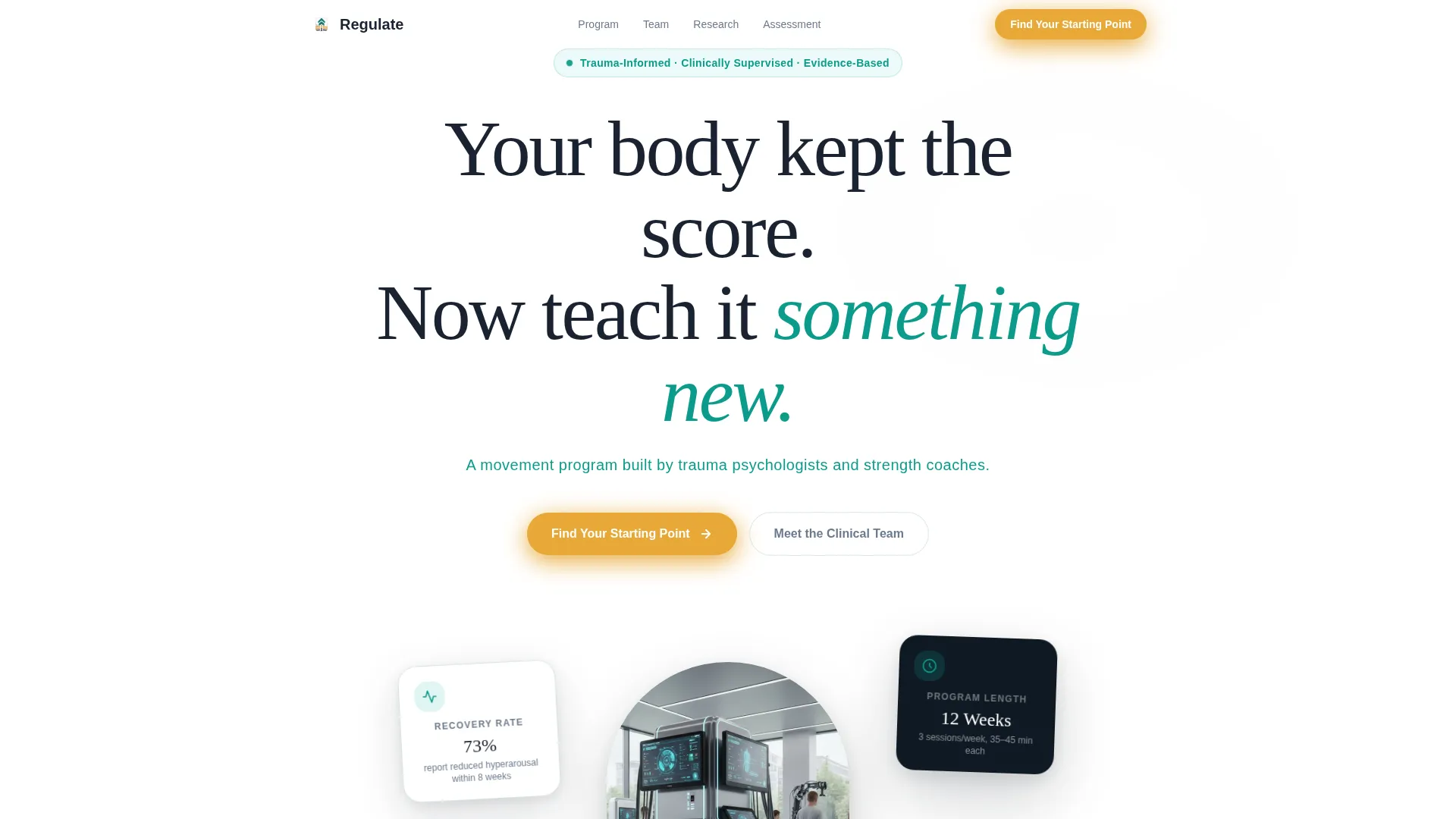
- A hero section with a viewport-scale headline, a one-line program descriptor in teal, and intentional white space that gives the nervous system room to settle
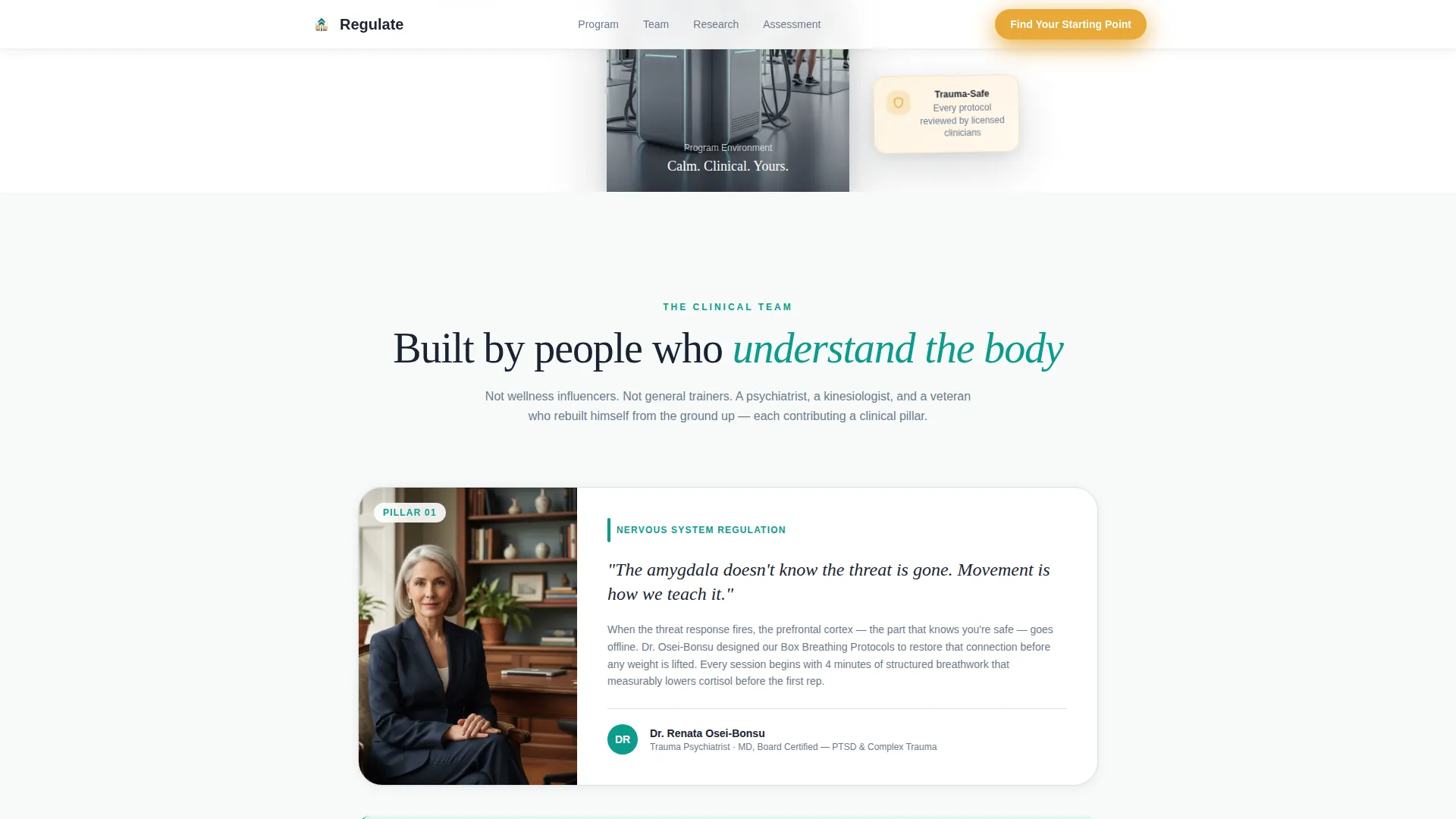
- A scrolling expert panel with individual clinical team sections, short video segment placeholders, and sliding peer-reviewed citation cards between each expert reveal
- A five-question quiz assessment flow that displays one question at a time, with no visible progress bar, leading to a personalized program tier recommendation
Feature list
This template delivers a focused set of components grounded directly in the source brief. Each one serves the clinical and conversion goals of a trauma-informed fitness landing page.
Giant Centered Hero Headline
The hero opens with a single, viewport-dominating typographic statement set in a weighted sans-serif on a stark white background. No imagery competes for attention. The emptiness is structural, giving visitors nothing threatening to visually scan.
Scrolling Expert Panel
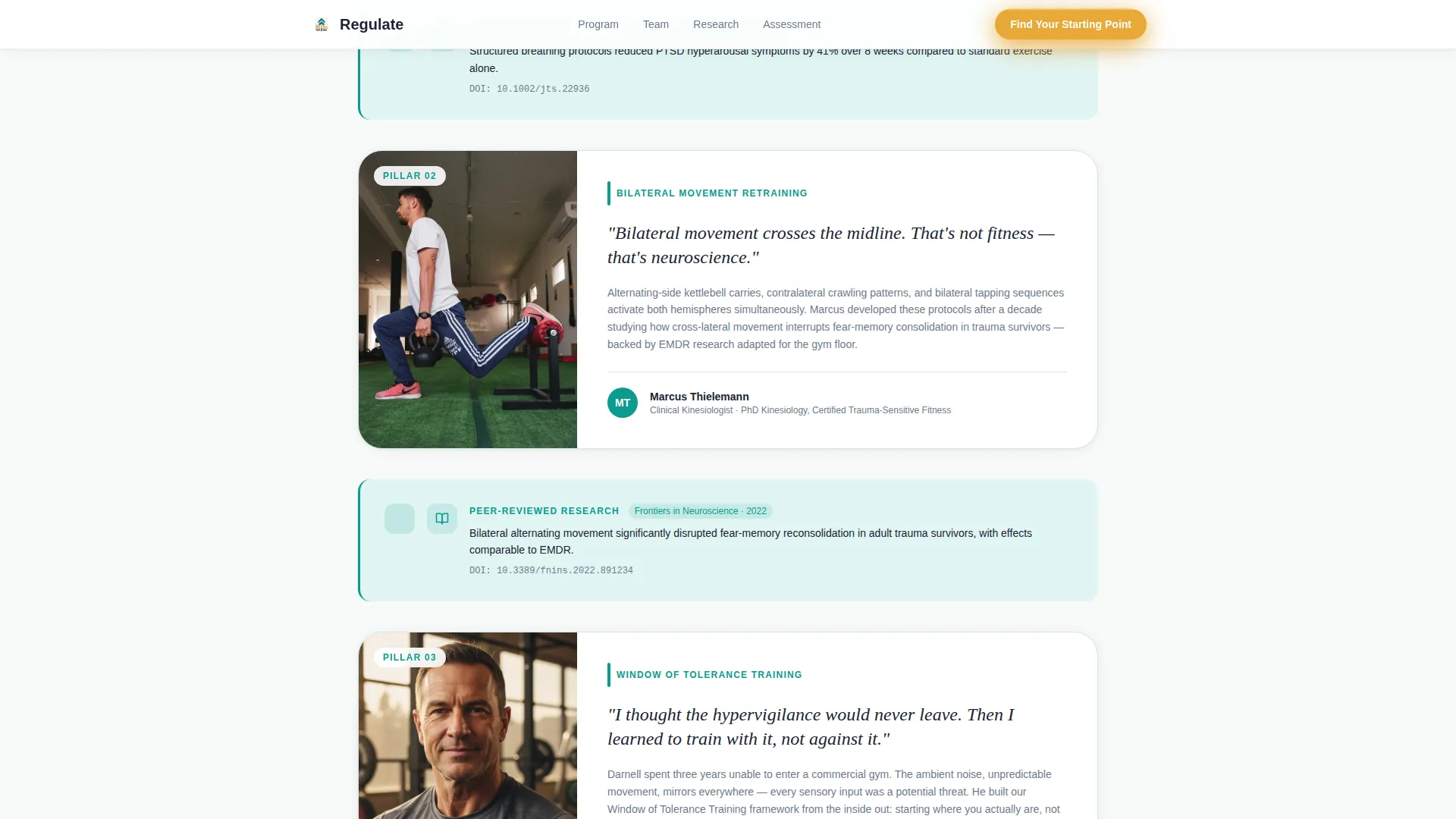
Clinical team members are introduced one by one as the visitor scrolls. Each expert section holds a short video segment placeholder, a program pillar summary, and a credibility layer that stacks trust progressively rather than overwhelming at once.
Peer-Reviewed Citation Cards
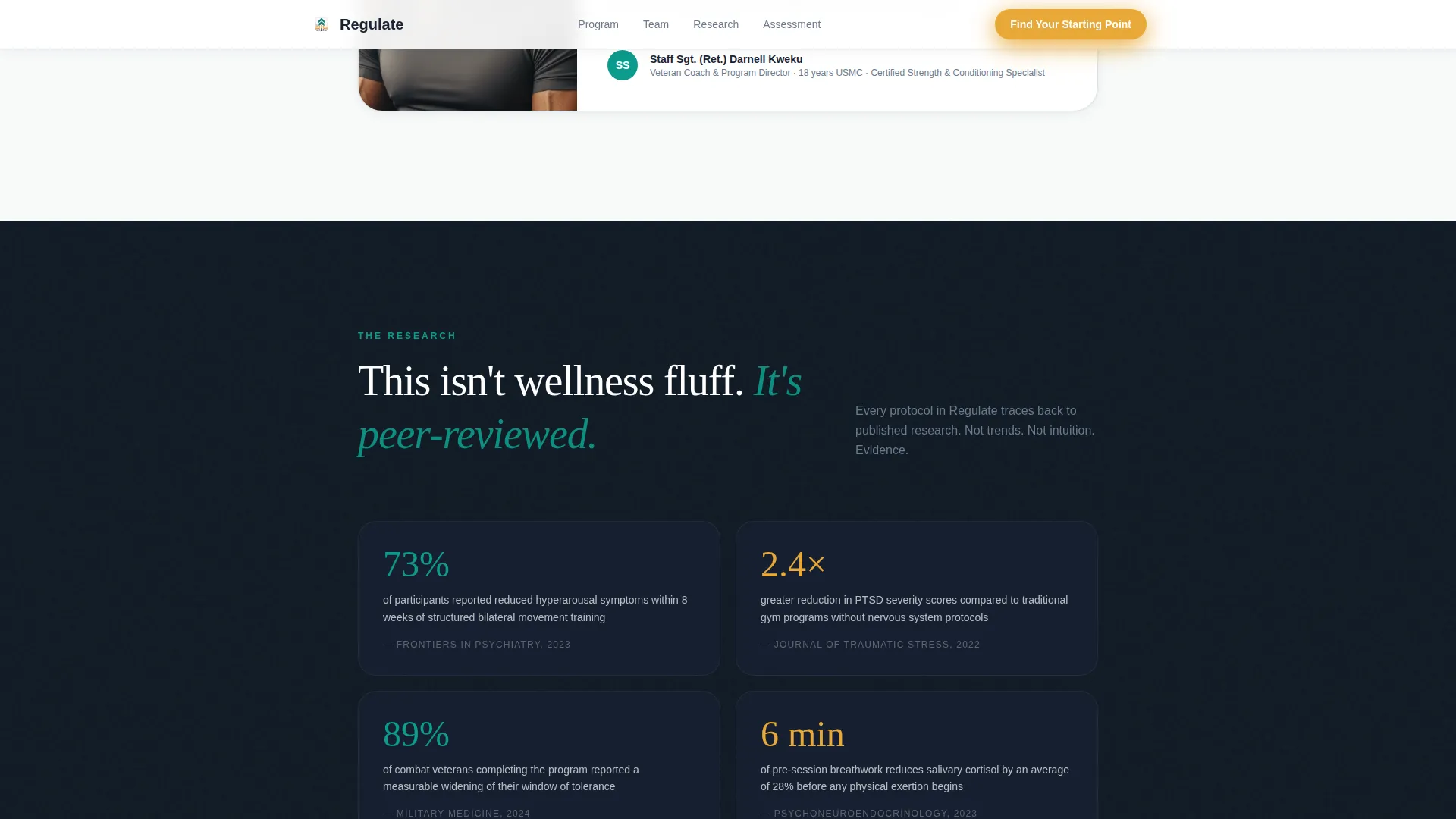
Between expert sections, citation cards slide in on scroll. These are not decorative. They serve as evidence anchors, separating this program from general wellness content and reinforcing its clinical methodology.
Five-Question Readiness Assessment
The primary call to action leads into a single-question-at-a-time quiz flow. Questions cover exercise frequency, movement barriers, and nervous system tendency. One optional question addresses primary trauma category and can be skipped. Results deliver a personalized program tier recommendation.
Program Pillars Bento Grid
A varied bento grid section presents what the program contains in a structured, scannable layout. It communicates the clinical movement protocols, breathing work, and bilateral movement techniques without feeling like a feature list.
Secondary Clinical Team Path
Alongside the primary assessment call to action, a secondary option reads "Talk to Our Clinical Team First." This path serves visitors who are not ready to begin independently, reducing drop-off among the most hesitant segment of the audience.
Page sections overview
| Section | Purpose |
|---|---|
| Hero Headline | Establish safety and program identity through typography alone |
| Expert Panel | Build clinical credibility through scrolling individual expert reveals |
| Research Proof | Anchor methodology with peer-reviewed citation cards |
| Program Pillars | Communicate movement protocol content in a bento grid layout |
| Assessment Call to Action | Convert visitors through a low-pressure five-question quiz flow |
| Footer | Provide horizontal navigation and closing program context |
Design & branding system
The visual identity follows a Medical Clarity theme. The palette is built to feel like a clinical space that is also genuinely welcoming, a balance that is essential when your audience has a complicated relationship with institutions.
- Primary color is clinical teal (#0D9B8C), used for the program descriptor line, section accents, and interactive highlights
- Deep charcoal (#1A2332) handles all body text, reading authoritative without aggressive contrast; soft antiseptic white (#F7FAFA) covers backgrounds
- Warm signal amber (#E8A838) is reserved exclusively for call-to-action buttons and progress indicators, creating a clear visual hierarchy for action moments
Mobile & speed optimization
The template is built mobile-first, which is a deliberate clinical decision. Trauma survivors often access sensitive health content privately on personal phones rather than shared desktop screens. The layout respects that context.
- Single-column flow eliminates complex grid breakpoints and keeps the mobile reading experience clean and predictable
- Scroll-triggered reveal animations use CSS-preferred implementation for smooth performance without heavy script dependencies
- Lazy image loading is built into the template structure to support fast first paint on mobile connections
How this template helps you convert
The conversion strategy in this template is structured around earning trust before asking for anything. That sequencing is not accidental. It mirrors the clinical principle of establishing safety before introducing challenge.
- The hero section delivers the program's core promise immediately, with no imagery distraction, so the visitor's nervous system registers calm rather than threat before they read a single word
- The expert panel and citation cards build layered credibility across the scroll journey, so by the time the assessment call to action appears, the visitor has already received substantial proof
- The five-question assessment acts as a low-commitment conversion bridge, replacing a hard sign-up with a personalized recommendation that feels like care rather than a sales funnel
Other information about this template
The Regulate template is categorized under Health & Medical, specifically the PTSD Care subcategory, with a niche focus on PTSD exercise programs. It sits at a high-specificity intersection of clinical credibility and fitness conversion design.
- Typography pairing uses Fraunces as the serif display face and DM Sans for body text, creating a contrast between emotional weight and clinical clarity
- Scroll-triggered animations are set to a medium intensity, with staggered expert card reveals and floating element depth effects that feel considered rather than flashy
- The footer follows a horizontal flow pattern, providing program navigation and closing context without adding visual noise at the end of a carefully calibrated page
- The template is built for English (United States) localization, using USD currency formatting and MM/DD/YYYY date display where applicable
Theme
Medical Clarity
Creative direction
Expert Panel
Color system
Teal Catalyst
Style
Single Column Flow
Direction
Quiz/Assessment
Page Sections
Giant Centered Hero Headline
Scrolling Expert Panel
Peer-reviewed Citation Cards
Five-question Readiness Assessment
Program Pillars Bento Grid
Secondary Clinical Team Path
Related questions
Who is the primary audience this template is designed to reach?
Can I customize the five-question assessment content?
Does the template include the expert video content?
Is this template suitable for a solo practitioner or small clinic?
What makes this different from a standard fitness landing page template?