Hospital & Health System Professional Website Template
A single-page landing page built for inpatient rehabilitation facilities. It opens with a three-step patient intake form, then guides visitors through expert panels and side-by-side outcome comparison tables. The design uses a precise clinical palette and clear calls to action, helping discharge planners, physicians, and family caregivers move confidently from first contact to a submitted referral.
by Rocket studio
Quick summary
This template is a clinically precise, referral-driven landing page built for a 120-bed inpatient rehabilitation facility. It leads with a self-qualifying multi-step intake form, then walks visitors through specialty expert panels and outcome comparison tables. The structure moves users from emotional reassurance to evidence-based confidence, ending with a clear path to the referral portal.
Who this template is for
This template speaks directly to the people who make rehabilitation placement decisions. Whether someone is racing an insurance deadline or Googling at 2 a.m. from a hospital waiting room, the page meets them at their exact level of urgency.
- Hospital discharge planners and referral coordinators who need fast admission confirmation and outcome data
- Adult children and family caregivers researching post-acute options for a parent in acute care
- Primary care physicians comparing functional outcome metrics across post-acute settings
What problem this template solves
Rehabilitation facilities often lose referrals not because of poor outcomes, but because their web presence cannot communicate clinical authority quickly enough. Discharge planners have narrow windows. Families feel overwhelmed. Physicians need hard numbers, not marketing language.
- No structured intake path to self-qualify the patient type before presenting clinical data
- No side-by-side comparison that makes this facility's outcomes feel measurably superior to skilled nursing or long-term acute care alternatives
- No layered conversion flow that serves both emotional and analytical decision-makers on the same page
What you get with this template
This landing page delivers a complete referral conversion system in a single structured scroll. Every section earns the next click rather than demanding it.
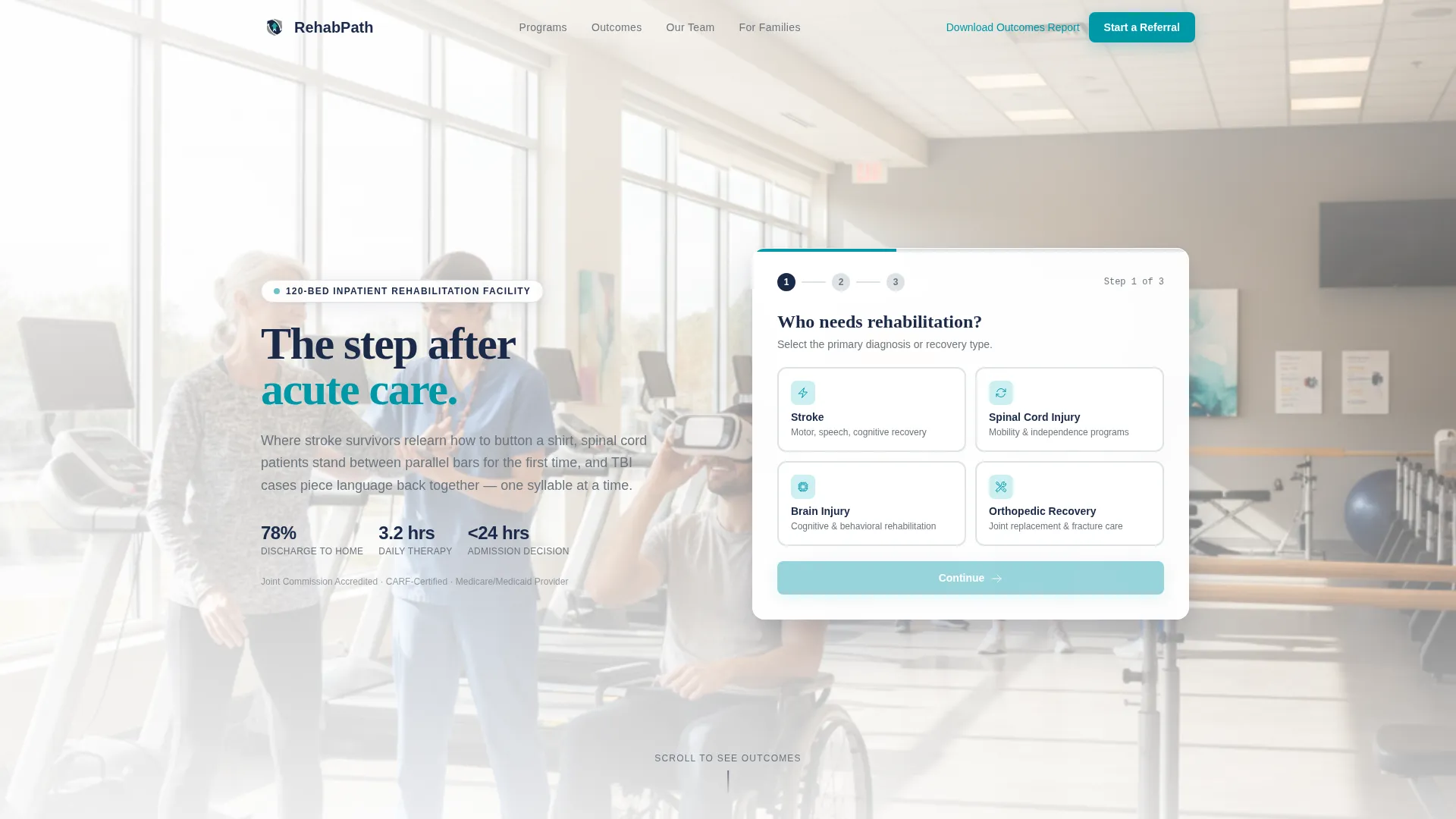
- A three-step multi-step intake form with tile-based patient selection, animated teal progress bar, and step transitions
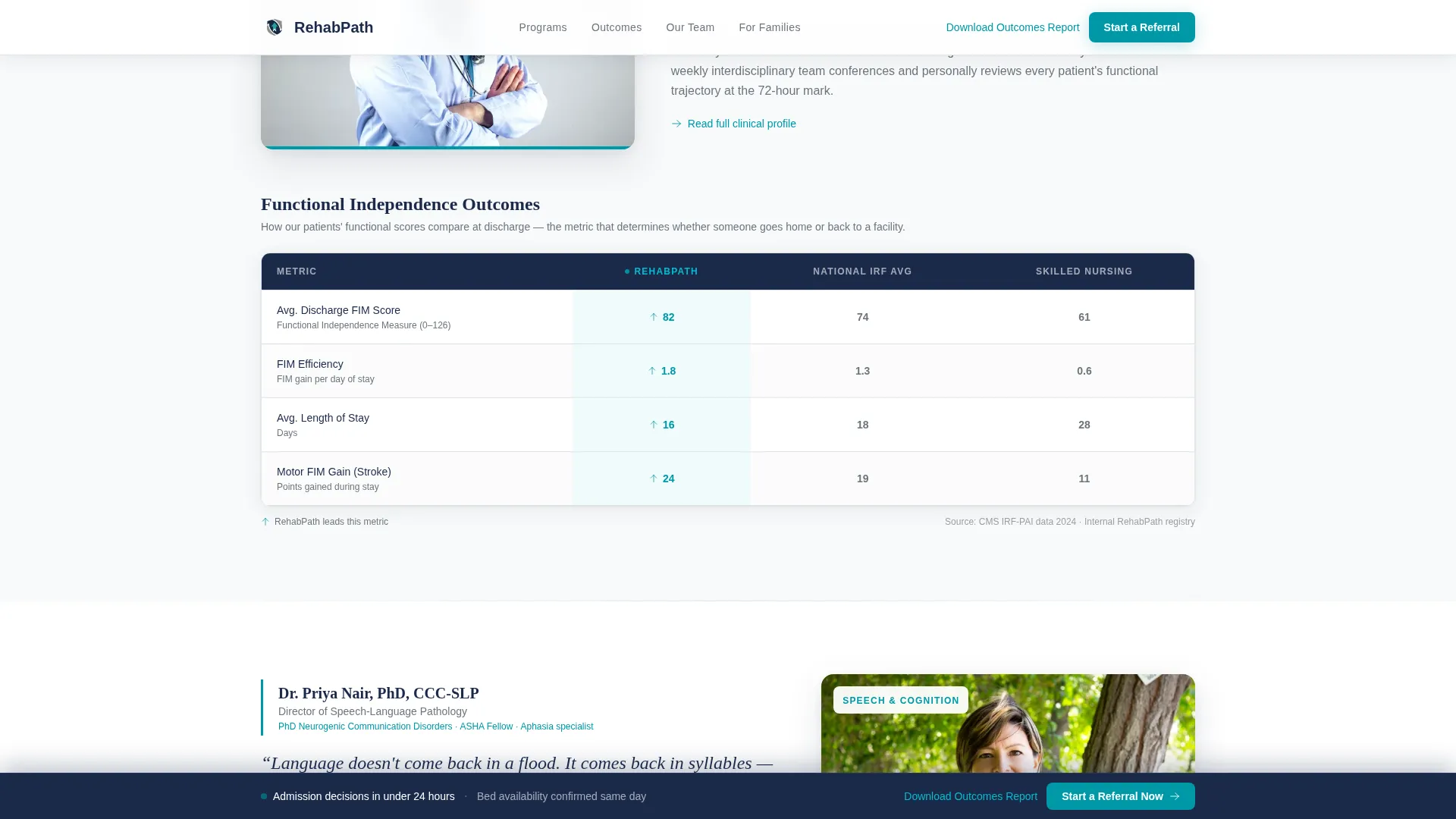
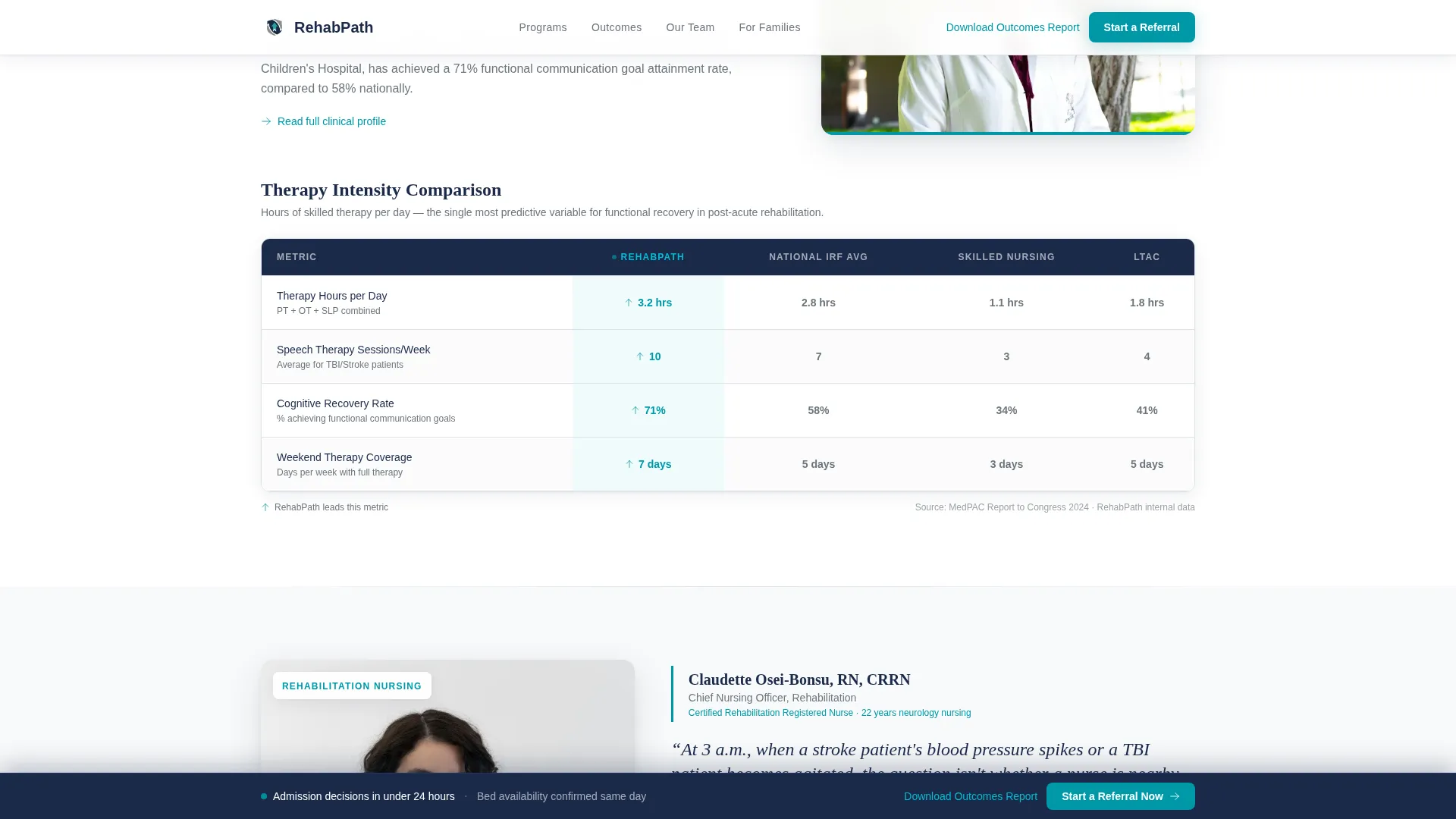
- Three expert panel sections, each paired with a comparison table showing Functional Independence Measure scores, therapy hours per day, and discharge-to-home rates against national benchmarks
- A closing call-to-action section with a 24-hour referral turnaround message and an email-capture path for an outcomes report download
Feature list
This section describes the core functional components built into this landing page template.
Three-Step Patient Intake Form
The header section presents a multi-step intake form floating over a soft-focus rehabilitation gym photograph. Step one asks "Who needs rehabilitation?" using four condition tiles: Stroke, Spinal Cord Injury, Brain Injury, and Orthopedic Recovery. Step two asks "Where are they now?" with four setting tiles: Intensive Care Unit, Acute Care, Skilled Nursing, and Home. Step three captures name, phone number, and insurance carrier. Each step advances with a teal progress bar animation, keeping the experience sequential and purposeful.
Expert Panel with Named Clinicians
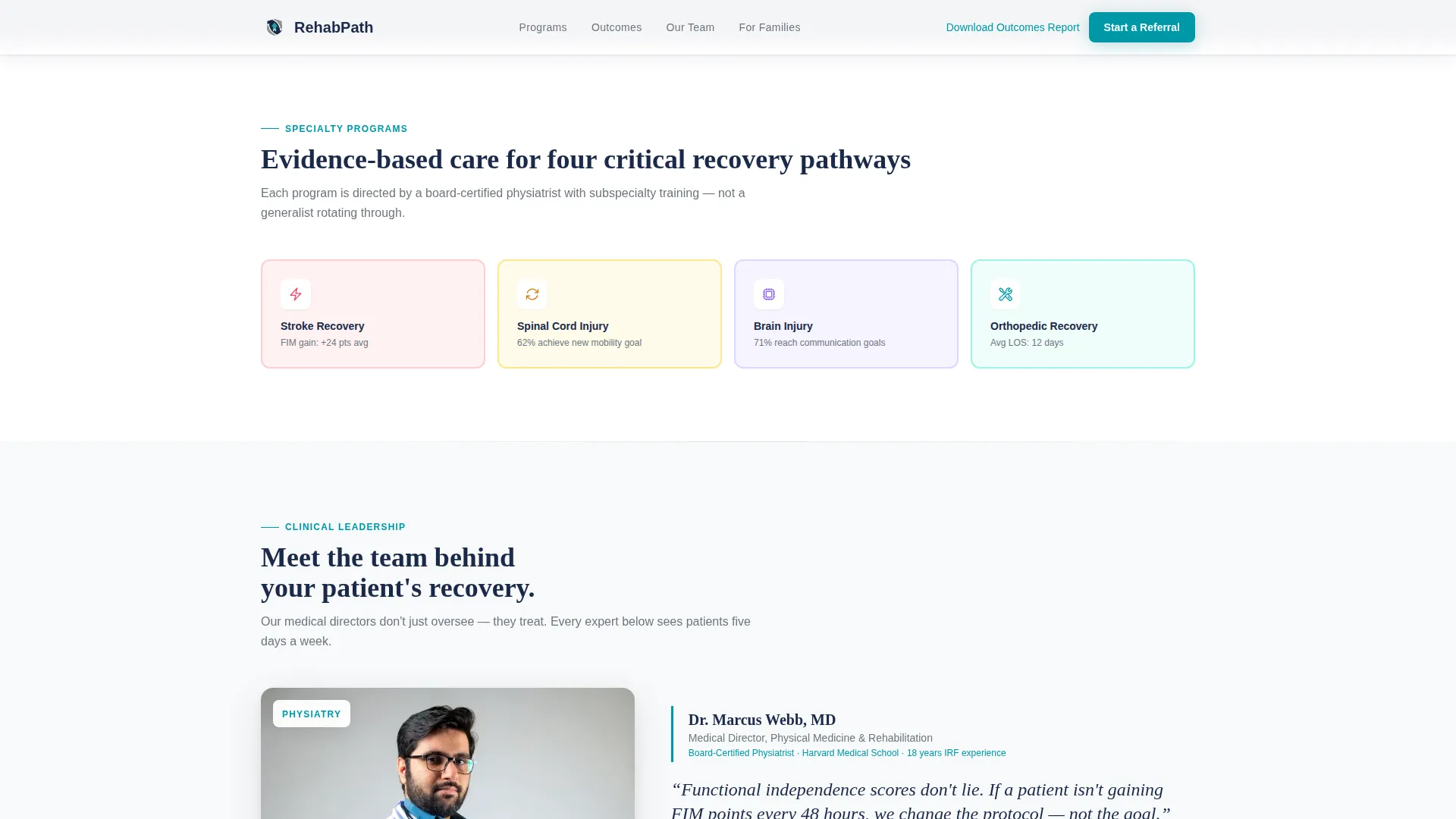
Three distinct expert panel sections introduce named medical directors and lead therapists by specialty. A physiatrist explains outcome metrics, a speech-language pathologist outlines cognitive recovery timelines, and a rehabilitation nurse describes 24-hour neurological monitoring. Each panel uses the Fraunces typeface for pull quotes and headers, lending the editorial weight of a peer-reviewed journal without losing human warmth.
Side-by-Side Outcome Comparison Tables
Comparison tables appear between each expert panel. They place this facility's reported metrics, including Functional Independence Measure scores, therapy hours per day, and discharge-to-home rates, directly against national benchmarks and competing post-acute settings such as skilled nursing facilities and long-term acute care hospitals. Hover states on table rows add interactivity without distracting from the data.
Layered Call-to-Action Architecture
The primary call to action, "Start a Referral Now," appears three times: inside the multi-step form completion screen, as a sticky bottom bar after the first comparison table, and again in the closing section. A secondary path, "Download Our Outcomes Report," captures email addresses from discharge planners who need data before committing. The two paths serve different decision stages without competing with each other.
Scroll-Reveal Section Transitions
Each content block enters the viewport with a scroll-reveal animation. The escalating emotional-to-analytical structure is reinforced visually, so the page feels like a guided clinical conversation rather than a static brochure.
Page sections overview
| Section | Purpose |
|---|---|
| Hero Intake Form | Self-qualify patient type in three animated steps |
| Expert Panel One | Physiatrist presents Functional Independence Measure outcomes |
| Comparison Table One | This facility versus. national benchmarks on key metrics |
| Expert Panel Two | Speech-language pathologist on cognitive recovery timelines |
| Comparison Table Two | Therapy hours per day versus. skilled nursing and long-term acute care |
| Expert Panel Three | Rehabilitation nurse describes 24-hour neurological monitoring |
| Comparison Table Three | Discharge-to-home rates across post-acute settings |
| Closing call to action Section | 24-hour turnaround promise and outcomes report email capture |
| Linear Footer | Single-row footer with key links and contact information |
Design & branding system
The visual identity follows a Corporate Precision theme. Every surface is clean and deliberate. Color is used as a functional signal, not decoration, so the eye always knows where to go next.
- Arctic White palette: surgical white (#F8F9FA) for backgrounds, deep clinical navy (#1B2A4A) for headers and data-heavy sections, instrument-grade steel (#6C757D) for body text and table borders, and vitals-monitor teal (#0097A7) reserved exclusively for calls to action and progress indicators
- Typography pairing: DM Sans for body copy and interface elements, Fraunces for expert panel quotes and section headers, creating a contrast between clinical precision and human authority
- Generous whitespace and sharp edges throughout, with no decorative clutter competing for attention
Mobile & speed optimization
The template is designed desktop-first to serve discharge planners working at hospital workstations. At the same time, the mobile layout is fully considered for family caregivers researching on a phone at any hour.
- Tile-based form steps restack cleanly on smaller screens, preserving the self-qualification flow without horizontal scrolling
- Images, including the rehabilitation gym hero photograph, are lazy-loaded to keep the initial page render fast
- The sticky call-to-action bar remains accessible on both desktop and mobile without obscuring content
How this template helps you convert
The conversion architecture on this page works in sequence. Each section earns the visitor's next action before asking for it.
- The multi-step intake form at the top front-loads self-qualification, so visitors invest in the process before seeing a single statistic, reducing drop-off before the data sections
- Expert panels paired with comparison tables shift the visitor's mindset from emotional anxiety to informed confidence, making the referral feel like a rational clinical decision rather than a leap of faith
- Three placements of "Start a Referral Now," including the sticky bottom bar and closing section, ensure the call to action is always one scroll away, while the outcomes report email capture provides a lower-commitment conversion path for analytical decision-makers
Other information about this template
This template is suited to inpatient rehabilitation facilities operating in competitive post-acute markets where differentiation on clinical data is a strategic priority.
- The page is structured for a B2B and B2C hybrid audience, meaning it addresses referral coordinators and physicians alongside family caregivers within the same scroll
- Footer follows a linear single-row pattern, keeping the bottom of the page clean and uncluttered
- The US English localization, United States date format, and US dollar context are built into the content structure, making it ready for domestic healthcare markets without modification
Theme
Corporate Precision
Creative direction
Expert Panel
Color system
Arctic White
Style
Comparison Table
Direction
Click-Through
Page Sections
Three-step Multi-step Intake Form
Expert Panel Sections with Named Clinicians
Outcome Comparison Tables
Layered Call-to-action Placement
Scroll-reveal Animations and Sticky Bar
Related questions
Who is this landing page template designed for?
Can the comparison tables be updated with actual facility outcome data?
What does the multi-step intake form collect from visitors?
Is this template suitable for a facility treating multiple diagnosis types?
How many times does the primary call to action appear on the page?