Psychiatrist Cost Calculator Website Template
The Reimburse Smart Billing Clarity Psychiatrist Landing Page Template is built for solo psychiatrists, group practice owners, and newly licensed PMHNPs who are losing revenue to denied claims and billing confusion. It combines an interactive reimbursement estimator, five-phase comparison tables, and two lead generation paths into one focused, educational landing page designed to turn billing anxiety into confident action.
by Rocket studio
Quick summary
The Reimburse template gives psychiatrists and mental health providers a single-page billing education hub. It opens with a live reimbursement calculator, walks visitors through five phases of medical billing via comparison tables, and closes with two conversion paths: a billing audit form and a downloadable CPT cheat sheet. Every section is designed to make the cost of billing errors visible and the next step obvious.
Who this template is for
This template speaks directly to the people most affected by complex mental health billing. It was built for practitioners who need clarity before they can act.
- Solo-practice psychiatrists who recently left a hospital system and are navigating credentialing for the first time
- Group practice owners watching a significant share of revenue disappear to claim rejections and insurance companies delaying payments
- Newly licensed PMHNPs (Psychiatric-Mental Health Nurse Practitioners) choosing between insurance panels and trying to understand out of network reimbursement rules
What problem this template solves
Navigating insurance reimbursement can feel overwhelming for both therapists and clients. Psychiatrists spend years training in mental health treatment but receive almost no instruction in medical billing. The result is a practice that delivers excellent care but struggles to get paid quickly and consistently.
- Denied claims pile up because CPT code selection, modifier 95 telehealth rules, and diagnosis codes are misapplied, and nobody flags the error before submission
- Missed payments and delayed reimbursement drain cash flow, especially for solo practices without a dedicated billing team
- Superbill template gaps, missing client information, and incomplete treatment plan documentation cause insurance companies to reject or stall valid claims
What you get with this template
This template packages a full billing education and lead generation system into a single, structured landing page. It is ready to deploy and easy to customize for your practice or your clients' practices.
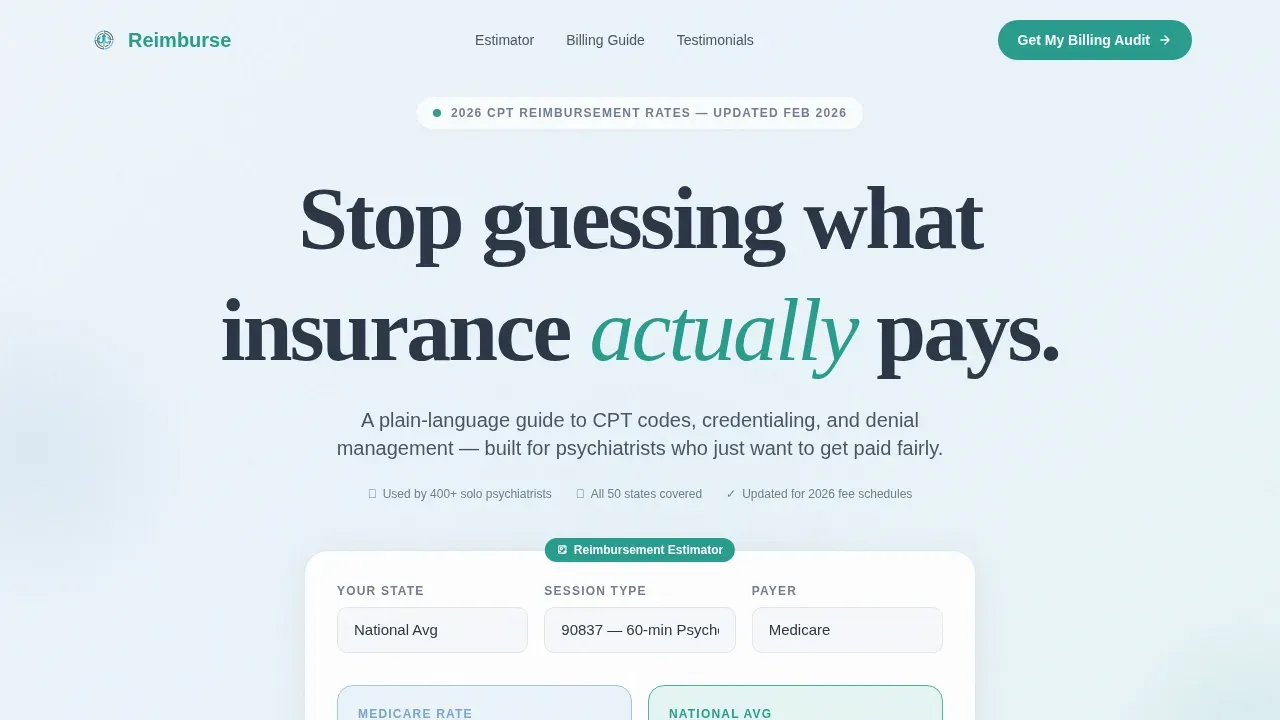
- An interactive reimbursement estimator in the hero section that lets visitors select state, session type, and payer to see estimated rates beside national averages
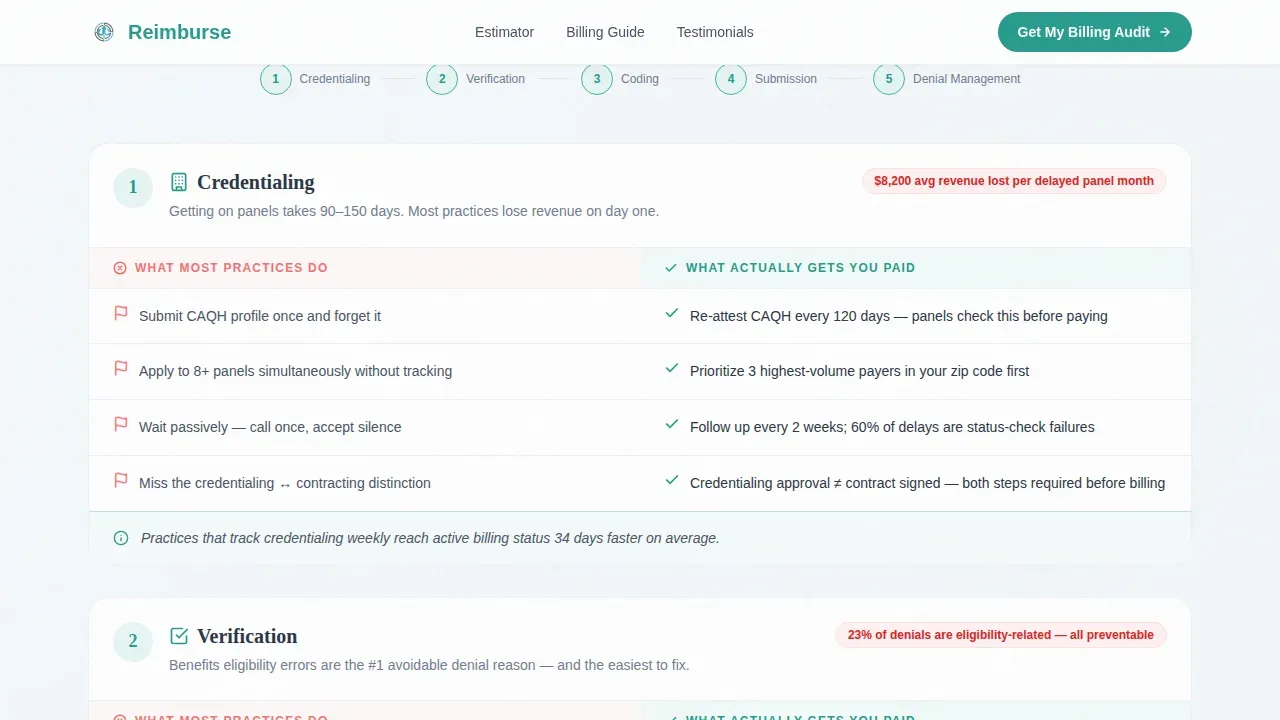
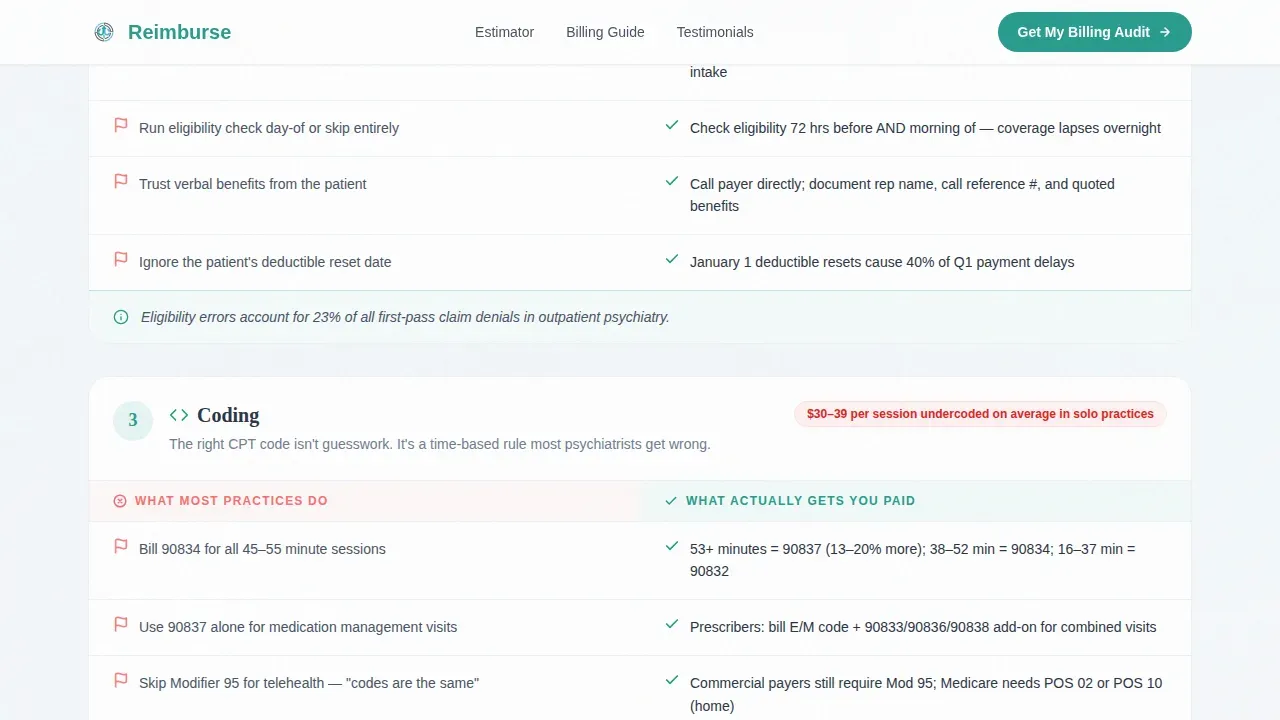
- Five-phase comparison tables covering credentialing, verification, coding, submission, and denial management, each showing what most practices do versus what actually gets paid
- Two conversion sections: a primary billing audit request form and a secondary email-gated downloadable cheat sheet for visitors not yet ready for a call
Feature list
This template includes purpose-built components that focus on education, transparency, and lead capture for mental health billing services.
Interactive Reimbursement Estimator
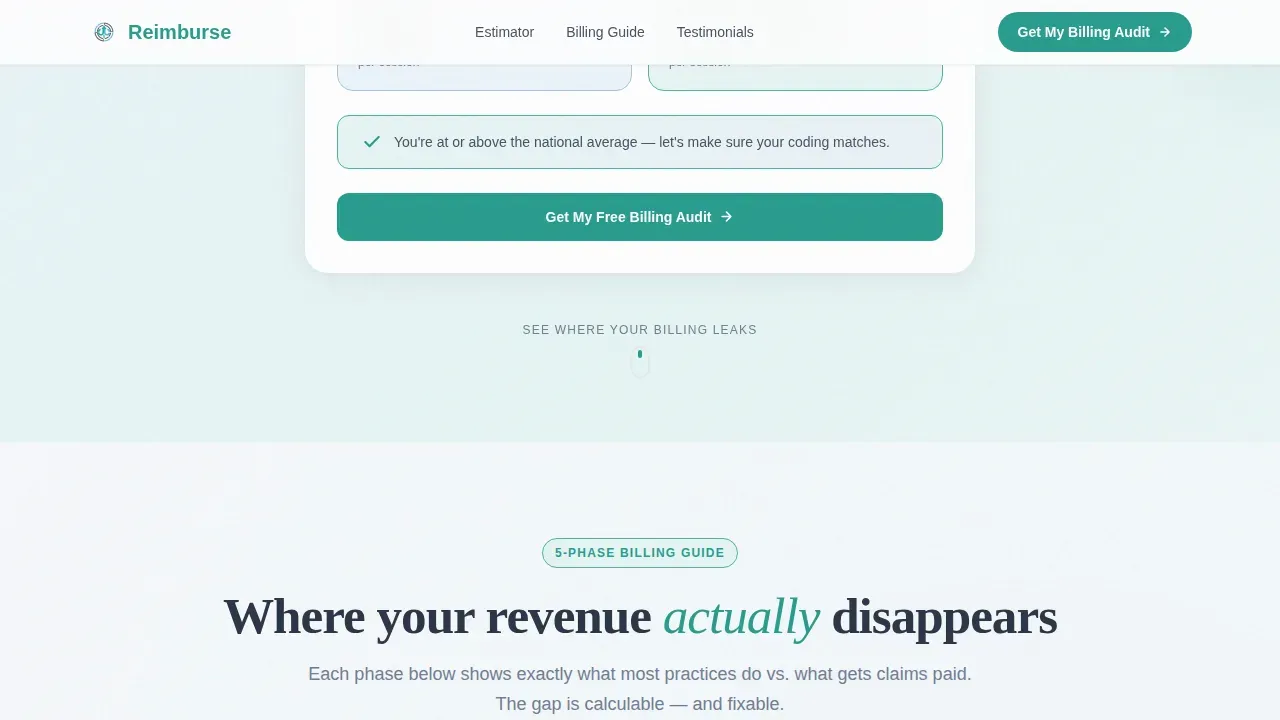
The header opens with a clean calculator tool. Visitors select their state, session type (such as CPT code 90837, 90834, or Evaluation and Management codes with add-ons), and payer (Aetna, BCBS, UHC, or Medicare). Estimated reimbursement rates animate upward like a register tallying, and a single line below the result shows how much revenue the visitor may be leaving on the table each month based on a default 25-patient weekly caseload.
Five-Phase Billing Comparison Tables
Scrolling past the calculator reveals five numbered phases of the psychiatric medical billing process. Each phase is presented as a comparison table row showing "What Most Practices Do" against "What Actually Gets Paid." Green checkmarks and red flags make the gap between current habits and correct billing visible and calculable, not abstract. The scroll builds a compounding realization as each section uncovers another leak in the current system.
Dual Lead Generation Paths
The primary call to action, "Get My Billing Audit," appears both below the calculator and after the final comparison table. The form collects practice name, number of providers, current clearinghouse selection (including an "I don't know" option), and an optional free-text field for the visitor's biggest billing frustration. A secondary path offers a downloadable 2024 Psychiatry CPT Reimbursement Cheat Sheet gated behind email only, capturing visitors who trust the page but are not yet ready for a call.
Outcome-Based Testimonial Section
A horizontal-scroll testimonial section features social proof grounded in specific dollar recovery amounts and named practice types. Patient testimonials focus on the experience and ease of the process rather than detailed clinical diagnoses, keeping the tone credible and compliant with professional standards.
Structured Note and Documentation Support
The template includes section space to communicate how structured note taking formats support billing compliance. For example, soap notes (Subjective, Objective, Assessment, and Plan) and birp notes (Behavior, Intervention, Response, and Plan) are referenced as documentation methods that help demonstrate medical necessity and support accurate records for claims.
Superbill and Cheat Sheet Download Block
A dedicated section presents the superbill template concept clearly. A superbill is a detailed invoice that gives clients all the information they need to seek reimbursement from their insurance provider. Therapists typically issue superbills to clients who pay out of pocket or use out of network benefits. The downloadable cheat sheet extends this value and serves as a secondary conversion asset.
Page sections overview
| Section | Purpose |
|---|---|
| Hero + Calculator | Estimator tool showing reimbursement rates by state, CPT code, and payer with animated results |
| Five-Phase Tables | Comparison tables across credentialing, verification, coding, submission, and denial management |
| Testimonials Block | Horizontal-scroll social proof with outcome-based quotes and dollar figures |
| Billing Audit Form | Primary lead generation form collecting practice details and billing frustration |
| Cheat Sheet Download | Secondary conversion block gated by email for CPT reimbursement reference |
| Footer | Linear single-row footer with practice and legal links |
Design & branding system
The visual identity follows an Educational Guide theme. The color palette uses soft, calming tones that promote a sense of safety, which research on mental health landing page design confirms is important for building trust with practitioners under stress.
- Colors: cumulus white (#F7F9FC) for backgrounds, pencil-graphite gray (#4A5568) for body text, calm sky blue (#7BA7CC) for secondary elements, and decisive teal (#2A9D8F) reserved for buttons, checkmarks, and active table highlights
- Typography: Fraunces serif for display headings creates an authoritative, editorial feel, while DM Sans handles body copy and interface elements with clean readability
- Visual tone: an organized notebook aesthetic, no clinical sterility, no urgency, just a quiet desk with structured thinking space where the eye rests and the mind trusts the information presented
Mobile & speed optimization
Since 63% of searches are conducted on mobile devices, this template is built with full mobile support despite its desktop-first priority. Psychiatrists reviewing billing data during admin hours typically use a desktop, but mobile access remains fully functional.
- Desktop-first layout optimized for wide comparison tables and the interactive calculator, with responsive stacking for smaller screens
- Scroll-triggered animations, counter animations, and staggered table row reveals use GSAP and are structured to load efficiently without blocking the primary content
- Server Components handle static sections for faster initial rendering, while the calculator runs as a Client Component to support live interactivity
How this template helps you convert
This template is engineered around a single insight: psychiatrists and mental health providers do not take action until they can see the financial cost of inaction in concrete numbers.
- The reimbursement estimator makes the revenue gap personal and immediate. Visitors do not read about billing problems in general terms; they see a specific dollar figure tied to their own weekly therapy sessions and caseload, which moves them from passive interest to active concern.
- The five-phase comparison tables build a compounding case for change. Each phase adds another layer to the problem, so by the time visitors reach the billing audit call to action, they have already mentally audited their own process and identified gaps in how they submit claims, document services provided, and manage denials.
- The dual conversion paths serve different levels of readiness. Visitors ready for help submit the billing audit form. Visitors who want to assess the problem themselves first download the cheat sheet, leaving their email and entering a lower-friction relationship with the service.
Other information about this template
This template is part of the Health and Medical category, under the Psychiatrist Website subcategory, with a niche focus on psychiatrist insurance and billing pages. It is designed for professional services and healthcare billing education contexts where the buyer is a practice owner or billing decision-maker.
- The reimburse smart billing clarity psychiatrist landing page template uses a Comparison Table style with a Step-by-Step Guide creative direction, meaning the information architecture rewards careful reading while still being skimmable
- The template supports note taking format references such as soap notes, birp notes, GIRP notes (Goals, Intervention, Response, Plan), and PIRP notes (Problem, Intervention, Response, Plan), giving the page authority with practitioners who document therapy sessions using structured clinical formats
- Offering clear billing options and price transparency helps build trust with clients who pay out of pocket, and the superbill template section supports this directly by explaining how clients can access out of network reimbursement without confusion
- The design supports trust signals such as professional affiliation display areas and HIPAA-compliant badge placement, which reassure patients about data privacy and help the practice build trust with new clients
- Automated claim scrubbing concepts are referenced in the comparison tables, highlighting built-in compliance checks that catch errors before submission and reduce the risk of legal requirements violations
- Real-time eligibility and authorization concepts appear in the verification phase, covering instant verification of benefits and session limits for clients
- Flexible payment plans, structured payment systems that reduce billing disputes, and automated invoicing reminders are all areas the template communicates to encourage clients to engage with the billing service
- Tips on maintaining accurate records, including the importance of the license number, diagnosis codes, and client details on every superbill template, are woven into the educational copy throughout the page
- The template can support a systematic approach to the full billing lifecycle, from credentialing through denial management, making it suitable for solo practitioners and group practice administrators alike
- Saving time through organized documentation, correctly completed soap notes and birp notes, and a reliable superbill template process is a consistent message the template reinforces across every phase
Theme
Educational Guide
Creative direction
Step-by-Step Guide
Color system
Cloud Canvas
Style
Comparison Table
Direction
Lead Generation
Page Sections
Interactive Reimbursement Estimator
Five-phase Billing Comparison Tables
Dual Conversion Lead Capture
Superbill and Documentation Section
Outcome-based Testimonials Block
SOAP and BIRP Note Reference Content
Related questions
What types of psychiatrists and mental health providers benefit most from this template?
Does the template include a working reimbursement calculator?
What is included in the downloadable cheat sheet conversion path?
Can I customize the comparison table content for my billing service?
How does the template address documentation and note taking compliance?