Professional Development Landing Page Template
The Pivot landing page template is built for career transition coaching practices serving mid-career professionals who are ready to leave a role behind and build something new. A card grid layout leads visitors through real client transformation stories, a 12-week methodology breakdown, and two conversion paths: a clarity call booking form and a downloadable readiness scorecard. The design pairs warm parchment tones with deep navy and decisive amber calls to action.
by Rocket studio
Quick summary
Pivot is a single-page coaching template that turns visitor skepticism into booked calls. It opens with a half-page portrait hero, moves through a modular card grid of real client career pivot stories, breaks down the coaching methodology in an accordion section, and closes every conversion moment with an amber "Book Your Free Clarity Call" button. A secondary email-gated scorecard keeps warm leads in the funnel.
Who this template is for
Career transition coaches and career pivot service providers need a page that does more than list credentials. This template is built for practitioners whose clients arrive feeling stuck, overwhelmed, and unsure whether their experience still matters in new industries. It gives those professionals a page that mirrors their own emotional journey and moves them toward action.
This template is a strong fit for:
- Independent career transition coaches running a 12-week or cohort-based program for mid-career professionals
- Workforce development organizations and outplacement firms that need a lead-generation landing page for career changers
- Coaching practices that work with professionals in leadership roles who are considering a move into new industries
What problem this template solves
Most career coaches rely on generic service pages that list offerings without connecting emotionally. Professionals in mid-career often face unique challenges: ageism, self-doubt, golden handcuffs, and the very real fear of losing seniority or income stability. A page that does not address those fears directly loses the visitor before the first scroll ends.
This template is built to close that gap:
- It addresses practical barriers like age bias and income instability by framing deep experience as an asset, not a liability
- It uses a case study card grid to accumulate proof, so visitors move from "could I?" to "which one of these sounds like me?" before they reach the call-to-action
- It offers two conversion paths, reducing friction for visitors who are not yet ready to book a call but are willing to share an email for a free resource
What you get with this template
The template delivers a fully structured landing page with every section pre-built and ready to customize. The layout follows a Case Study Narrative creative direction, meaning the page tells a story through real client arcs rather than abstract promises. Visual hierarchy is clear, white space is generous, and every element earns its place.
Here is what is included:
- A half-page photo-and-text hero section with a confident serif headline and a single amber call-to-action button
- A modular card grid (two rows of three cards) displaying client transformation stories with old job title, obstacle, new role, and timeline
- An accordion methodology section breaking down the 12-week framework, a three-step sequential lead capture form, and an email-gated scorecard modal for secondary lead capture
Feature list
A structured framework designed to move visitors from doubt to decision sits at the core of this template. Each feature below reflects a deliberate choice made to serve career transition coaching practices specifically.
Half-Page Portrait Hero Section
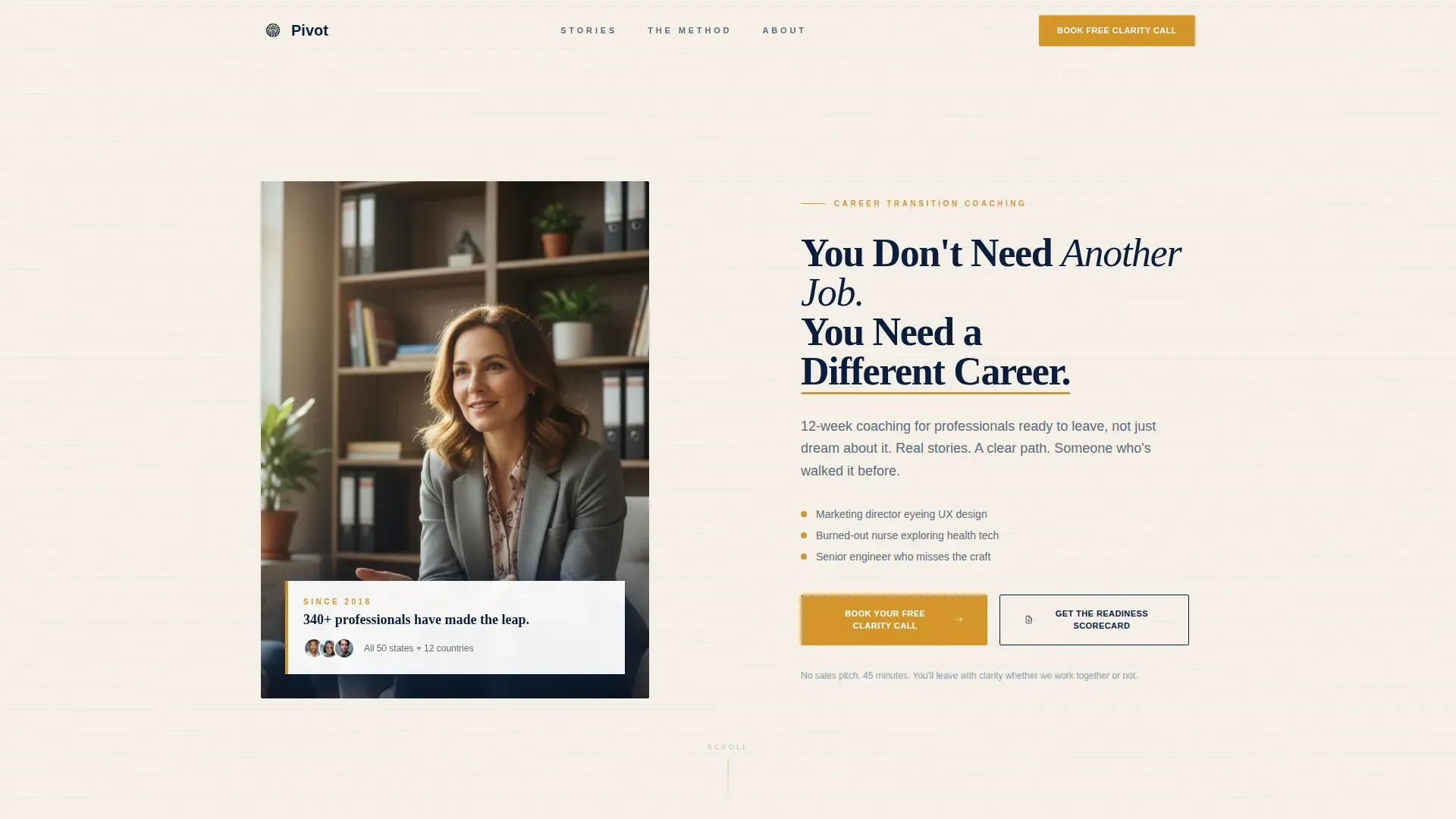
The hero uses a split layout: a candid, shoulders-up portrait photograph on the left and a 48-pixel serif headline on a warm parchment background on the right. The subline names the transformation in one sentence. This composition signals calm authority from the first moment and sets the conversational tone that career changers respond to. The amber call-to-action button anchors the right column.
Modular Case Study Card Grid
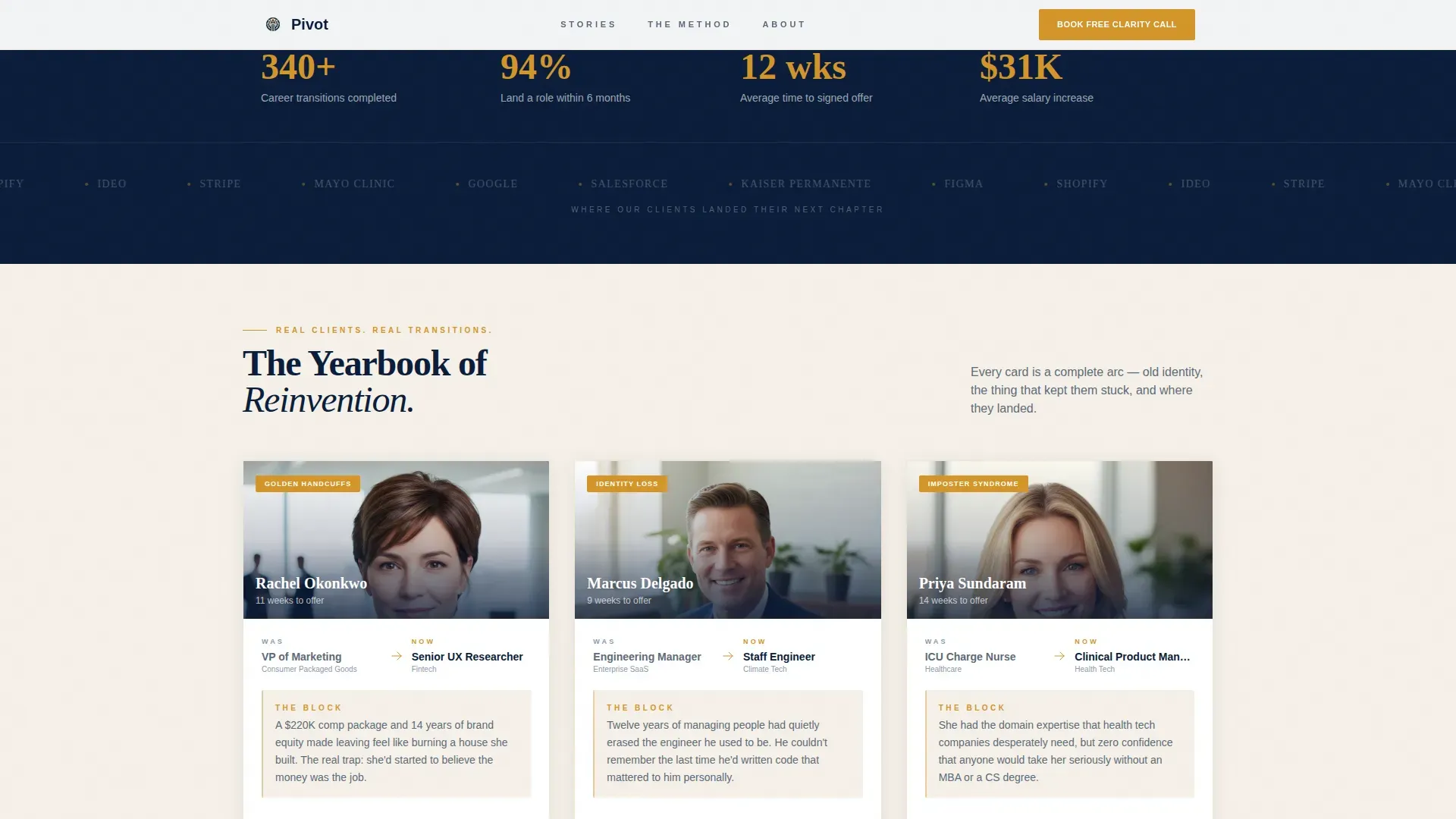
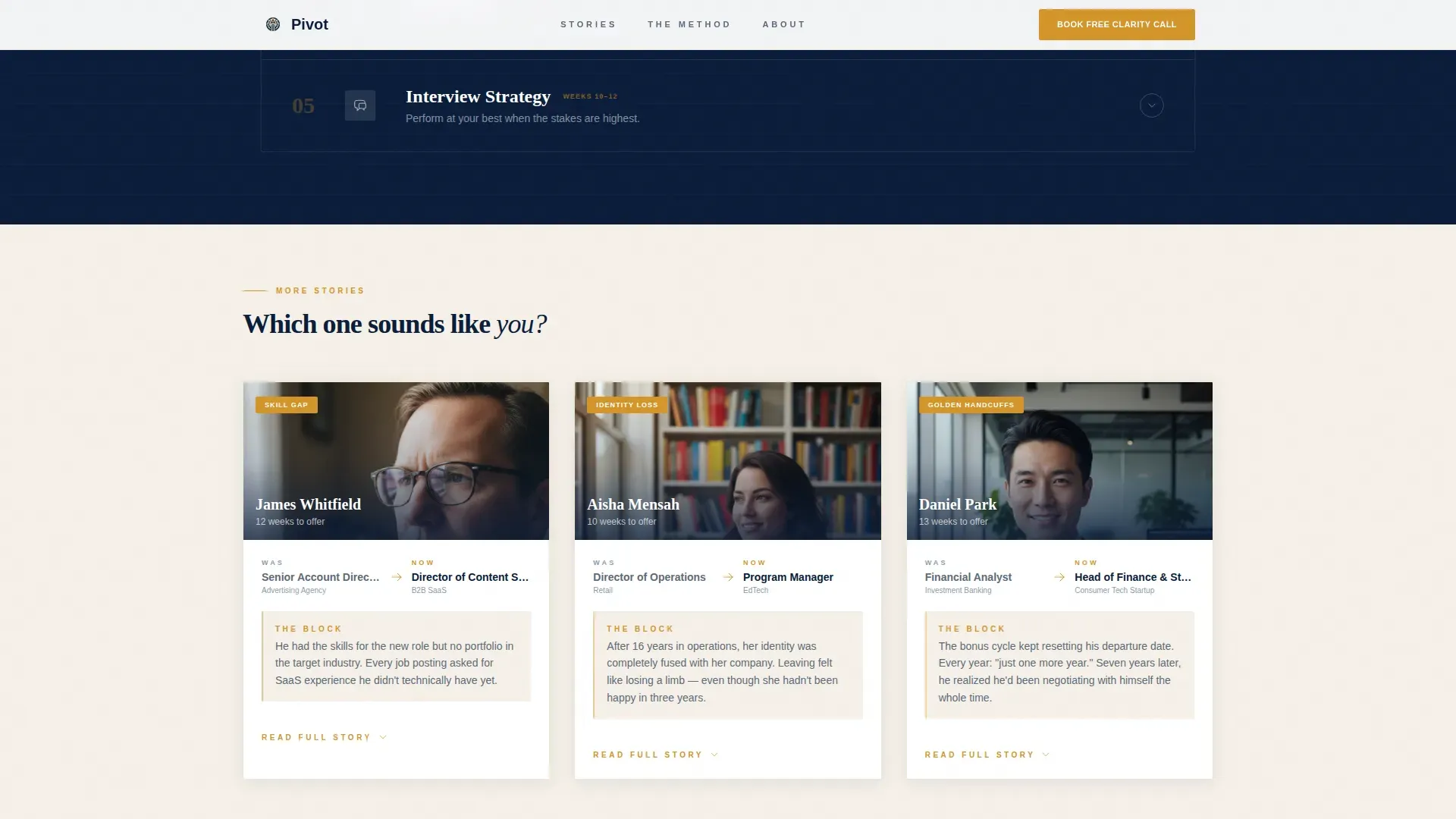
Six client story cards are arranged in two rows of three. Each card opens with the client's previous job title and industry, names the obstacle that kept them stuck, and closes with the new role they landed and the time it took. Scrolling through the grid feels like reading a yearbook of reinvention. Staggered card entrance animations and hover lift effects add interactivity without distracting from the stories themselves. This accumulation of proof is the core conversion engine of the page.
Accordion Methodology Interstitial
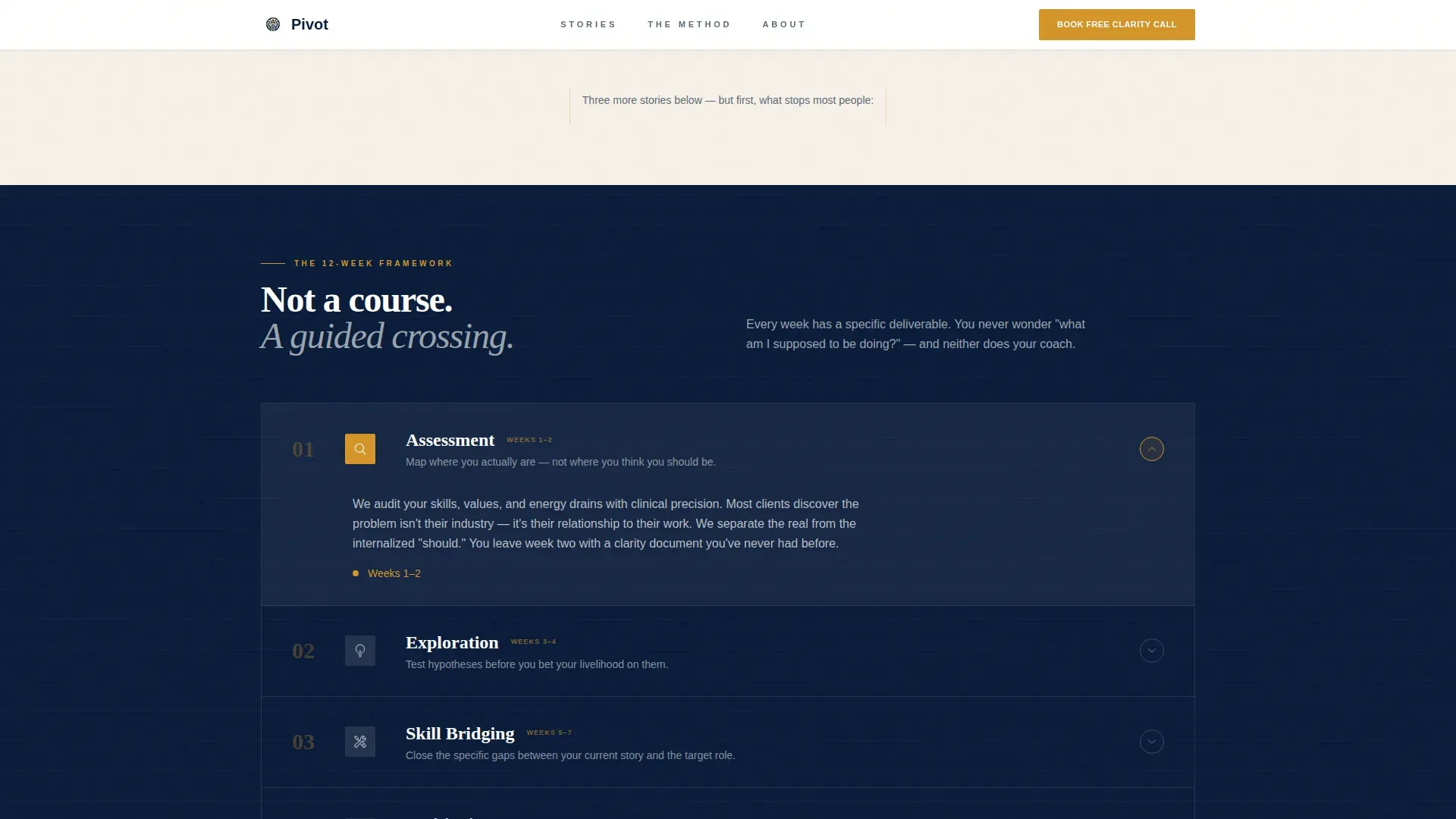
Between the two card rows, a single-column accordion section breaks down the five coaching phases: assessment, exploration, skill bridging, positioning, and interview strategy. Each phase is expandable, so visitors can learn exactly what the program covers without leaving the page. This section turns abstract coaching promises into a visible, structured framework that builds confidence in the process.
Three-Step Sequential Lead Capture Form
The primary lead capture form asks three questions in sequence: current role and industry, the direction the visitor is considering (with "I have no idea yet" included as a valid dropdown option), and preferred call time. The progressive reveal reduces perceived friction. Career professionals who have a low tolerance for long forms respond better to a staged approach, and this design reflects that reality directly.
Email-Gated Readiness Scorecard
A secondary conversion path offers a downloadable Career Transition Readiness Scorecard behind a simple email gate. This path is designed for visitors who are not yet ready to book a call but are actively doing research. The modal captures the lead without pressure, keeping the visitor warm and in the funnel for future follow-up.
Fixed Mobile Call-to-Action Bar
On mobile devices, a slim fixed bottom bar keeps the primary call-to-action visible at all times. This matters because many career researchers use mobile devices to explore options late at night or during commutes. The bar uses amber to maintain visual consistency with the rest of the page's action signals.
Page sections overview
| Section | Purpose |
|---|---|
| Hero Portrait Split | Opens with confident serif headline and amber call-to-action button |
| Social Proof Strip | Displays three quick-stat credibility markers and company logos |
| Card Grid Row 1 | Shows first three real client career pivot transformation stories |
| Methodology Interstitial | Breaks down the 12-week coaching framework in an accordion |
| Card Grid Row 2 | Shows three more client stories and repeats the call-to-action |
| Footer Arc Split | Displays logo and tagline left, navigation links right |
Design & branding system
The visual identity follows an Educational Guide theme built on the Navy Authority color system. The palette reads like a well-worn notebook on a mahogany desk: serious enough to trust with a career decision, warm enough to open at midnight. Every color choice serves a function, and no decorative element competes with the content.
Key design decisions include:
- Deep command navy (#0B1D3A) dominates the header, testimonial card backgrounds, and footer, establishing authority and focus
- Warm parchment (#F5F0E8) softens the body sections and methodology area, reducing anxiety and keeping the page readable for long sessions
- Decisive amber (#D4952A) appears only on calls to action and progress markers, training the eye to follow it like a highlighter through a career playbook
Typography pairs Fraunces serif for headlines with DM Sans for body text and interface elements. The combination balances editorial warmth with practical clarity. GSAP scroll reveal animations and card hover lifts add medium-level motion without distracting from the narrative content.
Mobile & speed optimization
The template is fully responsive and designed with mobile visitors in mind from the start. Career researchers often explore options on their phones, and the layout adapts cleanly from desktop to mobile without losing hierarchy or readability.
Mobile-specific features include:
- A fixed slim bottom bar on mobile that keeps the amber "Book Your Free Clarity Call" button permanently visible as visitors scroll
- Server components handle all static sections for faster initial load, while client components manage interactive elements like the accordion, sequential form, and scorecard modal
How this template helps you convert
Conversion on a career coaching page is not a single moment. It is a sequence of small permission-grants that build until the visitor decides to take action. This template is engineered around that sequence.
- The hero earns trust immediately with a real portrait, a direct headline, and a clearly labeled amber call-to-action button that tells visitors exactly what happens next
- The card grid accumulates proof across six real client stories, progressively shifting the visitor's internal question from doubt to identification, so by the fifth card, most people are not asking if a career pivot is possible but which story sounds most like their own
- The dual conversion path (clarity call form plus email-gated scorecard) ensures that visitors at every level of readiness have a relevant next step, capturing leads across the full spectrum from "I decided last week" to "I have no idea yet"
Other information about this template
This template covers a wide range of use cases beyond a single coaching practice. Career pivot service providers, workforce development organizations, and professional associations in the outplacement and career transition space will find the layout adaptable to their specific programs. The modular card grid makes it straightforward to swap in new client stories as the practice grows and more career transitions are completed.
The structured framework designed into the page reflects research-backed principles for career development content. Professionals considering a career change benefit from seeing a clear career plan laid out in stages, with skill gaps identified and addressed at each phase. The template supports that need by making the methodology visible and credible before any commitment is asked.
Several design principles align with what career changers respond to most:
- The "Mirror" effect in the card grid helps visitors see their own situation reflected in someone else's story, building trust faster than any single testimonial could
- Personal branding support is built into the positioning phase of the methodology accordion, helping clients understand how to present their experience to new employers in new industries
- The scorecard download functions as a learning resource and a self-assessment tool, giving job seekers a structured starting point even before they connect with a coach
- Informational interview strategies, professional networks, and online communities are natural follow-on topics that the methodology section can reference, supporting career changers who need guidance on how to explore and connect in their target field
- The pivot empowering mid career professional reinvention landing page template addresses the full arc from feeling stuck to signed offer, making it one of the most context-specific templates available for this niche
Career coaches who work with professionals across industries will appreciate that the template does not assume a single destination. The dropdown form option "I have no idea yet" is a validated choice, acknowledging that many career changers arrive without a firm direction and still deserve a relevant path forward. As industries evolve and new roles emerge, the coaching practice this template supports can adapt its case studies and methodology language to stay current and relevant for every wave of professionals looking to make a meaningful career change.
Theme
Educational Guide
Creative direction
Case Study Narrative
Color system
Navy Authority
Style
Card Grid (Modular)
Direction
Lead Generation
Page Sections
Half-page Portrait Hero Section
Modular Case Study Card Grid
Accordion Methodology Interstitial
Three-step Sequential Lead Form
Email-gated Scorecard Modal
Fixed Mobile Call-to-action Bar
Related questions
Who is this landing page template designed for?
Can I use this template if my coaching program is not exactly 12 weeks?
What are the two conversion paths included in this template?
Does this template address the specific fears of mid-career professionals?
How does the card grid display on mobile devices?