Publishing & Book Industry Portfolio & Case Study Website Template
Manuscript is a horizontal scroll landing page template built for literary agents who champion debut voices. It pairs a kinetic type hero, an anonymous manuscript gallery, and a fixed submission form into one theatrical experience. Deep plum, warm amber, dusky rose, and soft cream create a stage-and-spotlight atmosphere that draws unpublished writers in and moves them toward submitting their pages.
by Rocket studio
Quick summary
Manuscript is a single-page, horizontally scrolling template designed for a literary agent seeking debut talent. It opens with animated serif type against deep plum, moves through a gallery of anonymous manuscript first lines, and closes with a low-friction waitlist form. The visual language feels like the wings of a theater moments before a spotlight finds you.
Who this template is for
This template is built for independent literary agents who work directly with unpublished writers. It suits agents who want to signal taste, range, and editorial seriousness before a single query letter arrives. If you champion debut novels, nonfiction proposals, or poetry collections, this page speaks the language your ideal writers already use.
- Agents building a waitlist of unpublished novelists, nonfiction writers, and poets
- Creative professionals in traditional publishing who want a page that feels as curated as the manuscripts they represent
- Agents transitioning from word-of-mouth referrals to a digital submission pipeline
What problem this template solves
Many literary agents have no dedicated web presence beyond a brief agency directory entry. That gap costs them submissions from the writers who would be a genuine fit. Writers sitting on third drafts need to feel that an agent truly sees their kind of work before they invest the emotional effort of a submission. A generic page cannot do that. This template solves the credibility and atmosphere problem in one scroll.
- Writers cannot tell whether an agent is the right person for their manuscript without a clear signal of taste and editorial range
- A plain contact form gives no sense of the agent's voice, which leads strong writers to look elsewhere
- The agent loses the chance to build urgency and anticipation before submissions even open
What you get with this template
You get a fully designed, horizontally scrolling landing page with three core zones: a kinetic type hero section, a Community Gallery of manuscript cards, and a fixed submission form with a live writer counter. Every visual and interactive detail is already configured so you can focus on customizing copy, not building structure from scratch.
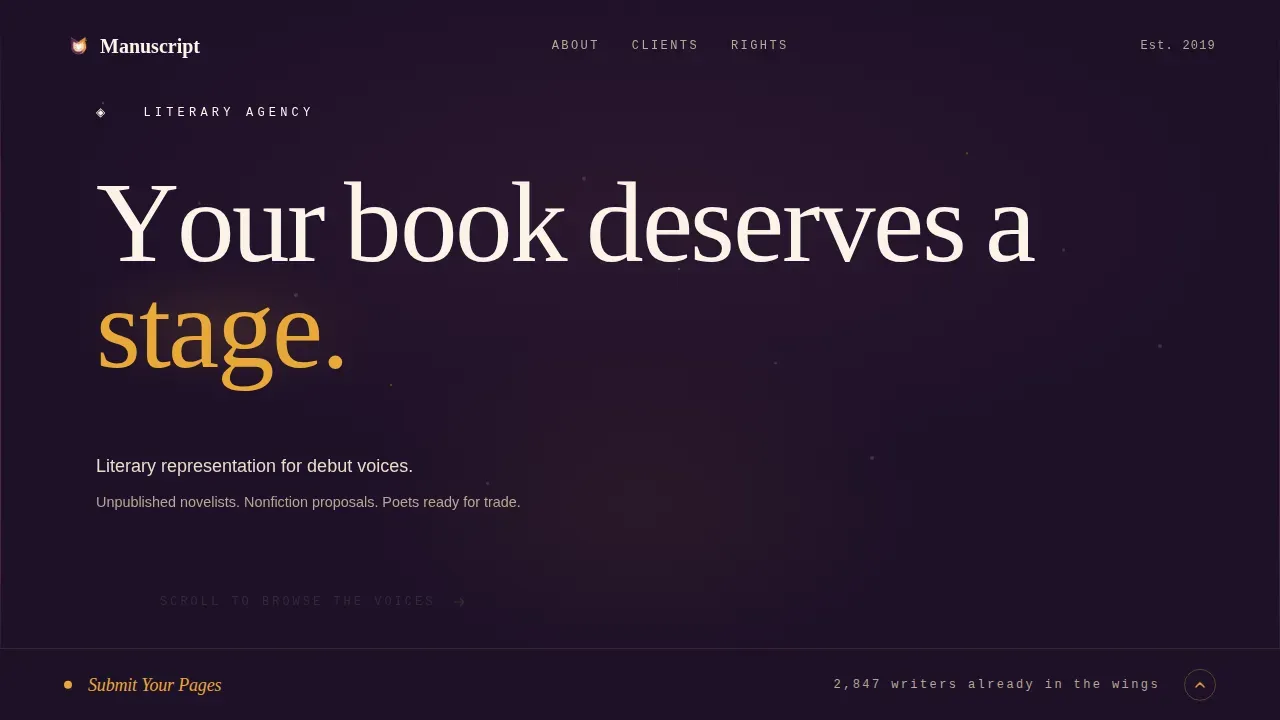
- A hero panel with large-format serif type that assembles letter by letter, culminating in an amber spotlight bloom behind the word "stage"
- A horizontal gallery of anonymous manuscript first lines, each card carrying a genre tag and a brief agent reader note, scrolling left to right with snap behavior
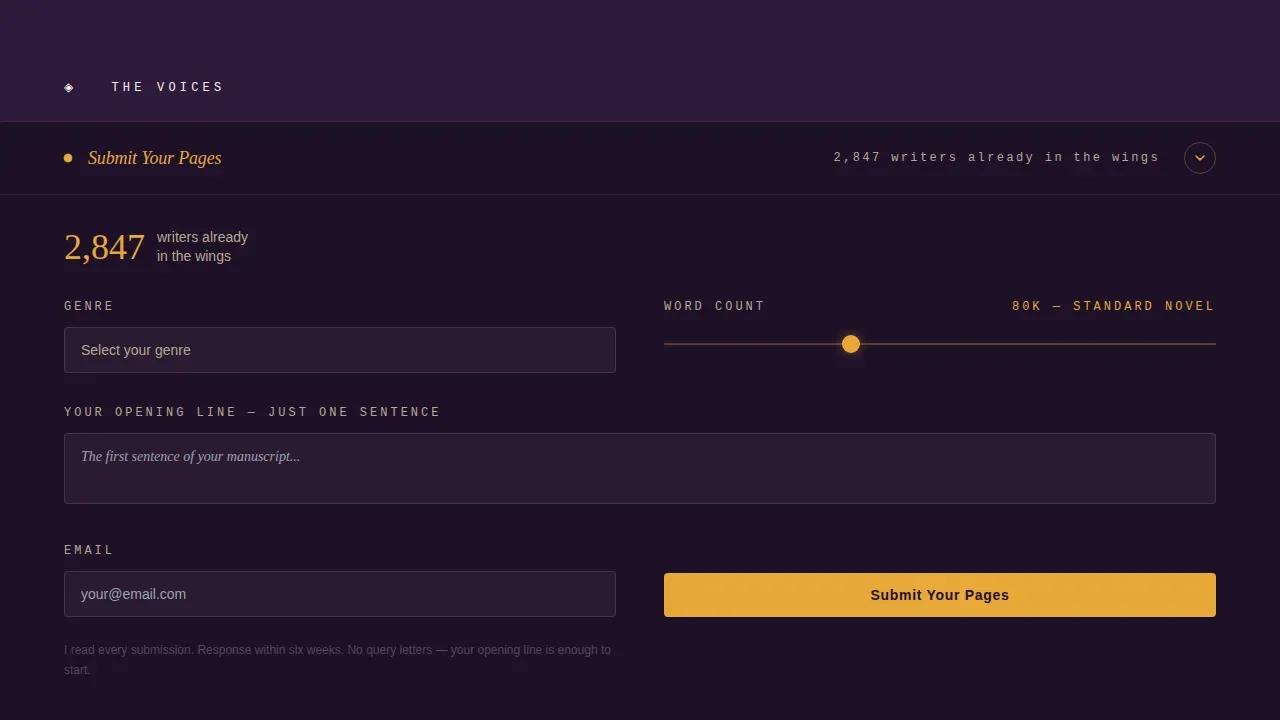
- A fixed-to-viewport "Submit Your Pages" form collecting genre, word count, opening line, and email, plus a counter showing how many writers are already on the list
Feature list
This template comes with a focused set of built-in features. Each one serves the single goal of turning a curious writer into a confident submission.
Kinetic Type Hero Panel
The hero opens on deep curtain plum with no image, no illustration, and no distraction. A single sentence assembles itself on screen, word by word, each arriving at a different speed. The word "stage" lands last and heaviest, and an amber glow blooms behind it like a footlight warming up. The large-format serif font makes the moment feel like the page itself is speaking directly to the writer reading it.
Horizontal Scroll Gallery with Snap Behavior
The Community Gallery drives the horizontal scroll experience. Each panel is a card displaying an anonymous first line from a manuscript the agent currently champions. Cards are set in different typefaces, each carrying a genre tag and one sentence of the agent's reader note. The rhythm of the gallery moves from quiet literary fiction through urgent thriller to lyric memoir, demonstrating range across the full manuscript stage without naming a single author. The final card is intentionally blank, a blinking cursor waiting for the next voice.
Fixed Submission Form
A "Submit Your Pages" call-to-action bar stays fixed to the bottom of the viewport throughout the entire scroll. The form asks for genre first via a dropdown, then word count via a slider, then a single textarea labeled "Your opening line, just one sentence." Email comes last, keeping friction as low as possible. This sequence mirrors the way a thoughtful agent actually reads: genre and scope before the sentence, the sentence before the person.
Live Writer Counter
Above the submission form, a counter displays the number of writers already on the waitlist. This single number does more persuasive work than any sales copy could. It shows that real people with real manuscripts are already paying attention, which gives a new visitor both social proof and a quiet reason to act before they scroll away.
Sunset Gradient Color System
The entire page uses a four-color palette: deep curtain plum (#2D1B3D) for backgrounds, warm amber (#E8A838) for interactive elements and hover states, dusky rose (#C46E7A) to mark transitions between gallery panels, and soft linen cream (#FAF3E8) for body text. The palette is warm enough to read by and dark enough to feel like something important is about to happen.
Theatrical Editorial Typography
The template uses a large-format serif display font for headlines and a clean sans-serif for body copy. The pairing gives the page the feel of a well-designed literary journal: authoritative, readable, and unmistakably intentional. Every font size decision reinforces hierarchy without requiring manual adjustment.
Page sections overview
| Section | Purpose |
|---|---|
| Kinetic Type Hero | Assembles the headline letter by letter against deep plum with an amber spotlight bloom |
| Horizontal Manuscript Gallery | Displays anonymous first lines as scroll-snap cards with genre tags and agent reader notes |
| Blank Final Card | Holds a blinking cursor, signaling an open spot for the next writer |
| Fixed Submission Bar | Keeps the "Submit Your Pages" form visible throughout the entire scroll |
| Genre and Word Count Form | Collects genre dropdown, word count slider, opening line textarea, and email field |
| Live Writer Counter | Shows the number of writers already on the waitlist above the form |
Design & branding system
The design language is theatrical editorial: the kind of warmth you feel standing near the side door of a theater as golden-hour light pours through. Nothing on this page feels corporate or generic. Every color, typeface, and spacing decision reinforces the idea that this agent takes writing seriously and expects the same from the writers who find this page.
- Plum anchors all background panels; amber marks every interactive element and hover state; rose signals transitions between gallery cards; cream holds all body text for comfortable reading at any scroll depth
- The display serif creates immediate authority in the hero and carries through chapter headings in the gallery; the sans-serif body font keeps every supporting paragraph easy to scan
- Spacing, scene transitions, and card rhythm are all pre-configured so the page flows naturally from the opening moment to the final blank card
Mobile & speed optimization
The horizontal scroll experience is desktop-first by design, because the gallery rhythm and viewport-fixed form work best on a wide screen. On smaller screens the template falls back to a vertical scroll layout, preserving all content and form functionality without losing the atmospheric quality of the design. Animations are handled with scroll-linked behavior and an Intersection Observer approach, keeping the page light without heavy library dependencies.
- Horizontal scroll snap on desktop gives the gallery a precise, controlled feel; vertical fallback on mobile keeps the full content hierarchy intact
- The fixed submission bar adapts to smaller viewports so the call to action remains reachable at all times, regardless of device
- Kinetic type assembly, spotlight bloom, card reveals, and the blinking cursor are all implemented with lightweight animation techniques to keep load times practical
How this template helps you convert
A really great story deserves a really great first impression, and this template is built to carry both sides of that equation. Conversion here means one thing: a writer submitting their opening line and email. Every design and copy decision serves that moment.
- The kinetic type hero creates an emotional hook in the first three seconds. A writer who feels seen by the headline will stay for the gallery, and a writer who stays for the gallery will almost always scroll to the form.
- The gallery of anonymous manuscript first lines functions as living social proof. It tells every visiting writer that this agent already has an eye for language and a track record of championing voices worth reading, which makes the submission form feel like a door worth knocking on rather than a wall.
- The fixed submission bar and low-friction form sequence remove every excuse to leave without submitting. Genre first, then word count, then one sentence, then email. The writer commits a little more with each step, and by the time they reach the email field, the decision is already made.
Other information about this template
This section covers additional context that helps you get the most from the template and understand how it fits into a broader submission and manuscript preparation workflow.
The template is designed as a manuscript stage spotlight: a focused, professional presentation tool that gives literary agents a digital storefront for their submission pipeline. A manuscript stage spotlight of this kind is most effective when the agent's curatorial voice is present in every card reader note and in the hero sentence itself.
When writers land on this page, they often arrive with questions about whether their manuscript is ready. The page does not answer those questions directly, but it sets a tone that helps serious writers self-select. Writers who are still on a first draft will likely feel that this agent is not yet their moment. Writers with a polished, well-formatted manuscript and a strong opening line will feel the opposite: that this is exactly where they belong.
For writers using this page as a reference point before they submit, it is worth knowing that manuscript formatting matters to every agent who receives pages. Literary agents are looking for manuscripts that are well-written and properly formatted. Agents often reject manuscripts that show early warning signs of poor presentation or carelessness. A strong query letter is essential for making a good first impression on literary agents. Manuscripts should be thoroughly edited before submission to ensure they are as polished as possible.
Manuscript formatting guidelines that agents broadly expect include:
- Format your manuscript in Times New Roman, size 12, and double spaced. Use one-inch margins on all sides.
- Include a title page with your book title, author name, and contact information. Page numbers belong in the header of each page, alongside your last name and book title.
- Use page breaks to separate chapters rather than pressing the space bar multiple times. The first paragraph of each new chapter should not be indented; indent paragraphs that follow.
- Scene breaks can be marked with a centered hash sign or asterisks. Avoid extra line breaks between new paragraphs.
- Save your manuscript as a computer file in a common format. Most agents and editors accept documents submitted as a standard word processing file, and it is a good rule to confirm the preferred file type before you submit.
- The entire manuscript should be free of dedications, acknowledgments, or images before submission. Keep the document clean and readable.
Understanding genre-specific word counts is important when preparing a manuscript for submission. Authors often fail to adhere to genre-specific word counts, which can be a red flag for agents. As a general reference, most commercial fiction novels run between 80,000 and 100,000 words. Children's books and picture books follow very different word count expectations. Authors should research agents to find the best match for their manuscript before submitting.
Many authors rush to submit their manuscripts without adequately revising them. Authors should take their time to revise their manuscripts instead of rushing to submit. Reading current books in your genre can help authors understand what works in contemporary writing. A well-structured synopsis is important for agents to understand the story arc and overall story structure of the manuscript. Authors should be prepared to revise their manuscripts based on feedback from agents or editors.
Book writing templates can help authors structure their manuscripts effectively. Templates can assist in character development, plot outlining, and overall story structure. Using a template can help authors avoid common pitfalls in story structure and pacing. The Three-Act structure is a commonly used template for plotting novels. A story forward approach and a clear story arc keep pacing tight and prevent the excessive description that leads to rejection.
Components of an effective submission page include a clear title, genre, word count, a powerful hook, and a prominent call to action. A spotlight typically includes a strong pitch, a synopsis of 300 to 500 words, character highlights, the central conflict, and the author's bio. A landing page for literary agents must be concise, professional, and visually clean. A professional author bio that highlights relevant experience contributes to a compelling page. Comparable titles, or comps, are recent titles from the last three to five years that are similar in tone or audience, and they are crucial for agents to understand market fit.
This template is compatible with self publishing workflows as well. Agents and authors exploring traditional publishing and traditional publishers will find the submission form easy to adapt. Writers who have also considered self publishing as an alternative path will find the page useful for understanding what traditional manuscript submissions require before making that choice.
Many authors are a big fan of the idea that a really great story sells itself, but most agents receive hundreds of submissions a week. Presentation, formatting, and the first paragraph of your manuscript all matter multiple times more than writers expect. Other authors who have gone through the process successfully tend to say the same thing: take your time, read books in your genre, format your manuscript carefully, and make sure your query letter is as strong as your opening line.

Theme
Stage & Spotlight
Creative direction
Community Gallery
Color system
Sunset Gradient
Style
Horizontal Scroll
Direction
Waitlist/Coming Soon
Page Sections
Kinetic Type Hero with Spotlight Bloom
Horizontal Scroll Gallery with Snap Cards
Fixed Viewport Submission Form
Live Waitlist Writer Counter
Sunset Gradient Color System
Theatrical Editorial Typography Pairing
Related questions
What kind of literary agent is this template designed for?
Can I customize the manuscript gallery cards with my own reader notes?
Does the template include the submission form and writer counter?
Is this template suitable for agents who represent multiple genres?
What should a writer prepare before submitting through this page?