Trusted Conflict Mediation Landing Page Template
Accord is a modular card-grid landing page template built for mediation and alternative dispute resolution practices. It guides skeptical visitors through a transparent six-card process, from initial consultation to signed agreement, while embedding social proof directly inside each stage. The Forest Trust color system and WPA civic-lodge visual identity create an atmosphere of calm authority that earns trust before asking for anything.
by Rocket studio
Quick summary
Accord is a single-page lead generation template designed for professional mediation and dispute resolution services. It demystifies the mediation process through an interactive six-card grid, a structured trust bar, and a three-step consultation form. The design feels like a well-lit civic room rather than a courtroom: warm, ordered, and purposefully free of spectacle.
Who this template is for
This template is built for practitioners and practices that guide parties through structured, non-adversarial resolution. It suits contexts where trust must be established before any commitment is made, and where the visitor arrives uncertain, not hostile.
- Certified mediators and alternative dispute resolution (ADR) firms serving family, business, and workplace clients
- Court-connected mediation programs that need a credible, professional web presence to attract referrals
- HR directors and legal departments seeking a resource to direct employees or counsel toward pre-litigation services
What problem this template solves
Most people arrive at a mediation services page already anxious. They do not fully understand the process, they are unsure whether a mediator can help their specific dispute, and they are reluctant to disclose personal details before they feel safe. A generic legal services page does nothing to resolve that anxiety.
- Visitors cannot determine what actually happens in a mediation session, so they leave without acting
- The absence of transparent process information makes arbitration and court proceedings feel equally opaque, reducing confidence in any path
- There is no clear moment where the page earns the visitor's trust before asking them to request a consultation
What you get with this template
Accord delivers a complete, ready-to-customize landing page structure that carries a visitor from first impression through to consultation request. Every section has a specific job, and no section wastes space.
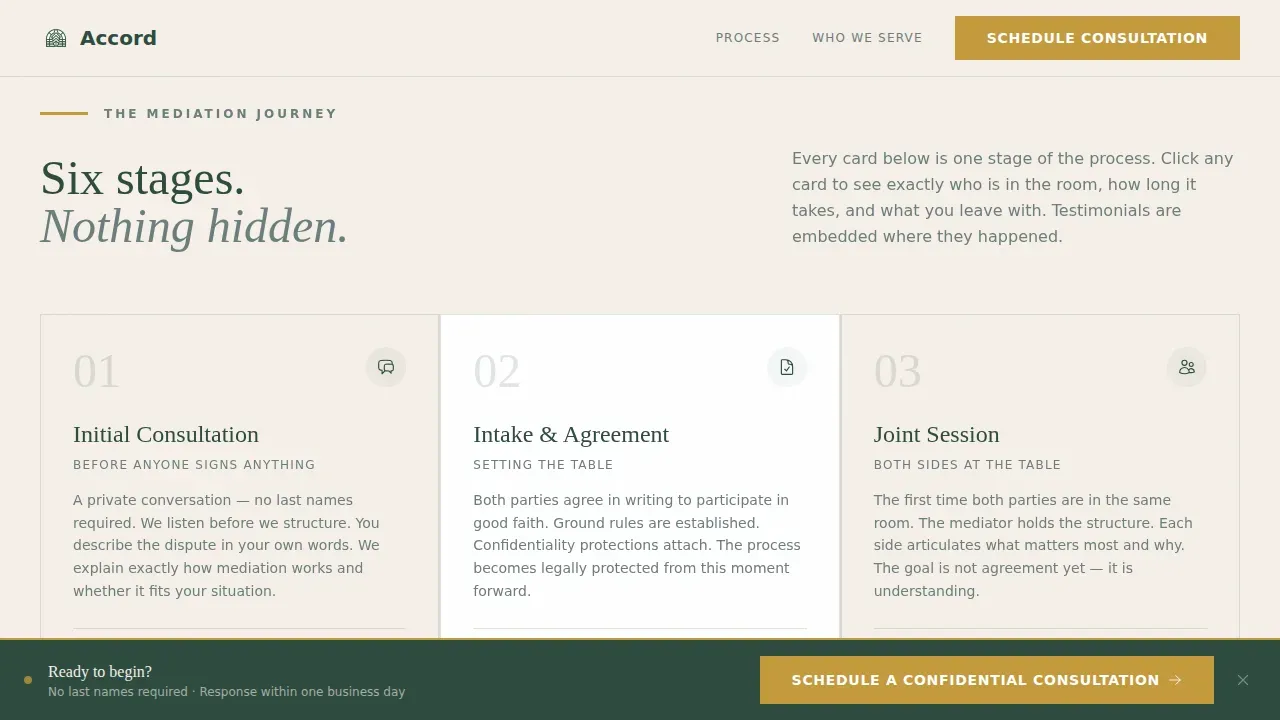
- A six-card interactive process grid that reveals the full mediation journey, from intake through signed agreement, with embedded testimonials at each stage
- A persistent bottom call-to-action bar that appears after scroll depth is reached, keeping the "Schedule a Confidential Consultation" prompt visible without interrupting reading
- A sequential three-question intake form that collects dispute type, number of parties, and preferred contact method, without requiring last names at the initial request stage
Feature list
This section covers the core built-in capabilities of the Accord template, each grounded in what the source brief specifies.
Interactive Six-Card Process Grid
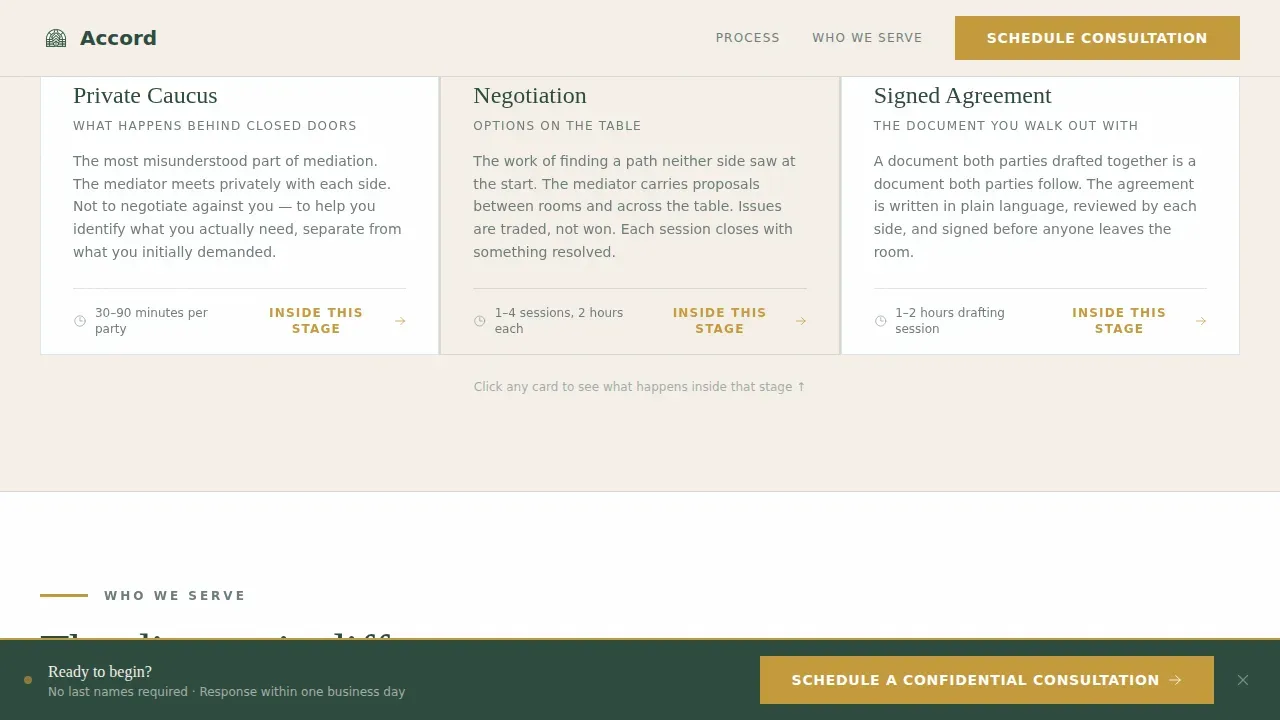
The centerpiece of the template is a modular card grid that maps the full mediation journey across six discrete stages. Each card represents one step: initial consultation, intake, joint session, private caucus, negotiation, and signed agreement. Cards flip or expand on interaction to reveal what happens inside each stage, including who is in the room, how long the stage typically takes, and what is produced. As the visitor scrolls, the grid builds progressively from one card to a complete six-card pathway, making an unfamiliar process feel systematic and manageable. This approach is consistent with best-practice guidance that a step-by-step visual of the mediation process helps manage visitor expectations and reduce anxiety about proceedings.
Embedded Structural Testimonials
Social proof in Accord does not sit in a separate testimonial carousel. Instead, each quote is placed inside the process card where the experience occurred. A client's opinion about the private caucus lives inside the caucus card. An attorney's observation about the joint session lives inside the joint session card. This structural placement makes testimonials feel like evidence of process quality rather than decoration, reinforcing acceptance at exactly the moment a visitor is absorbing that stage of the journey.
Trust Bar with Certification Seals
The header opens with a horizontal logo bar, a band of trust signals rendered in muted monotone against birch cream. It displays state bar association seals, mediation certification marks, court-approved program badges, and partner organization marks. This section communicates credentials and duties of professional standing before the visitor reads a single line of copy. Displaying such information early is consistent with guidance that certifications, panel memberships, and years of experience should be visible at the top of any high-converting mediation services page.
Typographic Hero with No Image
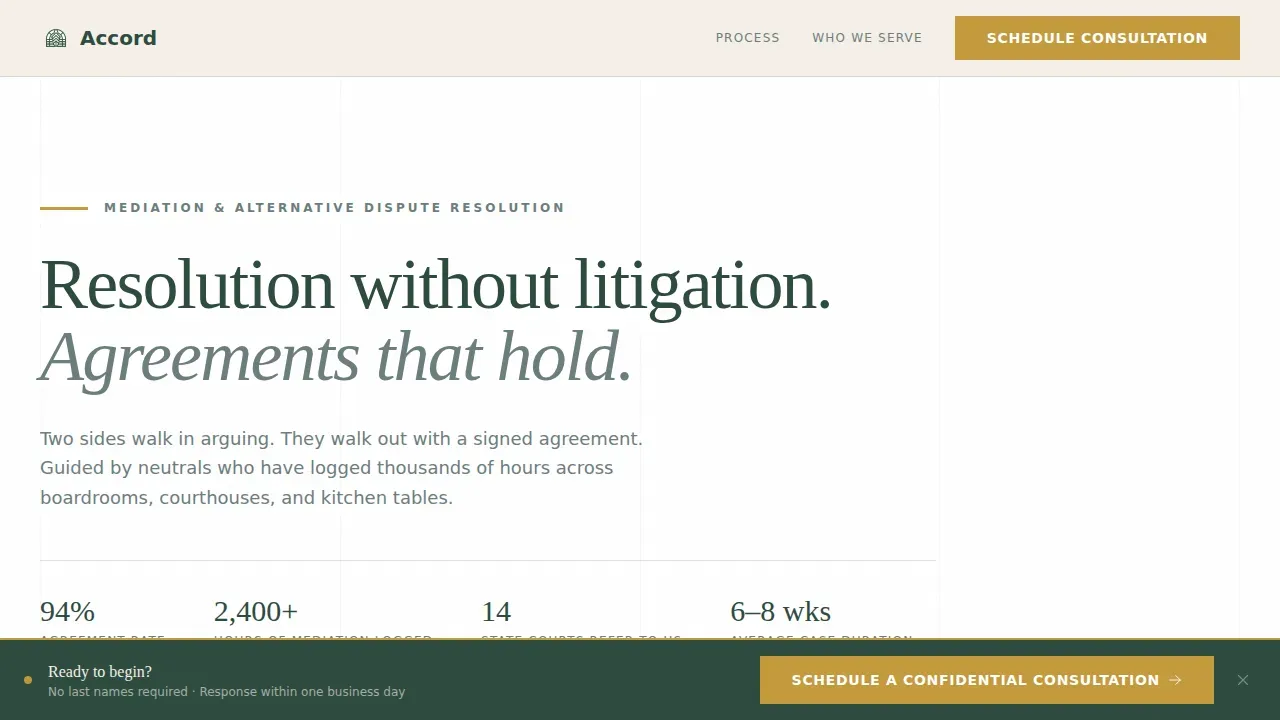
Below the trust bar sits a typographic headline: "Resolution without litigation. Agreements that hold." There is no hero image. The restraint is deliberate. The absence of photography signals exactly what mediation promises: no spectacle, no theater, just a disciplined process. This approach reflects the civic-service aesthetic and communicates calm authority to a person who is already managing stress.
Three-Step Sequential Intake Form
The consultation form asks three questions in sequence: dispute type (family, business, workplace, or community), number of parties involved, and preferred contact method. No last name is required at this stage. The sequential format reduces friction and mirrors the measured manner of the mediation process itself. Mediation sessions can often be scheduled for a first hearing within 30 days of the initial request, and this form is structured to make that first step feel low-risk and reasonable.
Persistent Scroll-Triggered Bottom Bar
After a visitor scrolls past 40 percent of the page, a persistent bottom bar appears carrying the "Schedule a Confidential Consultation" call to action. The bar uses amber, the template's action-only color, and remains visible as the visitor continues reading. This pattern keeps the conversion opportunity present without forcing it, allowing the page to earn the click through content before the bar surfaces.
Page sections overview
| Section | Purpose |
|---|---|
| Trust Bar | Displays certification seals, court-approved badges, and association marks to establish authority immediately |
| Typographic Hero | Delivers the core value statement with no image, signaling calm and process over drama |
| Process Card Grid | Maps the six-stage mediation journey with interactive flip/expand cards and embedded testimonials |
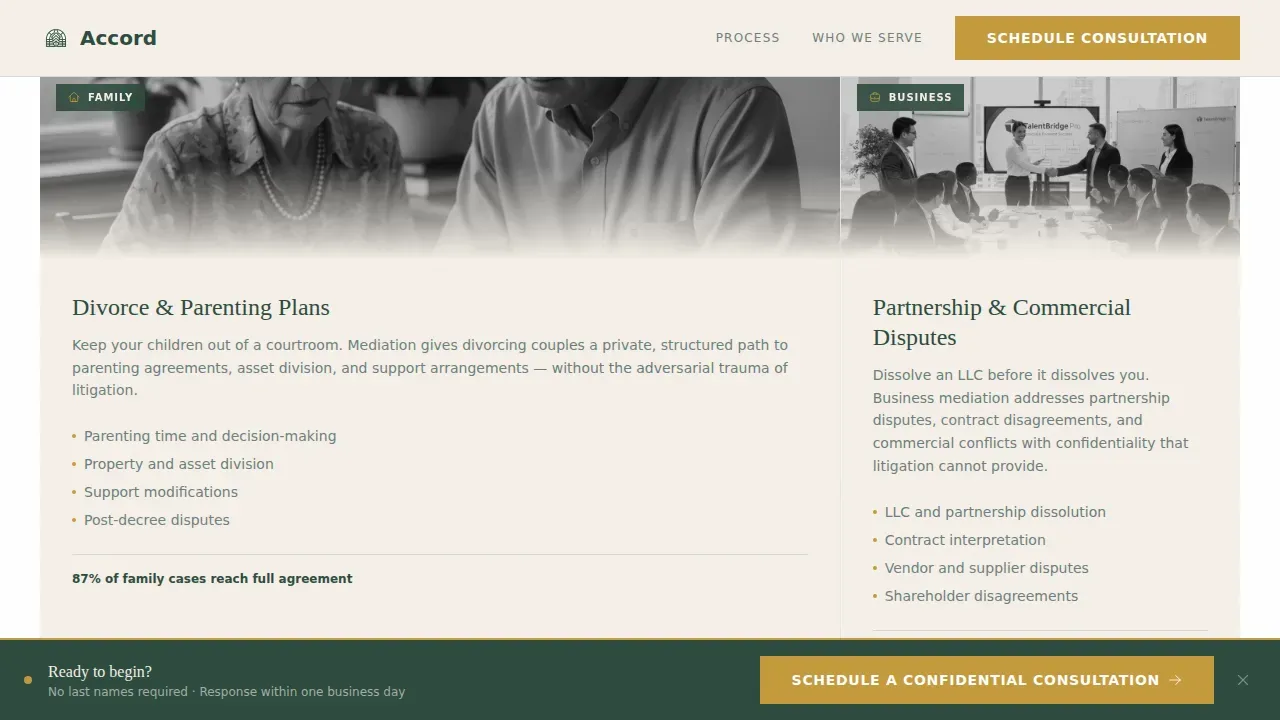
| Dispute Type Cards | Presents family, business, and workplace use cases in an asymmetric bento layout |
| Consultation Form | Collects dispute type, party count, and contact preference through a three-step sequential form |
| Footer | Closes with horizontal flow layout for contact details, disclaimers, and navigation |
Design & branding system
The visual language of Accord is rooted in a WPA civic-lodge aesthetic: dignified, warm, and structurally restrained. The Forest Trust color system was chosen to represent the sense of grounded authority that a mediator brings to any room.
- Old-growth green (#2D4A3E) carries all body text and primary headings, giving the page depth and seriousness without severity; birch bark cream (#F5F0E8) and white alternate as backgrounds to create visual rhythm without harsh contrast
- River stone gray (#6B7D7D) defines card borders and secondary elements, keeping the layout organized without drawing attention away from content
- Amber (#C49A3C) appears only on call-to-action elements and progress indicators, never on informational copy, so every amber element is a clear invitation to act
Mobile & speed optimization
Accord is built desktop-first, reflecting the reality that the primary audience researches mediation services carefully and often on larger screens. Full mobile support is included, ensuring the template serves all visitors regardless of device.
- Card flip and expand interactions are adapted for touch, so the six-card process grid remains fully usable on mobile screens without requiring hover states
- The persistent bottom bar and sequential form are sized and spaced for easy-to-tap interaction on smaller screens, following guidance that mobile-friendly design with fast load times and easy-to-tap buttons is critical for professional services pages
How this template helps you convert
Accord is structured so that every section earns the visitor's trust before the next one asks for anything. The conversion logic is sequential and deliberate.
- The trust bar and typographic hero establish authority and calm in the first viewport, ensuring the most critical information is visible without scrolling and giving the visitor an immediate reason to continue reading
- The process grid demystifies every stage of mediation, from the joint session through the private caucus to the final agreement, so that by the time the visitor reaches the consultation form, scheduling a session feels like the next logical step rather than a leap of faith
- The scroll-triggered bottom bar and the embedded call-to-action beneath the process grid create two natural conversion moments, both using amber to signal action, both appearing only after the page has already done the work of building confidence
Other information about this template
Accord sits within a broader ecosystem of professional services template design and connects naturally to several contextual areas that practitioners and their counsel should be aware of when building or deploying a mediation services page.
- The accord trusted mediation and dispute resolution landing page template is designed for use by mediation professionals, court-connected programs, and ADR practices that need a credible, trust-forward web presence without requiring custom development
- Alternative dispute resolution mechanisms, particularly mediation, are valued for their flexibility and cultural relevance across many dispute contexts, from family law to commercial conflict; the template is structured to represent this breadth through its dispute-type card section
- Community engagement is essential to successful mediation, and the template reflects this by making the process visible and accessible to every person who arrives on the page, regardless of their prior knowledge of legal proceedings
- The effectiveness of ADR in resolving disputes can be limited by logistical challenges such as scheduling conflicts and bureaucratic delays; the sequential intake form and clear date-gathering fields are intended to reduce that friction at the point of first contact
- In many jurisdictions, the government has established legal frameworks and institutions to promote ADR, and court-approved program badges in the trust bar reflect compliance with those frameworks, signaling to visitors that the practice operates within recognized rules and statute
- From an ethical standpoint, the duties of a practicing attorney or advocate in mediation proceedings differ meaningfully from their duties in litigation; a lawyer must continue to comply with professional obligations, disclose relevant authority, and must not permit conduct that would reflect adversely on the legal system or violate professional rules, even in a non-adversarial setting
- Mediators themselves are bound by conduct standards that require them to act with impartiality, protect the confidentiality of such information shared in private caucus, and disclose any conflict of interest that might reflect adversely on the neutrality of the process
- The Code of Conduct for United States Judges clarifies that judges should not act as arbitrators or mediators outside their official duties unless expressly authorized by law; this distinction is important for practices that seek referrals from the bench or operate court-connected programs
- A lawyer who serves as a mediator is generally not permitted to use personal knowledge gained in that role to represent either party afterward; the obligation prescribed by most state bar rules is that such information remains protected and may not be used in a manner that would favor one party
- Mediation is often preferred in circumstances where traditional litigation is assessed as too slow, too costly, or too adversarial; the template is designed to speak directly to clients who are weighing those options and seeking a reasonable alternative path
- For practitioners who work with smart legal contract frameworks, Accord Project templates tie legal text to computer code; those templates consist of three main components (Template Text, Template Model, and Template Logic) and can be executed on various platforms; while this web template does not implement that framework, practitioners who use such tools may find it useful to note that both are intended to bring greater structure and clarity to legal documents and agreements
- The page includes placeholder slots for images of actual mediators or office space, following best-practice guidance that authentic photography builds more comfort and trust than generic stock visuals; video introduction blocks can also be placed within the template structure to permit mediators to speak directly to prospective clients before any contact is made
Theme
Civic Service
Creative direction
Transparent Process
Color system
Forest Trust
Style
Card Grid (Modular)
Direction
Lead Generation
Page Sections
Interactive Six-card Mediation Process Grid
Structural Embedded Testimonials
Header Trust Bar with Certification Marks
Three-step Sequential Consultation Form
Scroll-triggered Persistent Bottom Bar
Dispute-type Use Case Card Section
Related questions
What types of disputes does this template address?
Can I embed real testimonials from past clients or attorneys?
Does the intake form require last names or sensitive personal details?
Is the template suitable for a court-connected mediation program?
How does the scroll-triggered bottom bar work?