Organ Builder & Restorer Business Professional Website Template
The Voicing template is a precision-built landing page for heritage organ builders and restorers working with institutional clients. It pairs a monochrome steel visual identity with a transparent, phase-by-phase restoration narrative. Every section earns institutional trust through credential-forward design, scope-of-work copy, and two focused conversion paths: a condition survey request and a gated specification download.
by Rocket studio
Quick summary
The Voicing template is a single-page, zigzag-format landing page built for organ building and restoration firms serving churches, cathedrals, universities, and civic venues. It speaks directly to church wardens, diocesan committees, university music directors, and municipal arts boards. The design uses a monochrome steel palette and structured, specification-grade copy to earn the trust of heritage property stewards before asking for any commitment.
Who this template is for
This template is designed for professional organ building and restoration companies working with institutional clients in the heritage and cultural sector. The audience is not individual musicians or hobbyists. It is built for firms that regularly deal with listed buildings, capital budgets, and multi-year commission timelines.
- Church wardens and diocesan property committees overseeing Grade I or Grade II* listed buildings with pipe organ repair budgets to allocate
- University music directors and faculty committees planning capital campaigns around a historic instrument in a recital hall or chapel
- Municipal arts boards responsible for a civic auditorium organ or a concert venue instrument that needs a complete restoration programme
What problem this template solves
Heritage organ restoration is a high-trust, high-value service. The typical buyer is a committee, not a single individual. They need to see institutional fluency before they will pick up the telephone. Most organ building firms have no dedicated landing page that speaks the language of procurement, heritage compliance, or capital governance. This template solves that gap directly.
- There is no clear way to demonstrate the full scope of restoration work, from survey to reinstallation, in a format that procurement committees can follow and share
- Institutional buyers cannot easily distinguish between a general repair workshop and a firm with genuine heritage credentials, making accreditation and process transparency essential
- Conversion paths for this audience require two routes: a direct commission enquiry and a lower-commitment entry point for buyers who are still drafting specification documents
What you get with this template
You receive a complete, single-page zigzag landing page built around five restoration phases. Each phase gets its own alternating panel. The page is designed for desktop-first review, which suits the procurement research behaviour of property committees and music directors. Every element has a defined role.
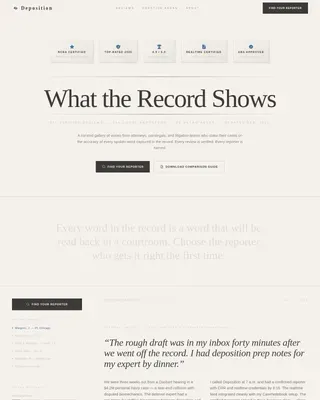
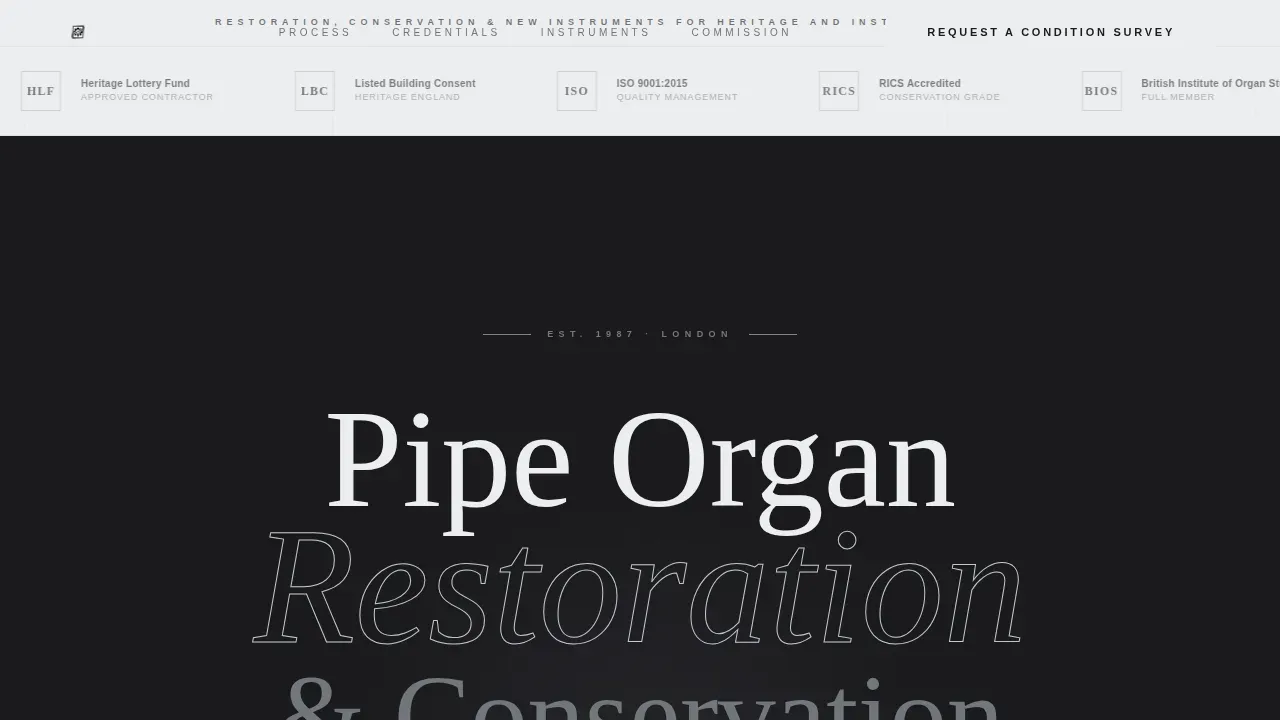
- A credential ribbon header displaying institutional trust marks including professional membership seals, heritage funding partner logos, listed building consent stamps, and quality certification marks, all rendered in monochrome
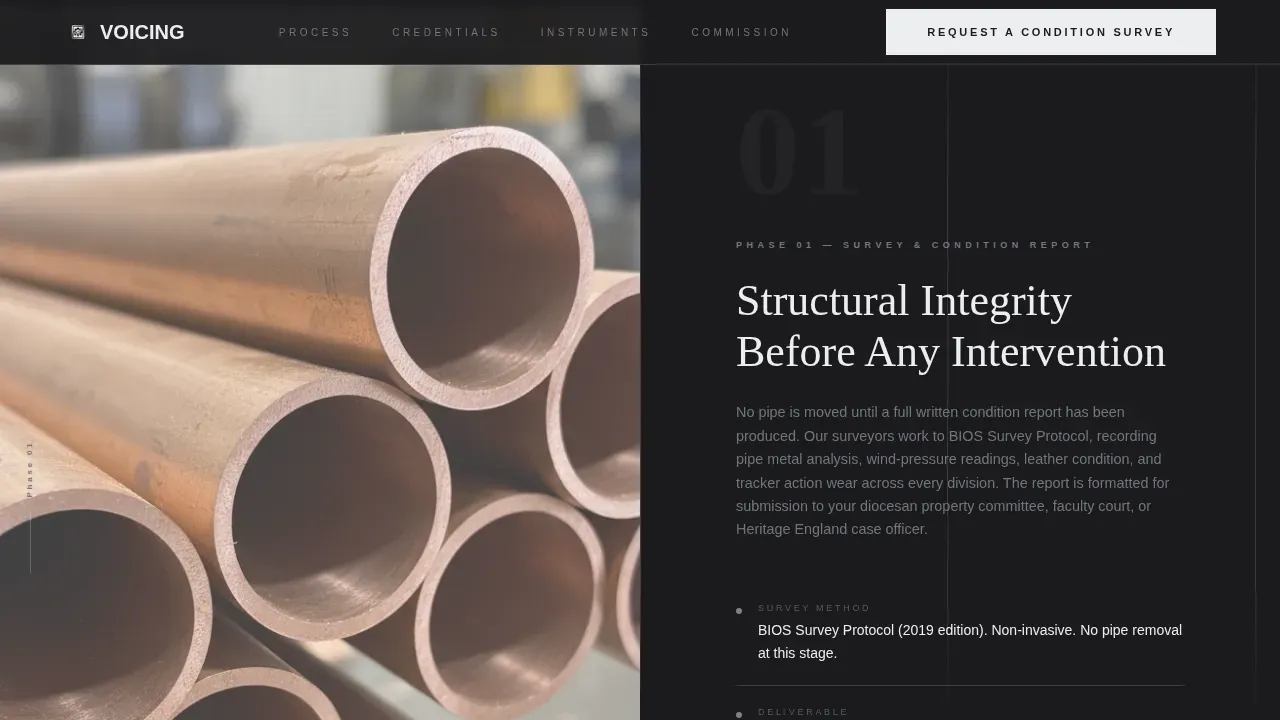
- Five zigzag content panels covering Survey and Condition Report, Pipe Removal and Cataloguing, Soundboard Repair, Revoicing and Tuning, and Reinstallation and Commissioning, each pairing a technical process photograph with specification-grade scope-of-work copy
- Two conversion components: a primary enquiry form collecting institution name, building listing status, organ builder of origin, and a free-text condition description, plus a secondary gated PDF download of a Specification Template for Organ Restoration Tenders
Feature list
The Voicing template packs a precise set of features. Each one is purpose-built for the institutional organ building and restoration market.
Credential Ribbon Header
The header opens with a horizontal ribbon of institutional trust marks. It includes professional body membership seals, heritage funding partner logos, listed building consent stamps, and quality certification marks. Every badge renders in monochrome so no single credential dominates. Below the ribbon, a single line of tracked-out uppercase type sets the service scope. This arrangement means credentials speak before copy does, which is exactly the right order for this audience.
Phase-by-Phase Zigzag Panels
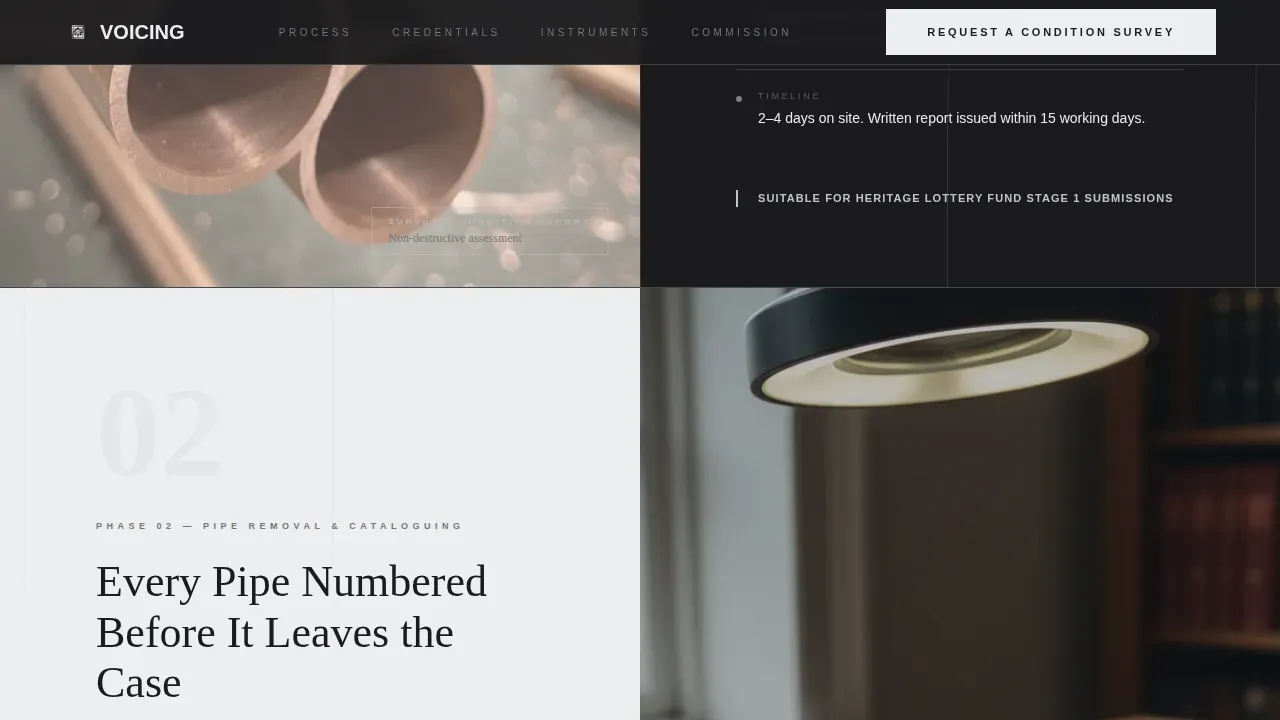
The page body is structured as five alternating panels, each representing a discrete phase of a real organ restoration. Backgrounds alternate between forge-black and workshop white. Each panel pairs a technical process photograph on one side with specification-grade scope-of-work language on the other. Materials are named. Methods are disclosed. Timelines are given. The scroll mirrors the restoration itself: survey before removal, dismantling before rebuilding, silence before sound.
Dual Conversion System
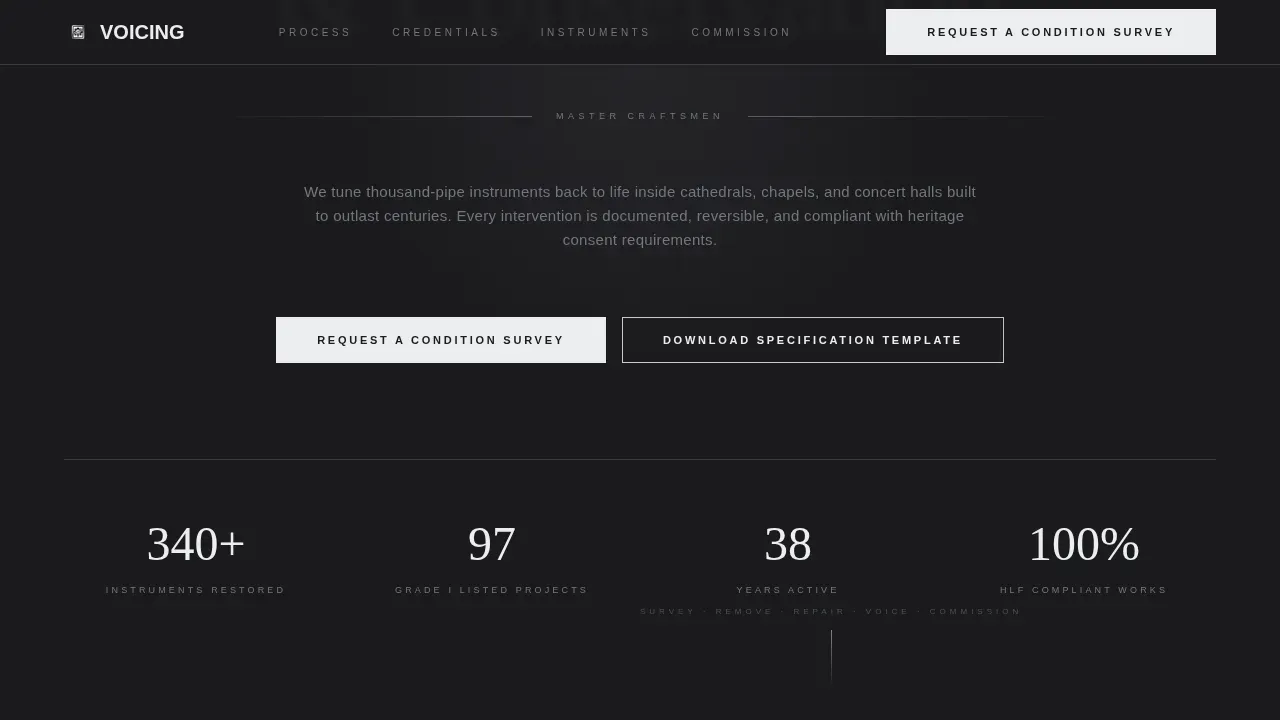
Two conversion paths run through the page. The primary call to action, Request a Condition Survey, appears at the header and again after the final commissioning panel. The form collects institution name, building listing status via a dropdown covering Grade I, Grade II*, Grade II, and Unlisted, organ builder of origin if known, and a free-text field for current instrument condition. The secondary path offers a downloadable PDF titled Specification Template for Organ Restoration Tenders, gated behind an email field, capturing procurement-stage leads who are drafting bid documents rather than ready to commission.
Monochrome Steel Design System
The visual identity uses four values only: forge-black (#1B1B1E), brushed chromium (#71767C), workshop white (#EDEEF0), and pipe-tin silver (#C0C5CE). Pipe-tin silver is reserved for divider lines, hover states, and specification callouts. Backgrounds alternate on each zigzag panel. Body text uses brushed chromium on dark sections and forge-black on light sections. Typography pairs Cormorant Garamond for display headings with Manrope for body copy. There is no warmth and no ornament, only the quiet authority of metal held to specification.
Scroll-Reveal Animation System
The template includes medium-intensity scroll animations built on IntersectionObserver logic. Headings use a word-by-word reveal. Content panels use staggered fade-up transitions. Credential marks respond to hover states with pipe-tin silver activation. These animations reinforce the sense of precision and deliberate construction without distracting from the specification-grade copy.
Specification-Grade Copy Framework
Each zigzag panel is written the way a real scope-of-work document reads. Materials are named by type. Methods are disclosed step by step. Timelines are given in plain terms. This copy framework proves institutional fluency to every reader, from a church warden reviewing the page on a desktop to a diocesan property adviser sharing the link with a faculty committee.
Page sections overview
| Section | Purpose |
|---|---|
| Credential Ribbon Header | Displays institutional trust marks and sets service scope in a single tracked-out line |
| Hero with call to action | Positions the firm's authority and presents the primary Request a Condition Survey call to action |
| Survey and Condition Report | Phase 1 zigzag panel pairing a technical photograph with survey scope-of-work copy |
| Pipe Removal and Cataloguing | Phase 2 zigzag panel covering cataloguing methods and pipe handling protocols |
| Soundboard Repair | Phase 3 zigzag panel detailing repair materials, methods, and timeline |
| Revoicing and Tuning | Phase 4 zigzag panel covering voicing adjustments, tonal calibration, and acoustics |
| Reinstallation and Commissioning | Phase 5 final panel with dual conversion: survey form and gated PDF download |
| Footer | Single-row linear footer on forge-black background |
Design & branding system
The design follows a Corporate Precision theme. The aesthetic is a machinist's inspection table: no warmth, no ornament, only the quiet authority of materials held to specification. Every colour and typeface choice is deliberate and functional.
- The four-value colour system uses forge-black (#1B1B1E), brushed chromium (#71767C), workshop white (#EDEEF0), and pipe-tin silver (#C0C5CE), with pipe-tin silver reserved for dividers, hover states, and callout lines only
- Typography pairs Cormorant Garamond as the serif display face for all major headings with Manrope as the sans-serif body face, creating a contrast between heritage authority and technical precision
- Zigzag backgrounds alternate between forge-black and workshop white on each panel, with brushed chromium carrying body text on dark sections and forge-black text appearing on light sections
Mobile & speed optimization
The template is designed desktop-first, reflecting the primary research behaviour of institutional buyers such as property committees and music directors who review detailed procurement pages on desktop during working hours. The layout is structured to perform cleanly across device sizes.
- Static sections use Server Components to keep render weight low on initial page load, while forms and scroll animations are handled through dedicated Client Components
- IntersectionObserver-based scroll reveals load content progressively, meaning heavy panel content does not block the initial view
- The form components are kept lean, with only essential fields collected, which helps the page remain responsive and the conversion experience friction-free on any screen size
How this template helps you convert
The page is engineered to move institutional buyers from awareness to action in a single scroll. Every section earns the next click.
- The credential ribbon establishes trust before a single line of body copy is read. Institutional buyers recognize accreditation marks, heritage funding logos, and listed building compliance stamps immediately. That recognition lowers resistance and sets the right frame for everything that follows.
- The five-phase zigzag structure mirrors the actual restoration journey. By the time a reader reaches the Reinstallation and Commissioning panel, they have mentally walked through the entire project. The dual conversion components then arrive at exactly the right moment: after comprehension, not before.
- The secondary PDF download path captures procurement-stage leads who are not yet ready to commission. A buyer drafting a tender specification will exchange an email address for a ready-made template. That lead is warm, high-intent, and positioned precisely at the start of a capital planning cycle.
Other information about this template
The Voicing template is built for the organ building and restoration sector, but the principles it applies are drawn from a deep understanding of how heritage institutions make purchasing decisions. Several points of background context are worth noting for anyone evaluating this template for their own firm.
- Organ building has a long tradition of named lineages. Aristide Cavaille-Coll, the nineteenth-century French organ builder, is recognized for designing the symphonic organ and built over 600 instruments, including major works in French churches. His instruments remain reference points for restoration craftsmen working on Romantic-era pipe organs. The Cavaille-Coll organ at St. Etienne in Caen, built in 1882, survives in near-original form. Arp Schnitger, the Dutch-German Baroque organ builder, produced a contrasting tonal school. Silbermann's organs, praised for their smooth and powerful tone, differed from those of contemporaries like Arp Schnitger. These historical lineages directly affect how a modern organ builder approaches restoration, because each instrument carries the tonal signature of its original maker and the voicing decisions made many years ago.
- Voicing techniques in organ building significantly affect the sound quality and overall performance of the instrument. Different voicing techniques can create distinct tonal characteristics. The voicing of an organ involves adjusting the pipes to achieve the desired tonal quality and blend of sounds. Acoustics play a crucial role in the voicing of organs, as the placement and design of the instrument can enhance or diminish sound quality. The final voicing of an organ is often tailored to the specific acoustical characteristics of the space in which it is located. Voicing techniques can include the use of different materials and methods in pipe construction to influence tonal quality.
- Modern organ restoration combines traditional craftsmanship with digital technology. Modern organ restoration tools include digital interfaces that allow for precise voicing adjustments. Many modern organ restoration tools utilize MIDI technology to enhance the voicing and control of organ sounds. Modern tools for organ restoration often include detailed voicing models that can be adjusted manually. Digital organ restoration tools can also simulate various acoustic environments to help refine sound quality before physical installation.
- Most pipe organs need tuning once or twice a year under standard maintenance arrangements. Mechanical action organs need cleaning and minor repairs at intervals of 25 to 40 years. Every twenty to thirty years, a church organ might also need a more substantial programme of repair work. Regular maintenance can help avoid expensive damage to your organ over its long life. The cost of maintenance for a pipe organ is approximately 5% that of a new instrument, making it a sound investment across many generations.
- Destroying or substantially altering a historic instrument is considered poor stewardship by heritage bodies. Carefully restoring your organ may produce a visual and musical improvement that serves both the congregation and visiting musicians for the next century.
- The template supports a range of institution types. Whether the brief covers two organs in a collegiate chapel, a single manual organ in a rural parish church, or a large four-manual organ in a civic concert venue, the phase-by-phase structure communicates the restoration logic clearly.
- The hero section of the template is designed to carry high-resolution photography of a restored pipe organ in a grand setting. Video content demonstrating before-and-after restoration work can also be placed to showcase voicing precision. A portfolio or case study section can be added to document specific heritage organs that have been restored, including challenges faced and outcomes achieved.
- Client testimonials from musical institutions, specifically praising sound quality and instrument preservation, reinforce the credibility this audience expects. Social proof through institutional endorsements carries more weight in this sector than general star ratings.
- For further information on adapting section copy or visual assets, the template structure accommodates case study content, testimonial blocks, and additional specification callouts without requiring layout changes.
- For further information on the credential ribbon, the template is pre-structured to carry membership seals from relevant professional bodies and heritage funding partners.
- A landing page for heritage organ restoration must bridge high-level technical expertise and artistic passion. The Voicing template is the voicing precision heritage organ restoration landing page template that achieves exactly this balance.
Theme
Corporate Precision
Creative direction
Transparent Process
Color system
Monochrome Steel
Style
Zigzag/Alternating
Direction
Partnership/B2B
Page Sections
Credential Ribbon with Institutional Trust Marks
Five-phase Zigzag Restoration Panels
Dual Conversion System
Monochrome Steel Visual Identity
Scroll-reveal Animation Framework
Specification-grade Copy Framework
Related questions
Who is the primary audience this template is designed for?
What conversion paths does the template include?
Can this template work for firms offering new organ commissions as well as restorations?
How does the credential ribbon build trust with institutional buyers?
Is this template suitable for firms outside the United Kingdom?