Orthopedic Surgeon Professional Website Template
Mend is a single-column landing page template built for board-certified orthopedic surgeons offering virtual consultations. It combines credential-forward design with a transparent patient journey, guiding injured and pain-affected visitors through a calm, clinical layout toward two clear actions: downloading a preparation guide or submitting a qualification intake.
by Rocket studio
Quick summary
Mend is a focused orthopedic virtual consultation landing page. It opens with a credential-badge hero, walks visitors through a transparent three-step consultation process, and closes with two conversion paths. The layout is designed to earn patient trust before asking for commitment, using a clinical-warm Arctic White color system and editorial typography.
Who this template is for
This template is built for orthopedic surgeons and specialist practices that offer virtual consultations. It suits providers who want patients to arrive informed, prepared, and confident before a single appointment is booked.
- Orthopedic surgeons offering remote imaging review, diagnosis, or post-surgical follow-up
- Specialist practices serving patients who cannot easily travel to an in-person clinic
- Board-certified providers who want their credentials and process to do the heavy lifting on the page
What problem this template solves
Patients with orthopedic injuries often wait weeks for an in-person consultation, unsure whether virtual care is even an option. When they do find a surgeon online, the page rarely explains what a virtual visit actually involves. That uncertainty creates hesitation and lost bookings.
- Patients do not know how to prepare imaging, position their camera, or what to expect from a remote orthopedic exam
- Surgeons with strong credentials and clear processes have no structured way to present both on a single page
- The gap between "I need help now" and "I trust this provider enough to book" is never addressed
What you get with this template
Mend delivers a fully structured single-column landing page with five clearly defined content sections and a linear single-row footer. Every section is designed around a specific patient mindset, from first-impression credibility to action-ready confidence.
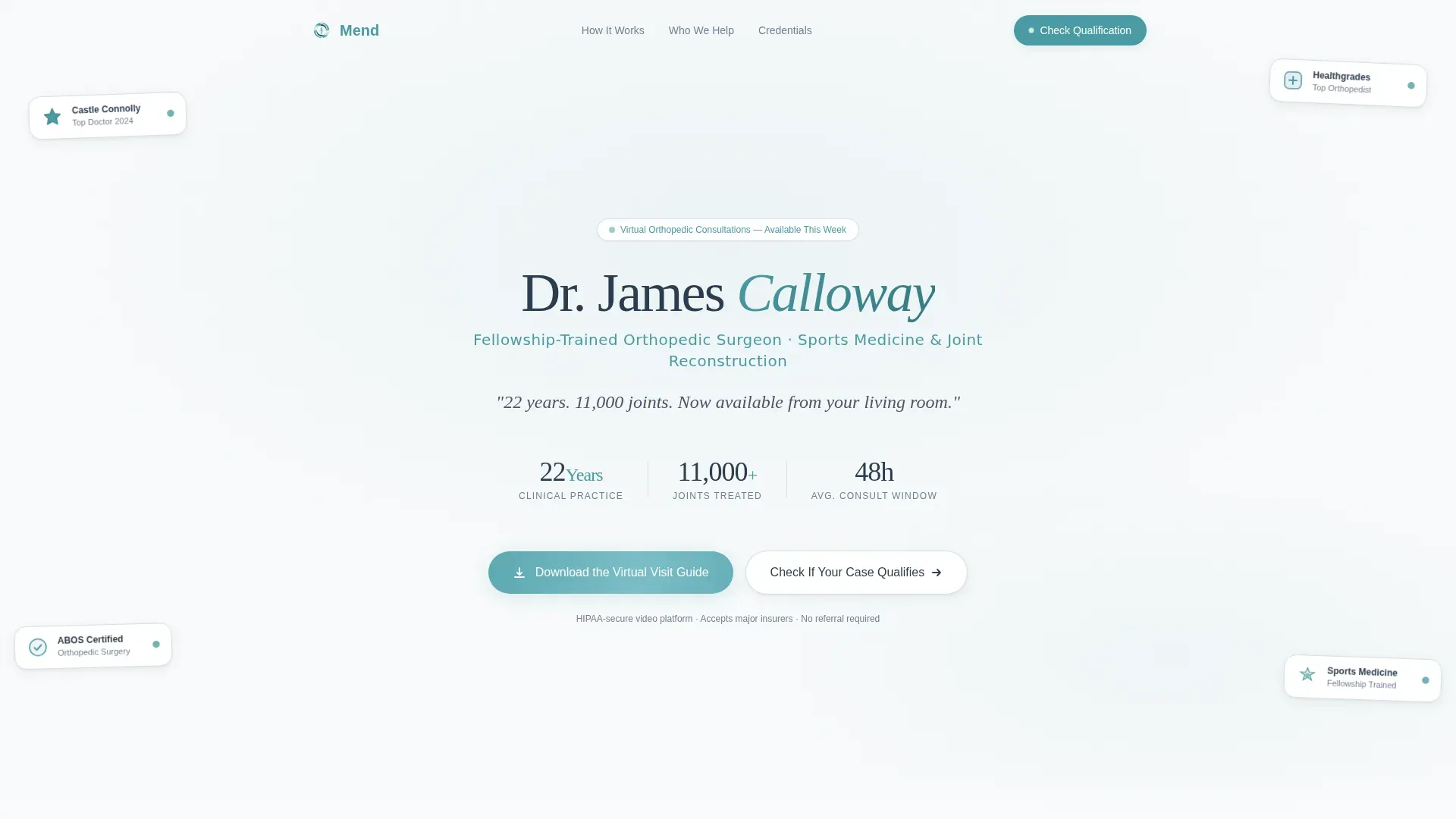
- A hero section with floating credential badge cards, surgeon stats, and a dual call-to-action layout
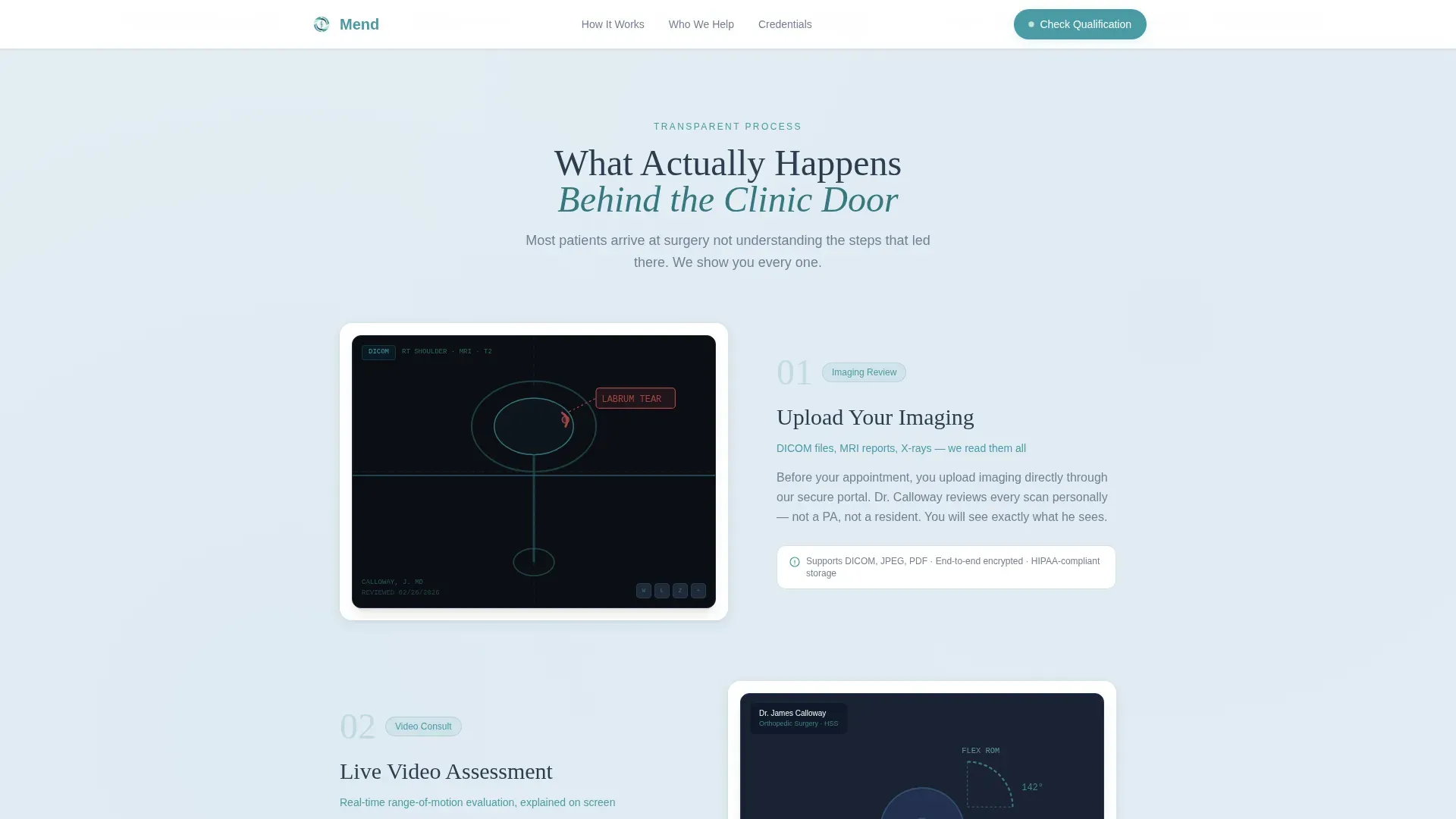
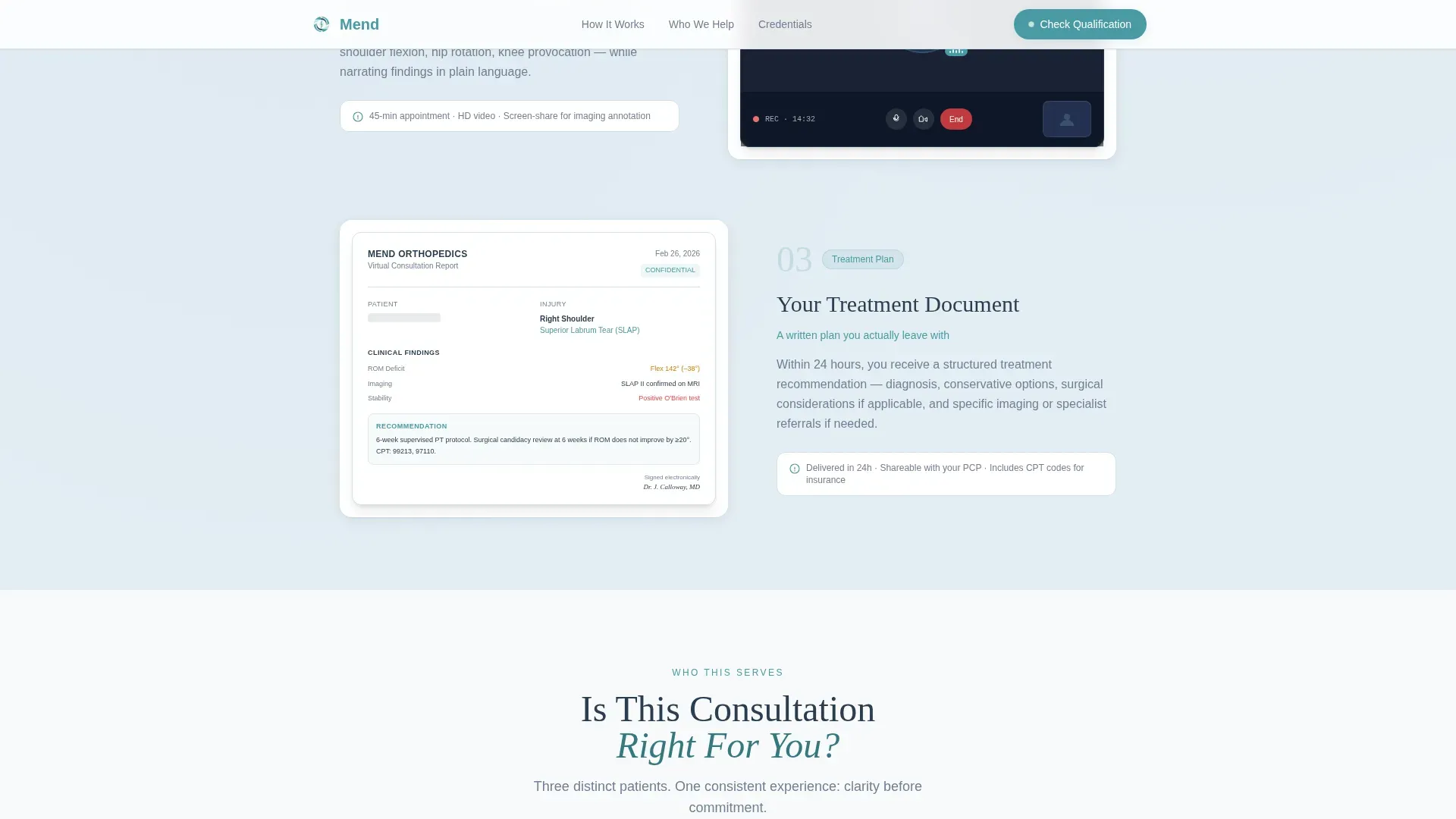
- A three-step process section with mock interface representations for imaging upload, live video assessment, and treatment document reveal
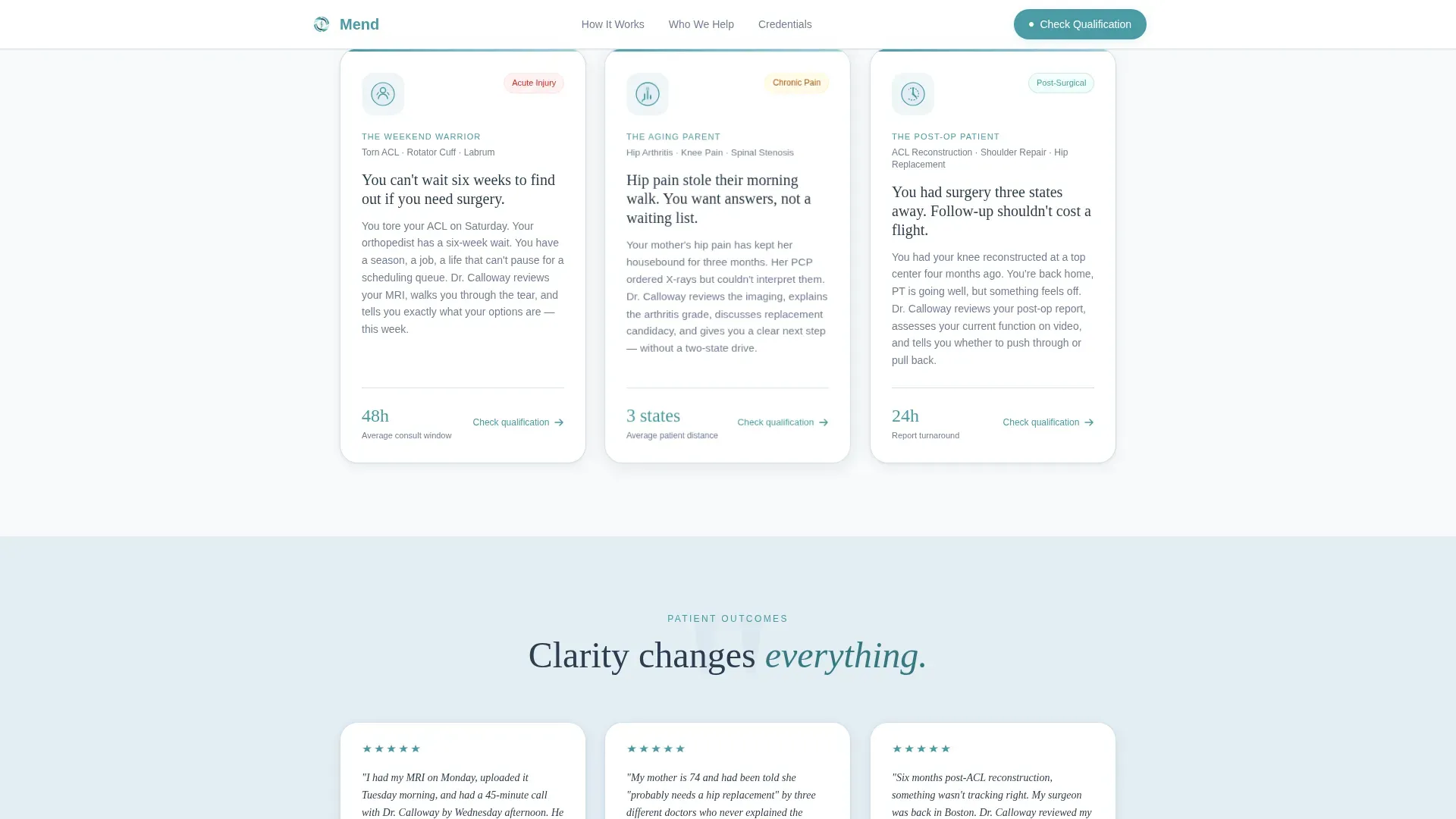
- Patient archetype cards, a testimonial section, a dual conversion section, and a compact footer
Feature list
Credential Badge Hero with Surgeon Stats
The hero section opens with animated board certification badges, fellowship crests, hospital affiliation marks, and recognition indicators. Beneath them, the surgeon's name, subspecialty, and a single confident stat line anchor the section. A dual call-to-action layout sits below, presenting both conversion paths immediately.
Transparent Three-Step Process Section
This section walks visitors through the exact consultation journey using three illustrated steps. Step one shows how imaging uploads work with a mock viewer interface. Step two presents a live video assessment example. Step three reveals a redacted but realistic treatment recommendation document.
Patient Archetype Cards
Three distinct patient profiles are presented as recognizable scenarios: the active adult with an acute injury, the older adult with chronic joint pain limiting daily movement, and the post-surgical patient needing remote follow-up care. Each card helps visitors self-identify and feel seen before they reach the conversion section.
Dual Conversion Section
The primary call to action offers a downloadable Virtual Visit Guide covering imaging preparation, camera positioning, clothing guidance, and insurance code information. The secondary path leads to a five-field qualification intake with a body-map injury selector, onset timeline, imaging status, insurance carrier, and preferred consultation window.
Testimonial Section with Outcome Context
Three patient testimonials are included, each paired with injury context and a specific outcome reference. This grounds social proof in clinical reality rather than generic positive sentiment.
Scroll-Triggered Animation System
The template includes medium-to-high interactivity: credential badge micro-glow animations on load, scroll-reveal transitions for process steps, spotlight hover states on cards, and parallax layering across sections. Process step navigation uses tab-style interaction.
Page sections overview
| Section | Purpose |
|---|---|
| Hero with Badges | Establish credentials and present dual calls to action |
| Transparent Process Steps | Walk patients through the virtual consultation journey |
| Who This Serves | Help visitors self-identify across three patient archetypes |
| Patient Testimonials | Reinforce trust with injury-specific outcome quotes |
| Dual Conversion Section | Drive PDF guide downloads and qualification intake submissions |
| Linear Footer | Provide concise navigation and contact reference |
Design & branding system
Mend uses a Healing Space theme built on an Arctic White color system. The palette feels clinical and calm without being sterile or intimidating. Fraunces, a display serif, handles headings while DM Sans handles body copy, creating a balance between specialist authority and readable warmth.
- Arctic white (#F8FAFB) as the dominant background, sterile ice blue (#E3EDF4) for section breaks, surgical teal (#4A9BA5) on interactive elements and trust indicators, and charcoal bone (#2C3E50) for body text
- Fraunces display serif for headings and DM Sans for body copy
- Clinical-warm editorial visual style with no stock photography; credentials, process visuals, and patient archetypes carry the narrative
Mobile & speed optimization
The template is built desktop-first with full mobile responsiveness. Patients commonly research orthopedic options on desktop and complete intake forms on mobile, so the layout adapts cleanly to both contexts without sacrificing form usability or section readability.
- Static-first architecture using server components for all non-interactive sections to reduce unnecessary rendering load
- The five-field intake form, body-map selector, and process step tabs are all designed to function cleanly on smaller screens
- Section reveals, badge animations, and hover states are implemented with scroll and interaction context, keeping motion purposeful rather than disruptive
How this template helps you convert
Mend is structured as a Content and Resource destination, which means it earns trust through education before it asks for a commitment. Every scroll deepens the patient's confidence rather than simply repeating a booking prompt.
- The credential badge hero builds immediate authority, allowing visitors to assess the surgeon's qualifications within seconds of arriving on the page
- The transparent process section removes the uncertainty that typically causes patients to leave without acting, by showing exactly what happens during a virtual orthopedic consultation
- The dual conversion paths match different patient readiness levels: the guide download serves visitors who need more information, while the qualification intake captures visitors who are ready to take the next step
Other information about this template
Mend is specifically designed for the orthopedic telemedicine space, where patient trust and clinical transparency are the primary conversion drivers. The template's content strategy reflects real patient behavior: research-heavy, trust-sensitive, and outcome-focused.
- The Virtual Visit Guide PDF concept is built into the template structure as a content offer, not a third-party dependency
- Insurance terminology, United States date formatting, and USD references are built into the copy and intake field assumptions
- The template name "Mend" reflects its positioning as a healing-forward, specialist-grade virtual consultation experience
- This template is well suited to practices that have previously relied on referrals alone and are now expanding into direct patient acquisition through digital channels
Theme
Healing Space
Creative direction
Transparent Process
Color system
Arctic White
Style
Single Column Flow
Direction
Content/Resource
Page Sections
Credential Badge Hero Section
Transparent Three-step Process
Patient Archetype Cards
Dual Conversion Section
Testimonial Section with Outcome Context
Scroll-triggered Animation and Interactivity
Related questions
Who is this landing page template designed for?
What conversion actions does this template support?
Can I use this template without a PDF guide already created?
Does the template include the patient testimonials and process visuals?
Is this template suitable for mobile users completing the intake form?