Historic Preservation Landing Page Template
The Postmark Keep the Window Open Preservation Landing Page Template is a zigzag, donation-focused single-page layout built for USPS post office advocacy campaigns. It pairs human stories with data visualizations in an alternating scroll, guides visitors toward a tiered donation form, and includes a secondary congressional letter path. The Cloud Canvas color system and serif typography give every section the weight of a handwritten letter.
by Rocket studio
Quick summary
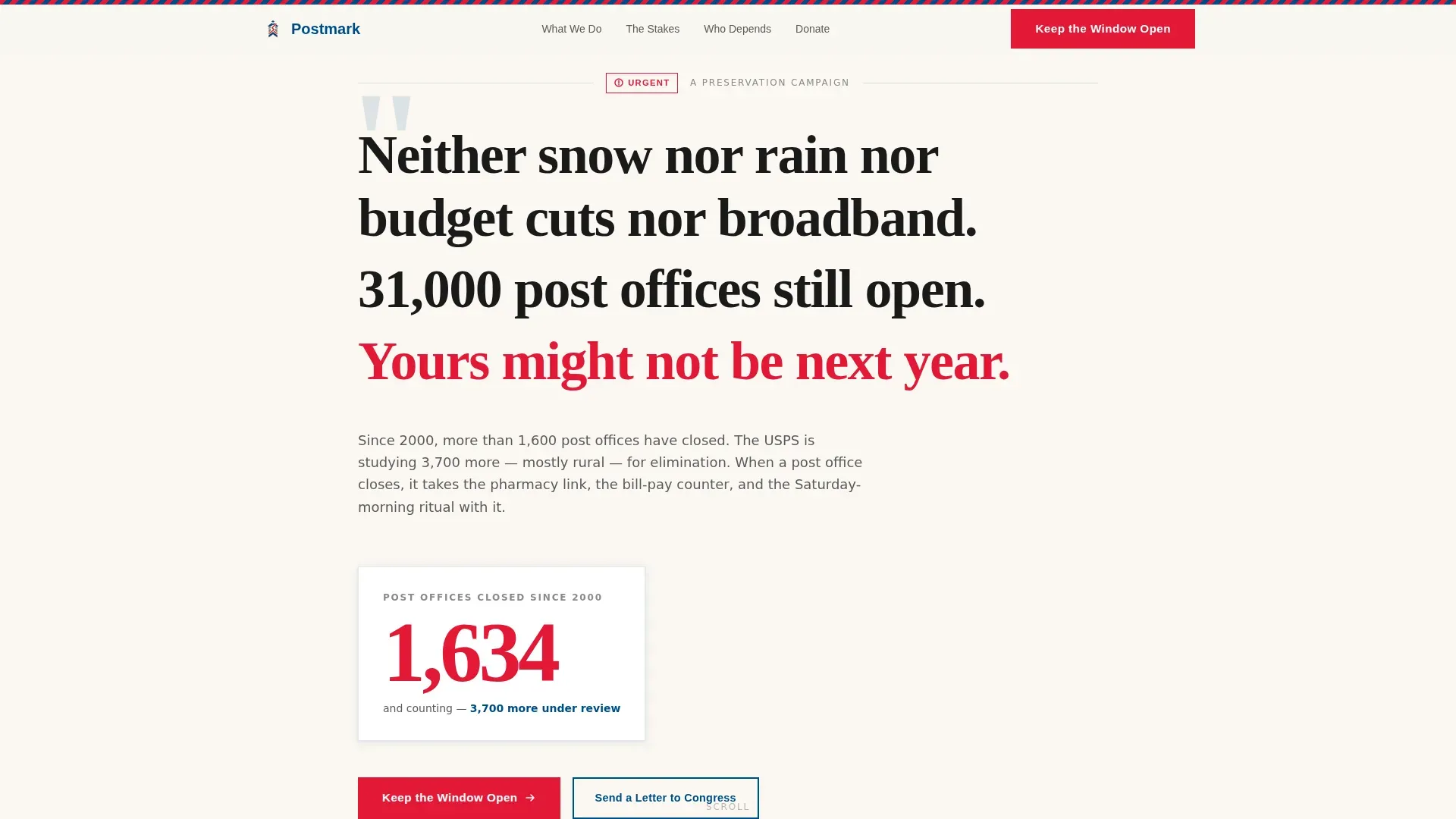
This is a single-page advocacy and fundraising layout designed to preserve rural post offices. It opens with a manifesto quote and an animated closure counter, then unrolls five zigzag sections that alternate between human stories and hard data. Two conversion paths run through the page: a tiered donation form with named outcomes and a congressional letter generator. The design is warm, editorial, and built for mobile-first rural audiences.
Who this template is for
This template serves civic organizations, nonprofit advocacy groups, and grassroots campaigns that need a credible, emotionally resonant fundraising page. It is especially suited to campaigns centered on public infrastructure, rural services, or government accountability. The layout is detailed enough for issue-driven campaigns that need to educate and convert in a single scroll.
- Nonprofit advocacy teams running donation and letter-writing drives for public services
- Civic tech builders who need a ready-made editorial fundraising layout they can customize quickly
- Small agencies and freelancers creating government and public interest campaign pages for clients
What problem this template solves
Many advocacy landing pages feel either too plain to be persuasive or too polished to feel authentic. Rural infrastructure campaigns in particular struggle to balance urgency with credibility. This template solves that tension by pairing the visual warmth of handwritten correspondence with the structured authority of a congressional briefing. It gives campaigns a page that earns trust before it asks for money.
- Campaigns often fail to connect abstract policy data with personal, human-scale stories
- Most donation pages do not offer a secondary path for visitors who are not ready to give financially
- Generic fundraising layouts rarely reflect the specific visual identity and civic tone a public service campaign needs
What you get with this template
You get a fully structured, ready-to-customize single-page layout with five thematic zigzag sections, two interactive conversion paths, and a defined visual system. Every design decision in the template is rooted in the brief. Nothing is generic filler. Each section has a specific editorial role, and the layout is organized so the narrative builds deliberately from awareness to action.
- A manifesto hero section with an animated post office closure counter
- Five zigzag sections pairing human photography with data visualizations, including closure maps and dependency statistics
- A tiered donation form with preset amounts tied to tangible outcomes, plus a congressional letter generator with name, zip, and district inputs
Feature list
The following built-in capabilities define what this template does and how it supports your campaign goals.
Zigzag Alternating Story and Data Layout
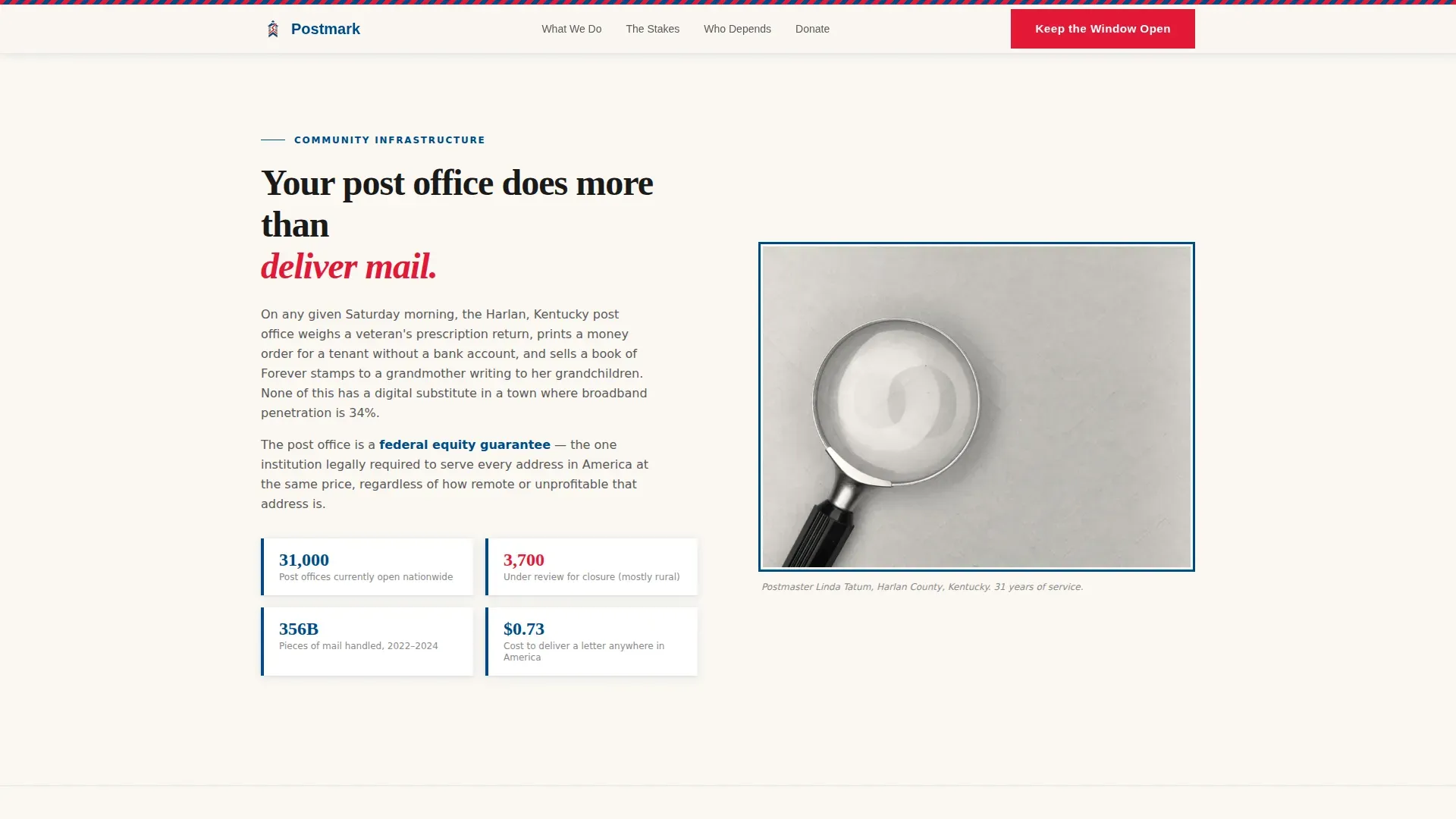
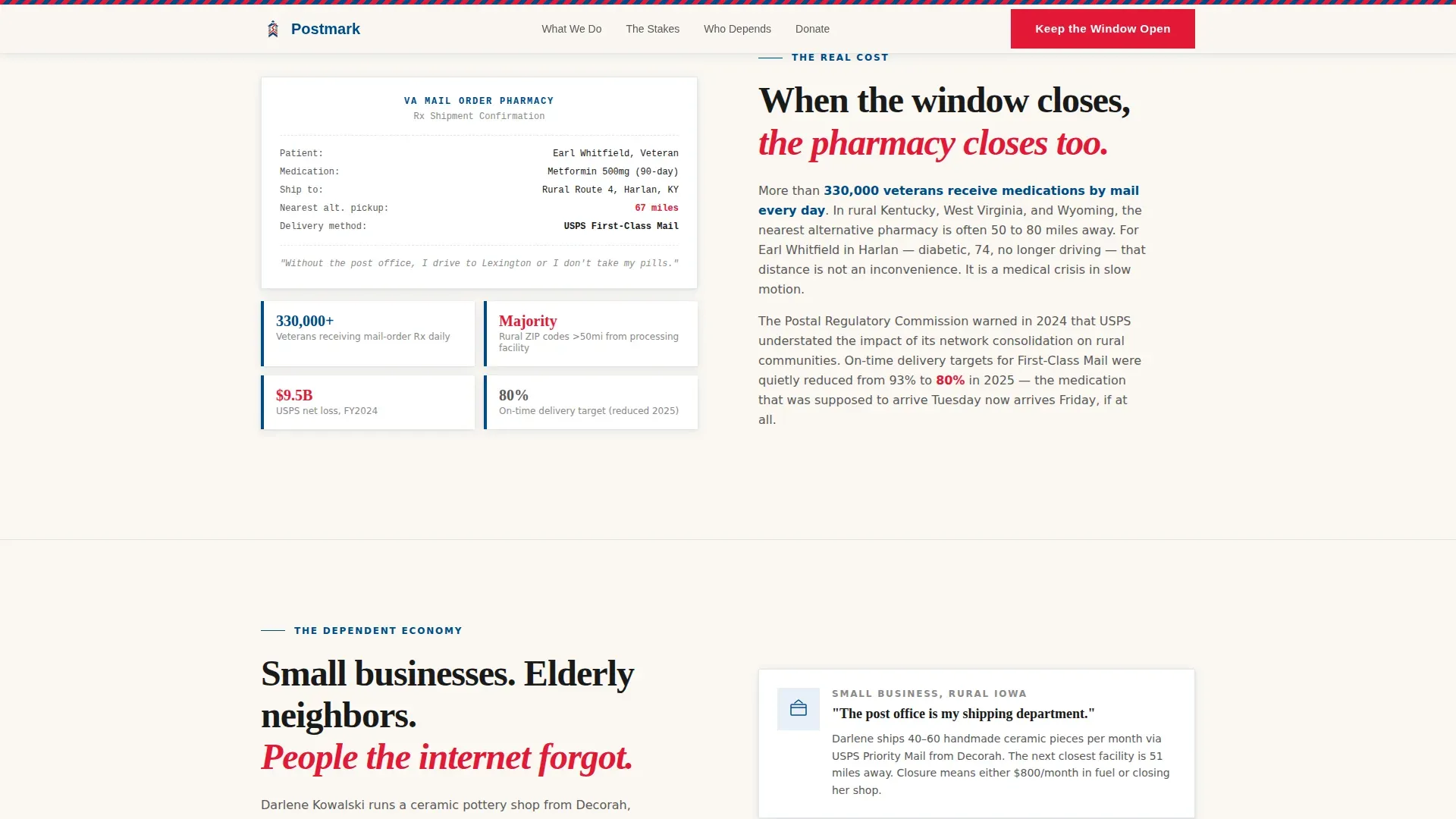
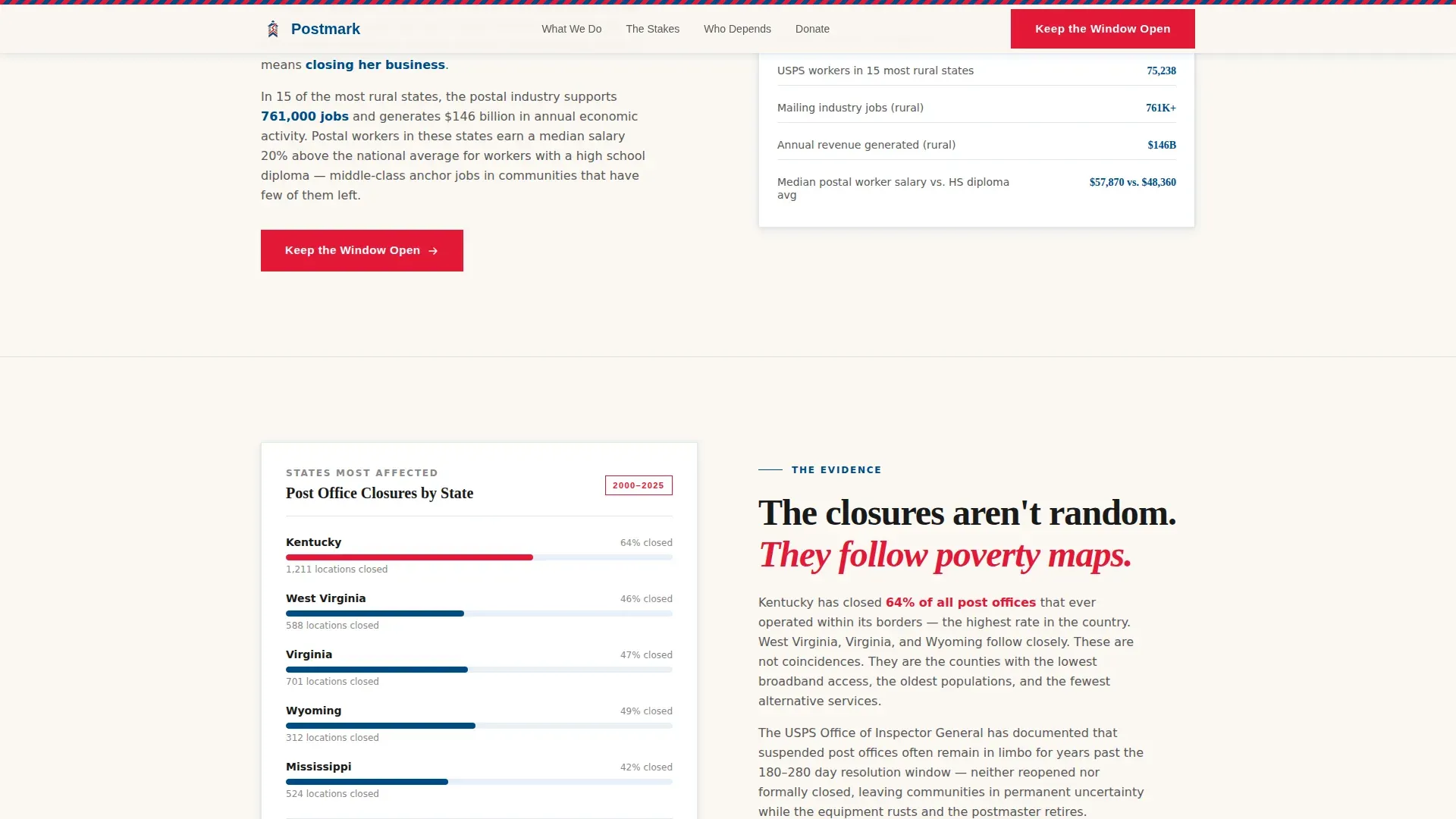
Each of the five main sections places a human narrative on one side and a supporting data visualization on the other. The alternating left-right rhythm creates natural scroll momentum. The layout builds a case the way a well-structured report does: evidence first, emotion alongside it.
Manifesto Hero with Animated Closure Counter
The hero section opens with a large, serifed manifesto quote set in white type on postal cream. The final sentence is rendered in priority-red to signal urgency without shouting. Below the quote, an animated counter ticks the number of post offices closed since 2000, grounding the emotion in a live-feeling number.
Tiered Donation Form with Outcome-Linked Preset Amounts
The primary conversion path is a donation form with three preset amounts: $25 to cover a rural route's Saturday fuel, $75 to fund a post office box fee waiver for a homeless veteran, and $150 to sponsor a community mailroom for a month. Each preset is labeled with its specific outcome so donors understand exactly what their contribution does.
Congressional Letter Generator
The secondary conversion path captures a visitor's name, zip code, and congressional district to auto-generate a preservation letter addressed to their representative. This path converts visitors who are not ready to donate into active advocates. It broadens the campaign's reach without requiring financial commitment.
Sticky Donation Bar on Final Scroll
A sticky donation bar appears when a visitor reaches the bottom of the page. It carries the primary call to action, "Keep the Window Open," and reinforces the donation prompt without interrupting the mid-page reading experience. This ensures the call to action stays reachable throughout the final sections.
Cloud Canvas Color System and Editorial Typography
The visual identity uses four carefully assigned colors: postal cream for backgrounds, mailbox blue for headers and navigation, cancellation-ink gray for body text, and priority-red reserved for calls to action and urgent callouts. Fraunces serif handles display headings, and DM Sans handles body text, creating an editorial warmth that matches the campaign's civic tone.
Page sections overview
| Section | Purpose |
|---|---|
| Hero Manifesto | Opens with quote and animated post office closure counter |
| What Your Post Office Does | Zigzag: postmaster photo paired with services data |
| What Disappears | Zigzag: veteran pharmacy story paired with closure map |
| Who Depends on It | Zigzag: small business story paired with rural dependency stats |
| What Donation Protects | Zigzag: donation tiers paired with named impact outcomes |
| Footer Row | Single-row linear footer with campaign navigation links |
Design & branding system
The Cloud Canvas color system treats every visual decision like a piece of postal correspondence. Cream dominates as background, the way unlined stationery invites a handwritten note. Blue anchors structure. Gray carries authority without demanding attention. Red appears only where something urgently matters.
- Postal cream (#FAF7F2) covers all backgrounds, mailbox blue (#004B87) anchors headers and navigation, cancellation-ink gray (#5A5A5A) carries body text, and priority-red (#E31837) signals calls to action and urgent callouts
- Fraunces serif handles all display headings in large, unhurried type; DM Sans handles body copy for clean readability at smaller sizes
- The Directory and Discovery theme organizes the scroll like a well-indexed report, making dense information feel navigable rather than overwhelming
Mobile & speed optimization
This template is built mobile-first, which is the right priority for a campaign reaching rural users on phones and elderly users on tablets. The zigzag layout adapts to a stacked single-column flow on small screens without losing its story-and-data pairing logic. Scroll reveals and counter animations are set to medium intensity, designed to perform well without heavy JavaScript overhead.
- Zigzag alternating sections reflow to vertical stacks on mobile, preserving the narrative sequence
- Medium-intensity animations, including the counter, scroll reveals, and zigzag stagger, are implemented with a minimal JavaScript approach to keep the page responsive on slower rural connections
- The sticky donation bar adapts to the bottom of the mobile viewport, staying accessible without blocking content
How this template helps you convert
The conversion architecture of this template is built around one primary action and one secondary action. The primary action, "Keep the Window Open," is introduced after the third section, when the narrative has already established stakes. The secondary action, the congressional letter path, appears alongside the donation form and gives every visitor a meaningful way to participate.
- The donation form uses preset amounts tied to specific, named outcomes, making it easier for visitors to choose a contribution level because they can see exactly what it funds before they click
- The congressional letter generator captures name, zip code, and district data to produce an auto-generated preservation letter, turning non-donors into advocates and expanding the campaign's reach beyond financial supporters
- The sticky donation bar on final scroll ensures the primary call to action remains visible as the page closes, catching visitors who scrolled through without stopping at the mid-page form
Other information about this template
This section covers additional practical details about the template's capabilities, technical context, and usage considerations that did not fit naturally into the sections above.
The template is built for campaigns that need to send email follow-ups after visitors donate or submit a congressional letter. If you plan to connect your donation form or letter generator to an email platform, using Postmark as your email delivery layer is a strong match for this use case. Postmark is a transactional email service that handles outbound notifications reliably and at scale.
When you create your Postmark account, a server is automatically created to help you organize emails by project or environment. Each server in Postmark has its own server token used for sending emails and making server-level API calls. To send email from your app using Postmark, you need to decide whether to use the API or SMTP. Using the Postmark API is required when you want to send templated emails, since template-based sending is not available via SMTP.
Postmark's templates allow for repeated use of an HTML and CSS layout while only passing dynamic content in API calls. Each template in Postmark is unique to its server, which helps you keep templates organized by project or client. Every template is identified by a template ID, which your API calls reference when triggering a send. You can use the Edit Test Variables button in the Postmark interface to simulate how different inputs change the rendered output before going live.
The Postmark platform supports multiple email types. You can use separate message streams for transactional and broadcast traffic, which helps maintain deliverability across different email types. Using separate message streams for transactional and broadcast emails keeps important notifications from being affected by bulk email activity. For example, a donation receipt is a transactional email, while a campaign update sent to your full list is a broadcast email. Keeping these in distinct message stream flows protects your sending reputation.
Using Postmark tools, you can send dynamic content that includes a donor's name or a personalized note tied to their contribution tier. Welcome emails, donation receipts, and congressional letter confirmations all benefit from this kind of personalization. You can also set up welcome emails that trigger automatically after a visitor submits their information, giving donors immediate confirmation and a personal note of thanks.
Sender signatures in Postmark confirm that you own the email address you are sending from. You can set up a new sender signature at any time in the Postmark user interface. Multiple sender signatures are supported without limit, which is useful if your campaign operates under more than one email address or organizational identity. Domain verification, which requires adding a DKIM record to your DNS, extends this further and lets you send from any address on a verified domain.
To test your email setup before going live, you can use sandbox mode in Postmark. Sandbox mode lets you test different parts of the email flow without sending messages to real recipients. You can also send a test email using the Postmark API Explorer by entering your X-Postmark-Server-Token and constructing a valid JSON request body. Using a Postman collection is another option for running API calls during development without writing code from scratch.
Webhooks in Postmark allow you to receive notifications and data in real time as email events occur. Postmark provides webhooks for bounces, inbound messages, clicks, and open tracking events. If a donor's confirmation email bounces, Postmark's delivery tracking will surface the event so you can act on it. Webhooks can also surface spam complaints, giving you early signals that help you adjust your email campaigns before deliverability is affected.
The default message content retention period in Postmark is 45 days. If your campaign runs longer and you need to retain message content beyond that window, the Postmark Retention Add-on can extend storage up to 365 days. All API connections in Postmark require HTTPS to ensure communication is secure. Images referenced in your HTML email templates should use URLs that point to a secure server, following best practices for HTML email rendering across inbox providers.
Using tags in Postmark helps you track which types of emails perform best. For example, you can tag your donation receipts separately from your advocacy update emails and compare open rates across your email campaigns. High-level reporting in Postmark helps you understand trends in engagement and deliverability over time, which is useful for refining your outbound messaging strategy across multiple campaign cycles. Paying attention to this reporting can help you make informed decisions for future content and communication planning.
For the email template design side, postmark's templates use a templating syntax called Mustachio, which supports dynamic content blocks, conditional sections, and loops. Layouts in Postmark let you define reusable code for shared CSS styles, headers, and footers across all our email templates. You can duplicate templates across different servers to keep them in sync if you run multiple campaign environments. Postmark allows attachments in templated emails the same way as in non-templated sends, so you can include a downloadable summary or sign-on document with any automated message.
The Postmark app and Postmark user interface make it straightforward to manage all your email configuration in one place. Account information, including your plan details, message stream settings, and domain records, is accessible from the Postmark account dashboard. The Postmark customer support team is available if you run into setup questions or need guidance on more advanced configurations. API snippets are available in the developer documentation to help you get code-level integration started quickly, with examples in multiple languages and a latest version reference for each library.
- The template supports a single-row linear footer with campaign navigation links, matching the Pattern 1 footer structure described in the brief
- The F-pattern reading flow is built into the zigzag layout, guiding the user's eye naturally from story to data and back across each section
- A 60/40 text-to-image ratio is a useful guideline to follow when populating the zigzag sections, helping avoid spam flags if you send email previews to supporters
- All our email templates connected to this campaign, including donation confirmations and advocacy updates, can share a single reusable layout through Postmark's layout system, keeping your branding consistent across every message
- Password reset and account notification emails are examples of transactional emails you might send to registered supporters after they create an advocacy profile on your campaign site
- Broadcast message streams are the right channel for campaign-wide updates and progress reports sent to your full supporter list
Theme
Directory & Discovery
Creative direction
Industry Report
Color system
Cloud Canvas
Style
Zigzag/Alternating
Direction
Donation/Fundraising
Page Sections
Zigzag Alternating Story and Data Layout
Manifesto Hero with Animated Closure Counter
Tiered Donation Form with Named Outcomes
Congressional Letter Generator
Sticky Donation Bar on Final Scroll
Cloud Canvas Color System and Editorial Typography
Related questions
What sections are included in this template?
Can the donation preset amounts be changed?
Does the template include the congressional letter generator?
Is this template suitable for mobile users?
Can I connect this template to an email platform for donation confirmations?