Upholsterer Business Professional Website Template
Reupholster is a split-screen landing page template built for skilled upholstery craftspeople. It leads with hard workshop numbers, walks visitors through project complexity section by section, and closes with a fabric care guide download. The design pairs deep navy panels with chalk white and worn brass accents to reflect the authority of a seasoned one-person workshop.
by Rocket studio
Quick summary
Reupholster is a single-page, split-screen portfolio template for independent upholsterers. It opens with a manifesto header, advances through stat-led project sections, and earns a lead capture with a downloadable fabric and care guide. Every section is built around craft evidence, not empty promises.
Who this template is for
This template speaks directly to craftspeople whose work is too detailed to explain in a sentence. It gives serious upholstery professionals a page that matches the precision of what they do.
- One-person upholstery workshops looking to present their craft and attract quality clients
- Independent upholsterers who serve both homeowners and commercial clients such as restaurant owners
- Skilled craftspeople whose portfolio needs to communicate experience before asking for contact
What problem this template solves
Most upholstery businesses rely on word of mouth. When a potential client finds them online, there is nothing that communicates the depth of skill involved. The page looks generic, and the work gets compared to cheap alternatives on price alone.
- Visitors leave without understanding the difference between basic re-covering and full antique restoration
- There is no clear way to capture leads from people who are not yet ready to book
- The portfolio shows photos but gives no context about process, time investment, or material expertise
What you get with this template
You get a fully structured split-screen landing page that does the storytelling for you. Each scroll section pairs a hard workshop number with a visual, so the visitor builds confidence as they move down the page.
- A manifesto-style header with a quote, social proof numbers, and a hero photograph
- Three stat-led project sections that escalate in complexity from simple re-covering to antique restoration
- A lead capture form offering a fabric and care guide download, with a persistent gallery link running alongside every section
Feature list
This template is built around a set of deliberate structural and visual decisions that work together to earn trust before asking for anything.
Split-Screen Section Layout
Every section divides the screen into two equal panels. The left panel carries the number or statement. The right panel carries the visual proof. This rhythm trains the visitor to expect evidence at every step.
Manifesto Header Block
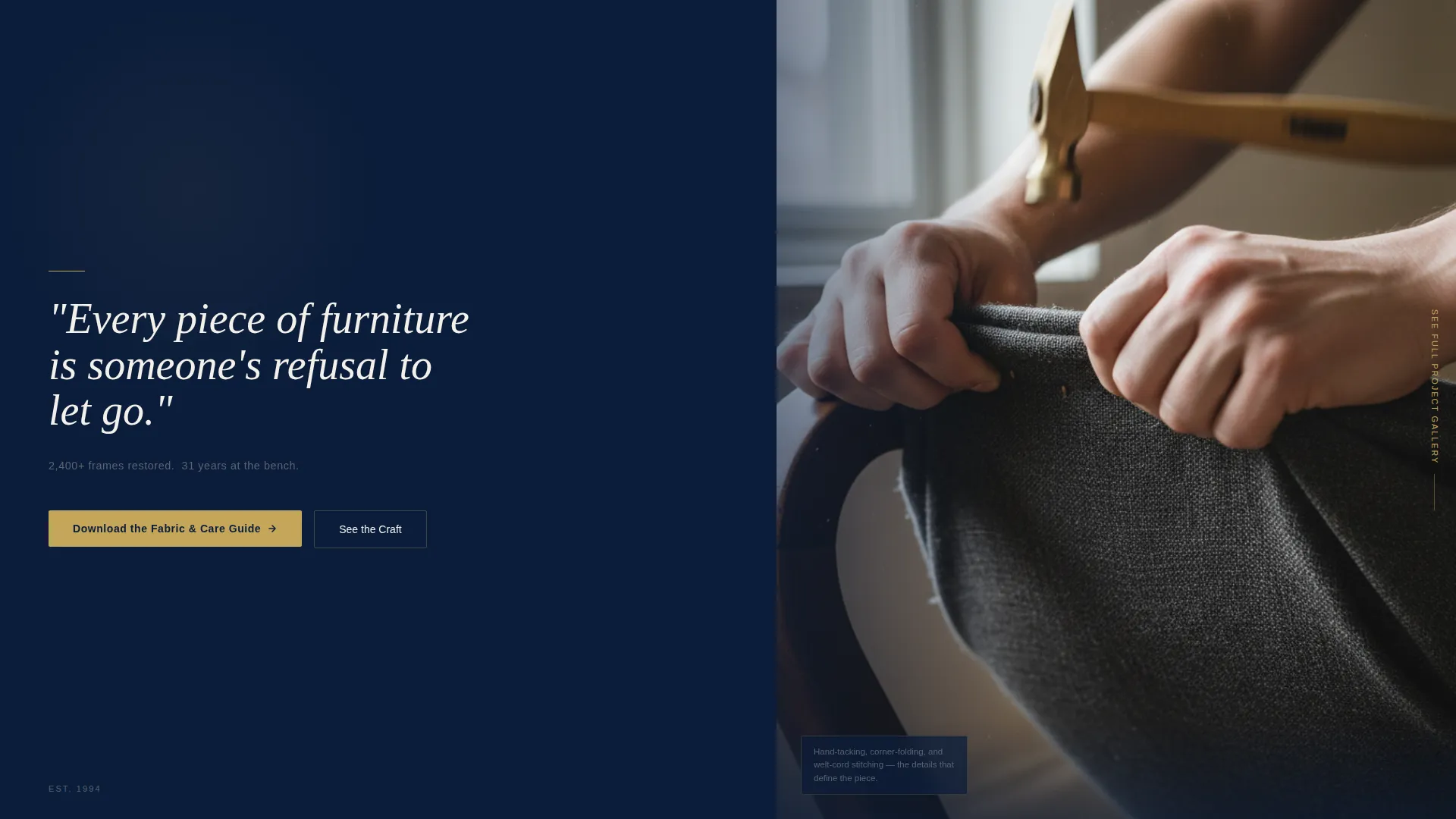
The header holds a single large serif quote against deep navy, a supporting stat line in tool-steel gray, and a close-up craft photograph on the right. There is no navigation and no logo. The opening is purely statement and proof.
Stats-First Narrative Structure
Each scroll section opens with a specific workshop number before revealing the story behind it. The stats create curiosity and signal precision. By the time visitors reach the form, they have already learned something about the craft.
Fabric and Care Guide Lead Capture
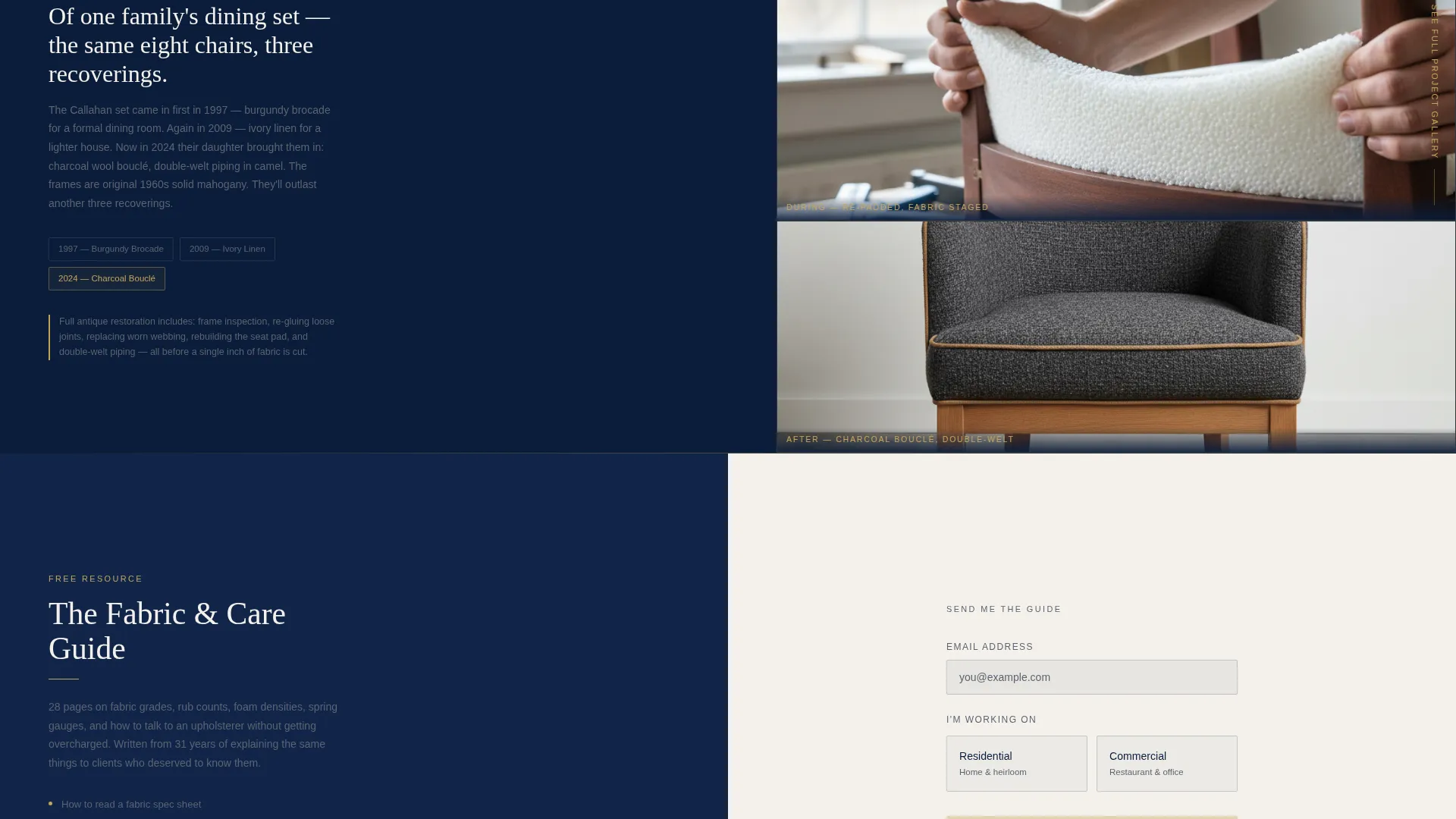
After the third project section, a focused form asks only for an email address and a single checkbox for residential or commercial intent. The download feels earned rather than forced because the page has already delivered real value.
Persistent Gallery Link
A secondary call-to-action runs along the right rail of every split section. The brass-colored "See Full Project Gallery" link opens an expanded image grid without breaking the scroll experience.
Before, During, and After Triptych Section
One dedicated section presents a three-panel before, during, and after view of a multi-generational dining set restoration. This section is the most complex in the sequence and demonstrates the full scope of antique restoration work.
Page sections overview
| Section | Purpose |
|---|---|
| Manifesto Header | Opens with quote, supporting stats, and craft photograph |
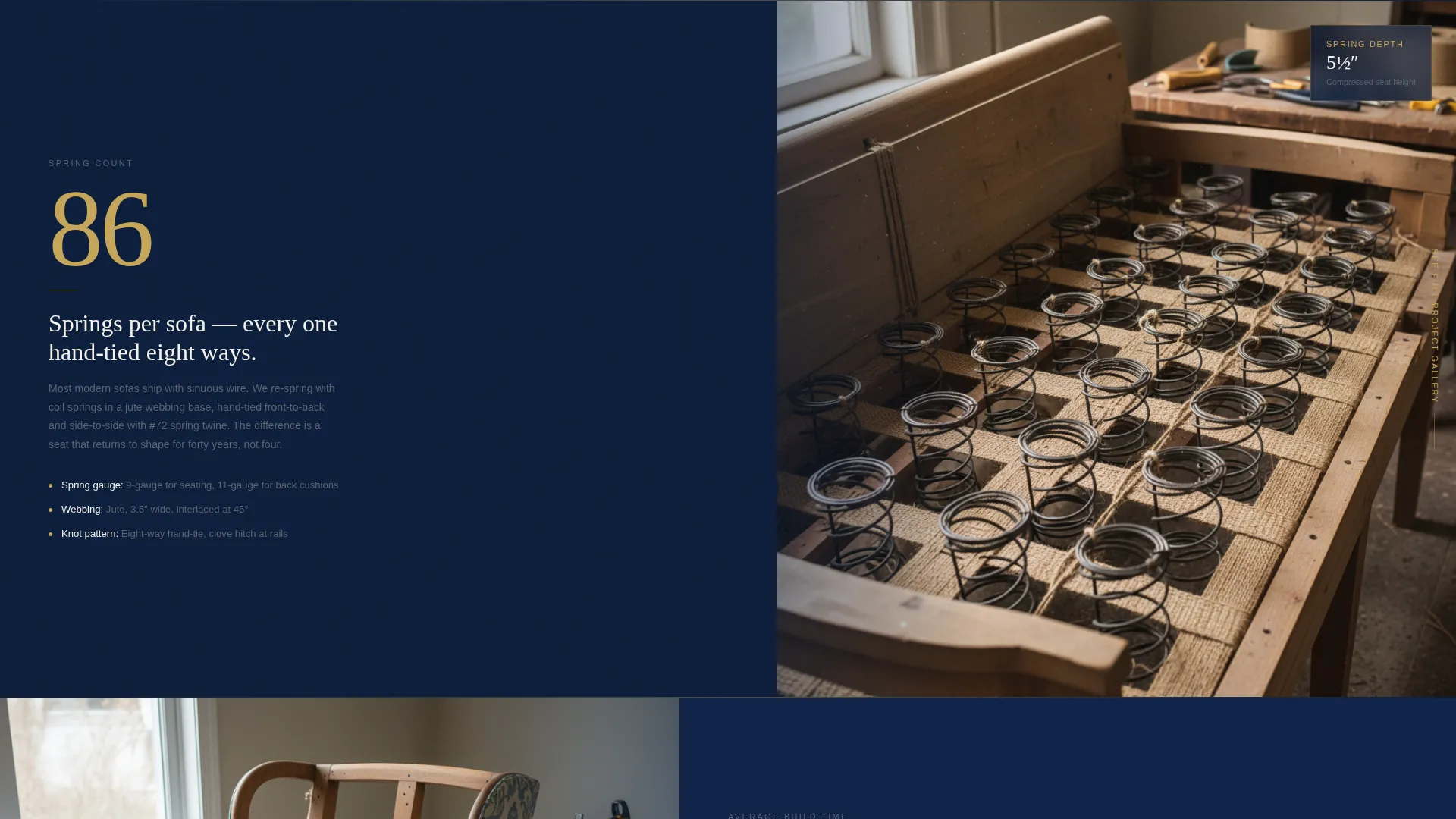
| Spring Deck Section | Pairs "86 springs per sofa" stat with exposed spring deck photo |
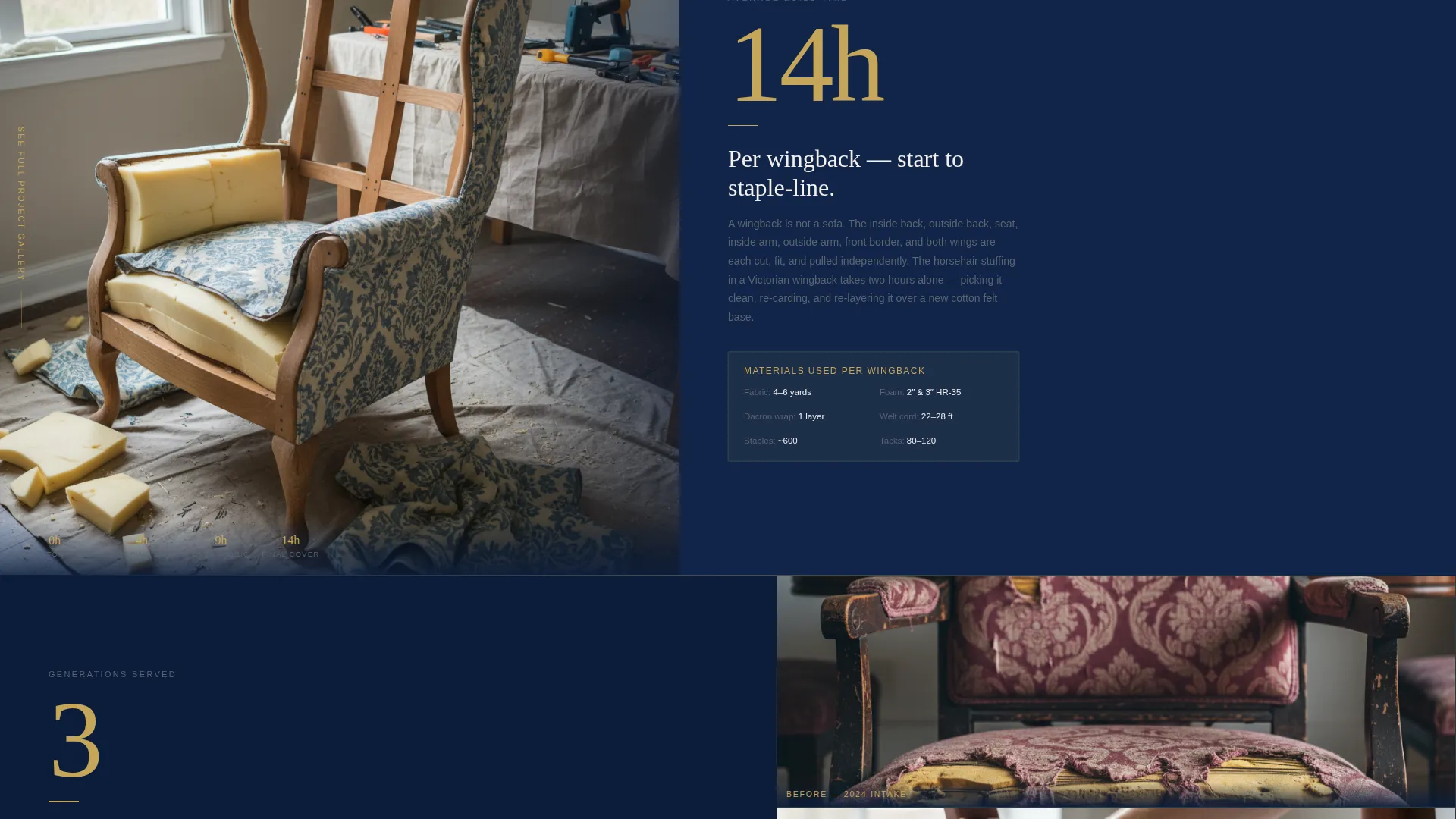
| Wingback Rebuild Section | Shows "14 hours average per wingback" beside a time-lapse rebuild strip |
| Restoration Triptych | Presents before, during, and after views of a three-generation dining set |
| Guide Download Form | Captures email and residential or commercial intent for fabric guide |
Design & branding system
The visual identity follows a Service Utility approach built on a Navy Authority color system. The palette is intended to feel like a well-lit workbench at the close of a working day. Navy dominates structural panels, chalk white opens reading space, and brass appears only where the eye needs to be pulled.
- Deep workshop navy (#0B1D3A) as the primary panel background on left-side split sections
- Worn brass (#C5A55A) for accent lines, hover states, buttons, stat numbers, and image borders
- Chalk white (#F4F1EB) for body text, section breaks, and right-panel backgrounds; tool-steel gray (#5C6370) for secondary type and dividers
Mobile & speed optimization
The split-screen layout is structured to restack cleanly on smaller screens. Each panel becomes a full-width block, preserving the stat-then-visual reading order on mobile without losing the narrative sequence.
- Left panels stack above right panels so the number always appears before its supporting image
- The persistent gallery link and download form remain accessible at each section without requiring horizontal scrolling
- Typography scales from large serif display sizes on desktop to readable proportions on mobile viewports
How this template helps you convert
The page is designed as a content-first destination. It earns the lead by delivering real craft knowledge before presenting any form or call-to-action.
- The manifesto header establishes credibility immediately with a specific stat line such as "2,400+ frames restored. 31 years at the bench." so the visitor knows they are in the right place before reading further.
- Three escalating project sections build expertise progressively, from simple re-covering through complex antique restoration, so by the third section the visitor understands the full range of skill available.
- The fabric and care guide download converts intent into a contact because the page has already demonstrated that the craftsperson knows more than the visitor. The guide feels like a natural next step.
Other information about this template
This template is designed as a standalone landing page, not a multi-page site. It is best suited for upholsterers who want a single authoritative presence rather than a full website. The structure also supports use cases beyond residential work, including commercial upholstery for hospitality venues and interior design trade clients.
- The template uses a zigzag alternating layout, meaning left and right panel content switches sides on consecutive sections to maintain visual rhythm
- The lead capture is intentionally minimal: one email field and one checkbox, keeping friction as low as possible for both residential homeowners and commercial buyers
- The page is well-suited to professionals who want to attract interior designers sourcing specialist upholstery trade partners, as well as direct homeowner inquiries
Theme
Legal Shield
Creative direction
Transparent Process
Color system
Navy Authority
Style
Zigzag/Alternating
Direction
Partnership/B2B
Page Sections
Split-screen Section Layout
Manifesto Header Block
Stats-first Narrative Structure
Fabric and Care Guide Lead Capture
Persistent Gallery Call-to-action
Before, During, and After Triptych
Related questions
Can I use this template if I work alone and do not have a large portfolio yet?
What is the fabric and care guide download, and do I need to create the guide myself?
Is this template only suitable for residential upholstery work?
Can I replace the default manifesto quote with my own workshop statement?
Does the persistent gallery link require a separate page to be built?