Maximize Dermatology Claims Landing Page Template
The Copay landing page template gives dermatology practices a structured, field-manual-style resource for tackling claim denials head-on. Built on a 50/50 split-screen layout, it walks billing staff and providers through denial causes, corrected claim approaches, and prior authorization workflows, turning overwhelmed office managers into confident, revenue-protecting billers.
by Rocket studio
Quick summary
This template is a single-page resource hub for dermatology billing. It pairs the visual clarity of a 50/50 split-screen layout with a problem-to-solution scroll structure. Every section moves the visitor from recognizing a painful billing mistake to understanding the exact corrected approach, before asking for anything in return.
Who this template is for
Dermatology practices lose more revenue to preventable billing mistakes than almost any other specialty. This template speaks directly to the people carrying that weight every day.
- Office managers and billing staff who manage high volumes of denied claims and need fast, actionable guidance
- Solo-practice dermatologists losing income to downcoded evaluation and management visits
- Newly credentialed providers who have never filed a CPT 17000 series code and need a reliable starting point
What problem this template solves
Claim denials cost U.S. healthcare providers an estimated $262 billion annually. Dermatology practices face denial rates that are disproportionately high because the specialty's coding is unusually complex. Modifier stacking, medical necessity documentation for biologics, and payer-specific bundling rules all trigger denials that could have been avoided.
- Lost revenue from coding errors, missing prior authorization, and incomplete patient information that could have been caught before claim submission
- Administrative burden that piles up when rejected claims require rework, appeals, and follow-up, increasing labor costs and delaying cash flow
- Lack of a structured denial management reference that shows the corrected approach, not just the problem
What you get with this template
The template delivers a complete, scroll-driven educational landing page built for dermatology practices. Every section earns visitor trust before presenting a call to action.
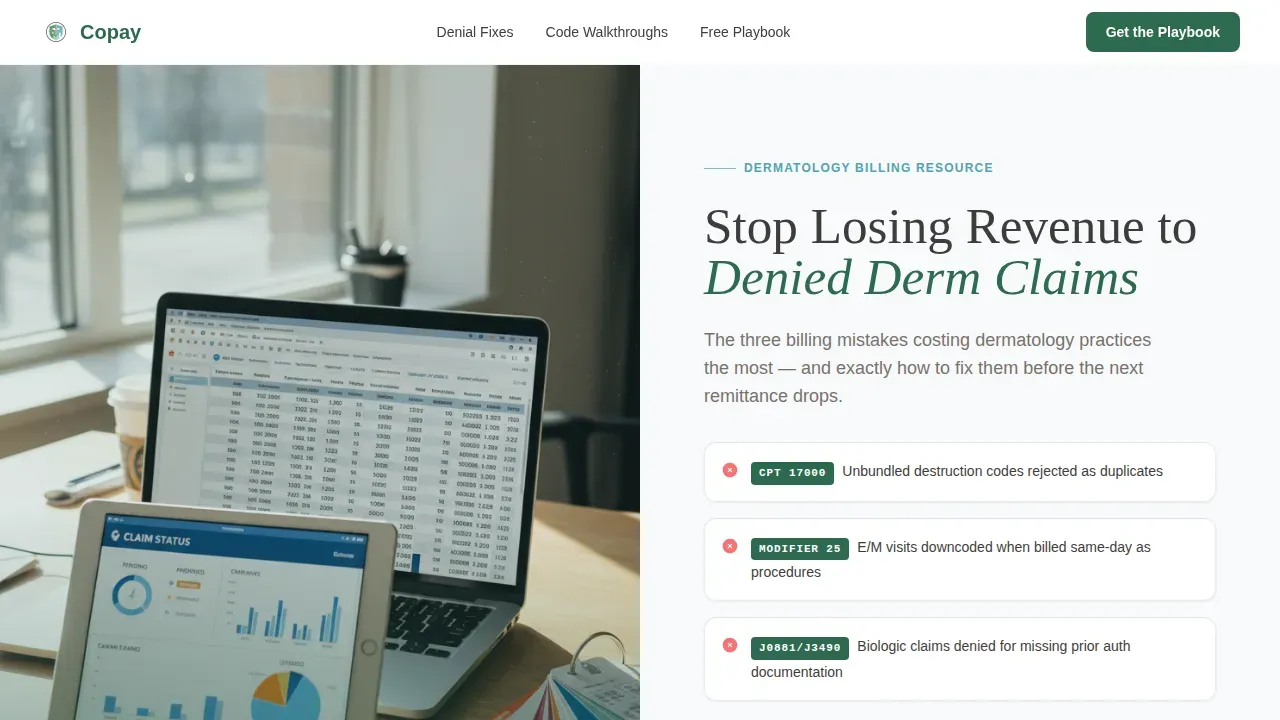
- A hero split panel with an operational desk photograph and a headline naming the three costliest billing mistakes in dermatology
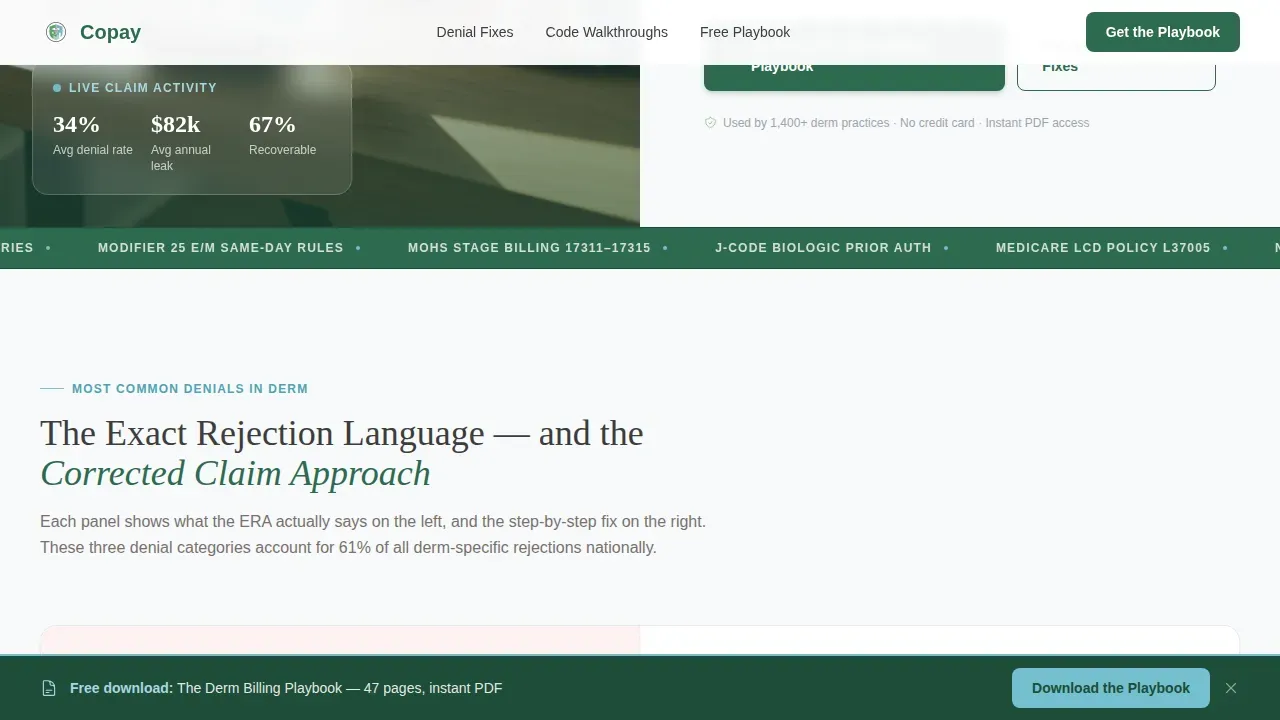
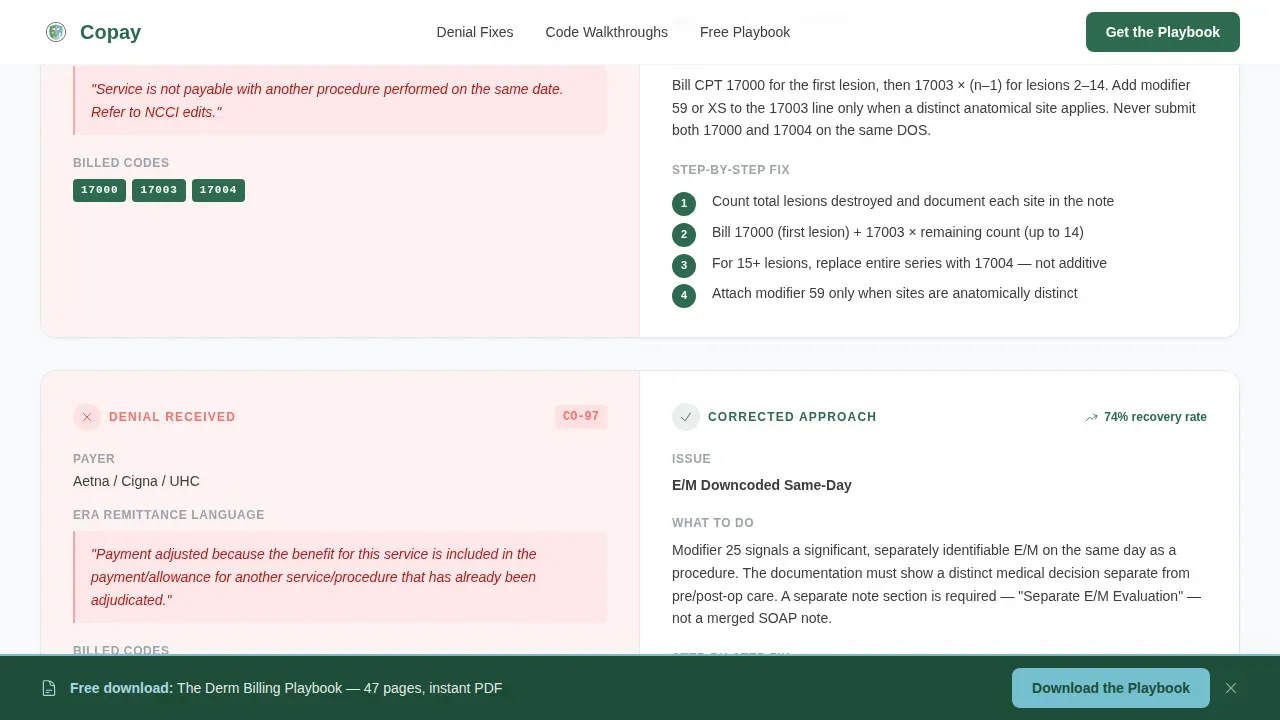
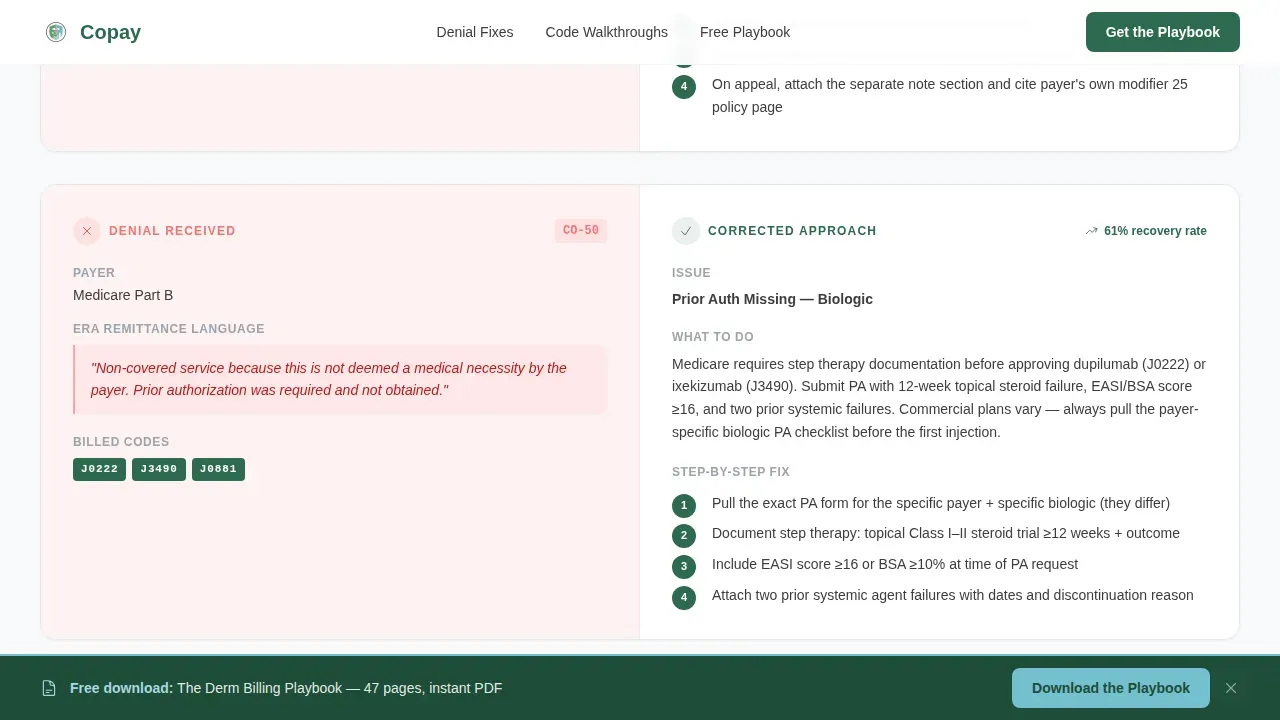
- A denial breakdown section with three side-by-side panels showing rejection language alongside the corrected claim approach
- Two full coding walkthroughs (Mohs modifier stacking and biologic prior authorization), a three-field playbook download form, and a secondary inline appeal template download gated by email only
Feature list
This template includes purpose-built layout components designed for dermatology medical billing education and denial prevention.
Problem-Solution Split Panels
Each denial scenario is displayed as a side-by-side split. The left panel shows the exact rejection language from the insurance provider. The right panel shows the corrected claim approach. Visitors immediately see the fix without hunting for it.
Coding Walkthrough Sections
Two full on-page walkthroughs guide readers through Mohs modifier stacking and biologic prior authorization workflows. These sections demonstrate medical necessity documentation practices and accurate coding before any form appears, building trust through visible value.
Dual Call-to-Action System
A three-field playbook download form (practice name, role, and email) sits after the second problem-solution pair. A sticky bottom bar repeats the primary call to action. A secondary inline download for a denial appeal template is gated by email only, catching visitors who want immediate tactical relief without committing to the full guide.
Alpine Fresh Color and Typography System
The layout uses an evergreen, snow white, glacial blue, and granite charcoal palette. Fraunces serif headlines provide authority and warmth. DM Sans body text keeps dense billing information legible. Soft sage section-break washes give the eye a resting point between informational blocks.
Scroll-Reveal Animation Layer
Low-to-medium scroll reveal animations and staggered text entrances guide the visitor through escalating complexity. Each section resolves its own tension before introducing the next topic, so readers feel progressively more capable rather than more confused.
Desktop-First Responsive Layout
The template is built desktop-first to match how billing staff actually work, at a workstation reviewing an explanation of remittance (ERA) screen. A mobile fallback ensures the page remains usable for providers checking resources from a phone.
Page sections overview
| Section | Purpose |
|---|---|
| Hero Split Panel | Introduces the billing problem with an operational photograph and a headline naming the three costliest mistakes |
| Denial Breakdown Panels | Shows three real denial scenarios with rejection language and corrected claim approach side by side |
| Mohs Coding Walkthrough | Guides readers through modifier stacking rules for Mohs procedures with accurate coding detail |
| Biologic Prior Auth Walkthrough | Walks through prior authorization workflows for biologics with medical necessity documentation guidance |
| Playbook Download Form | Collects practice name, role, and email to deliver the full Derm Billing Playbook |
| Inline Appeal Download | Offers a denial appeal template gated by email only for visitors wanting immediate help |
| Sticky Call-to-Action Bar | Repeats the primary download call to action throughout the scroll session |
| Single-Row Footer | Provides a clean, minimal footer in a linear single-row pattern |
Design & branding system
The Alpine Fresh color system gives this template a clinical, authoritative feel that stays warm. The palette was chosen to evoke a mountain clinic at morning: sharp, clear, and immediately calming for a visitor who arrived stressed about denied claims.
- Evergreen (#2D6A4F) anchors headers and navigation; glacial stream blue (#74C0CF) highlights interactive elements and linked resources; snow-field white (#F8F9FA) and soft sage (#B7D5B8) create breathing room between dense billing content
- Fraunces serif handles headlines to project authority and warmth; DM Sans handles body text to keep dermatology coding language easy to read at any density
Mobile & speed optimization
The template is built desktop-first because billing staff work at workstations. However, the layout includes a mobile fallback so providers and office managers can access the resource from any device.
- Optimized image use across sections supports fast visual loading, which is critical for user engagement when visitors arrive mid-workflow
- Static sections use server-side rendering patterns; interactive elements such as the form and sticky call-to-action bar are handled client-side to keep the overall page responsive
How this template helps you convert
This template is structured to demonstrate value before making any ask. The visitor trusts the resource before they see a form field.
- Two full coding walkthroughs appear on-page before any gate, so the visitor already knows the content is genuinely useful and technically accurate, reducing friction at the point of claim submission for the download form
- The dual call-to-action system captures visitors at two different levels of intent: those ready for the full playbook and those who only want the denial appeal template right now, minimizing the number of visitors who leave empty-handed
Other information about this template
This template is well-suited for healthcare organizations and dermatology billing teams looking to address revenue leakage at its source. Several broader billing principles inform its structure and are worth noting for teams evaluating the resource.
- Claim denials occur most often due to missing information, coding errors, and insurance eligibility failures; categorizing denial trends by root cause helps a billing team address the most damaging patterns first
- Eligibility verification before each visit, including real time eligibility verification of a patient's insurance status, can prevent claim denials related to lapsed coverage or incorrect patient details
- Claim scrubbing before submission catches documentation errors and diagnosis codes mismatches; automated systems can flag CPT/ICD-10 mismatches in dermatology-specific scrubber tools, reducing the rate at which rejected claims require rework
- A specialized billing team that follows current coding guidelines and payer guidelines can reduce denial rates by up to 40%; practices that submit clean claims consistently report a 20% improvement in clean claims rates after structured process changes
- Soft denial situations, where a claim is returned for missing information rather than refused outright, are recoverable when the billing partner acts quickly; hard denial situations, where the insurance payer refuses payment permanently, often require legal counsel or a formal appeals process
- Duplicate claims and multiple claims for the same service trigger automatic denials; preventing these requires claim management workflows that track submission history
- The Copay stop losing revenue to denied derm claims landing page template is designed to address specific revenue leaks including modifier errors, medical necessity gaps, and insurance eligibility failures that dermatology practices face daily
- The global healthcare revenue cycle management software market is projected to grow by $34.8 billion from 2024 to 2028, reflecting the scale of revenue leakage that healthcare providers are working to address across the healthcare industry
- Visual terminology guides that define terms such as copay, deductible, and coinsurance help patients understand their patient's insurance policy before appointments, improving patient satisfaction and reducing front-desk confusion
- The right billing partner for a dermatology practice understands the nuances of dermatology coding, from CPT 17000 series lesion removals to complex surgical bundling rules, and can improve both operational efficiency and financial stability
- Providing a digital advance beneficiary notice (ABN) informs patients about potential denials for services deemed not medically necessary, supporting transparent communication that reduces downstream disputes
- The American Medical Association publishes coding guidelines that inform accurate coding practices; staying current with these resources is a critical aspect of minimizing denials and protecting revenue cycle health
Theme
Educational Guide
Creative direction
Problem→Solution Arc
Color system
Alpine Fresh
Direction
Content/Resource
Page Sections
Problem-solution Split Panel Layout
On-page Coding Walkthroughs
Dual Call-to-action Conversion System
Alpine Fresh Visual Identity
Scroll-reveal Progressive Complexity
Desktop-first Responsive Structure
Related questions
What types of claim denials does this template address?
Who is the right audience for this landing page template?
Does the template show value before asking for contact information?
How does the dual call-to-action system work?
Can this template support a dermatology practice's denial management workflow?