Expert Occupational Therapy Landing Page Template
The Restore Healing Hands landing page is a hub-and-spoke patient education template for occupational therapy practices. It organizes free downloadable guides, illustrated technique cards, and self-assessment tools across five anchor-nav spoke sections. Warm, grounded visuals and a problem-to-solution scroll structure help post-stroke survivors, sensory-seeking children's caregivers, and desk workers with hand and wrist concerns find exactly what they need.
by Rocket studio
Quick summary
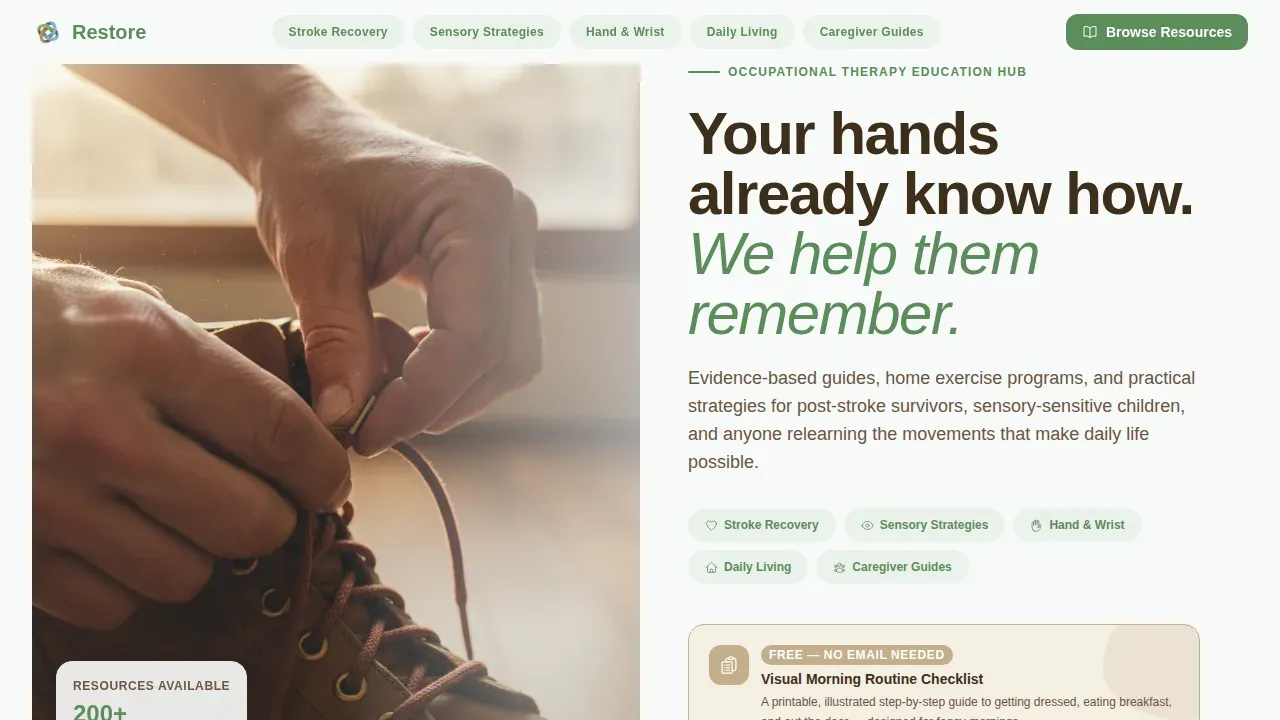
Restore is a warm, clinically grounded hub-and-spoke landing page built for occupational therapy patient education. It opens with an ungated free resource, earns trust through honest copy, and guides each visitor from a gut-level question to a downloadable solution. Five anchor-nav spokes cover stroke recovery, sensory strategies, hand and wrist care, daily living, and caregiver guides.
Who this template is for
This template is built for occupational therapists who want to publish patient education resources without piecing together a site from scratch. It works equally well for solo practitioners, small clinic teams, and staff at multi-location practices.
- Occupational therapists building a free resource hub for patients and caregivers
- Hand therapists who want to share home exercise guides, splint instructions, and self-assessments
- Clinic teams at any locations who need a single, organized destination for patient education materials
What problem this template solves
Patients searching for help at 2 a.m. do not need a brochure. They need a person who understands what they are going through and hands them the right tool immediately. Most therapy websites bury resources inside navigation menus or lock them behind generic forms that feel cold. This template solves that by leading with empathy and delivering value before asking for anything.
- Post-stroke adults, parents of sensory-seeking children, and desk workers with hand injury concerns all land on a page that speaks directly to their specific situation
- Each spoke section opens with the real question the patient already typed into a search bar, then delivers clinical validation and practical resources
- The first resource, a visual morning routine checklist, is completely free and ungated, proving quality before the email capture appears
What you get with this template
You get a fully structured landing page that organizes multiple types of occupational therapy patient education content into a single, scrollable, anchor-navigated destination. Every section is pre-built so your team can focus on adding real patient resources rather than designing from the ground up.
- Five spoke sections covering stroke recovery, sensory strategies, hand and wrist rehabilitation, daily living activities, and caregiver guides
- Resource card layouts ready for printable PDFs, illustrated technique guides, short video walkthroughs, and self-assessment checklists
- An email capture modal with an optional "I am a..." dropdown to segment patients, caregivers, and occupational therapists
Feature list
This template ships with purposeful, prompt-backed components that improve the patient experience and support your practice's education goals.
Hub-and-Spoke Anchor Navigation
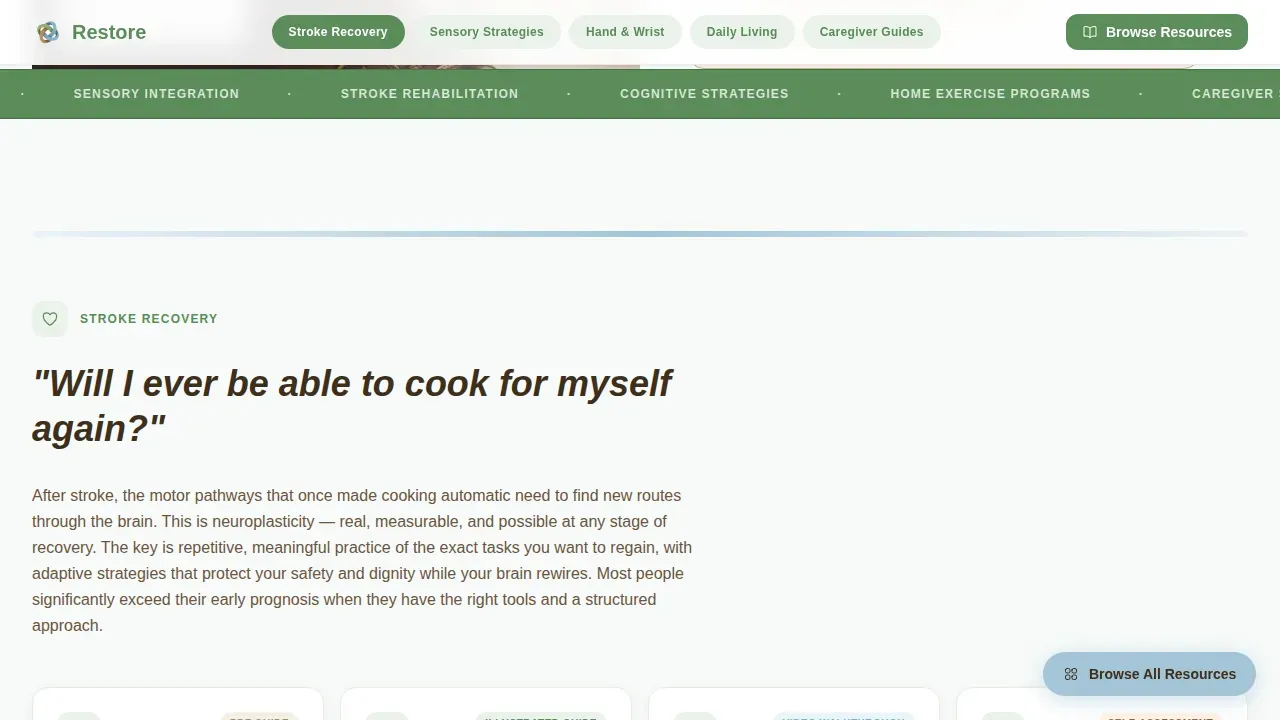
Five soft pine capsule links in the header let visitors jump directly to Stroke Recovery, Sensory Strategies, Hand and Wrist, Daily Living, or Caregiver Guides. A persistent floating button labeled "Browse All Resources" keeps people oriented as they scroll, reducing drop-off across long page sections.
Problem-to-Solution Spoke Structure
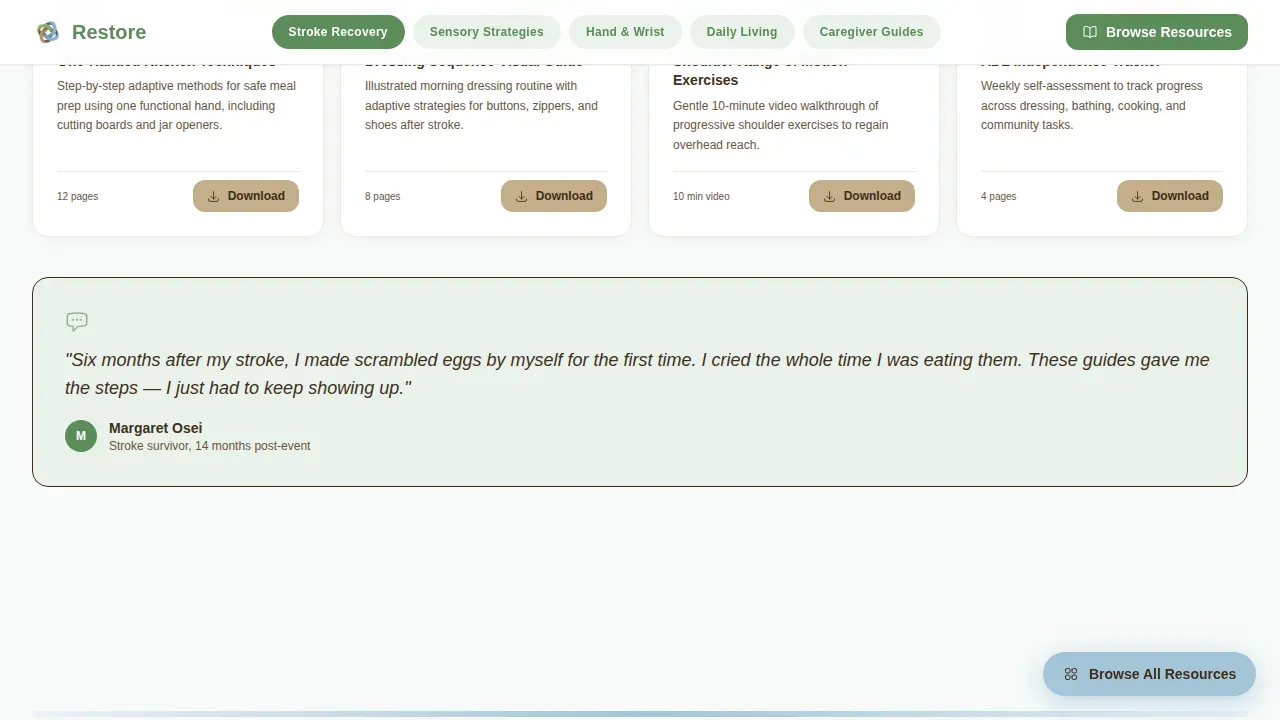
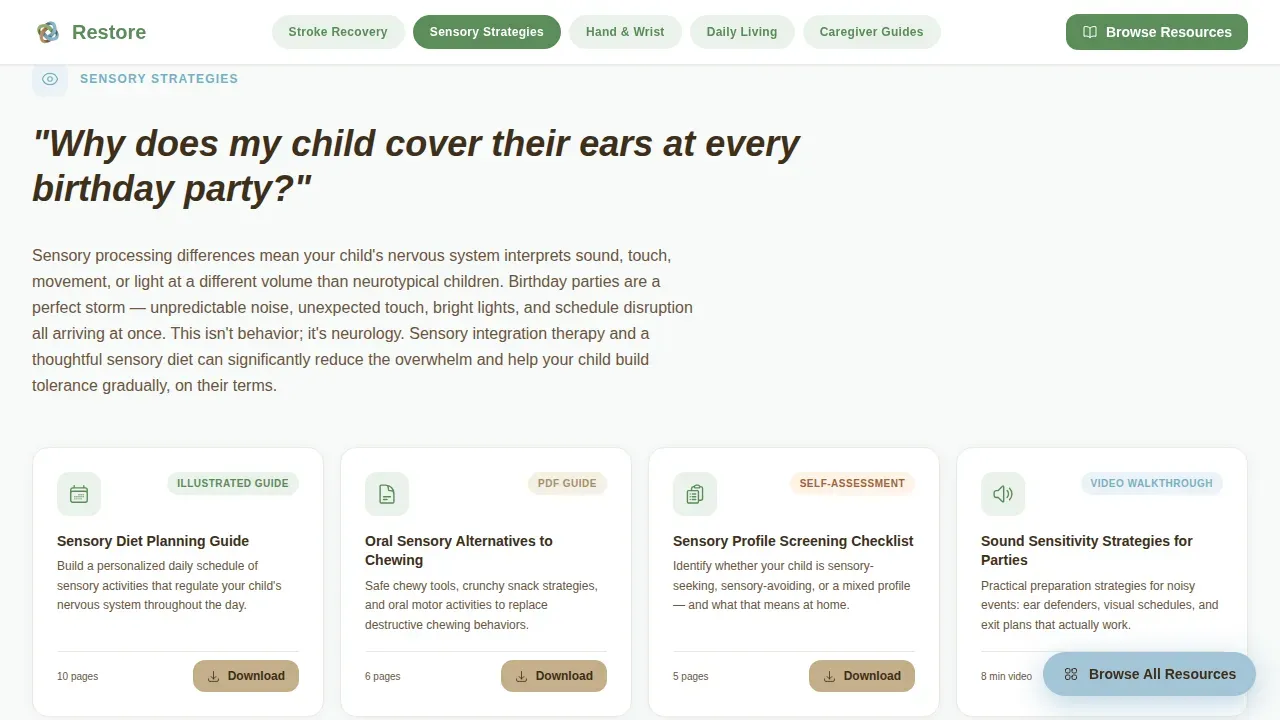
Each spoke section opens with a large, trail-brown question that mirrors real patient search behavior. A concise clinical explanation follows, then fans into three to four resource cards. The arc moves the visitor from understanding their condition to practicing the solution independently, so they feel more capable with each section they read.
Ungated Free Resource at the Top
A visual morning routine checklist sits completely free at the top of the page, no email required. This proves the quality of your content before asking for anything in return, which builds the trust that makes subsequent email captures feel fair rather than transactional.
Resource Card Email Capture
Every resource card carries a "Download This Guide" call to action. A single email field and an optional role dropdown appear in a modal, letting your team segment future sends between patients, caregivers, and occupational therapists without friction.
Warm Authentic Visual Framework
The half-page hero pairs a close-up photograph of weathered adult hands threading a shoelace with headline copy on mountain air white. Warm-toned images of hands engaged in meaningful activities are used throughout, building immediate trust through calm and supportive visuals.
Page sections overview
| Section | Purpose |
|---|---|
| Hero with anchor nav | Introduces the hub, displays anchor capsules, and delivers the ungated free morning routine checklist |
| Stroke Recovery spoke | Addresses cooking independence after stroke with clinical validation and four resource cards |
| Sensory Strategies spoke | Answers caregiver questions about sensory sensitivities with explanation and downloadable guides |
| Hand and Wrist spoke | Covers hand injury and desk-related wrist pain with technique guides and self-assessments |
| Daily Living spoke | Helps patients sequence morning routines and manage fog-related difficulties with practical tools |
| Caregiver Guides spoke | Provides targeted resources for people supporting a loved one through occupational therapy recovery |
| Footer | Single-row linear layout with practice contact information and supporting links |
Design & branding system
The Organic Flow visual identity uses an Alpine Fresh color system that feels like stepping onto a meadow after a quiet morning. Colors are soothing, calming, and professional, balancing clinical authority with a warm and supportive aesthetic.
- Soft pine (#5B8C5A) anchors navigation capsules and active states; glacier melt blue (#A3C4D7) washes across section dividers; warm stone (#C4AE8B) highlights downloadable resource cards
- Mountain air white (#F7FAF9) provides the base background and headline canvas; deep trail brown (#3E2F1C) carries all body text for grounded readability
- Plus Jakarta Sans, a humanist rounded sans-serif, is used throughout for a tone that feels human and approachable without losing clinical clarity
Mobile & speed optimization
This template is built mobile-first, because patients and caregivers are most likely searching for hand therapy resources on a phone late at night. Every layout decision prioritizes thumb-friendly navigation and fast content delivery on smaller screens.
- Anchor nav capsules stack and scroll horizontally on mobile so all five spoke links remain accessible without crowding
- Scroll-reveal animations, staggered card entries, and subtle parallax on the hero photo are set at a medium level so motion stays meaningful without slowing the experience
- Images are optimized and static content uses Server Components to keep the page responsive across device types and connection speeds
How this template helps you convert
The template is designed to earn trust first, then ask for an email. Every layout decision supports that sequence.
- The ungated free checklist at the top delivers immediate value, removing the barrier that makes most patients leave before they find what they need
- Each spoke section escalates from problem awareness to independent practice, so the visitor is already invested by the time a resource card prompts them to share their email
- Testimonials woven into spoke sections and resource download counts displayed as credibility signals give hesitant visitors the social proof they need to book their first appointment or download their first guide
Other information about this template
This template is a strong fit for occupational therapy practices that treat a wide range of conditions. Occupational therapy can assist patients recovering from stroke, arthritis, Parkinson's Disease, Alzheimer's Disease, spinal cord injuries, traumatic brain injuries, chronic pain syndromes, and conditions affecting feeding or swallowing. Hand therapy is defined as the art and science of rehabilitation of the upper extremity, including the hand, wrist, elbow, and shoulder girdle. Hand therapists are occupational or physical therapists with specialized knowledge of upper extremity function. Hand therapy is particularly useful for patients with injuries such as fractures, tendon injuries, and conditions like carpal tunnel syndrome. Custom splints can be a valuable part of the recovery process following an injury or surgery, and hand therapy often starts within days of an injury or surgery and continues until the patient returns to a productive lifestyle.
- The restore healing hands occupational therapy patient education hub landing page template is designed for practices that need both patient-facing education and a professional digital presence in one place
- Accurate documentation is essential in occupational therapy; templates can help occupational therapists track patient progress and adjust treatment plans while maintaining consistency in clinical notes
- A symptom tracker journal, usable as a downloadable log for tracking pain levels, can be added to the resource card system to help patients feel empowered between appointments
- Privacy and accessibility standards, including any applicable compliance requirements, should be addressed by the practice when publishing real patient-facing content on this template
Theme
Organic Flow
Creative direction
Problem→Solution Arc
Color system
Alpine Fresh
Style
Hub & Spoke (Anchor Nav)
Direction
Content/Resource
Page Sections
Hub-and-spoke Anchor Navigation
Problem-to-solution Spoke Structure
Ungated Free Resource at the Top
Resource Card Email Capture Modal
Warm Authentic Visual Framework
Testimonials and Credibility Signals
Related questions
What types of resources can I feature in the spoke sections?
Does the email capture work for both patients and occupational therapists?
Can I use this template across multiple clinic locations?
Is the first resource really free with no email required?
Who is considered a hand therapist?