TBI Rehab Landing Page Template | Sidebar Companion
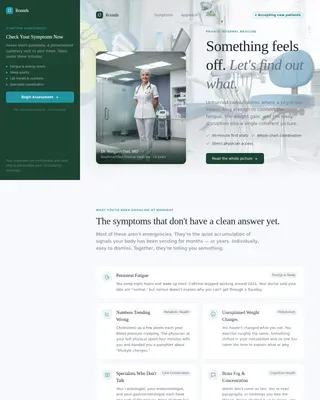
Rewire is a sidebar companion landing page template built for traumatic brain injury rehabilitation clinics. It pairs a Testimonial Mosaic layout with a persistent phase-tracking sidebar to guide overwhelmed families and survivors from acute care through community reintegration. The primary conversion is a "Download Your Recovery Roadmap" lead capture, earned through real patient stories and specific clinical context before the call to action ever appears.
by Rocket studio
Quick summary
Rewire is a single-page, sidebar companion landing page template designed for traumatic brain injury rehabilitation clinics. It uses a Testimonial Mosaic structure to tile real recovery stories across four stages of the TBI journey. A persistent sidebar tracks each phase and surfaces the lead-capture form at the right moment, so visitors download the Recovery Roadmap because a real person's story made it feel necessary.
Who this template is for
This template is built for neuroplasticity-based rehabilitation clinics that serve patients and families navigating traumatic brain injury recovery. It works equally well for outpatient TBI programs, inpatient rehabilitation centers, and veteran-focused rehab services that need a credibility-first web presence.
- Family caregivers who are a few weeks post-accident and searching for a clear, practical path forward
- Adult TBI survivors, veterans working through VA referrals, and the referring neurologists or emergency physicians who need a resource to hand families
- Clinic marketing and intake teams who want to convert overwhelmed visitors into qualified leads without relying on generic calls to action
What problem this template solves
Families who land on a rehabilitation clinic's page after a traumatic brain injury are rarely ready to book a call. They need proof first. Most clinic websites offer credentials and phone numbers but not the specific, human detail that earns trust when a person's whole life has been rearranged by injury.
- Generic "we care about you" copy that fails to show clinical specificity or real recovery timelines
- No structured path for caregivers to self-identify and receive the right resource for their stage of the journey
- A conversion model that asks for commitment before the visitor has been given a reason to trust
What you get with this template
Rewire delivers a complete, section-led landing page that earns its lead capture through sequenced storytelling and clinical specificity. Every design and layout decision supports the emotional and practical needs of TBI families, survivors, and referring providers.
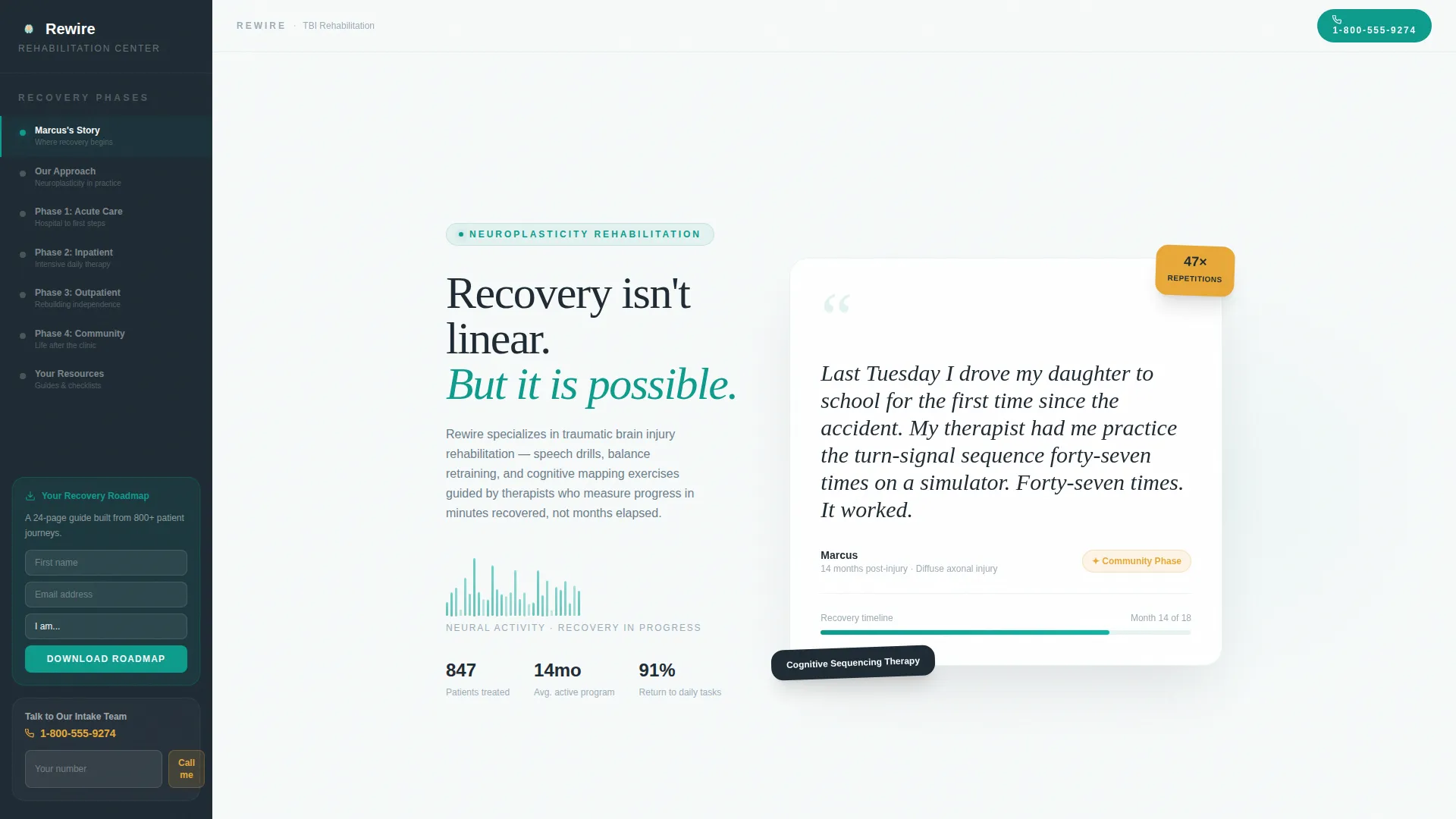
- A floating hero Testimonial Card featuring a first-name patient story with a specific recovered ability, a waveform SVG graphic, and an immediately visible sidebar companion
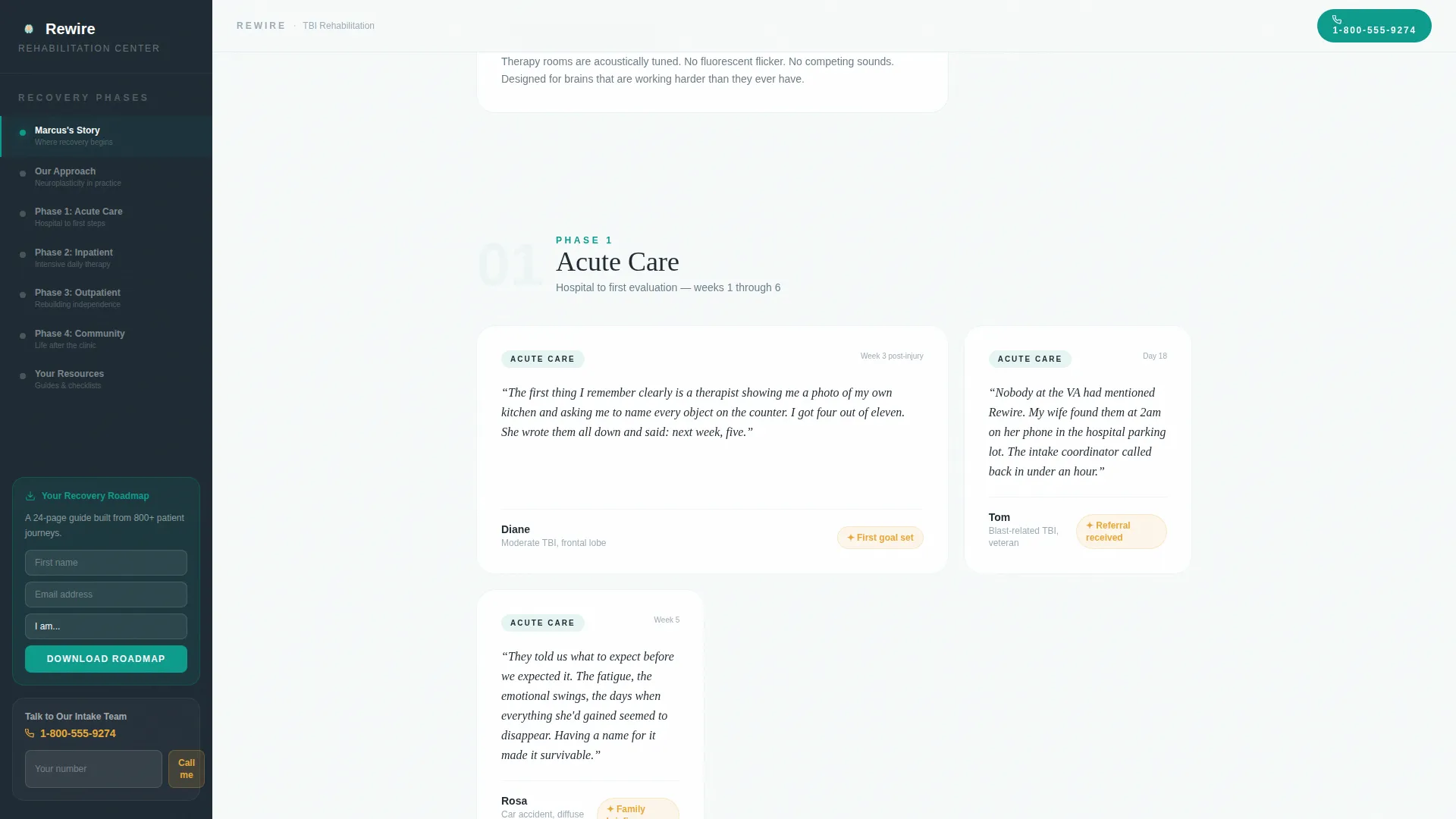
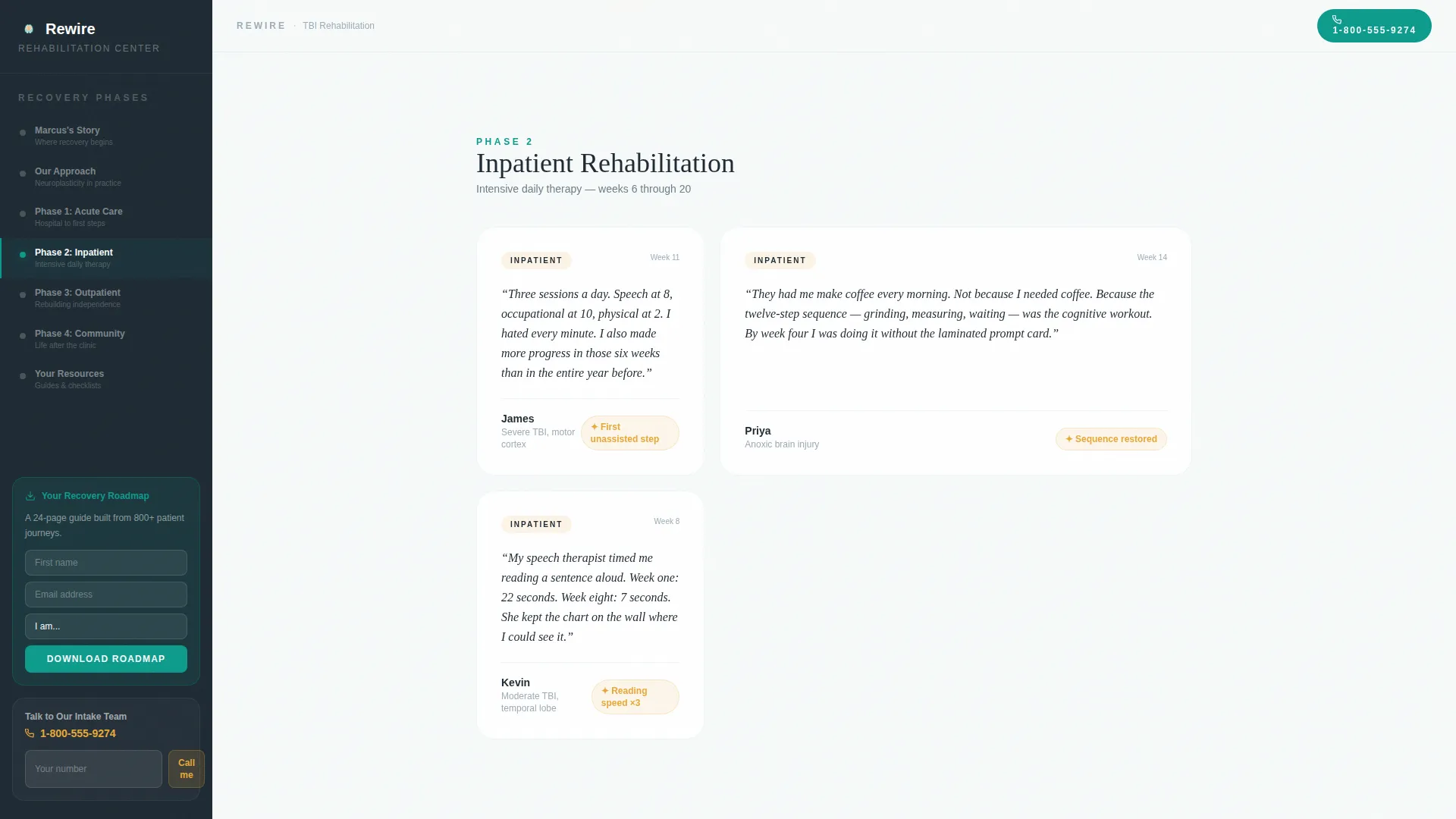
- A Testimonial Mosaic bento grid that tiles recovery stories across acute care, inpatient rehab, outpatient milestones, and community reintegration phases
- Downloadable resources (caregiver checklists, insurance navigation guides, and cognitive exercise PDFs) each placed directly after the testimonial that makes them feel urgent
- A sidebar-first lead capture form asking only for first name, email, and relationship to patient, followed by a click-to-call phone number and a single-field callback request
Feature list
This template ships with a focused set of design and layout features grounded in the specific needs of TBI rehabilitation marketing.
Phase-Tracking Sidebar Companion
A persistent sidebar anchors every scroll position. It lists recovery phases like a trusted table of contents and highlights the active stage as the visitor moves through the page. The sidebar surfaces the "Download Your Recovery Roadmap" form after the second testimonial cluster, after trust has already been established.
Testimonial Mosaic Bento Grid
Recovery stories tile and interlock across the main content column in a bento grid layout. Each card represents a distinct TBI phase and includes a first-name attribution with a specific recovered ability and a measurable timeline. GSAP scroll reveals animate each card into view as the visitor reaches that section.
Contextual Downloadable Resources
Three downloadable resources appear between testimonial clusters rather than on a generic downloads page. Each resource is introduced by the patient story that precedes it, making the download feel like a natural next step rather than a marketing prompt.
Floating Hero Testimonial Card
The header presents one oversized patient testimonial card floating against the soft medical white background. A handwritten-style pull quote, first-name attribution with post-injury timeline, and a subtle waveform SVG replace stock photography with clinical warmth and specificity.
Therapy Modalities Marquee Strip
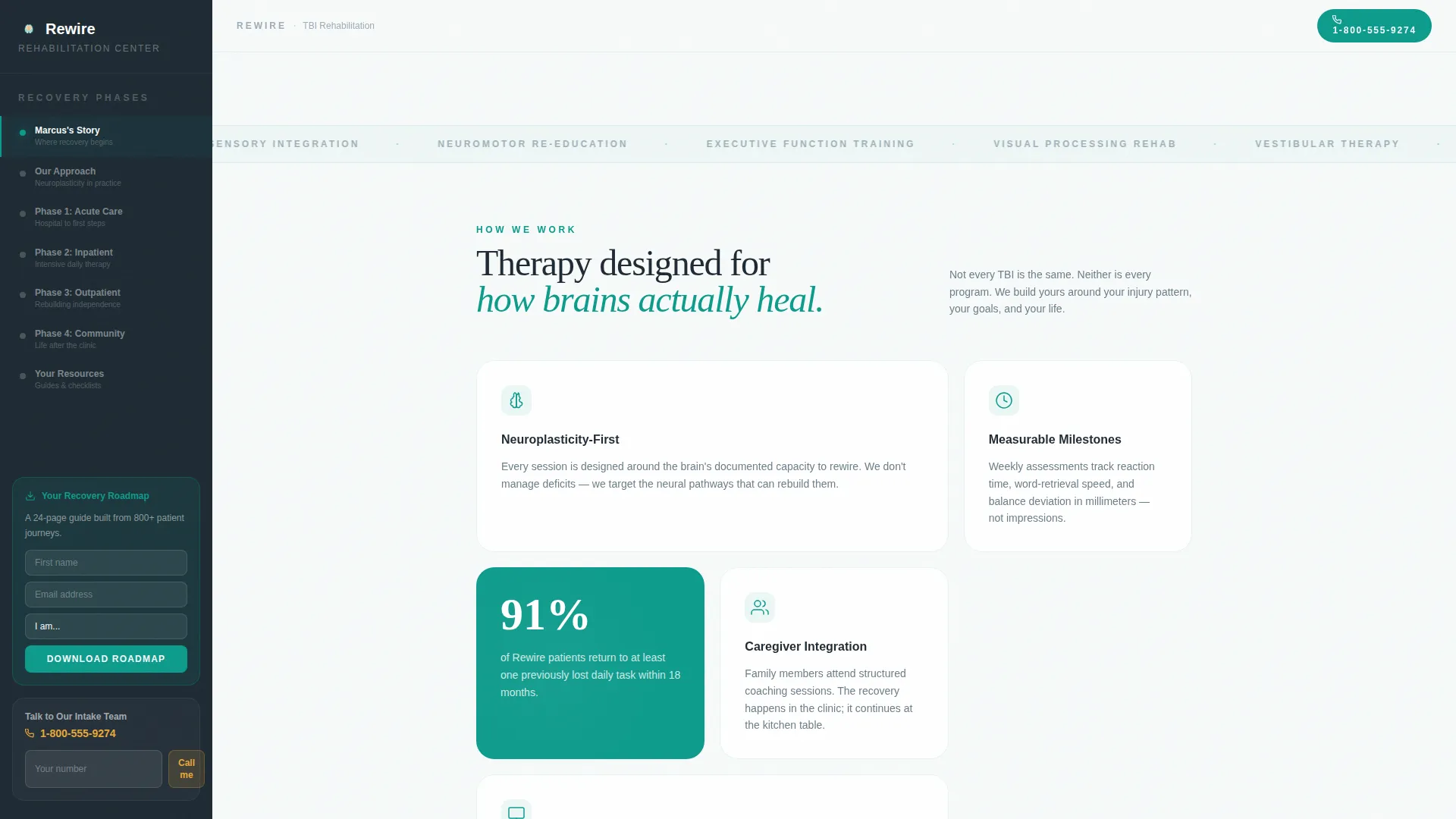
A scrolling marquee strip names specific therapy approaches, followed by asymmetric bento approach cards that describe each modality. This section signals clinical depth before the visitor has read a single testimonial.
Dual-Path Intake Section
A bottom intake section pairs a click-to-call phone number with a single-field callback request form. It gives visitors two ways to start the conversation, one immediate and one low-pressure, without requiring a lengthy intake form.
Page sections overview
| Section | Purpose |
|---|---|
| Hero Testimonial Card | Opens with a specific patient story, waveform SVG, and visible sidebar |
| Therapy Modalities Strip | Marquee and bento cards signal clinical depth early |
| Testimonial Mosaic Grid | Tiles four TBI recovery phases with real, named stories |
| Contextual Resources | Downloadable guides placed after relevant testimonials |
| Intake and Call to Action | Click-to-call, callback form, and final Recovery Roadmap prompt |
| Footer | Horizontal flow footer pattern |
Design & branding system
The visual identity follows a Medical Clarity theme. The palette moves from the precision of a clinical environment toward the warmth of natural daylight in a private therapy room. Every color choice has a functional role, not just a decorative one.
- Clinical teal (#0D9B8C) is the primary action color for buttons, active sidebar states, and interactive elements; deep charcoal (#1E2A33) covers body text and the persistent sidebar background; soft medical white (#F7FAFA) fills all content backgrounds
- Warm amber (#E8A838) is reserved specifically for milestone markers and progress indicators, so visitors can read recovery timelines at a glance
- Typography pairs DM Sans for body text and interface elements with Fraunces, a serif typeface, for pull quotes, creating a contrast between clinical precision and human warmth
Mobile & speed optimization
The template is desktop-first by design because the sidebar companion layout requires screen width to function as intended. On smaller screens, the sidebar collapses into a responsive flow without losing its phase-tracking logic.
- Server Components handle all static sections to keep initial load fast; Client Components are scoped to the sidebar tracker and GSAP animations
- The sidebar collapses gracefully on mobile and tablet viewports, converting the phase tracker into an inline progress indicator
- Magnetic button interactions and hover testimonial expansions are touch-adapted on mobile so no interactive feature is lost on smaller devices
How this template helps you convert
The conversion strategy in Rewire is built on sequencing. The visitor earns trust before the call to action appears, which means downloading the Recovery Roadmap feels like a logical step, not a marketing transaction.
- The Testimonial Mosaic presents real stories with specific timelines and named outcomes across four recovery phases before the lead-capture form is ever shown, so the visitor arrives at the form already believing in the clinic's competence.
- The sidebar lead-capture form appears only after the second testimonial cluster and asks for just three fields (first name, email, and relationship to patient), reducing friction at the exact moment trust is highest.
- The dual-path intake section at the bottom of the sidebar offers a click-to-call number and a callback form side by side, giving high-intent visitors an immediate route and lower-intent visitors a low-pressure alternative.
Other information about this template
Rewire is a specialized template built for a specific clinical context. A few additional details are worth knowing before you use it.
- The template is built with Next.js, using GSAP for scroll reveals, a grain overlay, and magnetic button animations; all animation intensity is set to a medium level by default
- The footer uses a horizontal flow layout pattern suited to single-page experiences where navigation is handled by the sidebar rather than a traditional header menu
- The sidebar phase tracker uses active-state highlighting to show visitors exactly which stage of the TBI journey they are reading about, functioning like a chapter marker in a long-form editorial piece
- All copy, patient names, and testimonial details in the template are placeholder content intended to be replaced with real, consent-approved patient stories before publishing
- The lead-capture form includes a relationship-to-patient dropdown with three options (I am the patient, I am a caregiver, I am a referring provider) so intake teams can route leads appropriately from day one
Theme
Medical Clarity
Creative direction
Testimonial Mosaic
Color system
Teal Catalyst
Style
Sidebar Companion
Direction
Content/Resource
Page Sections
Phase-tracking Sidebar Companion
Testimonial Mosaic Bento Grid
Contextual Downloadable Resources
Floating Hero Testimonial Card
Therapy Modalities Marquee Strip
Dual-path Intake Section
Related questions
Who is this landing page template designed for?
Can I replace the placeholder testimonials with real patient stories?
What does the sidebar do and how does it work on mobile?
What is included in the downloadable resources section?
How does the lead-capture form work?