Precision Hollowparts Landing Page Template
A precision-focused landing page template built for rotational molding manufacturers. It uses a Monochrome Steel color system and an Industry Report creative direction to speak directly to procurement engineers, product designers, and operations directors. The layout guides technical buyers from process benchmarking through material data to a DFM review request, all within a single, structured page flow.
by Rocket studio
Quick summary
This template is a single-page, zigzag-layout landing page for a rotational molding manufacturer. It combines a Data Command visual theme with technical depth, process comparisons, material specifications, and a production timeline, to move industrial buyers from first impression to qualified inquiry. The amber-accented design signals precision without decoration.
Who this template is for
This template is built for B2B manufacturers in the rotational molding space who sell to technically informed buyers. It suits companies that need to communicate process capability, tooling economics, and material performance before asking for contact details.
- Rotational molding manufacturers targeting procurement engineers at agricultural equipment or marine OEMs
- Plastics fabricators selling to water infrastructure firms and chemical vessel producers
- Industrial product companies that need a landing page serious enough to earn a conversation with an operations director
What problem this template solves
Most industrial manufacturers use generic web pages that fail to pre-qualify serious buyers. A procurement engineer or product designer arrives, finds no useful data, and leaves. This template fixes that by leading with technical content that earns trust before making any ask.
- Engineers waste time on sales calls that could be filtered by process comparisons and material specs upfront
- Manufacturers lose credibility when their page cannot answer basic questions about wall thickness tolerances or tooling costs
- Buyers at the benchmarking stage need a secondary path, like a downloadable spec guide, not just a contact form
What you get with this template
You get a fully structured, section-led landing page designed around the rotational molding sales conversation. Every section has a defined job, from the annotated process header to the gated spec guide download.
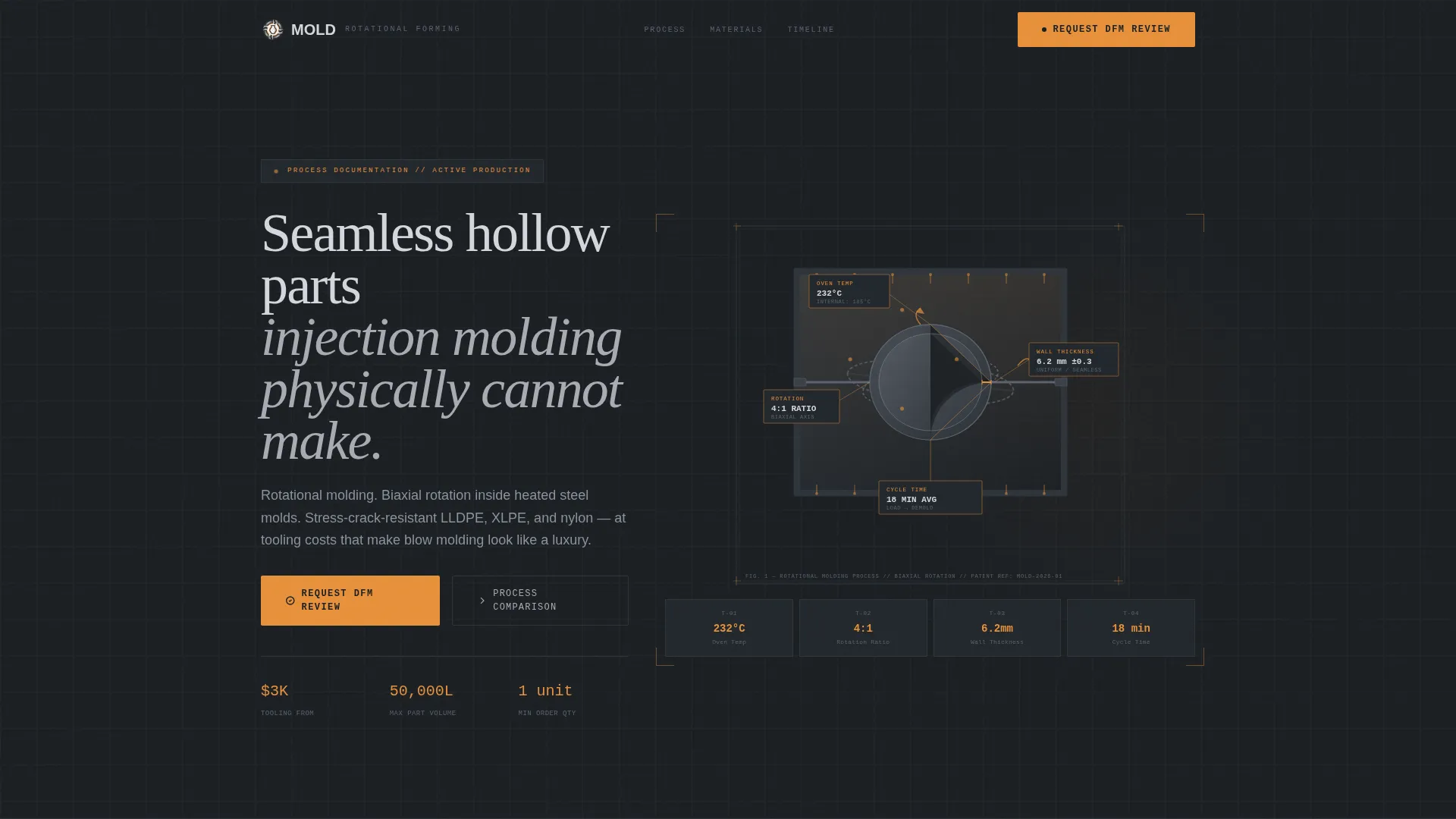
- Isometric cutaway header illustration with amber data callouts showing wall thickness, internal temperature, rotation ratio, and cycle time
- Zigzag alternating content sections covering process benchmarking, material data sheets, and a Gantt-style production timeline
- Two conversion paths: a detailed DFM review request form and an email-gated spec guide download for earlier-stage engineers
Feature list
This template includes the following built-in components and layout features.
Annotated Isometric Process Header
The header renders a translucent steel mold rotating on two axes inside an oven chamber. Amber data callouts pin live process values, including wall thickness at 6.2 mm plus or minus 0.3 mm, internal temperature at 232 degrees Celsius, a 4-to-1 rotation ratio, and an 18-minute cycle time. It reads like a patent drawing brought to life, not a stock photograph.
Process Comparison Section with Table
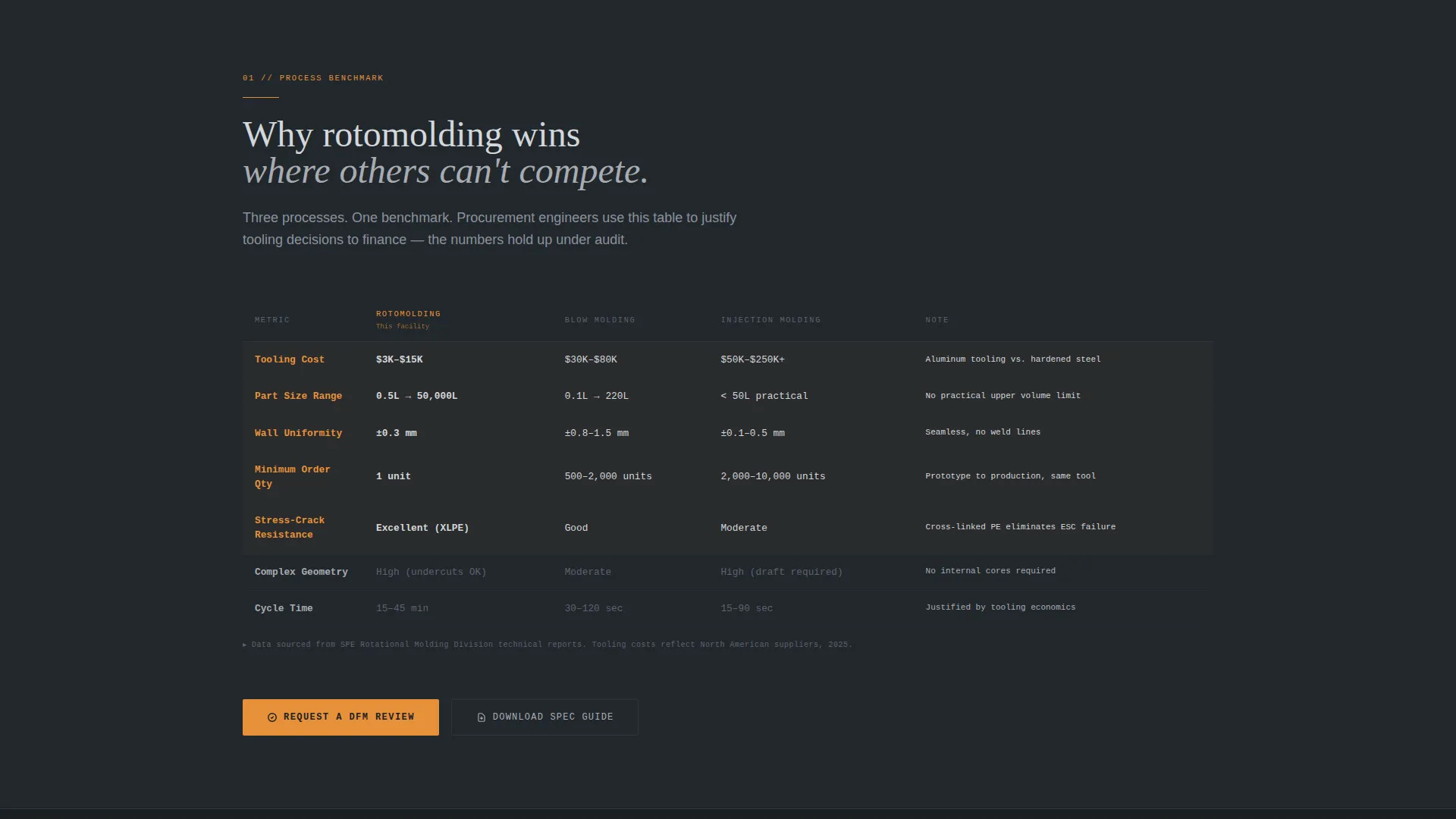
Section one benchmarks rotational molding against blow molding and injection molding across tooling cost, part size range, and minimum order quantity. The comparison table gives procurement engineers a direct, scannable answer to their most common process selection question, positioned early enough to build confidence before the first call to action appears.
Material Data Sheet Section
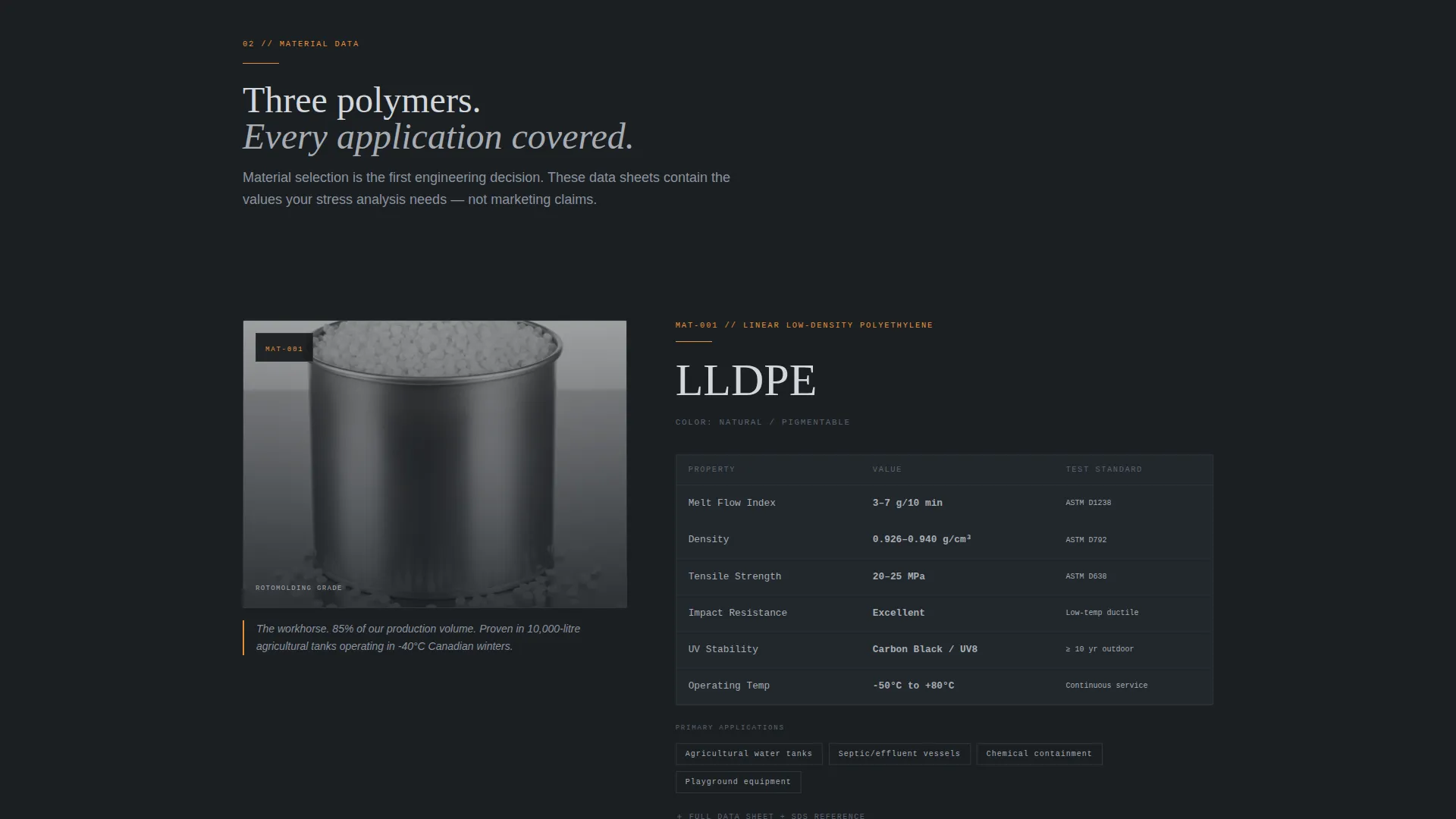
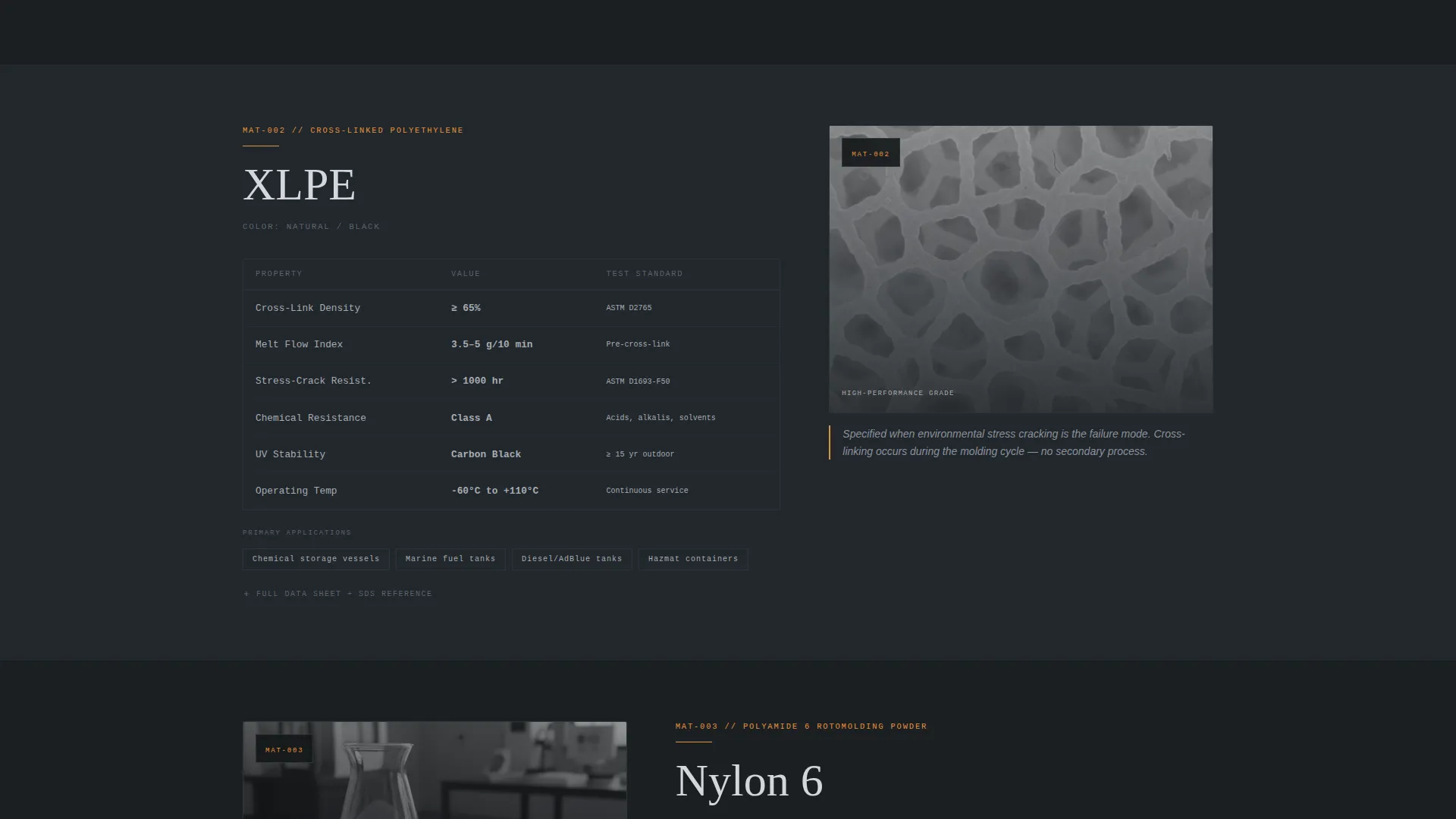
Section two presents material profiles for Linear Low-Density Polyethylene (LLDPE), Cross-Linked Polyethylene (XLPE), and nylon. Each profile includes melt-flow indices and ultraviolet stability ratings. This level of specificity signals that the manufacturer understands material selection, not just part production.
Gantt-Style Production Timeline
Section three maps the full production journey from CAD file receipt to crated shipment using a horizontal bar layout. Engineers and operations directors can immediately visualize lead time and project planning implications without needing a phone call.
Engineering-First DFM Review Form
The primary conversion form collects part application first via a dropdown covering tanks, enclosures, marine, and custom categories. It then asks for annual volume estimate and accepts STEP or IGES file uploads before requesting a company email. The sequence signals engineering competence and filters casual inquiries.
Gated Spec Guide Download
A secondary conversion path offers the Rotomolding Spec Guide behind an email-only gate. This captures earlier-stage engineers who are still comparing processes and are not yet ready to submit a DFM file, extending the funnel without pressuring an unqualified lead.
Page sections overview
| Section | Purpose |
|---|---|
| Isometric Process Header | Introduce rotational molding with annotated technical illustration and amber data callouts |
| Process Comparison Table | Benchmark rotomolding against blow and injection molding on cost, size, and volume |
| DFM Review call to action | Convert self-qualified buyers with an engineering-first request form |
| Material Data Sheets | Present LLDPE, XLPE, and nylon specs with melt-flow and UV stability data |
| Production Timeline | Show the Gantt-style journey from CAD receipt to crated shipment |
| Spec Guide Download | Capture early-stage engineers via an email-gated secondary conversion path |
Design & branding system
The visual identity follows a Data Command theme built on a Monochrome Steel palette. Every color choice is functional. The overall feel is a CNC control panel at operating hour, precise and purposeful, with warmth appearing only where action is required.
- Four-color palette: mill-finish aluminum (#D4D7DC) for backgrounds, tool-steel dark (#1B1F23) for text and structure, machined-surface mid-gray (#5C6370) for secondary elements, and molten-polymer amber (#E8913A) reserved exclusively for calls to action, live data callouts, and hover states
- No stock photography and no decorative illustration; the header isometric and the technical annotations carry all visual weight
- Typography and layout follow an Industry Report creative direction, meaning each section reads like a chapter of a white paper, dense with meaning but cleanly formatted
Mobile & speed optimization
The zigzag alternating layout is structured to reflow cleanly on smaller screens. Technical sections like comparison tables and the timeline bar are the primary layout considerations for responsive behavior.
- The isometric header illustration and amber data callouts are designed to scale within the layout without losing readability
- Alternating zigzag blocks stack vertically on mobile, preserving the logical reading order of the content
- The two-form conversion structure, DFM review and spec guide download, remains accessible at each relevant scroll depth on all screen sizes
How this template helps you convert
The conversion architecture is built around a principle: give engineers enough technical evidence to self-qualify before asking for anything. Every section earns the next.
- The process comparison table and material data sections establish credibility early, so by the time the DFM review form appears, the visitor already understands why this manufacturer is worth contacting.
- The engineering-first form sequence, starting with part application and file upload before email, signals that the manufacturer values the engineer's time and expertise, which reduces friction for high-value leads.
- The secondary spec guide download path captures buyers at the benchmarking stage, building a pipeline of leads who are not yet ready to submit a file but are moving toward a decision.
Other information about this template
This template is built specifically for the rotational molding niche within the broader plastics and injection molding manufacturing category. It is designed to serve a market segment where the sales cycle is long, the buyer is technical, and generic marketing pages consistently underperform.
- The template style is Zigzag/Alternating, which naturally separates each technical chapter into a distinct visual block, making dense content easier to navigate
- The Industry Report creative direction is intentional for this niche: rotational molding is a process most procurement contacts encounter only when other processes have been disqualified, so the page must educate before it sells
- Part applications covered in the form dropdown reflect the real end-use range of the process: water storage tanks, industrial enclosures, marine hulls, and custom hollow components
- The template is categorized under Manufacturing and Industrial, subcategory Plastics and Injection Molding, and is optimized in structure and language for rotational molding manufacturers seeking partnership-level B2B clients
Theme
Data Command
Creative direction
Industry Report
Color system
Monochrome Steel
Style
Zigzag/Alternating
Direction
Partnership/B2B
Page Sections
Annotated Isometric Process Header
Process Benchmarking Comparison Table
Material Data Sheet Section
Gantt-style Production Timeline
Engineering-first DFM Review Form
Email-gated Spec Guide Download
Related questions
Who is this landing page template designed for?
Can I edit the process comparison table and material data sections?
What file types does the DFM review form support?
What is the purpose of the gated spec guide download?
Is this template suitable for manufacturers producing parts beyond water tanks and kayak hulls?