Logistics Consulting Appointment Booking Website Template
Route is a split-screen editorial landing page template built for logistics growth consultants. It pairs a dramatic stats wall with scroll-linked spreads, an embedded booking scheduler, and a gated PDF case-study form. The result is a lead generation page that reads like a heavyweight business journal and converts corner-office executives into booked audit calls.
by Rocket studio
Quick summary
Route is a 50/50 split-screen landing page template designed for a logistics growth consultant targeting mid-market executives. It opens on a typographic stats wall, moves through editorial problem-method-proof spreads, and closes on a full-width booking section. Every design decision earns attention and guides the right visitor toward one action: booking a Growth Audit.
Who this template is for
This template is built for consultants and advisors who sell high-ticket engagements to senior decision-makers in logistics, supply chain, and fulfillment. The page is structured to do the persuading before a single conversation happens. It suits professionals who need their online presence to carry the weight of a portfolio, a track record, and a pitch deck, all at once.
The ideal users of this template include:
- Mid-market supply chain and logistics consultants running independent or boutique practices
- Freight brokerage advisors and fulfillment network specialists targeting VP-level and C-suite buyers
- Operations consultants who need a credible, conversion-focused landing page to support lead generation and inbound booking
What problem this template solves
Most professional services landing pages fail the audience they most need to impress. A generic page layout with stock photography and vague value propositions does not move a freight brokerage chief executive officer to book a call. The template solves the trust-and-credibility gap that sits between a consultant's reputation and their digital presence.
Common problems this template directly addresses:
- Visitors arrive, skim a wall of text, and leave without converting, inflating bounce rate and wasting traffic
- Consultants lack a structured way to present credentials, case study outcomes, and a booking path on a single page
- The auditing process for a prospect's decision to engage has no digital anchor, so opportunities slip through channels that paid ads and social media alone cannot recover
What you get with this template
You get a fully structured, editable landing page with every section pre-built and every design decision already made. The template eliminates the blank-canvas problem so you can focus on dropping in your numbers, your outcomes, and your booking link. Each section is a distinct editorial spread that escalates the argument for engaging your services.
Included in the template:
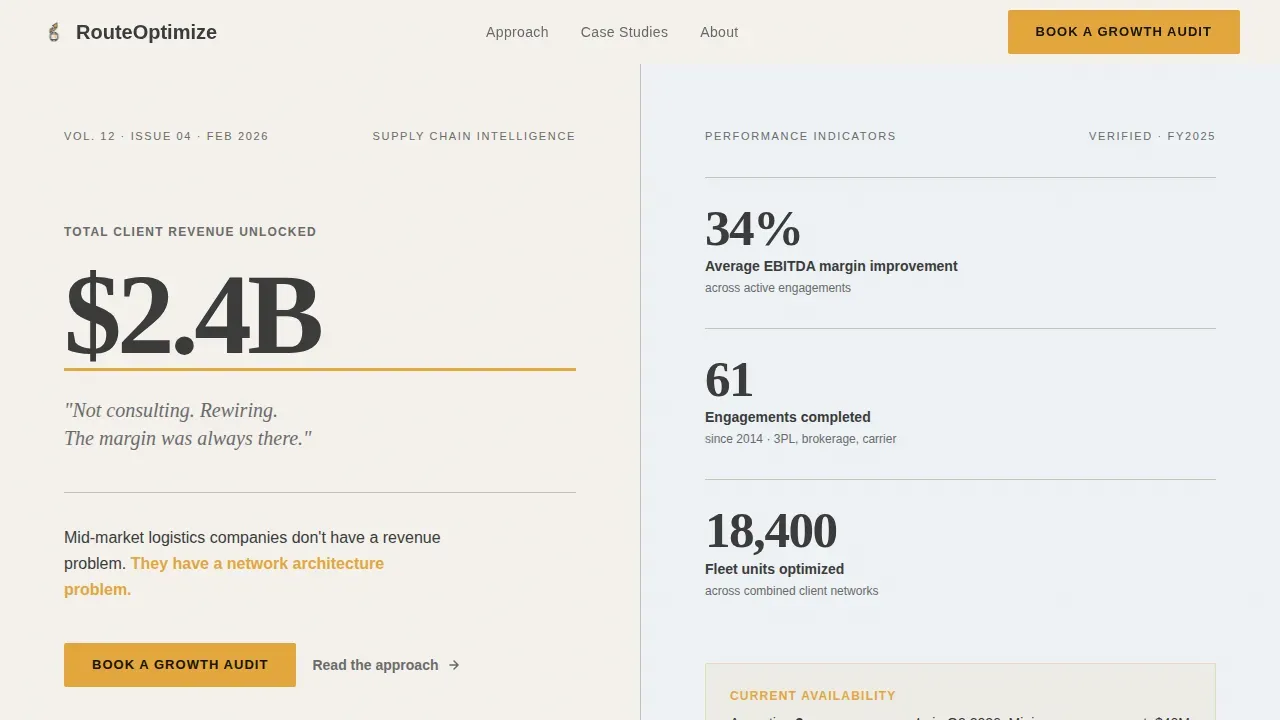
- A hero stats wall with oversized typographic stat placement, three secondary metric slots, and an editorial one-line subhead
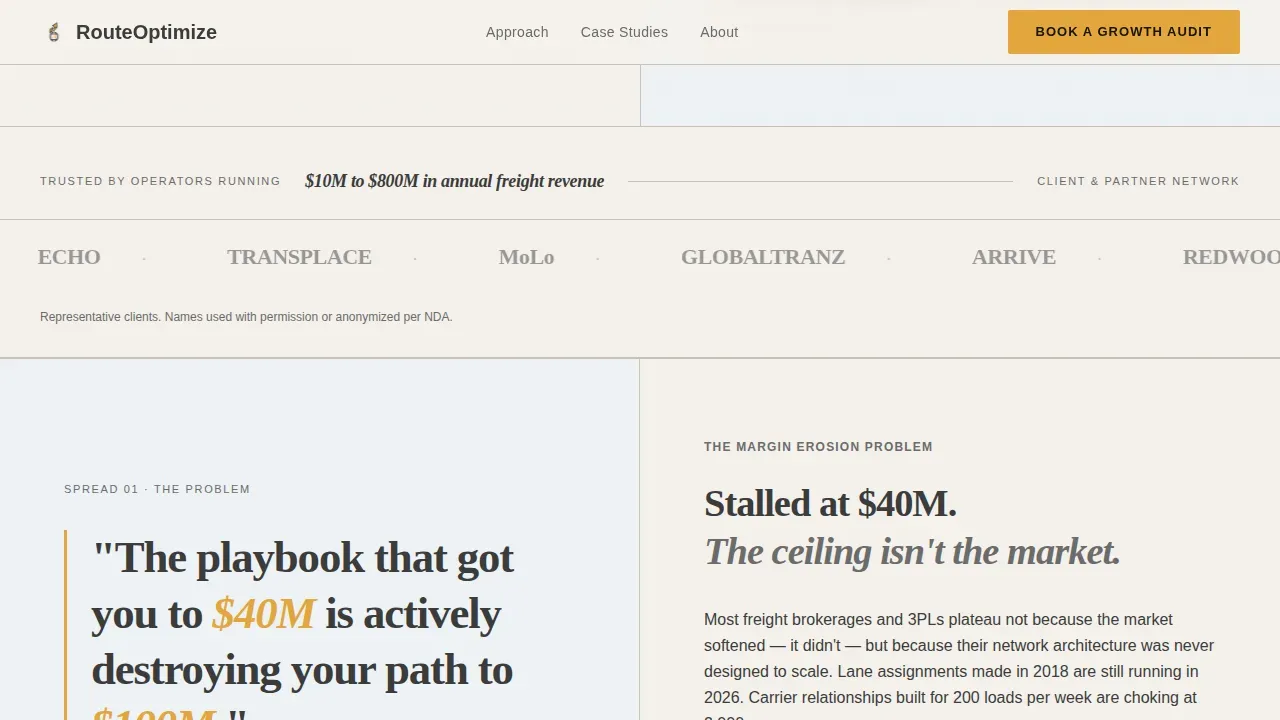
- A scroll-animated logo wall presented as a magazine-style trusted-by spread with desaturated graphite treatment
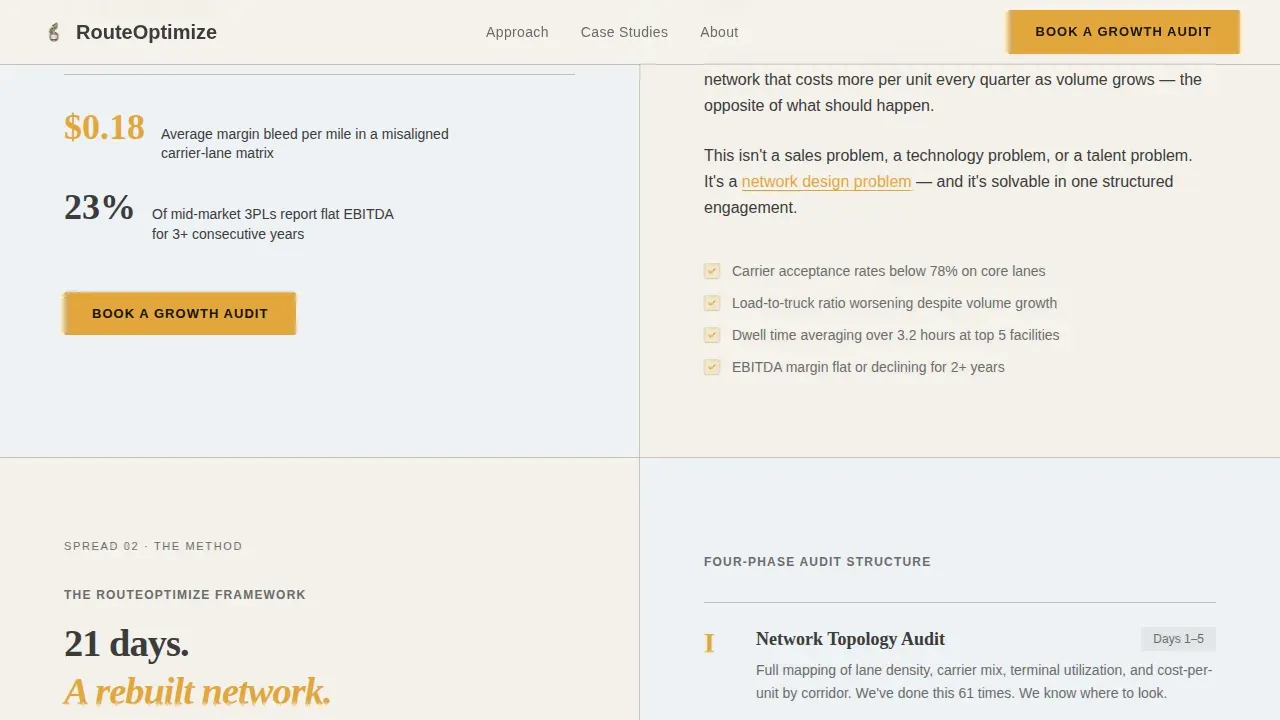
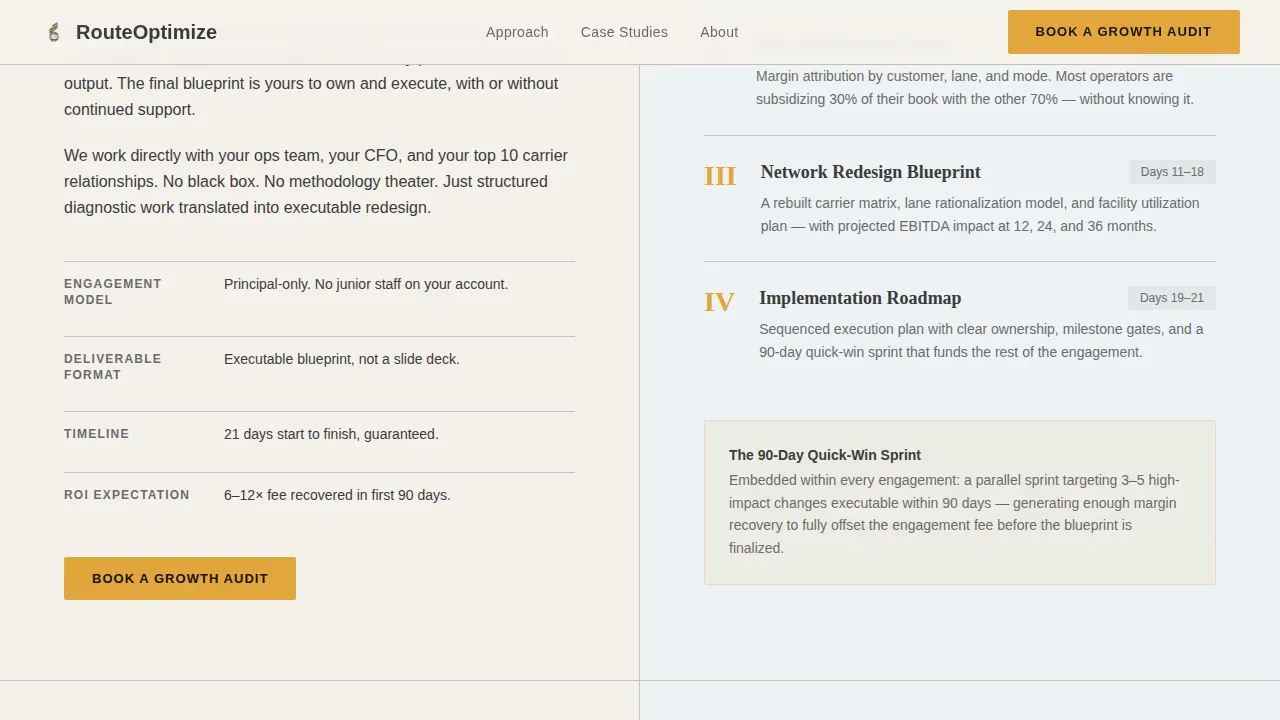
- Three editorial spreads covering problem, method, and proof, each with a pull-quote or metric panel on the left and narrative context on the right
- A full-width booking close section with an embedded scheduler form and a secondary gated PDF case-study capture field
- A linear single-row footer and a persistent signal-amber "Book a Growth Audit" button pinned in the top-right corner
Feature list
This section details the key capabilities built into the Route template, drawn directly from the design and functional brief.
Typographic Stats Wall Hero
The hero opens with a single enormous serif statistic on the left panel, styled to function as a credential rather than a headline. Three secondary metrics stack on the right. A thin amber underline and a horizontal rule complete the editorial hierarchy. No photography. No illustration. Just numbers that establish authority before the visitor reads a word of body copy. This approach directly supports the content audit philosophy that content quality and specific proof points outperform generic claims.
Scroll-Linked Editorial Spreads
Below the hero, the page delivers three 50/50 spreads: problem, method, and proof. Each spread is a self-contained argument. The left panel carries a pull quote or before-and-after metric. The right panel provides the narrative context. Scroll-linked reveals and split-screen parallax give the experience the rhythm of turning pages in a printed journal. This structure helps website visitors move through the argument at their own pace without losing the thread.
Embedded Booking Scheduler
The primary conversion element is an embedded Calendly-style scheduler that captures company name, annual revenue range via dropdown, and a single open-text field labeled "What's the bottleneck?" The scheduler appears in the final section and is also triggered by the persistent top-right button. Form submissions feed directly into the consultant's calendar flow, keeping the friction between interest and booked call as low as possible.
Gated PDF Case Study Form
A secondary conversion path sits alongside the scheduler. Visitors not yet ready to book can enter their email address to receive a downloadable PDF case study. This secondary path supports lead generation by capturing warm prospects who need more proof before committing. It also allows the consultant to collect data on audience segments that fall outside the immediate booking window, building a pipeline for future outreach.
Persistent Signal-Amber Call to Action Button
The "Book a Growth Audit" button stays pinned in the top-right position throughout the entire scroll experience. The button uses signal amber, the single accent color reserved for interactive and callout elements. This persistent placement ensures the primary conversion path is always visible, regardless of where a visitor pauses to read, without interrupting the editorial flow of the page.
Scroll-Animated Logo Wall
The logo wall presents client and partner marks in a desaturated graphite treatment, positioned as a magazine-style editorial spread rather than a standard trust bar. One row activates a marquee animation on scroll. This section provides social proof in a format that matches the restrained, authoritative tone of the overall design. Logos appear credible because the presentation is selective, not exhaustive.
Page sections overview
| Section | Purpose |
|---|---|
| Hero Stats Wall | Lead with specific credential numbers before copy |
| Editorial Subhead | State the consultant's point of view in one line |
| Trusted-By Logo Wall | Establish client authority via curated logo spread |
| Problem Spread | Surface margin erosion and stalled growth stakes |
| Method Spread | Present proprietary audit framework and process |
| Proof Spread | Deliver named outcomes and before-and-after metrics |
| Booking Close Section | Drive audit bookings via embedded scheduler form |
| PDF Case Study Gate | Capture warm leads with gated downloadable proof |
| Persistent call to action Button | Keep booking path visible across full scroll depth |
| Linear Single-Row Footer | Close the page with minimal, clean navigation |
Design & branding system
The template uses an Editorial Magazine theme built on the Cloud Canvas color palette. Every color choice is intentional. The palette is restrained enough for a corner-office audience but specific enough to communicate expertise and taste. Typography follows a large-set serif and tight sans-serif pairing that mirrors a heavyweight printed journal.
Design and branding specifications:
- Colors: newsprint white (#F4F1EC) for backgrounds, graphite editorial gray (#3B3B3B) for body text, muted cloud blue (#A8BCC9) for section washes, and signal amber (#E2A63D) exclusively for callouts, pull quotes, and interactive elements
- Typography: Fraunces serif for all headlines and pull quotes, DM Sans for body copy and form labels, with generous whitespace that lets data and metrics breathe at large scale
- Visual treatment: no stock photography, no illustration, data visualizations and typographic statistics carry all visual weight; logo wall elements desaturated to graphite gray
Mobile & speed optimization
The template is designed desktop-first to serve a corner-office executive audience who primarily browses on desktop and laptop devices. The page layout and split-screen structure are built to perform at large viewport widths where the editorial spreads have room to breathe. That said, the template is structured with mobile friendliness in mind so the reading experience holds up across screen sizes.
Mobile and performance considerations:
- The split-screen 50/50 layout collapses gracefully on smaller screens, preserving readability on mobile devices without breaking the editorial hierarchy
- Scroll-linked animations, staggered number counters, and marquee logo effects are implemented as client components, keeping the static layout fast at initial load and avoiding slow load times that increase bounce rate
- Mobile friendliness is reinforced by the persistent call-to-action button, which remains accessible at every scroll depth regardless of screen size
How this template helps you convert
A content audit of any high-performing consulting page reveals the same pattern: the pages that convert do not wait for visitors to self-qualify. They build the case section by section, presenting credentials before claims, proof before asks. Route is structured to do exactly that. The page earns the click by leading with numbers and letting the editorial weight of each spread do the selling.
- The stats wall converts skepticism into attention immediately. Specific quantitative metrics in the hero replace generic claims and establish the consultant as a proven operator before the visitor reaches any written argument.
- The three-spread narrative arc escalates stakes from problem to method to proof, reducing bounce rate by giving engaged visitors a reason to keep scrolling. By the final section, the booking scheduler feels like a logical next step rather than a cold ask, producing more conversions from the same volume of organic traffic.
Other information about this template
This template is positioned at the intersection of editorial design and high-ticket professional services conversion. It is especially useful for consultants who want their landing page to function as an audit tool for their own brand, demonstrating the same rigor they bring to client engagements.
Additional context worth knowing before customizing the template:
- The website audit principles embedded in this template's structure reflect best practices in content audit methodology: lead with a content inventory of your strongest proof points, sequence the narrative to address the target audience's known objections, and gate secondary content behind a low-friction email capture
- A good content audit template asks whether every element on the page earns its place. Route applies that standard visually: every section, every pull quote, every metric must serve the argument or it does not appear
- The audit template structure mirrors a repeatable process: hero credentialing, authority social proof, problem framing, method explanation, outcome demonstration, and booking close. Consultants can adapt this audit checklist logic to different niches without breaking the editorial rhythm
- Because AI-generated answers can push traditional content down in search results and AI-generated content can occupy significant screen space in search results, impacting organic traffic, the editorial depth built into this template supports content quality standards that both human readers and structured content systems reward
- Content audits help identify underperforming pages that may be losing traffic to AI features. This template provides a framework for presenting content that has depth, specificity, and narrative structure, qualities that AI systems favor when surfacing answers
- Updating outdated content and maintaining a consistent brand voice are practices that apply equally to the pages you build with this template and to the client engagements you showcase on it
- The page supports organic traffic goals by presenting the consultant's expertise in a format that search engines can parse clearly: structured sections, specific data, and a logical content hierarchy
- For consultants who run regular digital audits of their own web presence, this template can serve as the anchor page that a site audit references when evaluating site performance against business objectives
- The template's audit spreadsheet equivalent is the spread-by-spread structure itself: each section maps to a measurable conversion goal, making it straightforward to track which panels drive the most scroll depth and form submissions
- The route editorial growth audit landing page template is purpose-built for the logistics consulting niche, but the underlying structure is adaptable to any professional services context where a website content audit reveals that the existing page lacks editorial authority
- Google Analytics, Google Search Console, and other audit tools can be connected to the pages built from this template to collect data on conversion rate, bounce rate, keyword rankings, and organic traffic performance over time
- Using Google Search Console alongside Google Analytics gives you a fuller picture of how your landing page performs in search results, which target keyword terms drive the most website visitors, and where internal links may be helping or limiting your reach
- Tracking metrics across a defined date range allows you to measure success against baseline performance and understand whether changes to website content are improving or hurting site performance
- The template's design supports the principle that reducing friction on landing pages produces more conversions. Research indicates that reducing copy length on a landing page by 50 percent can increase conversions by 30 percent. The Route template is already edited for density, letting data and pull quotes carry weight that paragraphs of prose would dilute
- Social media platforms and paid referral channels can drive visitors to this landing page. The scheduler and PDF gate are both designed to capture those visitors efficiently, regardless of whether they arrive from organic search, social media, Google Ads referrals, or direct outreach
- Social media metrics such as click-through rate from posts and link engagement can be tracked alongside on-page conversion data to understand which channels deliver the highest-quality traffic to the booking section
- The template is well-suited for consultants who want to conduct content audits for their clients and demonstrate that expertise through the design and structure of their own page. A well-built page is itself a case study in content strategy execution
- Because duplicate content and outdated content can weaken a site's presence in search results, the single focused landing page structure of this template avoids content sprawl by concentrating all proof, method, and booking elements in one editable file
- Internal links from blog posts, case studies, or social media posts to this landing page can strengthen link equity and push more organic traffic toward the booking conversion goal
- On page seo fundamentals, including well-structured meta descriptions and clear heading hierarchy, are easy to customize within the template to align with your target keyword strategy
- The template's section structure naturally supports on page seo best practices: each spread has a clear topical focus, reducing the risk of competing for the same keyword across multiple sections
- Core web vitals, load speed, and mobile friendliness considerations are built into the component architecture, with client-side interactive elements separated from the static layout to minimize impact on initial page load
- Google PageSpeed Insights can be used after deployment to verify that the page meets current load speed and core web vitals thresholds, ensuring that website performance does not become a barrier to conversion
- Whether you are building this page to support a product launch, a consulting practice rebrand, or a new service line, the template gives you a structured content inventory to work from rather than starting from a blank document
- Success stories and named case study outcomes displayed in the proof spread give website visitors the specific evidence they need to move from interest to action, addressing the content gaps that most generic professional services pages leave unfilled
- The audit checklist built into the page's logic asks: does every section identify opportunities, present evidence, and close with a clear next step? If any spread fails that test during your customization process, the template's modular structure makes it easy to revise without rebuilding from scratch
- Consultants who regularly conduct content audits for clients will recognize the site audit discipline reflected in this template's design. Each section is a deliberate choice, not a default. That discipline is visible to the executives who will read it
- The website content audit framework embedded in this page's structure ensures that the content supporting your booking call-to-action is specific, sequenced, and strategically aligned with the business objectives of your target audience
Theme
Editorial Magazine
Creative direction
Logo Wall Authority
Color system
Cloud Canvas
Style
Split Screen (50/50)
Direction
Booking/Scheduling
Page Sections
Typographic Stats Wall Hero
Scroll-linked Editorial Spreads
Embedded Booking Scheduler
Gated PDF Case Study Capture
Persistent Signal-amber Call to Action Button
Scroll-animated Trusted-by Logo Wall
Related questions
Can I use this template without coding experience?
How do I connect the booking scheduler to my calendar?
Is this template only for logistics consultants?
What numbers should I use in the stats wall hero?
Can the PDF gate and booking scheduler operate independently?