Leather Worker & Saddler Business FAQ Website Template
Saddler is an editorial landing page template built for leather workers and saddlers. It leads with a bold manifesto header, then scrolls through a FAQ-driven content flow where each question anchors its own section with a short honest answer, a close-up photograph, and a price or turnaround note. The primary call to action is a simple job enquiry form.
by Rocket studio
Quick summary
Saddler is a single-page editorial template for a leather worker and saddler service. It opens with a typographic manifesto and unfolds through a series of real visitor questions, each answered in the craftsperson's own voice. The page earns trust before it asks for anything, then closes with two clear conversion points: a job enquiry form and a downloadable leather care guide.
Who this template is for
This template is built for working leather craftspeople who repair, restore, and make to order. It suits anyone who needs a page that explains their work clearly and converts enquiries from clients who already know what they need.
- Saddlers and harness makers offering repair and bespoke work
- Independent leather workers serving equestrians, farmers, reenactors, and pet owners
- Craft-focused service businesses where trust and expertise must be established before a client gets in touch
What problem this template solves
Most leather workers and saddlers have no web presence that matches the quality of their craft. A generic portfolio page does not answer the practical questions clients arrive with. This template replaces that gap with a page that reads like a conversation with the maker.
- Clients leave before enquiring because their specific question goes unanswered
- A vague "contact us" page fails to justify the value of specialist repair work
- The maker has no way to demonstrate authority and earn the email address or the enquiry
What you get with this template
The template delivers a fully structured editorial landing page with a fixed section order and two built-in conversion paths. Every section is designed to be populated with real answers and real close-up photography from the workshop.
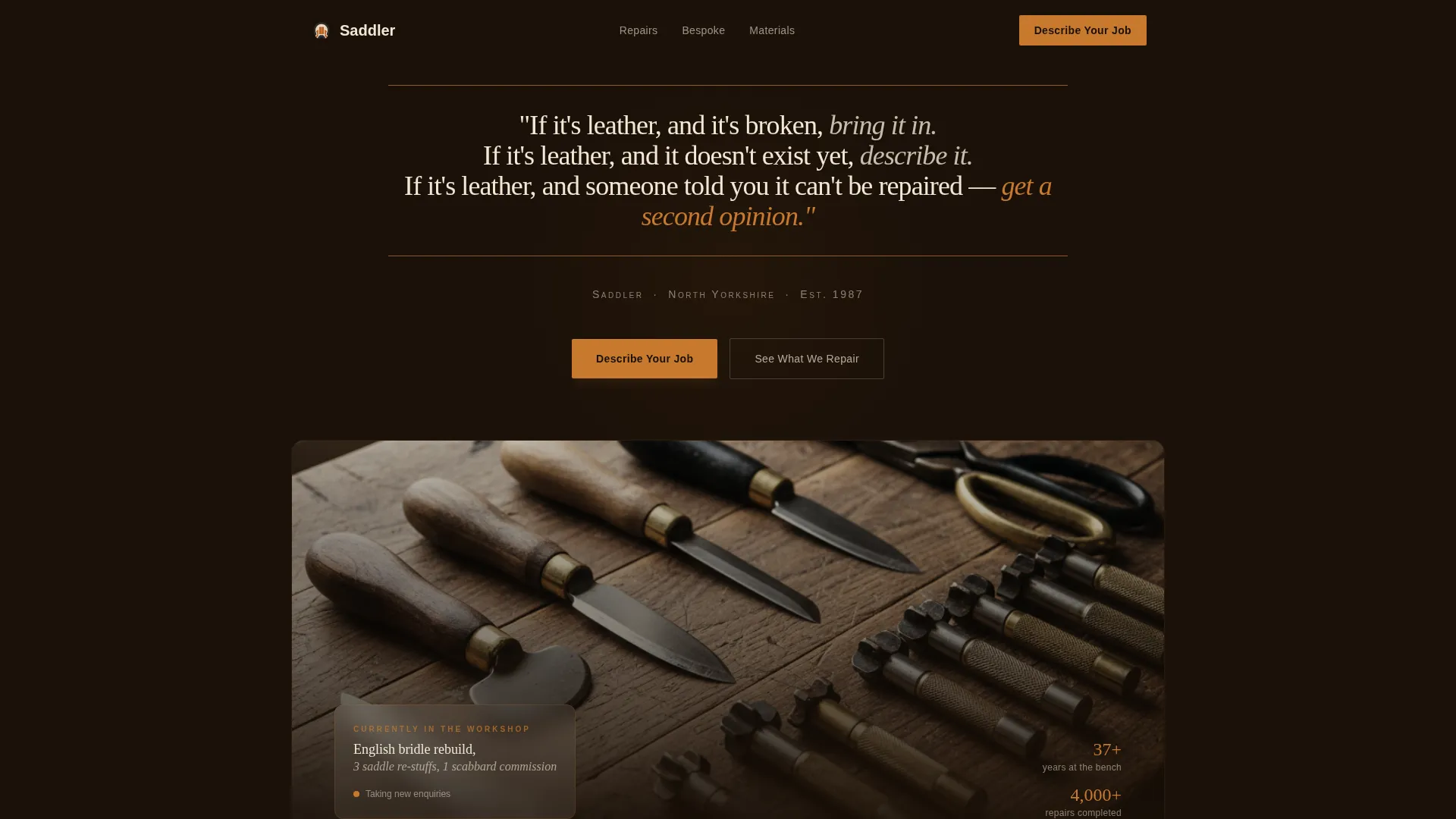
- A manifesto-style header block with the workshop name, county, and year established
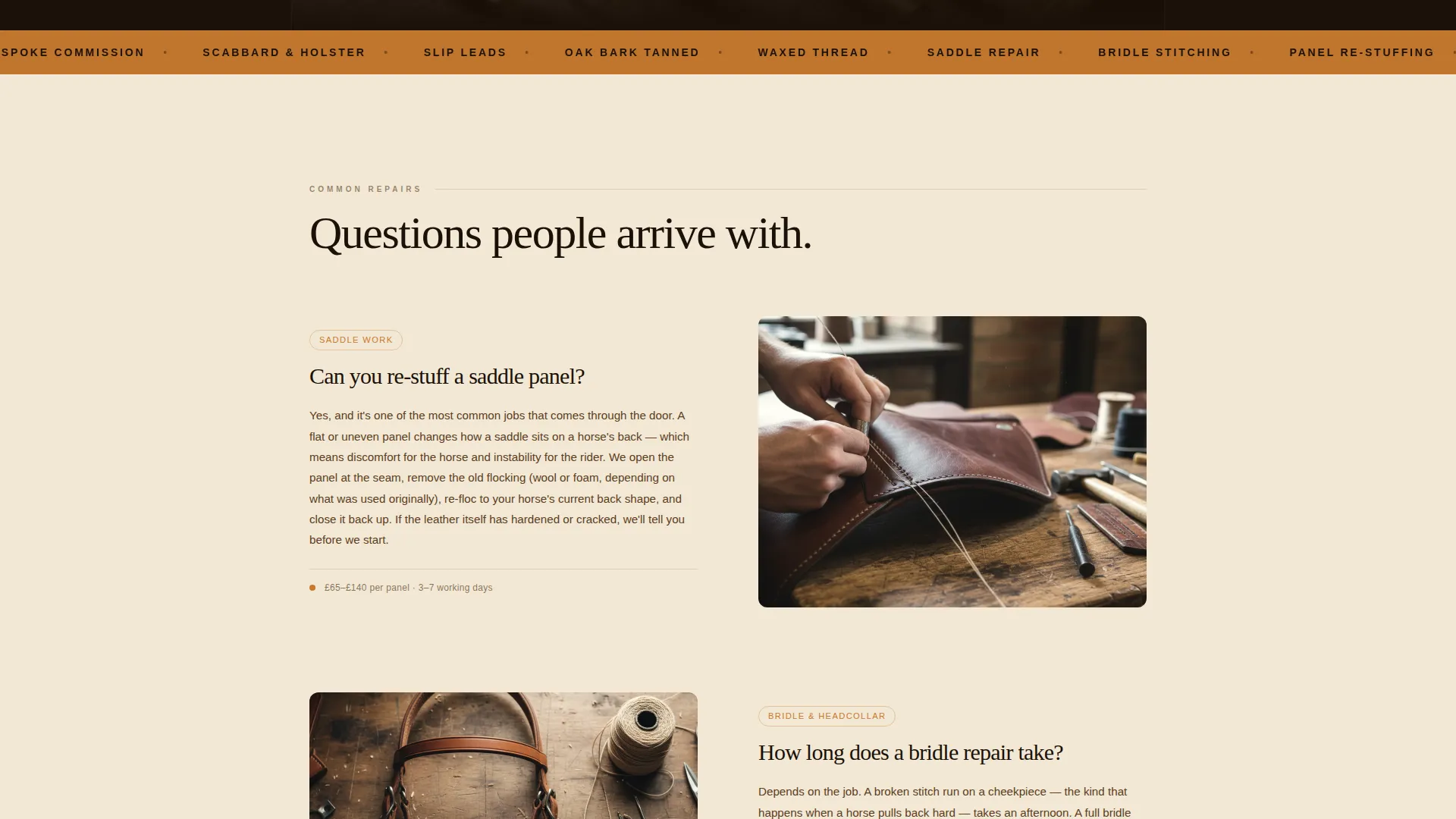
- A repeating FAQ editorial layout: question, written answer, photograph, and optional price or turnaround note
- A primary "Describe Your Job" enquiry form and a secondary downloadable PDF lead-magnet section
Feature list
This template was designed around one core idea: answer fifteen questions before asking for anything in return. Every built-in feature serves that editorial rhythm.
Manifesto Header Block
The header carries white serif text on a deep charcoal background, framed by thin amber rules above and below. No image, no gradient. The confidence of the statement is the design. A single line of small-caps text below it carries the workshop name, county, and year established.
FAQ-Driven Editorial Sections
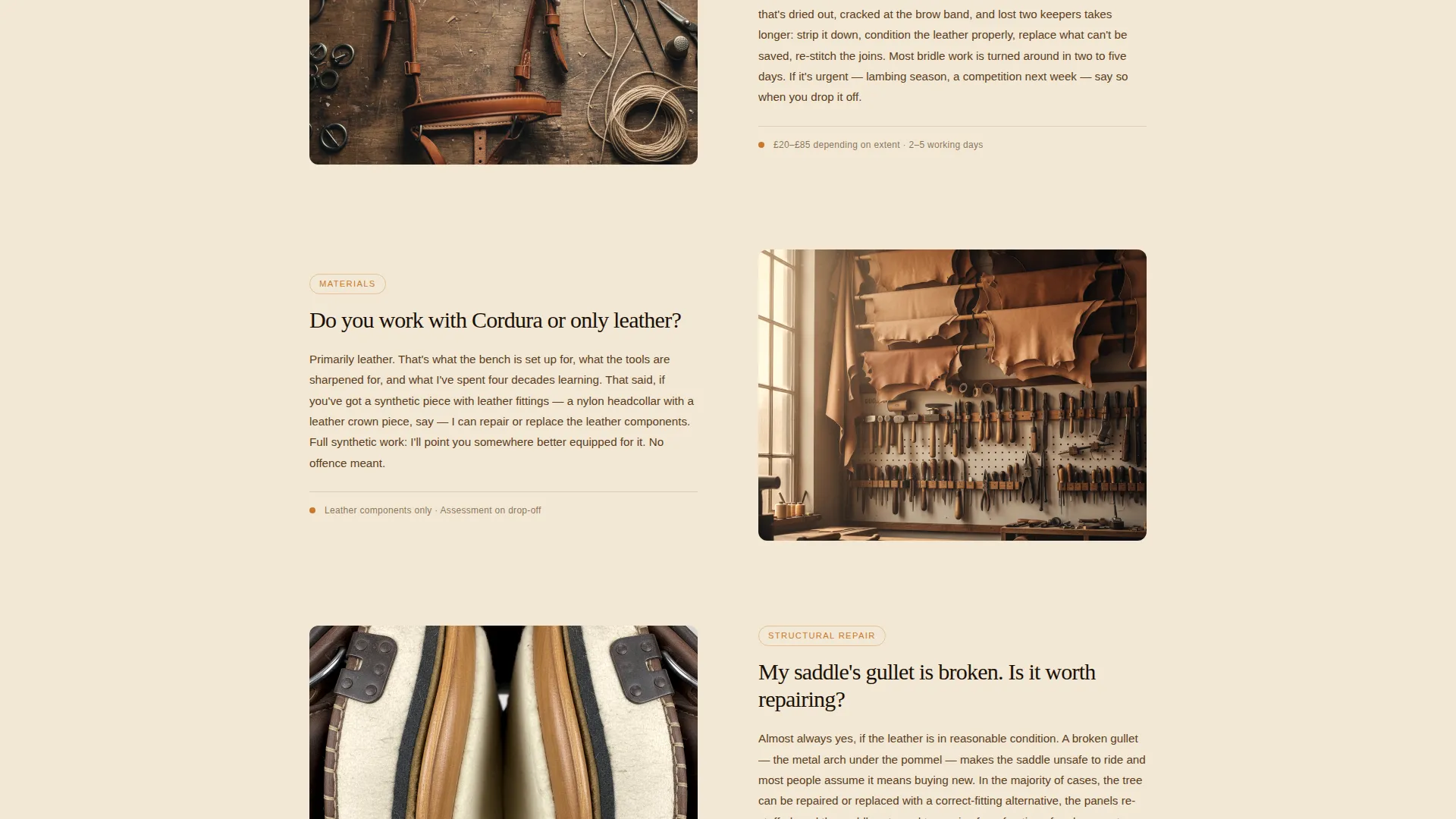
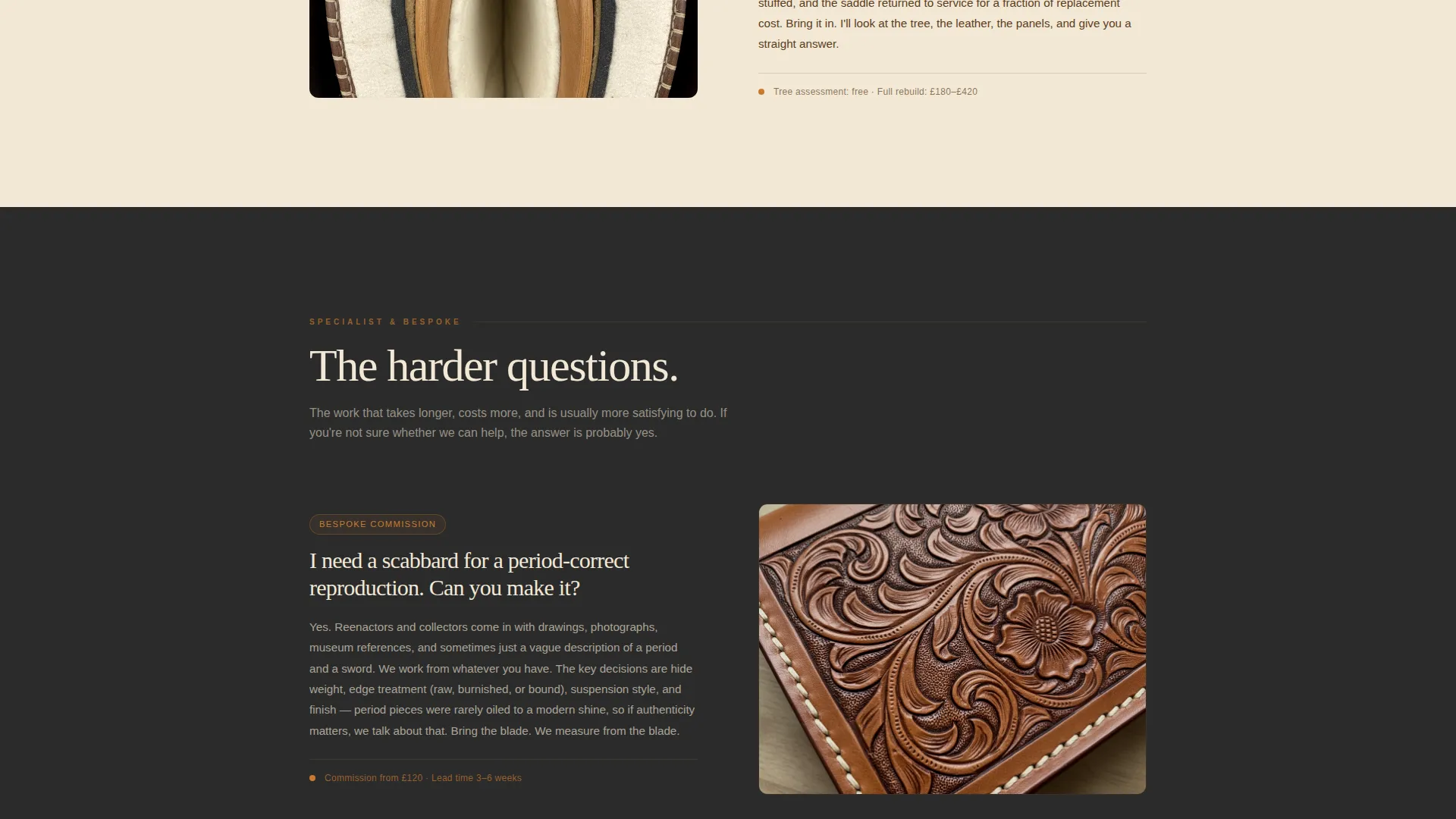
Each section begins with a real visitor question as a heading. A short, honest answer follows in the craftsperson's voice. A close-up photograph sits alongside the text, and a price range or turnaround window appears where relevant. The rhythm repeats from simple repairs through to full bespoke commissions.
Primary Enquiry Form
The "Describe Your Job" call to action links to a simple form asking three things: what the item is, what is wrong with it, and an optional photo upload. The form reduces friction and matches how a client would actually explain their problem to a maker in person.
Downloadable Lead-Magnet Section
A secondary conversion block offers a one-page PDF guide titled "Leather Care Between Repairs." The download is gated behind an email address field. It positions the saddler as an authority who helps clients maintain their leather between visits, not just fix it when it fails.
Charcoal and Amber Color System
The palette uses four named values: deep workshop charcoal for primary backgrounds, saddle-tan amber for headings and accent lines, oiled leather brown for secondary text and borders, and pale suede for content panels. The combination reads as warm, worn, and purposeful without relying on decoration.
Serif Editorial Typography
Headings are set in a serif typeface with generous leading to match the manifesto tone. Small-caps are used for the workshop descriptor line. Body copy is set for readability at long scroll depths, supporting the content-resource page direction.
Page sections overview
| Section | Purpose |
|---|---|
| Manifesto Header | Opens with the workshop's defining statement and identity line |
| Workshop Descriptor Line | Names the workshop, county, and year established in small caps |
| FAQ Section: Simple Repairs | Answers common entry-level questions with voice, photo, and pricing note |
| FAQ Section: Tack and Harness | Covers saddle, bridle, and harness repair questions with turnaround context |
| FAQ Section: Bespoke Work | Addresses custom commission questions and process expectations |
| Enquiry Form Block | Presents the "Describe Your Job" form as the primary conversion action |
| Lead-Magnet Block | Offers the leather care PDF guide in exchange for an email address |
Design & branding system
The visual identity follows a Service Utility theme. The palette is built around four values drawn from the materials of the trade itself, giving the page a workshop atmosphere without relying on decorative imagery.
- Deep workshop charcoal (#2B2B2B) for primary backgrounds, saddle-tan amber (#C87A2E) for headings and accent lines
- Oiled leather brown (#5C3D21) for secondary text and borders, pale suede (#F2E8D5) for content panels and open space
- Thin amber rules are used as structural dividers, echoing the stitching lines and panel edges of the work itself
Mobile & speed optimization
The editorial layout is designed to reflow cleanly at smaller screen widths. The FAQ section structure, with its question heading, text answer, and photograph, stacks naturally into a single column without losing its rhythm or hierarchy.
- Text-heavy editorial sections remain fully readable on narrow screens with no horizontal overflow
- The enquiry form and lead-magnet block are placed within the single-page flow, keeping conversion actions reachable without deep scrolling on mobile
How this template helps you convert
The page is structured to build trust through content before presenting any call to action. By the time a visitor reaches the enquiry form, they have already read answers to questions very similar to their own.
- The FAQ-driven scroll answers real visitor questions in order of complexity, reducing hesitation and establishing the maker's expertise before any ask is made.
- The "Describe Your Job" form lowers the barrier to contact by framing the enquiry as a simple description rather than a formal request, matching how clients naturally think about their problem.
- The downloadable PDF guide captures email addresses from visitors who are not yet ready to enquire, creating a secondary conversion path that keeps the workshop front of mind.
Other information about this template
This template is well suited to leather workers who serve specialist client groups, including equestrians, working farmers, historical reenactors, and pet owners commissioning durable custom goods. The editorial format supports long-form trust-building, which is particularly valuable for high-value repair and bespoke commission services where clients need confidence before spending.
- The template style is Editorial/Magazine, making it a strong fit for craft businesses where voice and expertise are key selling points
- The content-resource page direction means the page functions as a reference destination, not just a promotional brochure
- The FAQ structure can be expanded or trimmed to match the specific range of services a workshop offers, from single-craft specialists to multi-discipline leather businesses
Theme
Service Utility
Creative direction
FAQ-Driven
Color system
Charcoal & Amber
Style
Editorial/Magazine
Direction
Content/Resource
Page Sections
Manifesto Header with Amber Rules
Faq-driven Editorial Layout
Describe Your Job Enquiry Form
Leather Care PDF Lead Magnet
Charcoal and Amber Color System
Serif Editorial Typography
Related questions
What kind of leather worker is this template designed for?
How does the FAQ-driven layout work in practice?
What are the two conversion actions built into this template?
Can I adjust which questions appear in the editorial FAQ sections?
Does the header use a background image or photograph?