Auto Parts Auction Landing Page Template
Salvage is a Neo-Retro auto parts auction landing page built for gearheads who mean business. Modular auction cards, live bid tickers, countdown timers, and a cinematic device mockup header combine to create an urgent, discovery-driven buying experience. The Citrus Burst color system makes every part feel like a barn-find worth fighting for.
by Rocket studio
Quick summary
Salvage is a single-page auto parts auction template designed for platforms where rare, hard-to-find, and numbers-matching components change hands fast. A Neo-Retro visual identity, modular card grid layout, and real-time urgency mechanics give buyers every reason to bid now and browse later.
Who this template is for
This template is built for operators running competitive, inventory-rich auto parts auction platforms. It works for sellers and platform owners whose buyers already know their part numbers and need a fast path to bidding.
- Weekend restoration hobbyists hunting correct-date-code components for a specific build
- Professional builders sourcing verified, VIN-tagged panels for concours-level judging
- Junkyard flippers and resellers who move inventory fast and need buyers to act quickly
What problem this template solves
Finding rare auto parts online is exciting, but most auction pages kill the momentum with flat layouts and zero urgency. Buyers arrive, browse, and leave without committing. This template solves that problem by making every second on the page feel like a countdown.
- Auction cards with live bid counts and closing timestamps remove the "I'll come back later" hesitation
- A frictionless sign-up modal with one-tap payment options lowers the barrier for first-time buyers
- The "Set Alert for This Part" secondary path captures intent from visitors who are not ready to bid yet
What you get with this template
You get a fully structured, single-page auction landing page with every section pre-built and ready to customize. The layout is modular, so card rows, interstitial blocks, and the closing cluster can all be adapted to fit your inventory depth and sale cadence.
- A parallax device mockup header with an active auction scene and chrome-yellow headline
- A stagger-animated modular card grid with flip-reveal hover states and "Place Bid" call-to-action buttons
- A full-width "Barn Find of the Week" interstitial, a live-ticker sold-price ribbon, and a "Closing Soon" urgency cluster
Feature list
A paragraph introducing the feature blocks below: each feature below reflects a distinct, prompt-specified capability built into this template.
Parallax Device Mockup Header
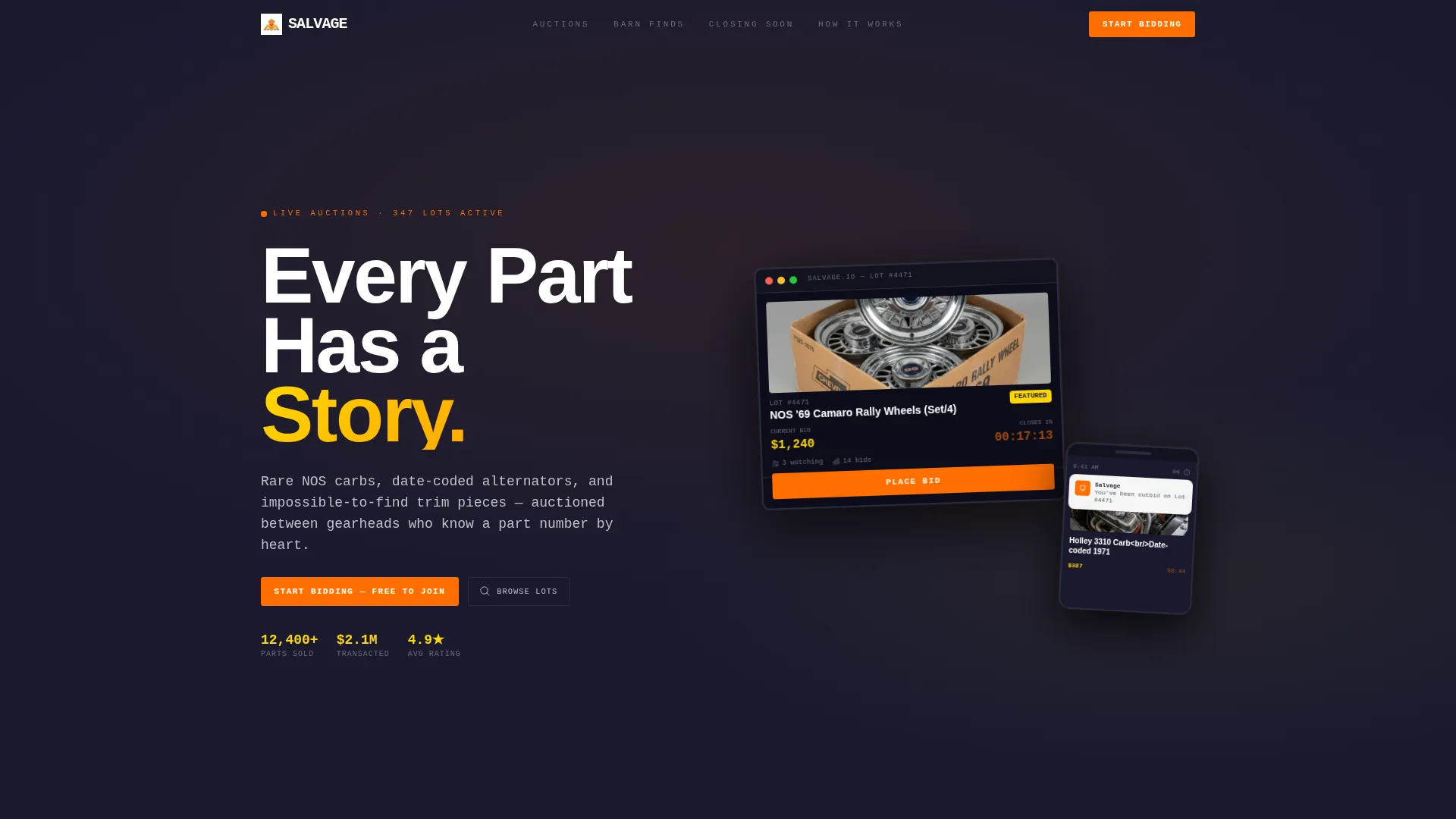
The header displays a phone and laptop floating at a slight parallax angle, both showing an active auction in progress. A tangerine countdown, a push notification preview, and a chrome-yellow headline set the stakes the moment a visitor lands.
Stagger-Animated Card Grid
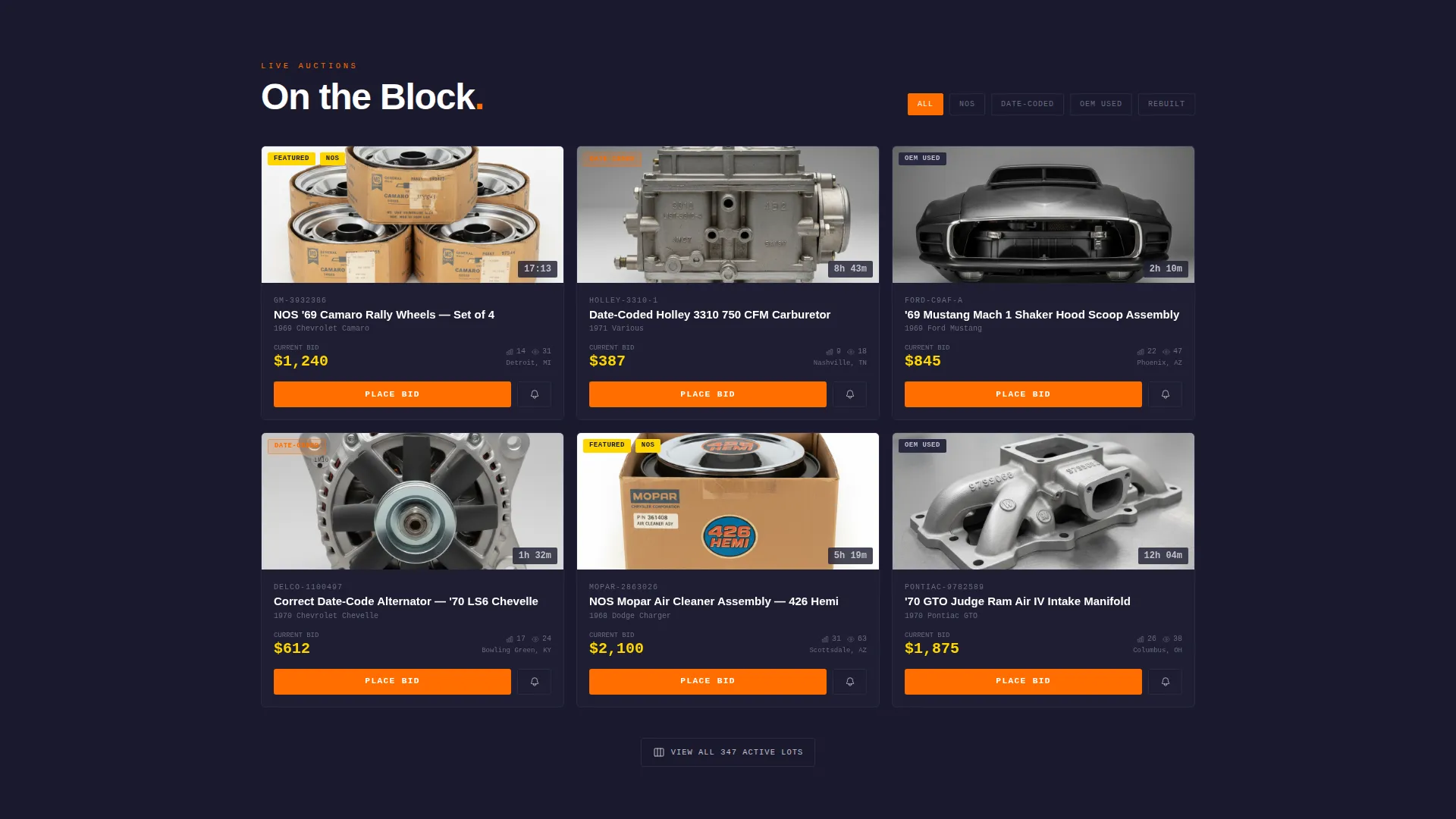
The first card row loads with gentle stagger animations. Each card flips from a silhouette mystery state to a full-color part reveal on hover, mimicking the tactile thrill of unwrapping a shipped component straight from a barn find.
Barn Find of the Week Interstitial
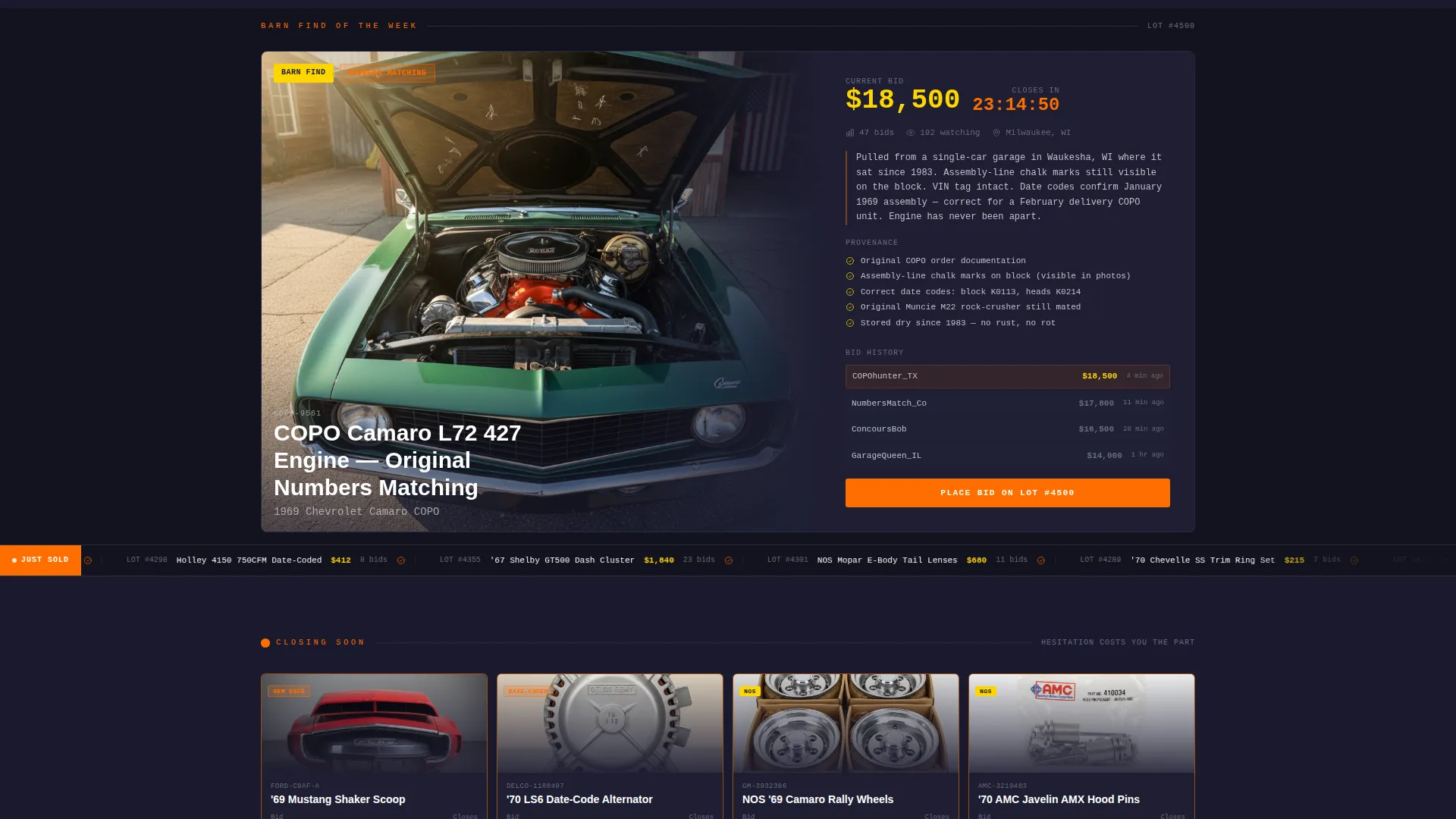
A full-width card breaks the grid mid-scroll, peeling open like a garage door to reveal a featured part with provenance photos and bid history. It gives high-value inventory the spotlight it deserves without disrupting the grid flow.
Live Sold-Price Ticker Ribbon
A scrolling ribbon streams recent sale data in real time, showing part numbers, final prices, and bid counts. Visitors feel the market moving around them, which turns passive browsing into active participation.
Closing Soon Urgency Cluster
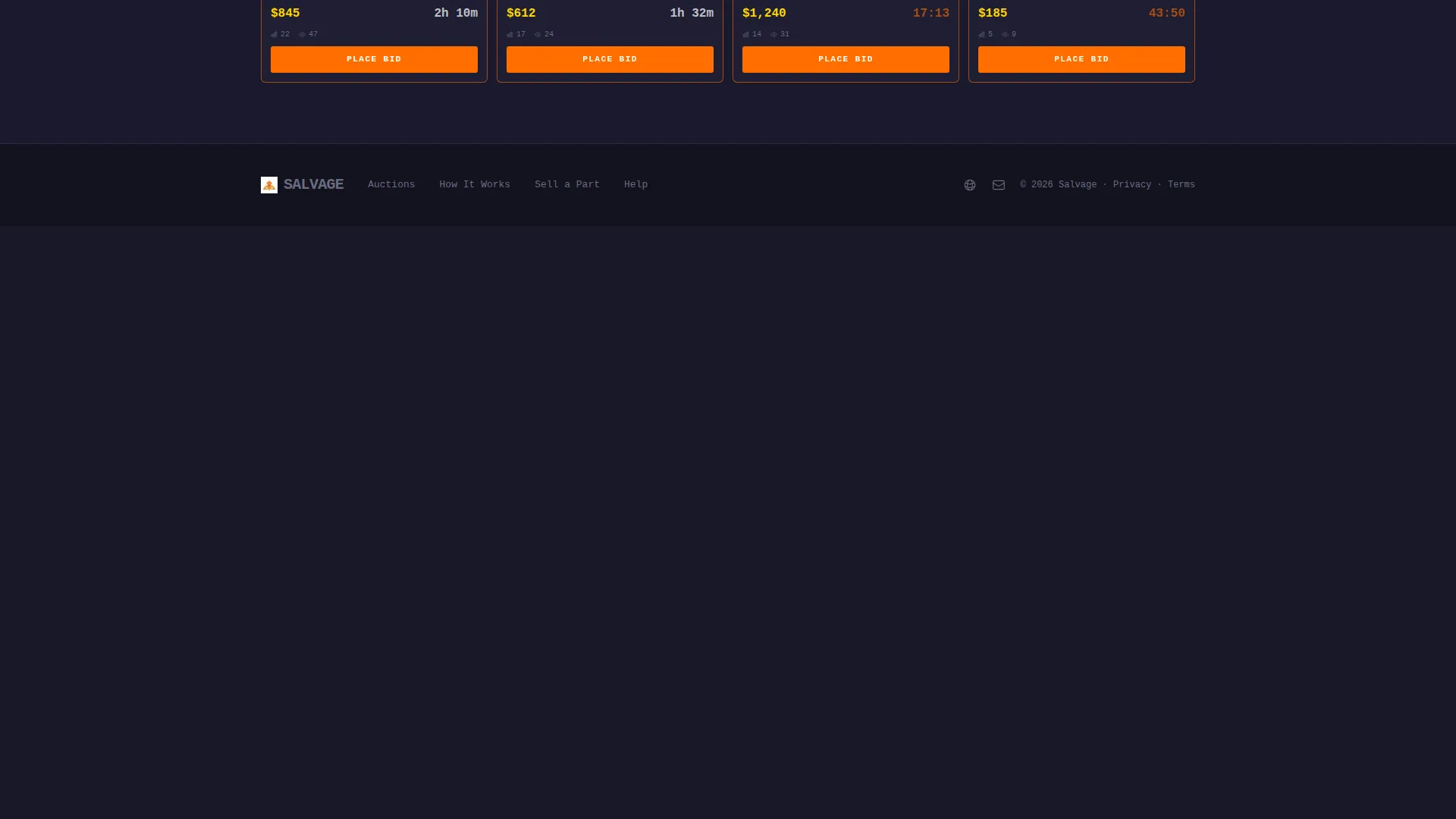
Toward the bottom of the page, auction cards with the shortest remaining time group together. Countdown timers pulse in tangerine, and the tighter card spacing compresses the visual urgency as the scroll approaches the end.
Frictionless Bid and Sign-Up Flow
First-time visitors encounter a lightweight modal requiring only an email address, zip code for shipping estimates, and a payment method. Apple Pay and Google Pay appear as one-tap alternatives, and the "Set Alert for This Part" option captures intent from visitors who are not bidding today.
Page sections overview
| Section | Purpose |
|---|---|
| Parallax Header | Establishes auction context and headlines the active bid scene |
| Card Grid Row | Displays auction inventory with flip-reveal hover and bid details |
| Barn Find Interstitial | Spotlights a featured high-value part with provenance and history |
| Live Ticker Ribbon | Streams recent sold prices to inject social proof mid-scroll |
| Closing Soon Cluster | Groups ending auctions with pulsing timers to compress urgency |
| Sign-Up Modal | Captures new bidders with a low-friction email and payment entry |
| Set Alert Path | Collects part-level intent from visitors not ready to bid yet |
Design & branding system
The visual identity runs on a Citrus Burst palette that channels a vintage speed shop sign glowing with neon at dusk. Every color has a job, and none of them overlap.
- Tangerine (#FF6D00) fires on call-to-action buttons and countdown timers; lemon-chrome yellow (#FFD600) highlights winning bids and featured tags
- Deep garage-shadow black (#1A1A2E) anchors card backgrounds and the persistent navigation bar
- Greased-aluminum silver (#C0C0C8) separates grid gutters and carries secondary type, keeping the layout readable without breaking the visual energy
Mobile & speed optimization
The modular card grid is built to reflow cleanly across screen sizes, keeping bid details, countdown timers, and call-to-action buttons accessible without pinching or horizontal scrolling.
- Stagger animations are scoped to load progressively, so the first visible card row appears without waiting for the full grid to resolve
- The sign-up modal and one-tap payment options are sized and spaced for thumb-friendly interaction on smaller screens
How this template helps you convert
Every layout decision in this template points toward a single outcome: getting a qualified visitor to place a bid or save a part before they leave the page.
- Live bid counts and closing timestamps on every card create genuine scarcity that makes hesitation feel costly, pushing visitors toward the "Place Bid" button before time runs out.
- The two-path conversion model serves both ready buyers and not-yet-ready browsers. The primary path drives immediate bids; the "Set Alert" secondary path builds a retargetable list of part-specific intent.
- The frictionless first-time sign-up flow, with one-tap payment options, removes the friction that typically loses first-time auction participants at the payment step.
Other information about this template
This template is categorized under Retail and E-Commerce, specifically within the Auto Parts E-Commerce subcategory and the Auto Parts Auction Platform niche. It carries an intersection match score of 9, indicating a high degree of alignment between the design system, creative direction, and target use case.
- The Neo-Retro theme and Surprise and Delight creative direction are purpose-matched to the auction format, where discovery and urgency are the core emotional triggers
- The Card Grid (Modular) template style means individual auction card components can be duplicated, reordered, or removed as inventory volume changes
- The Direct Sales landing-page direction keeps the layout focused on conversion rather than content browsing, making it suitable for time-sensitive auction events
Theme
Neo-Retro
Creative direction
Surprise & Delight
Color system
Citrus Burst
Style
Card Grid (Modular)
Direction
Direct Sales
Page Sections
Parallax Device Mockup Header
Flip-reveal Auction Card Grid
Barn Find of the Week Interstitial
Live Sold-price Ticker Ribbon
Closing Soon Urgency Cluster
Two-path Conversion Flow
Related questions
Who is the target buyer for this template?
Can the card grid handle different inventory sizes?
What makes the urgency mechanics feel real rather than manufactured?
How does the template handle visitors who are not ready to bid?
Is this template suitable for a single auction event or an ongoing marketplace?