Healthcare & Hospital Design Directory Website Template
Sanctuary is a landing page template built for behavioral health facility design consultancies. It uses a 60/40 asymmetric grid, a collage-style hero, and a persistent interactive toolkit sidebar to demonstrate deep domain authority. The layout guides behavioral health directors, architects, and real estate investors toward a gated Evidence-Based Design Toolkit download through editorial content and trust-building resources.
by Rocket studio
Quick summary
Sanctuary is a specialized landing page template for mental health facility design consultancies. It pairs a collage-style hero with a 60/40 editorial grid and a persistent interactive toolkit sidebar. The page earns trust through specification-level content and case studies before presenting a gated download as the natural next step.
Who this template is for
This template is built for design consultancies operating in the behavioral health space. It speaks directly to professionals who need to demonstrate compliance expertise and clinical fluency to high-stakes buyers.
- Behavioral health system directors who are expanding campuses and evaluating design partners
- Architects navigating Facility Guidelines Institute (FGI) Guidelines for the first time on a behavioral health project
- Private equity groups converting commercial real estate into residential treatment centers
What problem this template solves
Behavioral health design is a niche field where credibility must be earned before any conversation about scope begins. Generic architecture portfolio pages do not communicate ligature-resistant hardware fluency or trauma-informed wayfinding knowledge. Sanctuary solves this by building trust visually and editorially before the call to action appears.
- Buyers arrive skeptical and need proof of clinical domain knowledge before they engage
- The gated toolkit download requires a page that earns the ask rather than simply placing a form above the fold
- Standard portfolio templates cannot accommodate a persistent interactive sidebar and a scrolling research environment side by side
What you get with this template
This template delivers a fully structured, single-page layout with distinct editorial and interactive zones. Every section is designed to move a qualified visitor closer to the download form without feeling like a sales funnel.
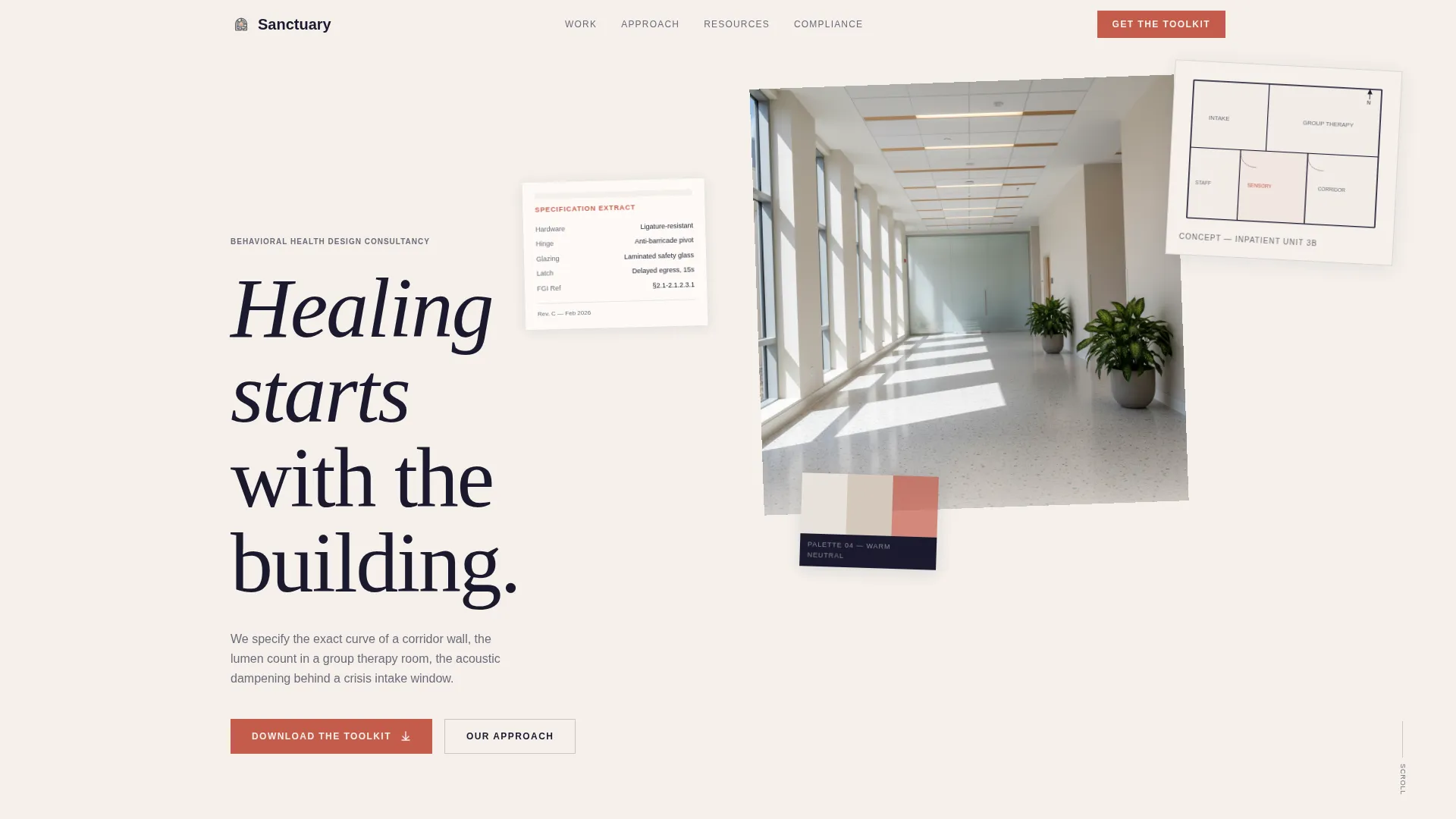
- A collage-style hero with layered floor plan fragments, material swatches, and a single editorial serif headline
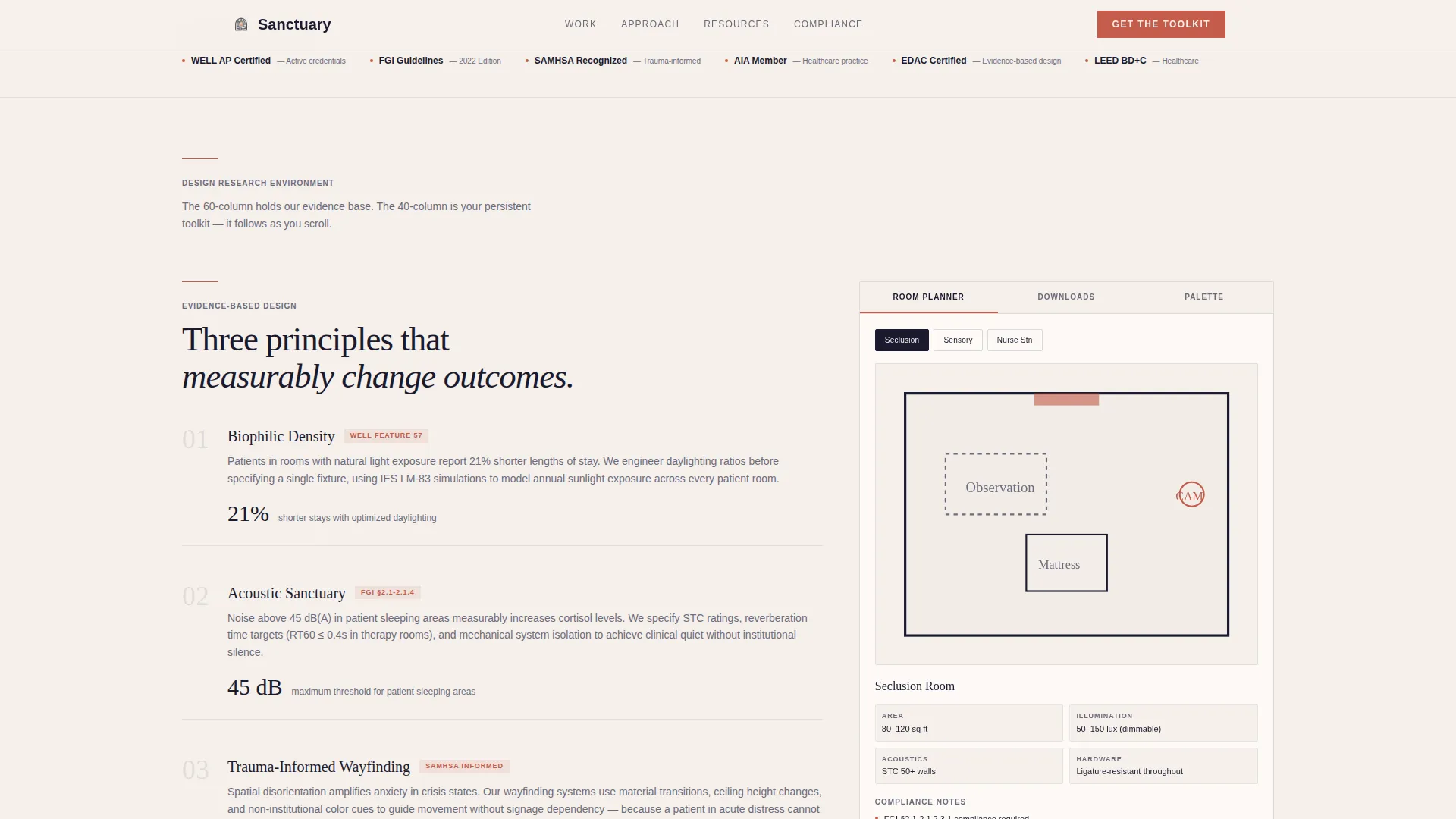
- A 60/40 asymmetric grid where the wide column holds deep editorial content and the narrow column holds a persistent interactive toolkit sidebar
- A gated two-field download form for the Evidence-Based Design Toolkit, preceded by three ungated free articles
Feature list
This template is built around a small number of high-impact components. Each one serves a specific purpose in moving a visitor from curiosity to commitment.
Collage and Scrapbook Hero
The header layers floor plan sketches, material swatches, a terrazzo corridor photograph, and a torn specification sheet with deliberate overlap and slight rotation. Nothing is centered. The composition feels like a pinned studio wall, and a single editorial serif line anchors the concept.
Asymmetric 60/40 Editorial Grid
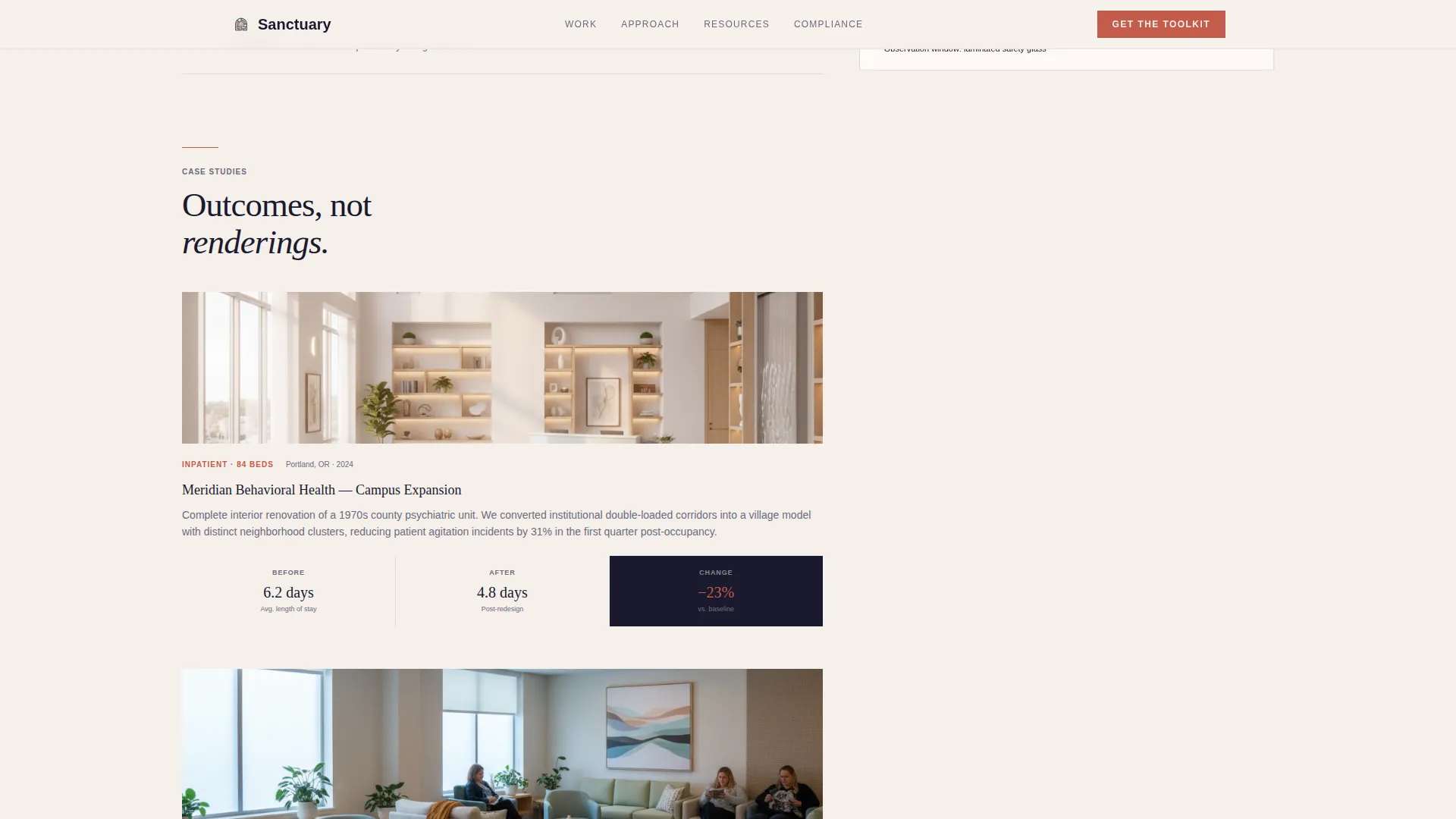
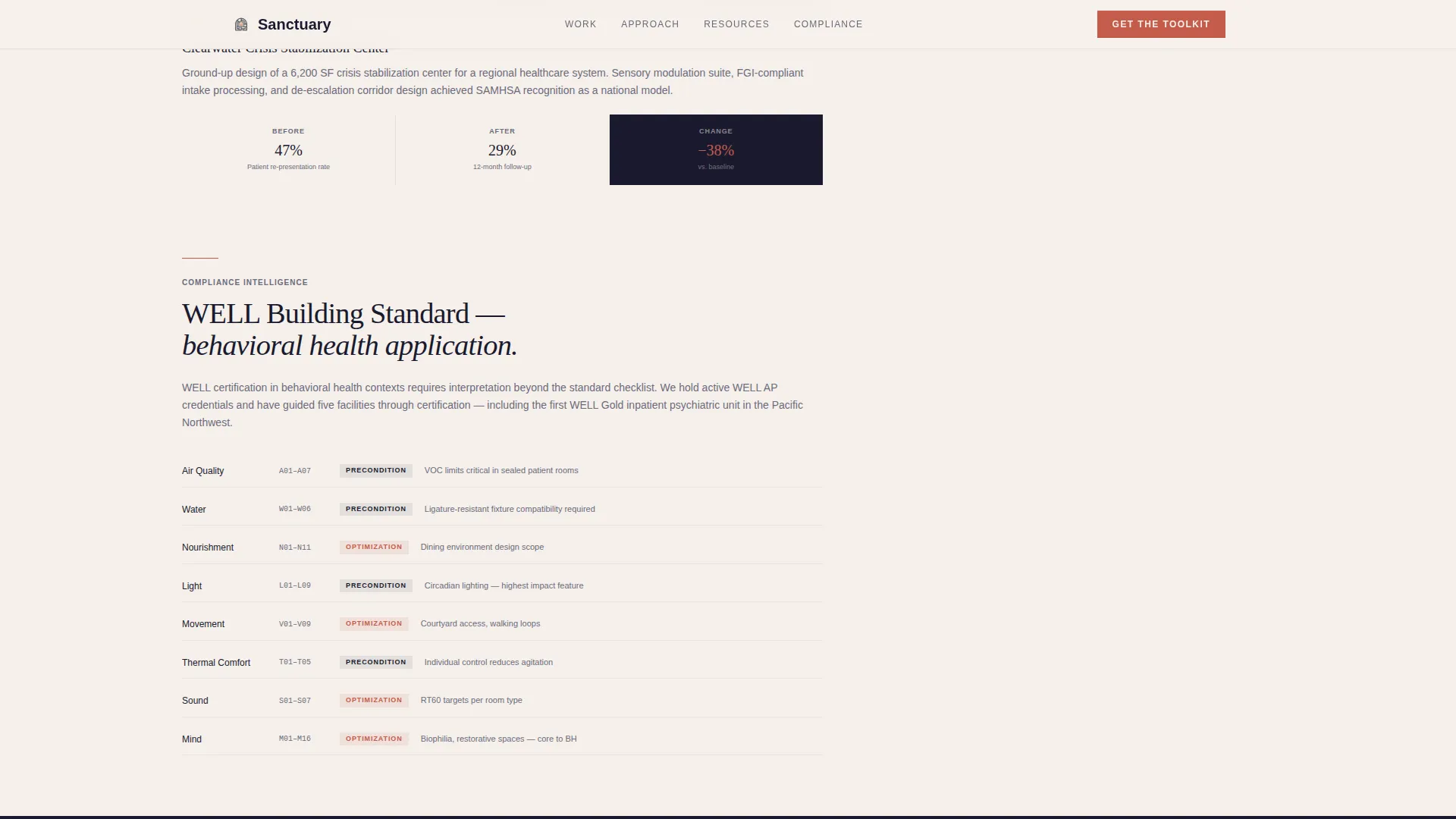
The scroll experience splits the page into two persistent columns. The wider 60-column carries evidence-based design principles, WELL Building Standard compliance breakdowns, and case studies with before-and-after patient outcome data. The narrower 40-column holds the interactive toolkit that follows the visitor as they scroll.
Persistent Interactive Toolkit Sidebar
The sidebar stays visible throughout the scroll and contains downloadable PDFs, material palettes, code-compliance checklists, and a room planner toggle. Visitors can switch between seclusion room, sensory modulation space, and nurse station configurations without leaving the page.
Gated Evidence-Based Design Toolkit Form
The primary call to action is a two-field form gated behind a work email and a facility type selector. Facility types include inpatient, outpatient, residential, and crisis. The form appears after sufficient editorial content has demonstrated consultancy expertise.
Ungated Free Articles Section
Three free resources are offered before the gated ask. This section builds trust incrementally and gives hesitant visitors a lower-commitment entry point before they reach the download form.
Case Studies with Outcome Data
A dedicated case study section presents project-level specifics with before-and-after patient outcome data. Archival red accents draw attention to key data points and create visual hierarchy within the deep ink background sections.
Page sections overview
| Section | Purpose |
|---|---|
| Hero Collage | Establish consultancy identity and editorial tone with a layered composition |
| Evidence Principles | Present evidence-based design content alongside the persistent toolkit sidebar |
| Case Studies | Demonstrate project outcomes with before-and-after patient data |
| Free Articles | Offer three ungated resources to build trust before the gated ask |
| Toolkit Download | Convert qualified visitors with a two-field gated form |
| Footer | Provide navigation and brand tagline in a split layout |
Design & branding system
The visual identity follows a Luxe Minimal approach. The palette feels like opening a hand-bound monograph on a linen tablecloth: restrained, tactile, and weighted with intention.
- Four-color system: deep sumi ink (#1A1A2E), warm cotton stock (#F5F0EB), soft graphite (#6B6B7B), and archival red (#C45B4A) reserved exclusively for interactive hotspots and download indicators
- Typography uses Fraunces as the editorial serif for headlines and DM Sans for body text and user interface elements
- Backgrounds alternate between cotton stock and ink across sections, with text inverting accordingly, and generous whitespace serving as the primary layout tool
Mobile & speed optimization
The template is designed desktop-first, with the 60/40 persistent sidebar experience native to wider viewports. The mobile layout collapses gracefully so every content zone remains accessible on smaller screens.
- The persistent toolkit sidebar stacks below editorial content on mobile, preserving all interactive functionality
- Scroll-linked parallax on collage fragments and staggered reveal animations use medium intensity, keeping the experience purposeful rather than decorative
- Static editorial content uses server-side rendering while interactive components such as the room planner toggle and sticky sidebar are handled as client-side components
How this template helps you convert
The conversion strategy is built around demonstrating expertise before making any ask. The page earns the download rather than demanding it.
- Three ungated free articles establish credibility and give visitors a low-risk first interaction, reducing friction before the gated form appears.
- The persistent toolkit sidebar keeps downloadable resources visible throughout the scroll, reinforcing value at every stage and making the full toolkit feel like the obvious next step.
Other information about this template
This template is part of the Architecture and Design category, specifically within the Healthcare and Hospital Design subcategory. It is purpose-built for the mental health facility design niche and carries a high intersection match score for that audience.
- The footer uses a split layout with the consultancy logo and tagline on the left and navigation links on the right
- Animation intensity is medium: scroll-linked parallax, staggered content reveals, and a sticky sidebar are included without overwhelming the editorial tone
- Interactivity is high: the room planner toggle, persistent sidebar, and gated form are all active client-side components
- The template is localized for English-language, United States professional context with USD pricing conventions in mind
- The overall tone of the page is formally editorial, comparable in feel to a specification monograph rather than a marketing brochure
Theme
Luxe Minimal
Creative direction
Interactive Explorer
Color system
Ink & Paper
Style
Asymmetric Grid (60/40)
Direction
Content/Resource
Page Sections
Collage and Scrapbook Hero Section
Asymmetric 60/40 Editorial Grid
Persistent Interactive Toolkit Sidebar
Gated Evidence-based Design Toolkit Form
Ungated Free Articles Section
Case Studies with Patient Outcome Data
Related questions
Who is this landing page template designed for?
What is the primary call to action on this page?
Can visitors access any content without filling out the form?
What does the interactive room planner include?
Is this a single-page layout or a multi-page site?