Heritage Memorial Planning Landing Page Template
Sanctum is a heritage-style memorial planning landing page template built for mausoleums and columbariums. It uses atmospheric full-bleed photography, slow-scroll storytelling, and a warm Soft Mist color palette to guide emotionally ready visitors toward a planning guide request. The form is minimal, the tone is gentle, and every section is designed to earn trust before it asks for anything.
by Rocket studio
Quick summary
Sanctum is a storybook single-page landing page template designed for mausoleum and columbarium services. It leads with cinematic imagery, moves through five immersive sections, and closes with a low-friction planning guide form. The design speaks in the language of permanence and care, treating pre-need planning as an act of love rather than a confrontation with loss.
Who this template is for
This template was built for memorial service providers who want to reach people at a quiet, considered point in their lives. It is not designed for urgency or transaction. It is designed for trust.
- Adult children between the ages of forty and sixty who are navigating their parents' final wishes and need a place to begin.
- Couples in their sixties who have decided to choose their resting place together, while that choice still feels like planning rather than grief.
- Estate attorneys and pre-need advisors who refer clients to resources that speak with dignity and clarity.
What problem this template solves
Most memorial service landing pages ignore the emotional weight their visitors are already carrying. They present features like a product catalog and push calls to action before any trust has been established. Families who are trying to do right by their parents, or by each other, tend to leave those pages feeling rushed and unseen.
Sanctum solves that. It is built around the belief that a visitor who feels genuinely respected is far more likely to move forward than one who feels sold to.
- It replaces aggressive conversion tactics with atmospheric storytelling, letting families move at their own pace through five emotionally distinct sections.
- It positions the primary call to action only after three full sections of immersive content, once emotional trust has been earned.
- It treats the form as an invitation, not a gate, asking only for a first name, an email address, and one quiet question about who the visitor is planning for.
What you get with this template
You get a complete, ready-to-use landing page layout that covers every stage of the visitor journey, from first impression to guide request. The template is built for a desktop-first audience that skews fifty-five and older, while remaining fully supported on mobile devices.
- A five-section full-page layout that moves from hero image through silence, legacy, craft, and gathering, each section carrying a distinct emotional register.
- A primary call to action in warm bronze that requests the planning guide, plus a secondary path offering a downloadable PDF on mausoleum, columbarium, and memorial garden options with a soft email capture.
- Typography set in Fraunces for serif display headings and DM Sans for interface labels, paired with a Soft Mist color system in heirloom ivory, weathered bronze, morning fog gray, and deep chapel stone.
Feature list
This template was built with deliberate restraint. Every feature serves the emotional journey described in the brief. Nothing is included that does not earn its place on the page.
Full-Bleed Cinematic Hero Section
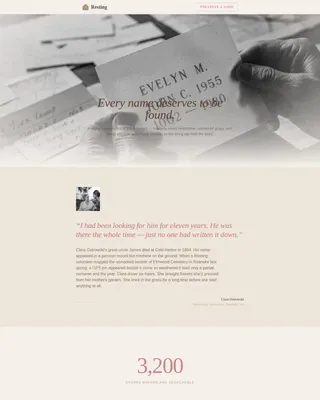
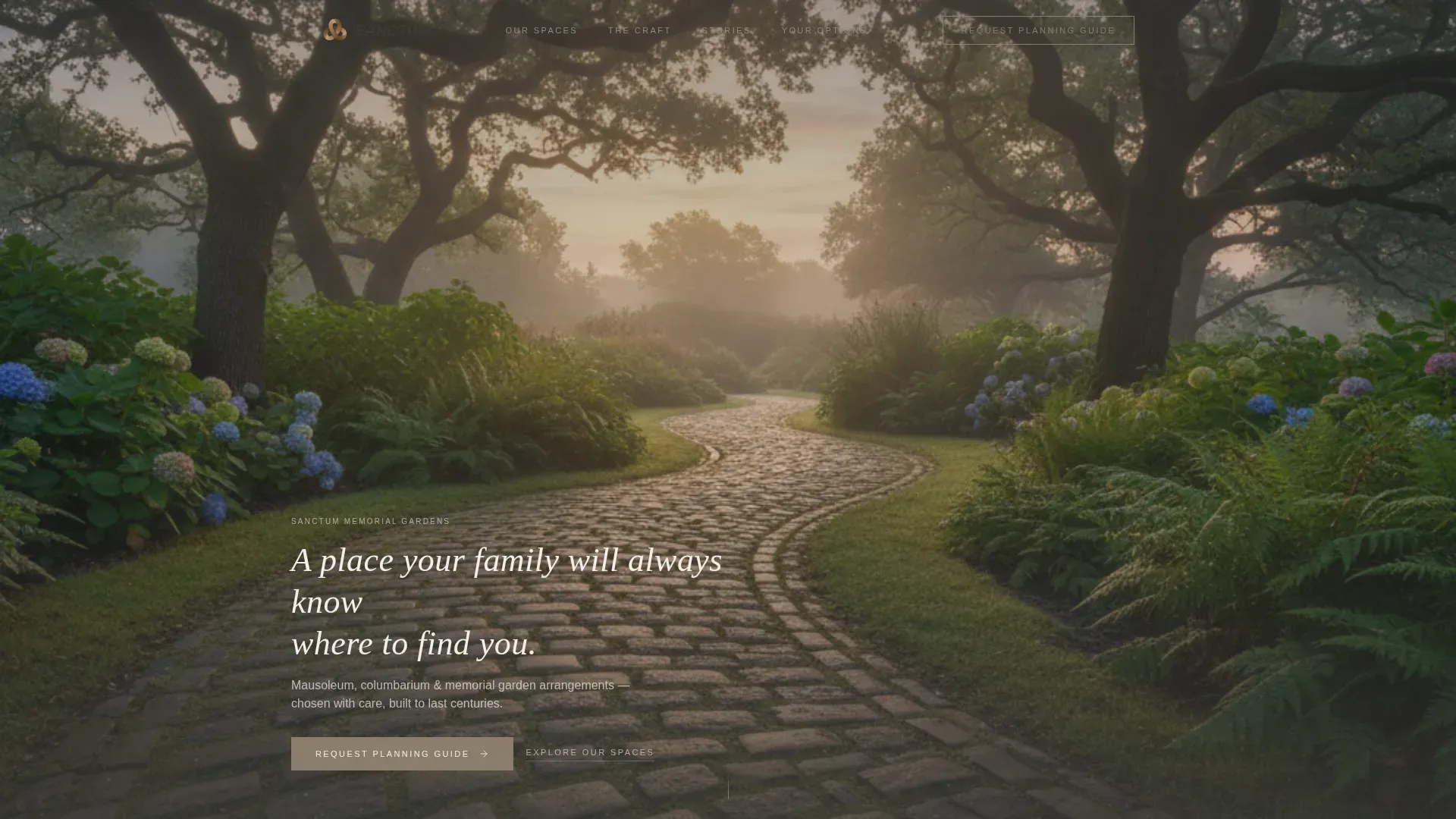
The hero section uses a lifestyle photograph of an older couple walking arm-in-arm down a colonnaded walkway. Late-afternoon light casts long amber columns across the marble floor. The image bleeds edge to edge. A headline in small, spaced serif type appears at the bottom: A place your family will always know where to find you. This is the first sign that the page is different from anything else in this category. The calming hero image establishes a positive first impression before a single word of copy is read.
Five Immersive Atmosphere Sections
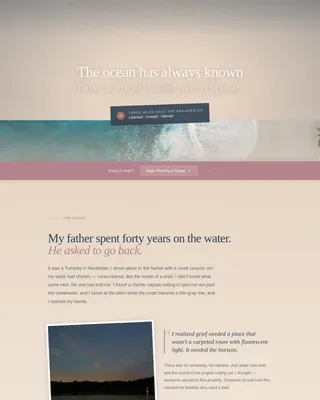
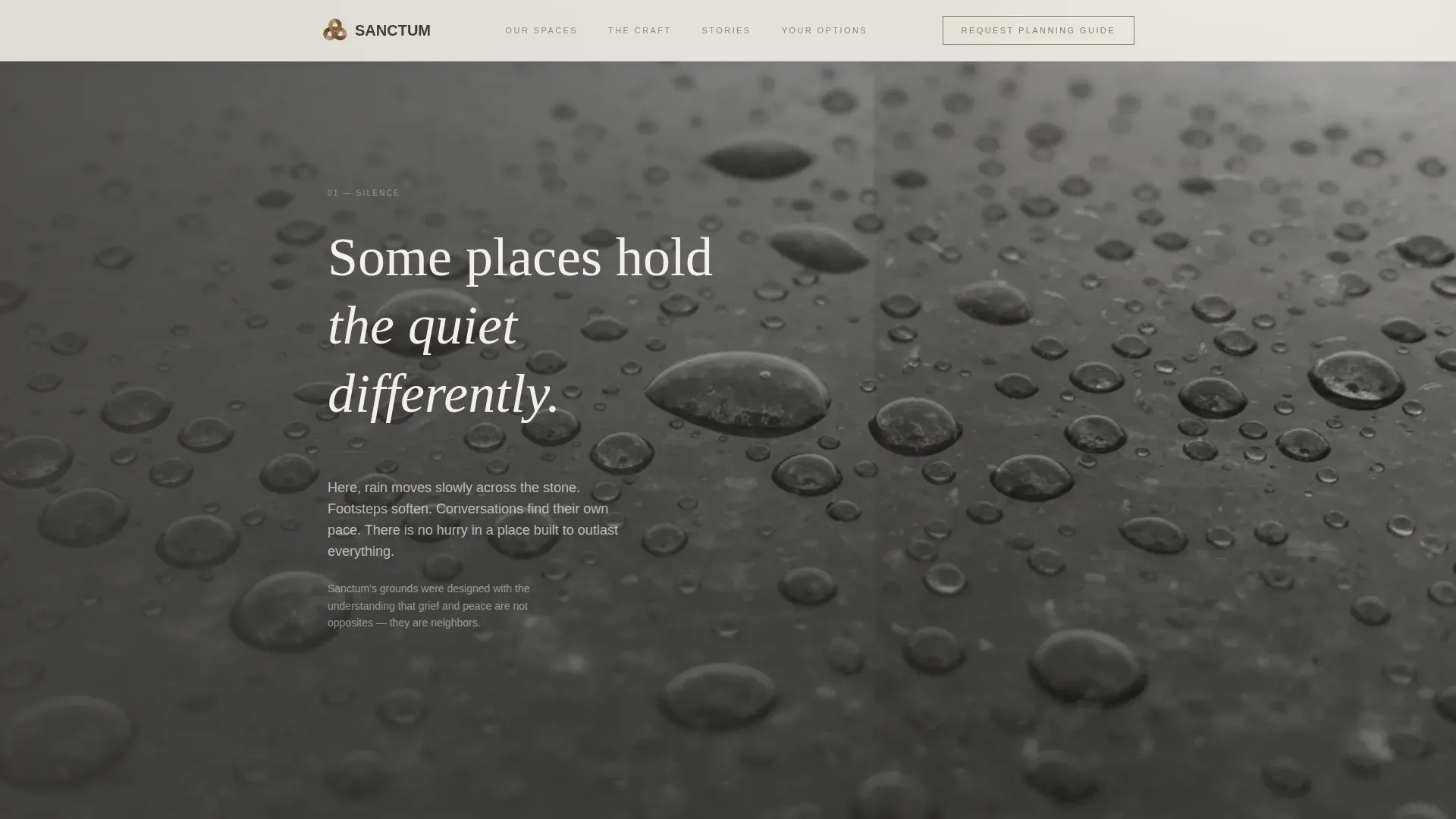
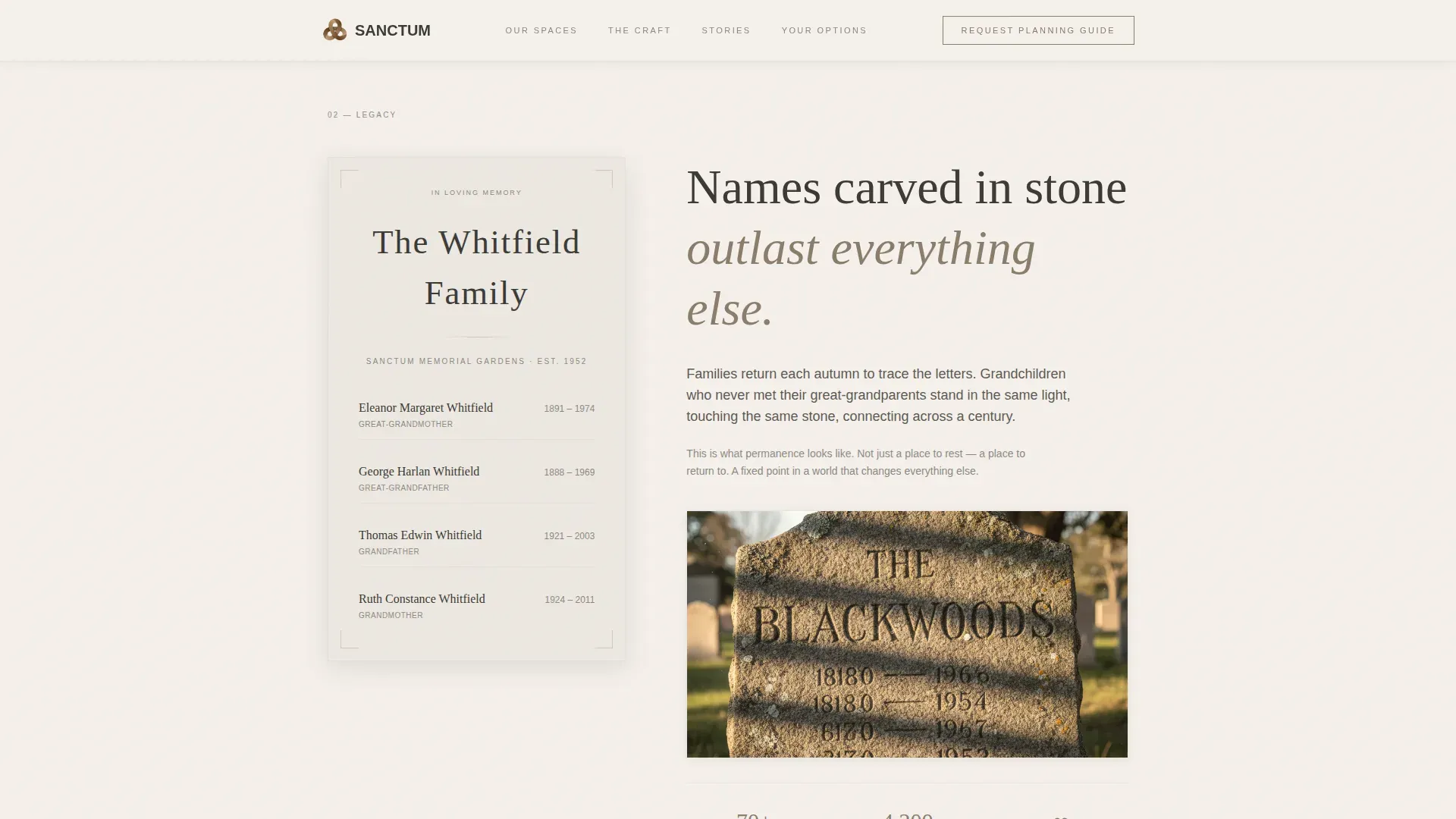
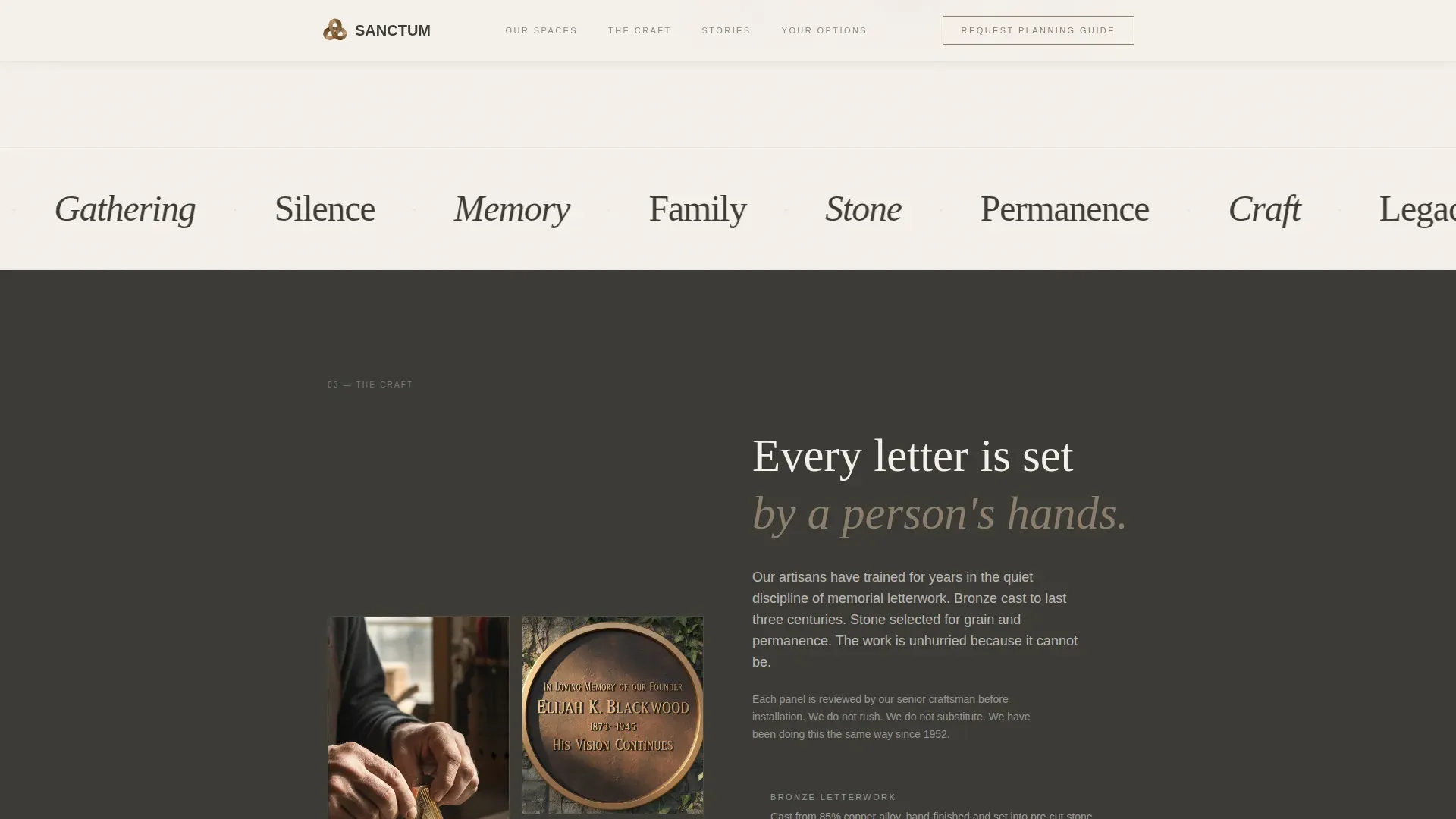
Each of the five primary sections immerses the visitor in a different emotional register. Rain beads on polished granite. An engraved family name carries four generations of dates. Hands set a bronze letter into stone. A family places flowers on a spring morning. The scroll does not accelerate. It slows, section by section, until the pace of reading matches the pace of reflection. This atmosphere-and-mood creative direction is rare in the memorial category and is the core reason the template converts without pressure.
Tiered Call-to-Action Architecture
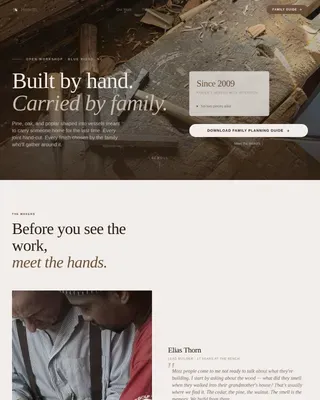
The primary call to action, "Request Our Planning Guide," appears in warm bronze only after the third immersive section. It is placed when emotional trust is established, not before. A secondary path offers a downloadable PDF titled Understanding Your Options: Mausoleum, Columbarium and Memorial Gardens. The PDF has no hard gate. It uses a soft email capture on completion. Together, these two paths give visitors a choice of how involved they want to be without forcing either option.
Minimal Planning Form
The form is designed around one core belief: the fewer the fields, the lower the friction. It asks only for a first name, an email address, and one quiet question: Are you planning for yourself or for someone you love? This approach is consistent with best practices for sensitive landing pages, which recommend minimizing form fields to only essential information to reduce user effort. The form does not assume what the visitor needs. It listens.
Testimonial Slider for Social Proof
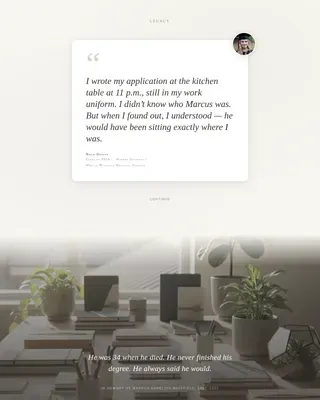
The gathering section includes a testimonial slider adapted for heritage editorial style. Social proof, including client testimonials, helps humanize the service and reassure families who are in the middle of something difficult. The slider carries guest stories in a format that feels like personal letters rather than review snippets, reinforcing the generational legacy theme that runs through the entire page.
Heritage Editorial Typography and Color System
The template uses Fraunces as its serif display face, a typeface with warmth and age built into its letterforms. DM Sans handles interface labels and body text at smaller sizes. The Soft Mist color system pairs heirloom ivory for backgrounds, weathered bronze for primary interactive elements, morning fog gray for secondary surfaces, and deep chapel stone for body text. The result is a visual language that feels like opening a linen-wrapped family Bible, nothing shiny, nothing loud, everything earned by time.
Page sections overview
| Section | Purpose |
|---|---|
| Hero cinematic photo | Establishes emotional tone with full-bleed lifestyle imagery and a quiet editorial headline |
| Silence rain granite | Immerses the visitor in atmosphere, slowing the pace of reading before any offer appears |
| Legacy family engraving | Demonstrates permanence through a four-generation engraved family name, building trust in the craft |
| Craft bronze setting | Highlights artisan credibility and places the primary planning guide call to action |
| Gathering family flowers | Features a testimonial slider and the secondary PDF download path alongside the planning form |
| Footer minimal row | Closes with a single-row linear footer on an ivory background, clean and unhurried |
Design & branding system
The design direction is Heritage and Story, expressed through a Soft Mist color system and an atmosphere-and-mood creative framework. Every visual decision is intended to slow the visitor down rather than push them forward. The palette was chosen to feel like time itself has touched it.
- Colors: heirloom ivory (#F5F0EB) for backgrounds, weathered bronze (#8B7D6B) for primary calls to action and interactive elements, morning fog gray (#D5D8DC) for secondary surfaces, and deep chapel stone (#3B3A36) for body text.
- Typography: Fraunces for large display headings and editorial moments; DM Sans for form labels, navigation, and smaller interface text.
- Animation and interaction: medium animation weight using CSS heroFade slideshow transitions, GSAP section reveals on scroll, and scroll-linked parallax on photography sections; native CSS smooth scroll without Lenis.
Mobile & speed optimization
The template is built desktop-first to match an audience that skews fifty-five and older and tends to research on larger screens. Full mobile support is included. The layout adapts cleanly across device sizes without sacrificing the immersive quality of the photography sections.
- Native CSS smooth scroll is used in place of JavaScript-based scroll libraries, keeping the experience lightweight.
- Server Components handle static sections, and images are intended for compression and optimization before deployment to support fast loading speeds.
- The responsive layout ensures that visitors who arrive on smartphones during sensitive or urgent situations can still navigate the page with ease and dignity.
How this template helps you convert
Sanctum does not convert through pressure. It converts through patience. The entire page is structured to build enough emotional trust that the visitor decides to reach out on their own terms, at their own pace, without feeling pushed.
- The five-section atmospheric scroll earns attention before asking for anything, placing the primary call to action only after three full sections of immersive storytelling so that the desire to connect feels natural rather than manufactured.
- The minimal three-field form and the ungated PDF download offer two low-friction paths forward, giving visitors a clear and empathetic way to take the next step without committing to more than they are ready to give.
- The testimonial slider in the gathering section adds human social proof at exactly the right moment, just before the form, so that families feel they are joining something real rather than filling out a contact sheet.
Other information about this template
This section covers additional context, practical considerations, and topics that serious buyers tend to want answered before they commit. The goal is to give you a full picture of what Sanctum is, where it fits, and how it was conceived.
Sanctum was designed for a world in which pre-need planning is advancing from a niche legal concern into a mainstream act of family care. Across cities large and small, more adults are discovering that deciding early, while the process still feels like a gift rather than a burden, is one of the most considered things they can do for the people they love. Scholars of grief and bereavement have long believed that clarity around end-of-life wishes reduces the emotional injuries that families tend to carry for years after a death. Sanctum was built in that spirit.
The template takes advantage of the fact that the memorial category has, until now, largely ignored the power of atmosphere. Most providers in this space reject the idea that aesthetics matter at this point in a family's journey. That assumption appears to be wrong. Families who are born into a culture of care, who were raised to believe that beauty and permanence are signs of love, respond to a page that speaks their language. They are not interested in a form-first, feature-heavy pitch. They want to feel that the earth they choose, and the land where their name will be carved, was chosen with the same degree of intention they are bringing to the decision.
The sanctum heritage memorial planning landing page template was built specifically for this emotional register. It does not kill the mood with product tables. It does not ignore the weight of the moment. It does not abandon the visitor to a generic layout. Instead, it advances them gently through a story, from first sight of the hero image to the quiet act of submitting their name and email, without ever making them feel like a transaction.
For builders and developers, it is worth noting that AI-powered website builders now allow users to create and launch templates like this without traditional coding skills. These tools often utilize natural language processing to interpret instructions and generate code accordingly. They can handle many things automatically, including backend integrations and deployment, simplifying the build process for non-technical users. Platforms of this kind are particularly beneficial for small businesses and memorial service providers who want to move quickly from concept to a production-ready application. Many operate on a subscription model with various pricing tiers to accommodate different needs, making it free to explore before committing.
Memorial planning websites can also benefit from integration with donation platforms to facilitate contributions, as well as booking systems for scheduling memorial services or events. Incorporating social media sharing features can help reach a wider audience and allow families to share tribute pages. Effective implementations often include sections for event details, a guestbook, and donation options, giving families a complete toolkit in one place. Users may seek templates that are customizable to reflect the unique aspects of the service being planned, and Sanctum was designed from the start to support that kind of personalization.
Sanctum clearly outlines what makes a heritage memorial service unique, including the option for personalized ceremonies, transparent service details, and the kind of human storytelling that builds lasting trust. Memorial planning websites may also offer resources for grief support and planning services, and this template can support those additions with minimal structural change. The game of earning visitor trust in this category is not won with volume or speed. It is won with stillness, craft, and the rare courage to let the story breathe.
- The template is categorized under Funeral and Memorial, Subcategory Cemetery and Burial, Niche Mausoleum and Columbarium.
- It is designed as a storybook full-page single-column landing page with a Heritage and Story theme.
- The header concept is a Lifestyle Shot, not a building exterior or product photograph.
- The landing page direction is Content and Resource, using a planning guide and PDF download as the primary and secondary conversion paths.
- The color system is Soft Mist, the creative direction is Atmosphere and Mood, and the template style is Storybook Full-Page.
- Animation weight is medium, using CSS heroFade, GSAP reveals, and scroll-linked parallax without Lenis.
- Localization is English, United States of America, with pricing in United States dollars.
Theme
Heritage & Story
Creative direction
Atmosphere & Mood
Color system
Soft Mist
Style
Storybook/Full-Page
Direction
Content/Resource
Page Sections
Full-bleed Cinematic Hero Section
Five Immersive Atmosphere Sections
Tiered Call-to-action Architecture
Minimal Three-field Planning Form
Heritage Editorial Testimonial Slider
Soft Mist Color and Typography System
Related questions
Who is the primary audience for this template?
Can this template be customized for a specific memorial brand?
What is the purpose of the ungated PDF download?
Is the form designed to collect detailed visitor information?
Does the template include social proof?