Music & Audio Portfolio Portfolio Website Template
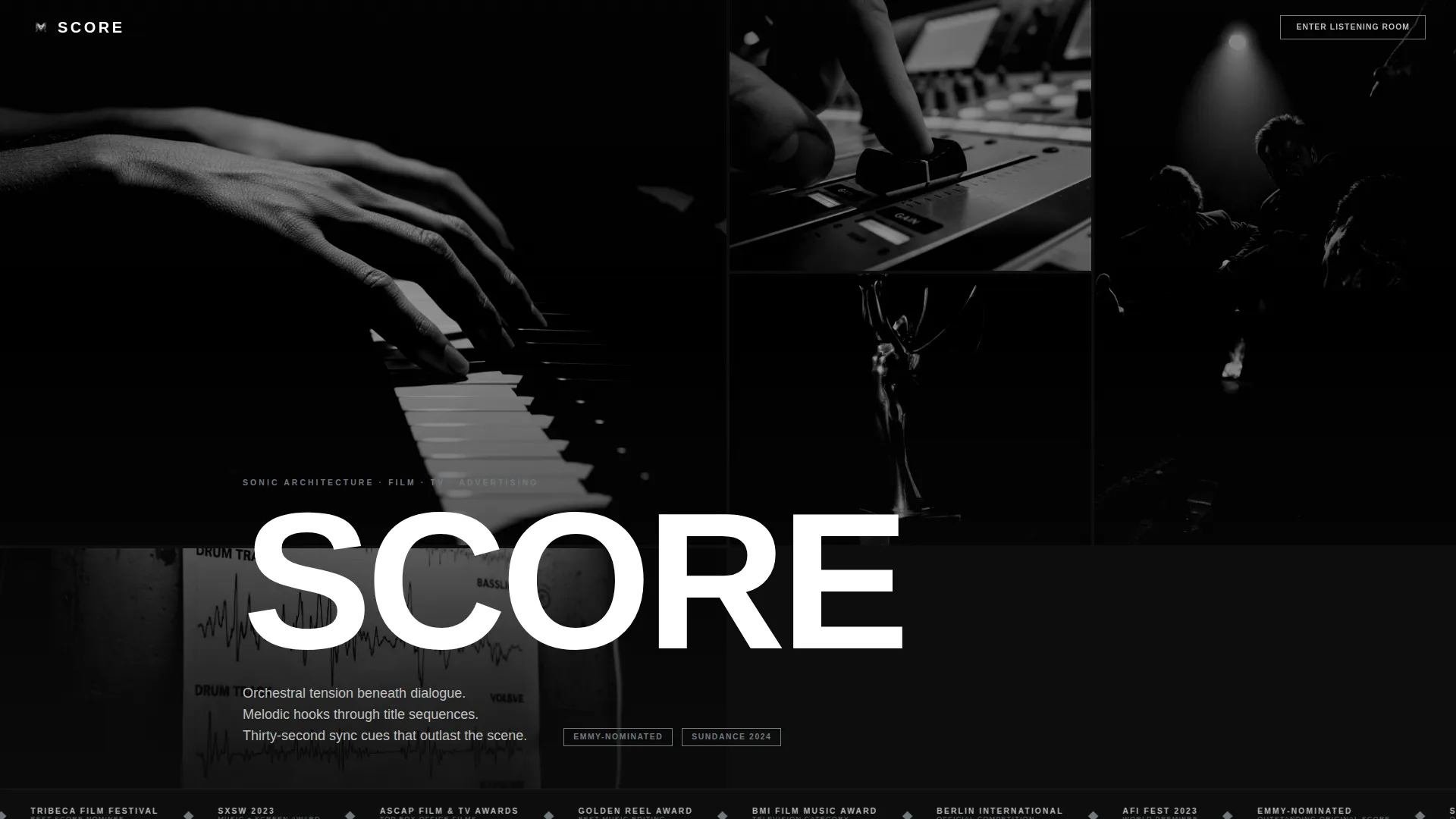
Score is a bold brutalist composer landing page template built for serious film, television, and advertising composers. It combines a photo grid mosaic header, layered case study cards, a horizontal awards ticker, and a click-through flow leading to a private listening room. The result is a portfolio that proves the work before asking for any conversation.
by Rocket studio
Quick summary
Score is a single-page brutalist composer portfolio template designed to land high-value clients. It opens with a mosaic of high-contrast studio images, escalates through layered project case studies, and closes with a full-width call to action. The page feels as heavy and intentional as the music it represents.
Who this template is for
This template is built for professional composers who work at the intersection of sound and screen. It speaks directly to the people whose work shapes how a scene feels, not just how it sounds.
- Film and television composers with a growing body of work to showcase
- Sync composers targeting music supervisors, indie directors, and advertising creative directors
- Any audio professional whose clients need proof of craft before starting a conversation
What problem this template solves
Most composer portfolio pages look like music blogs or generic agency sites. They bury the best work behind navigation menus and soft, safe design choices that say nothing about the weight of the music inside.
- There is no visual language that matches the gravity of orchestral scoring work
- Case studies are scattered or missing, leaving music supervisors with no context for the work
- There is no clear path from "I like this" to "let me hear more and reach out"
What you get with this template
This template gives you a complete single-page layout structured to build credibility from the first scroll to the final call to action. Every section earns the next one.
- A brutalist photo grid mosaic header with oversized knockout type and stacked, irregular image tiles
- A horizontally scrolling awards and recognition ticker rendered in steel gray on black
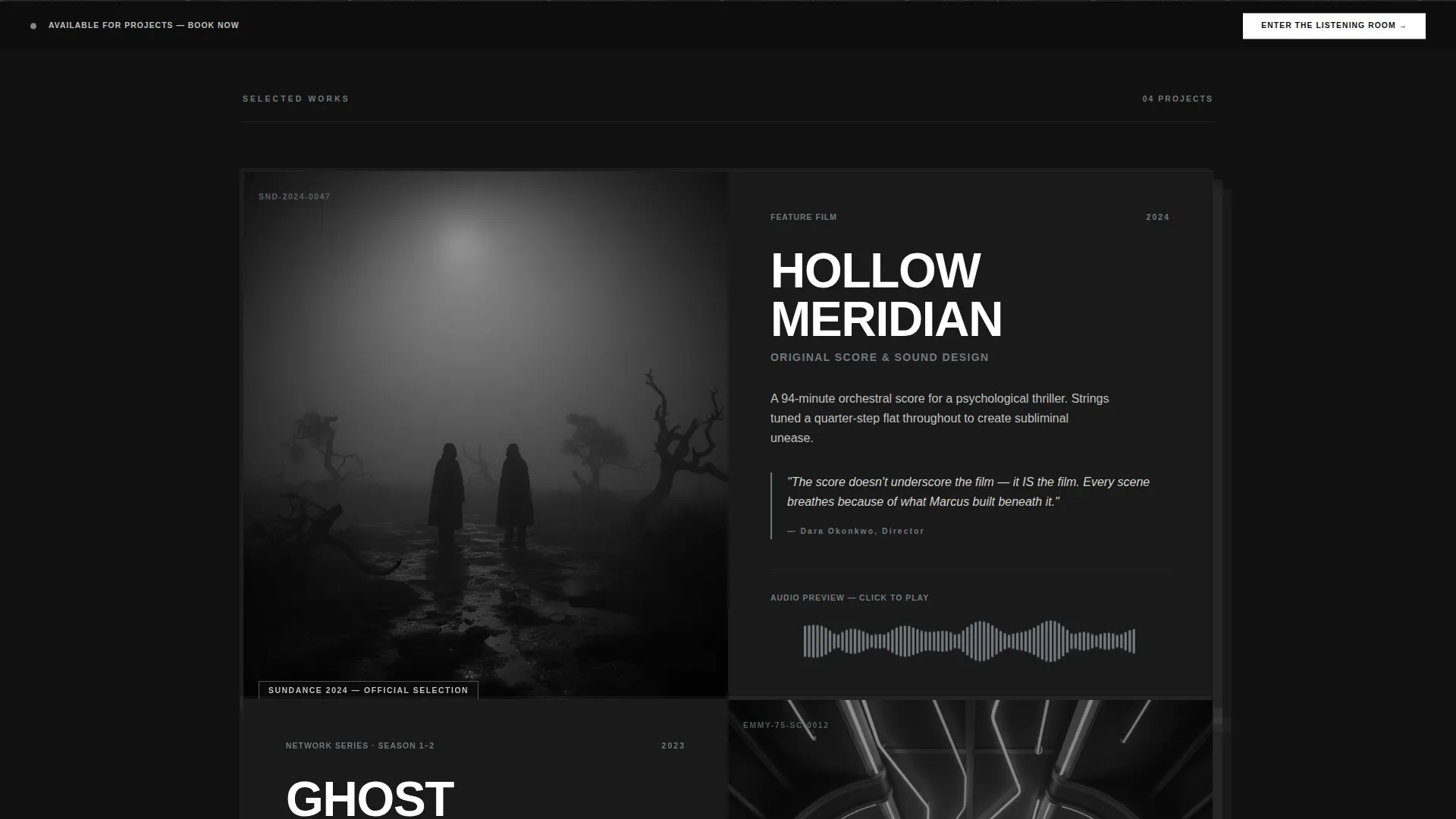
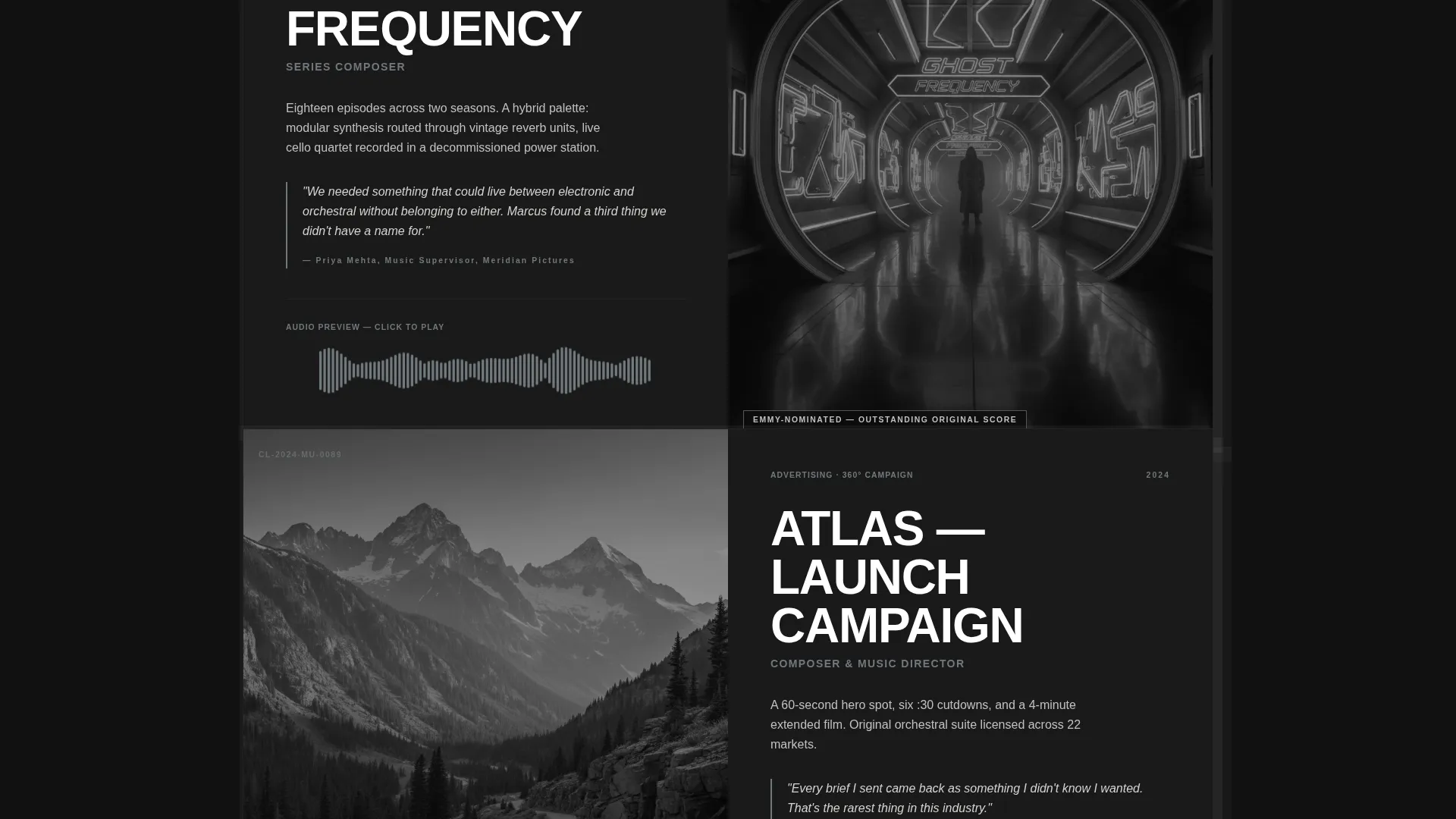
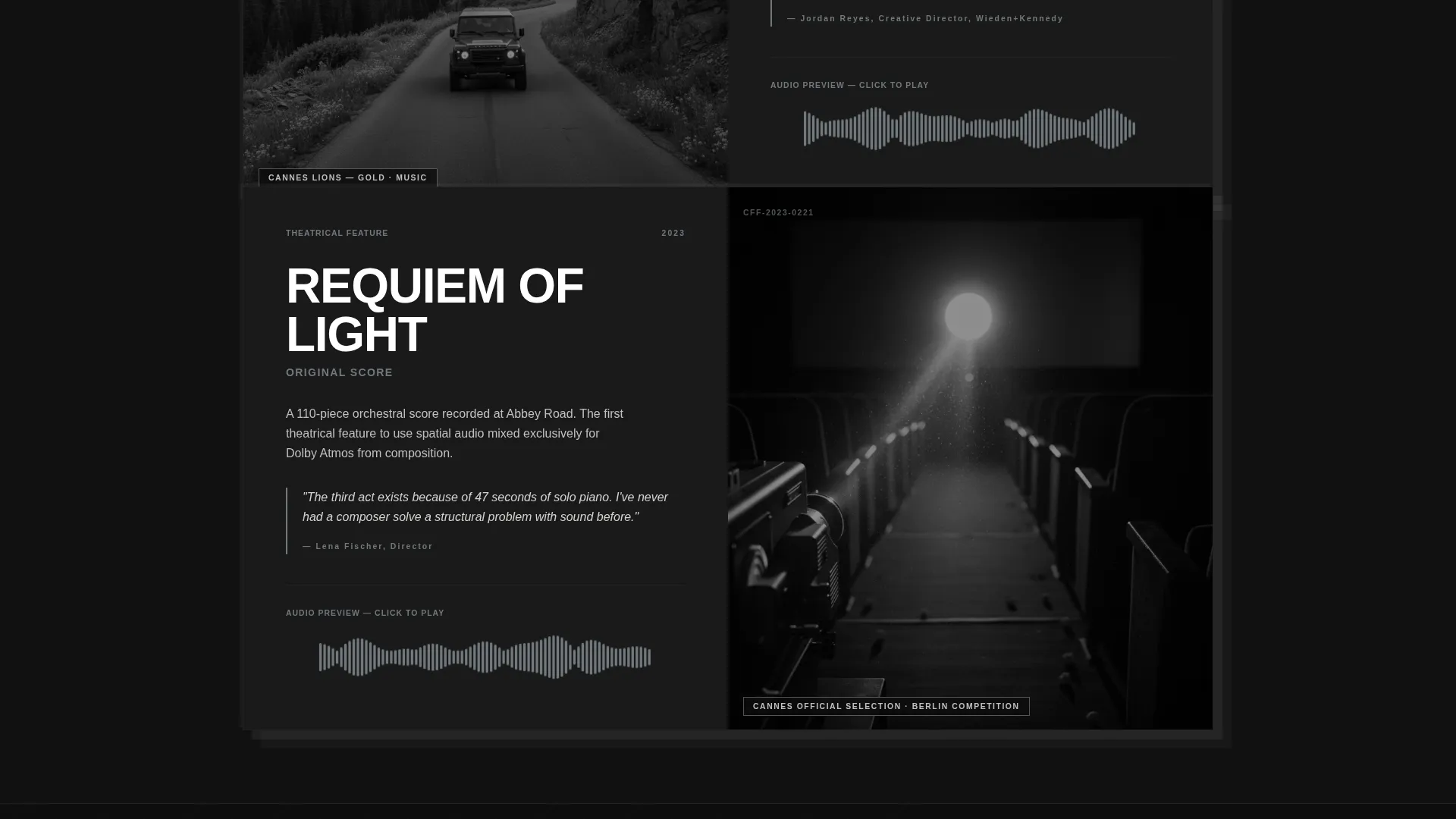
- Layered case study cards that slide beneath one another, each with a project poster, role credit, pull-quote, and embedded waveform audio snippet
- A fixed bottom bar call to action and a full-width closing block, both leading to the listening room
- A curated reel destination page with extended tracks, stems, and a minimal contact form
Feature list
This template delivers a focused set of components, each chosen to reflect the discipline and seriousness of professional scoring work.
Photo Grid Mosaic Header
The header is a brutalist collage of high-contrast black-and-white images tiled at irregular sizes with visible overlap. A close-up of piano keys, a mixing desk fader, a scored film still, an award statuette, and a waveform printout build the composition together. The composer's name sits enormous across the mosaic in knockout white, partially obscured by the top image layer.
Scrolling Awards Ticker
A horizontal ticker scrolls continuously beneath the header, displaying laurels, festival stamps, and nomination badges in steel gray on black. Recognition markers such as "Emmy-Nominated," "Sundance 2024," and "Cannes Official Selection" are stamped in monospaced type. The effect reads like end credits rolling at a measured, deliberate pace.
Layered Case Study Cards
Each project card slides partially beneath the one above it, revealing the project poster peeking out from behind a dark slab. The slab contains the project title, a composer role credit, and a single pull-quote from a director or supervisor. The scroll order moves from indie shorts to network series to theatrical features, building an unmistakable career arc.
Waveform Audio Visualizer
Every case study card includes an embedded audio snippet that auto-loads a visible waveform pulse rather than a plain play button. The visualizer invites interaction through movement, not instruction. It signals that there is something worth clicking before the visitor has decided to commit.
Click-Through Listening Room Flow
The primary call to action, "Enter the Listening Room," appears first as a fixed bottom bar after the second case study and again as a full-width brutalist block at the end of the page. The destination page holds extended tracks, stems, and a contact form. The form asks for project type, timeline, and a single open field labeled "Describe the scene."
Brutalist Typography System
All type is oversized, uppercase, and set in a grotesque sans-serif that looks stamped into metal. Section headings are unapologetic in scale. No decorative serifs, no soft weights. The type system treats words as structural material, not decoration.
Page sections overview
| Section | Purpose |
|---|---|
| Photo Grid Header | Opens with identity and range through overlapping high-contrast imagery |
| Awards Ticker | Scrolls recognition credentials in a continuous, understated horizontal band |
| Case Study Cards | Presents scored projects as layered, escalating proof-of-work panels |
| Audio Waveform Snippets | Invites playback through a visible pulse embedded in each project card |
| Fixed call to action Bar | Keeps the listening room call to action present after the second case study |
| Closing call to action Block | Delivers a full-width brutalist prompt to enter the listening room |
| Listening Room Page | Hosts extended tracks, stems, and a minimal project inquiry form |
Design & branding system
The visual language is Bold Brutalist, built on a Monochrome Steel color palette that evokes a recording studio control room late at night. Every surface is matte, every shadow is hard, and every edge is deliberate.
- Color palette: forge-black (#111111) for backgrounds, cold-rolled steel (#71797E) for secondary elements, polished aluminum (#C0C0C0) for surface highlights, bare concrete (#D4D2D0) for neutral slabs, and molten white (#FFFFFF) reserved exclusively for text, borders, and hover states
- Section backgrounds stack as heavy dark slabs with visible offset shadows, as if steel plates were welded at slight angles
- Typography is set in an oversized grotesque sans-serif, uppercase throughout, treated as structural mass rather than readable decoration
Mobile & speed optimization
The template is built so the brutalist weight of the design does not compromise usability on smaller screens. Heavy visuals are structured to adapt without losing their industrial character.
- The photo grid mosaic collapses to a stacked vertical layout on mobile, preserving the overlapping image aesthetic at reduced scale
- Waveform visualizer components are touch-friendly, allowing mobile visitors to tap and play audio snippets without friction
- Fixed call to action bar remains accessible on all screen sizes so the listening room entry point is never buried
How this template helps you convert
The page is structured as a deliberate proof-before-ask sequence. Every section builds credibility so that by the time a visitor reaches the call to action, the conversation feels earned.
- The awards ticker and recognition stamps establish professional credibility within the first scroll, before a single note plays.
- The escalating case study sequence moves visitors from curiosity to confidence by showing range, context, and real client voices across a career arc.
- The listening room click-through separates casual browsers from serious buyers. The contact form's minimal, specific fields make it easy for music supervisors and creative directors to start a real conversation.
Other information about this template
This template works as a standalone portfolio landing page or as the public-facing front end of a larger composer web presence. It is designed for professionals who already have strong work to show and need a layout that matches that work's weight.
- The template style is Overlap/Layered, meaning sections visually stack and intrude on one another rather than sitting in clean, separate rows
- The listening room destination functions as a secondary page with its own curated reel, extended audio content, and contact form
- The contact form on the listening room page includes four structured fields: project type (film, television, advertising, or game), timeline, budget context is intentionally absent, and a free-text field labeled "Describe the scene"
- This template suits composers whose clients include music supervisors, advertising creative directors, and independent film directors working under deadline pressure
- The no-pricing approach is a deliberate design choice built into the template flow, keeping the focus on the work until the right conversation begins
Theme
Bold Brutalist
Creative direction
Award & Recognition
Color system
Monochrome Steel
Style
Overlap/Layered
Direction
Click-Through
Page Sections
Photo Grid Mosaic Header
Scrolling Awards Ticker
Layered Case Study Cards
Waveform Audio Visualizer
Click-through Listening Room Flow
Related questions
Can I replace the sample images with my own studio and project photography?
Does the waveform visualizer support my own audio files?
Is this template suitable if I am earlier in my career with fewer credits?
Does this template include the listening room as a separate page?
Can I adjust the contact form fields on the listening room page?