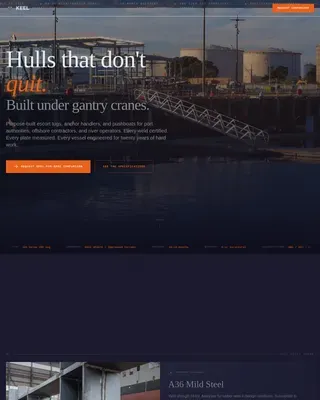
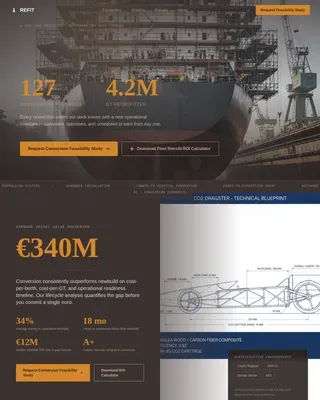
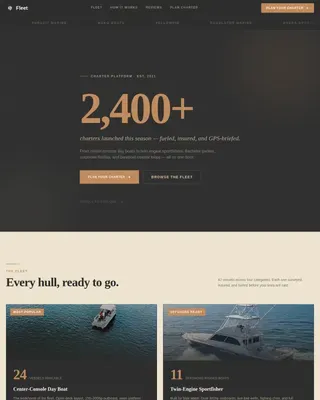
Ship Recycling & Demolition Landing Page Template
Scrap is a single-page landing page template built for ship demolition and recycling yards. It uses a zigzag case study layout to walk fleet managers, maritime lawyers, and compliance officers through the full decommissioning lifecycle. Dark industrial visuals and live data metrics build the credibility needed to convert high-value maritime leads into recycling assessments.
by Rocket studio
Quick summary
Scrap is a lead generation landing page for ship recycling yards targeting fleet managers, maritime lawyers, and protection and indemnity clubs. It uses a zigzag case study narrative with real vessel data, a before-and-after header comparison, and persistent calls to action. Every section moves a serious buyer closer to requesting a recycling assessment.
Who this template is for
This template is built for industrial maritime operators who need to communicate technical credibility to demanding, detail-oriented buyers. The audience does not respond to vague claims. They respond to documented outcomes, auditable data, and proof that the yard can handle the paperwork as confidently as it handles the hull.
- Fleet managers at shipping conglomerates offloading end-of-life tonnage
- Maritime lawyers handling Hong Kong Convention compliance requirements
- Protection and indemnity clubs seeking verifiable green recycling certificates for EU audits
What problem this template solves
Ship recycling is a regulated, liability-heavy process. Yards that fail to communicate compliance rigor, material recovery accuracy, or hazmat handling capability lose contracts to competitors who do. This template solves the credibility gap between what a yard can actually deliver and what a prospective client can verify before signing.
- Buyers cannot easily assess a yard's compliance track record from a generic website
- Fleet managers need vessel-specific data to justify decommissioning decisions internally
- Compliance officers require documented proof of process before adding a yard to an approved shortlist
What you get with this template
You get a fully structured, single-page layout that takes visitors from first impression through multiple proof points and into a qualified lead capture form. The design is ready to populate with your own vessel case studies, recovery metrics, and certificate samples.
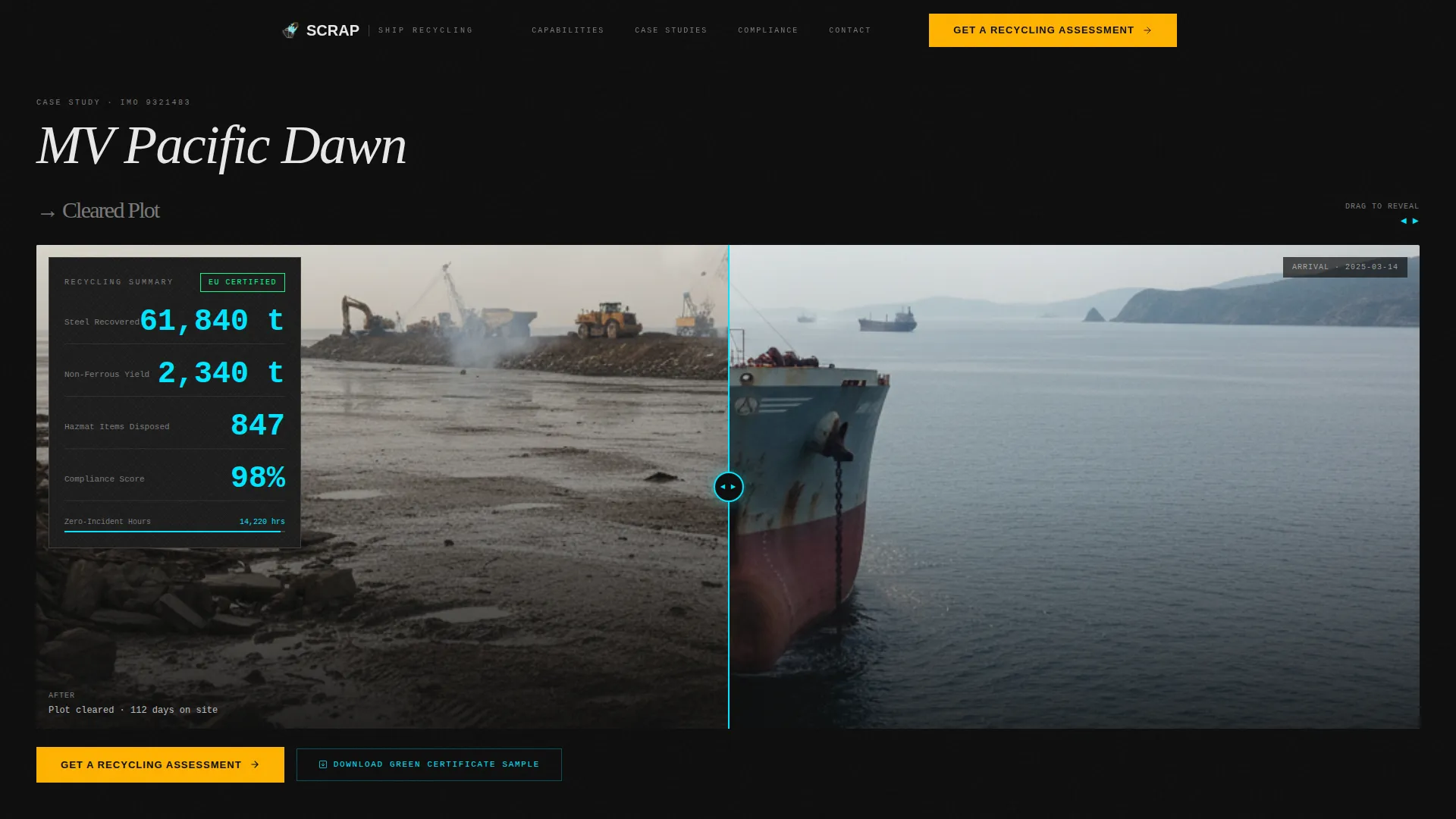
- A draggable before-and-after header comparing a vessel at anchorage with the cleared berth and recovery dashboard
- Zigzag alternating sections, each built around a different vessel class with its own micro-timeline and data table
- Two conversion paths: a recycling assessment slide-in form and a downloadable green recycling certificate sample
Feature list
This template is built around a set of deliberate design and functional choices, each serving the specific needs of the ship demolition and recycling sector.
Draggable Before-and-After Header
The header displays a named vessel with its International Maritime Organization number and gross tonnage visible. A slow horizontal wipe lets visitors drag between the vessel's arrival state and the cleared berth, with animated data counters showing recovered steel tonnage, non-ferrous yields, hazmat disposals, and the total recycling compliance score.
Zigzag Case Study Sections
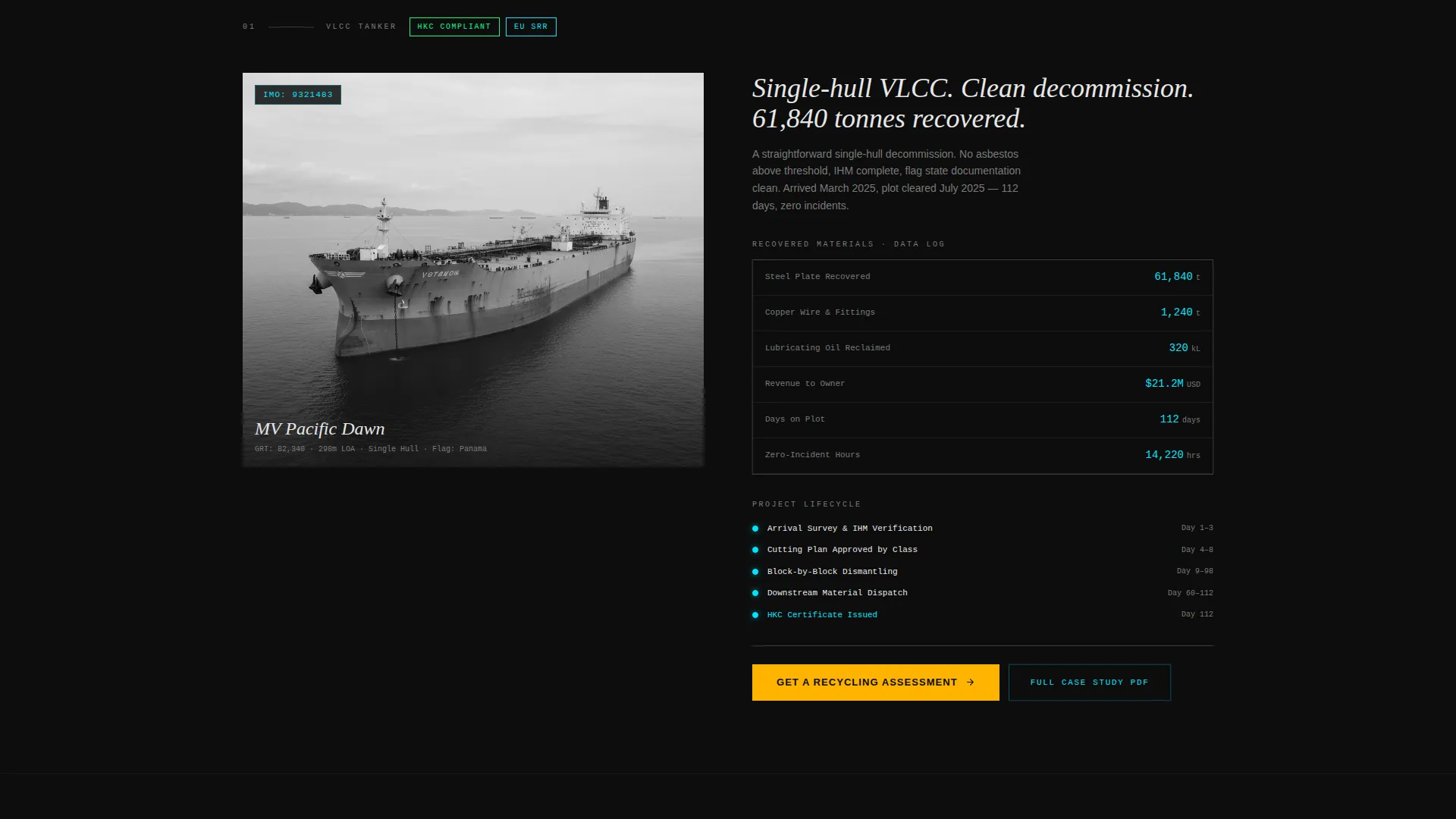
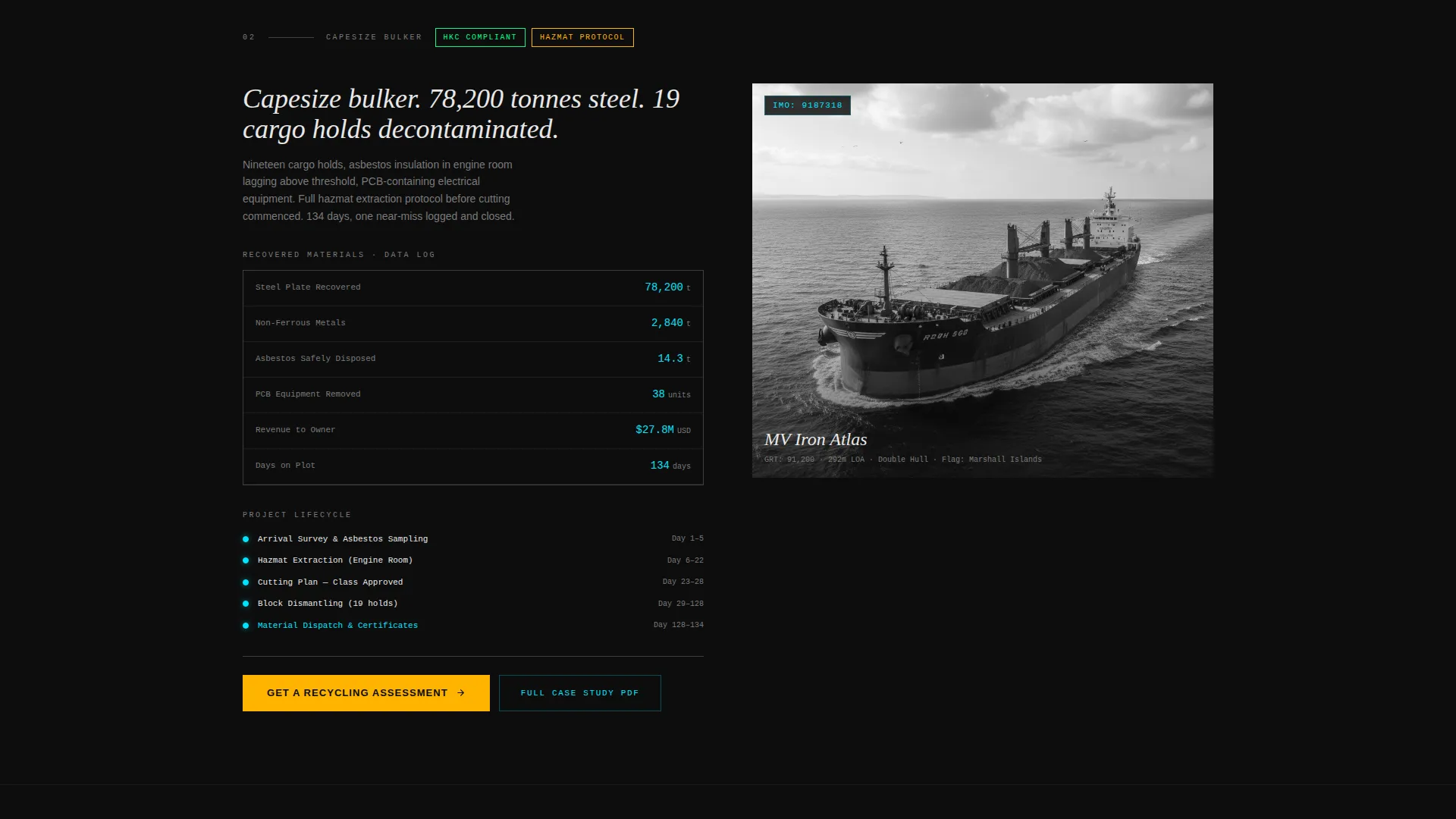
Each alternating section features a different decommissioned vessel class: a single-hull tanker, a Capesize bulker, a container feeder, and an asbestos-laden floating production storage and offloading unit. Sections escalate in complexity. Image-left and data-right panels reverse with every block to sustain visual rhythm while building a credibility arc across the scroll.
Micro-Timeline Per Vessel Block
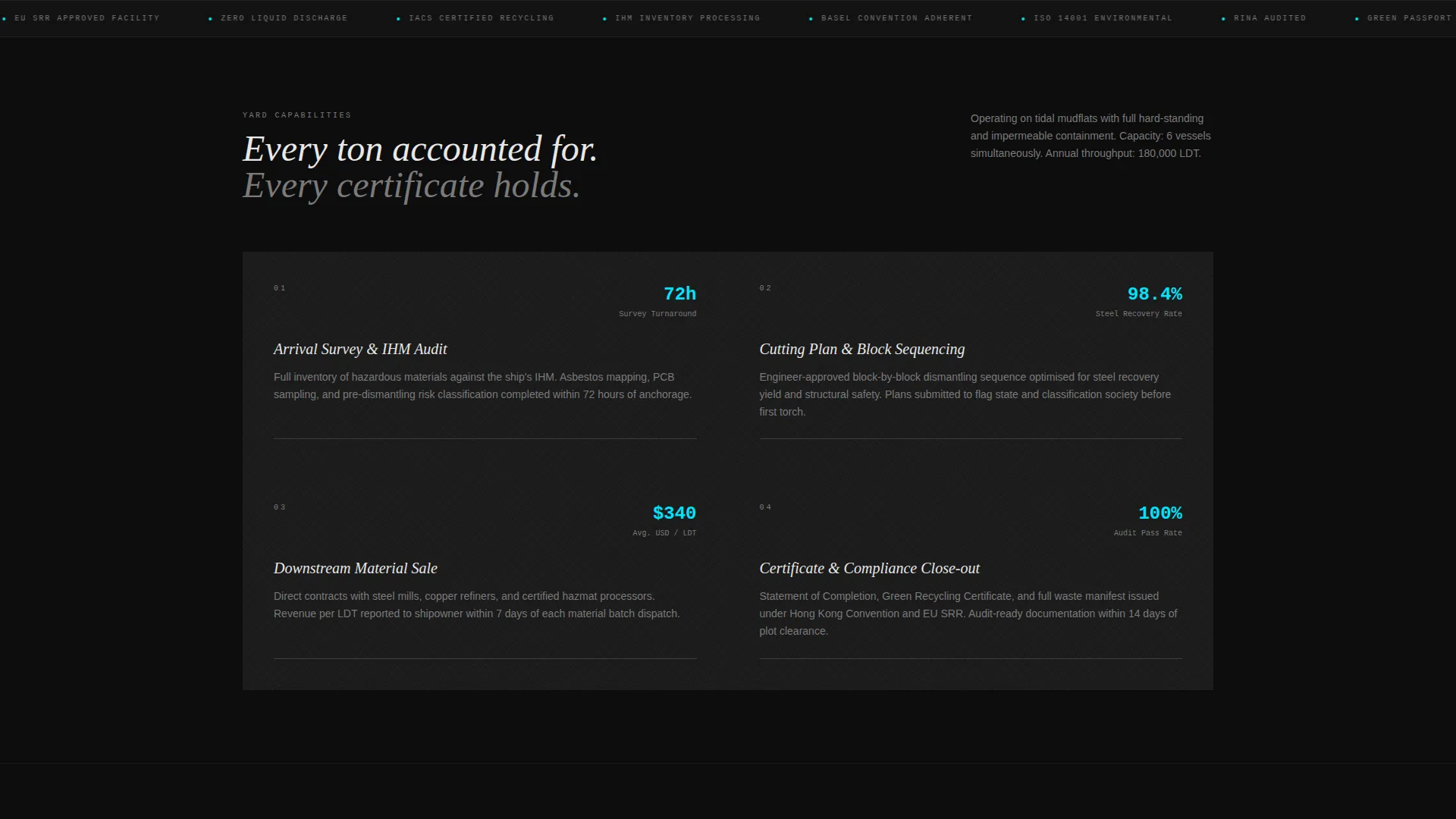
Inside every case study block, a compressed project timeline shows arrival survey, cutting plan approval, block-by-block dismantling, downstream material sale, and certificate issuance. The timeline communicates process discipline and gives compliance-minded buyers a clear view of how each stage is documented.
Live Data Command Metrics
Each vessel block surfaces real-type metrics: light displacement tonnage recovered, revenue per ton, days on plot, and zero-incident hours logged. The Data Command visual language presents these figures in a format that reads like a bridge instrument panel, reinforcing precision and accountability.
Persistent Recycling Assessment Call to Action
A primary call to action button reading "Get a Recycling Assessment" in amber on black is anchored to the bottom of every case study block. It is never more than one scroll away. Clicking it opens a slide-in panel form that starts with the vessel's International Maritime Organization number and auto-populates vessel name and class.
Certificate Download Conversion Path
A secondary conversion path lets compliance officers and lawyers download a green recycling certificate sample by submitting their email. This captures leads from buyers who are building an approved-yard shortlist but are not yet ready to commit a vessel, extending the template's reach into the pre-qualification stage of the sales cycle.
Page sections overview
| Section | Purpose |
|---|---|
| Before/After Header | Show vessel arrival versus cleared berth with animated recovery data |
| Single-Hull Tanker | Open the case study narrative with a clean, straightforward vessel |
| Capesize Bulker Block | Escalate complexity with bulk carrier dismantling data and timeline |
| Container Feeder Block | Demonstrate range across vessel classes and shorter project cycles |
| FPSO Hazmat Block | Prove full hazmat protocol capability on the most complex vessel type |
| Assessment Form Panel | Capture qualified leads via slide-in IMO-first vessel intake form |
| Certificate Download Strip | Convert compliance researchers with a green certificate sample offer |
Design & branding system
The visual identity follows a Data Command theme built on a Carbon Fiber color system. The palette is dark, dense, and deliberately industrial, designed to read like a bridge instrument panel at night where every bright element signals something measurable.
- Base tones: deep hull black (#0D0D0D) and plate-steel charcoal (#2B2B2B) with weave-pattern graphite (#3D3D3D) for layered depth
- Torch-arc cyan (#00E5FF) appears on data points, interactive highlights, and animated counters to direct attention to key metrics
- Safety-marking amber (#FFB300) is reserved exclusively for calls to action and alert states, giving every conversion prompt a consistent, high-visibility signal
Mobile & speed optimization
The template is structured for clear, responsive rendering across screen sizes. The heavy visual content is organized in stacked blocks that adapt naturally to narrower viewports without losing the data-forward layout logic.
- Zigzag alternating columns collapse to single-column stacks on smaller screens, keeping case study content readable and sequential
- The draggable before-and-after header adapts to touch interaction on mobile devices, preserving the interactive reveal experience
- Data tables and micro-timelines are formatted to remain legible on compact screens without horizontal scrolling
How this template helps you convert
Every design and layout decision in this template is aligned to one outcome: turning a skeptical maritime professional into a qualified, form-submitted lead.
- The before-and-after header opens with immediate proof. Visitors see a real vessel quantified into steel tonnage, non-ferrous yields, and a compliance score before they read a single line of copy, establishing trust in the first seconds.
- The escalating case study arc earns deeper scroll. Each vessel block is more complex than the last, rewarding continued reading and demonstrating that the yard can handle whatever a buyer's fleet requires, from a clean tanker to a full hazmat FPSO.
- Two conversion paths match two buyer states. The assessment form captures buyers ready to move a specific vessel, while the certificate download captures compliance officers still building their shortlist, so no qualified visitor leaves empty-handed.
Other information about this template
This template is part of a broader library of marine and maritime templates built for specialized industry niches. It is designed to support operators in the ship demolition and recycling sector who serve international clients and need a professional digital presence that matches the seriousness of the work.
- The template style is zigzag and alternating, making it well-suited for yards that want to present multiple vessel case studies without the page feeling repetitive
- The lead generation direction is intentional: the layout is optimized to capture high-value inquiries from fleet managers and compliance professionals, not general web traffic
- The template can support custom vessel photography, real metric inputs, and certificate documents dropped directly into the pre-built section slots
- It fits within the Marine and Maritime category under the Shipbuilding and Repair subcategory, specifically aligned to the Ship Demolition and Recycling niche
Theme
Data Command
Creative direction
Case Study Narrative
Color system
Carbon Fiber
Style
Zigzag/Alternating
Direction
Lead Generation
Page Sections
Draggable Before-and-after Header
Zigzag Case Study Narrative
Micro-timeline Per Vessel Block
Data Command Metrics Display
Persistent Assessment Call to Action
Certificate Download Conversion Path
Related questions
Who is this landing page template designed for?
Can I use my own vessel case studies and metrics?
What are the two conversion paths included in this template?
Does the template support the vessel IMO number lookup feature?
Is this template suitable for yards that handle hazmat-class vessels?