Tourism Board & Destination Professional Website Template
Archipelago is a data-driven conservation fund landing page built for institutional donors, corporate partners, and diaspora communities. It leads with hard numbers before asking for anything. Every card, chart, and giving tier is mapped to a specific island coordinate, turning abstract conservation goals into accountable, investable outcomes across the world's most vulnerable oceans.
by Rocket studio
Quick summary
Archipelago is a modular card-grid landing page designed for island conservation funds that sell their mission through evidence, not emotion. It presents crisis metrics, funding outcomes, and giving tiers mapped to real island coordinates. The page earns trust before it asks for a contribution, making it the right tool for institutional donors and CSR directors who respond to data.
Who this template is for
This template is built for organizations that need to communicate measurable conservation impact to a discerning audience. It works best when the mission touches islands, oceans, or coastal ecosystems and when the donor base demands accountability over storytelling.
- International development agency directors who need grant allocation proof and published impact data before committing resources
- Corporate social responsibility directors developing measurable environmental partnerships with documented outcomes
- Diaspora communities and regional foundations investing in the long-term health of their home islands
What problem this template solves
Conservation funds serving island nations often struggle to convert institutional interest into actual contributions. The gap is not passion. It is proof. Donors in this group need to see the numbers before they act, and most templates are not built for that kind of rigor.
- Generic fundraising pages rely on emotional imagery that fails with data-oriented donors who need strategy and accountability
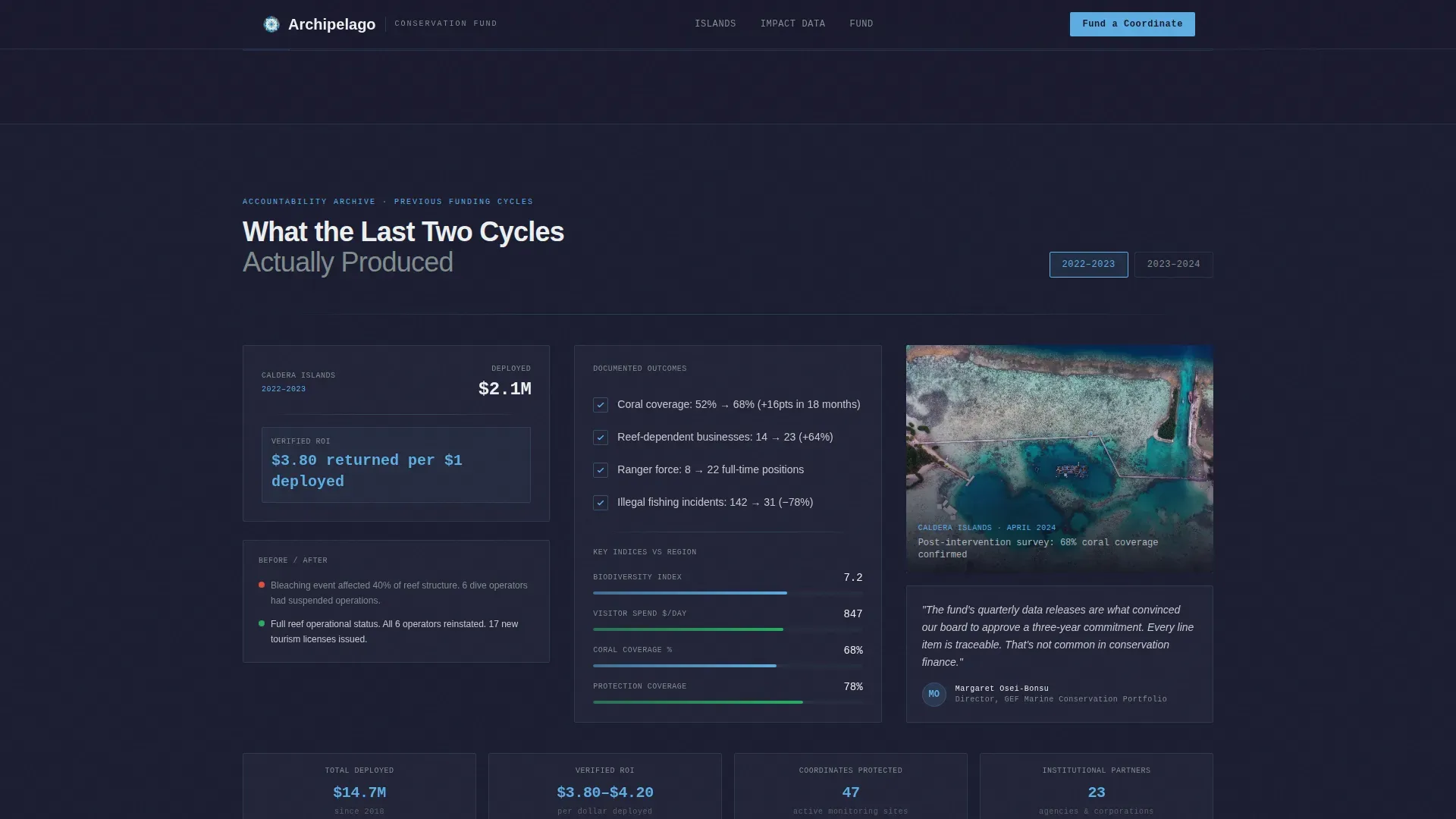
- Crisis urgency gets lost when the page cannot show what previous funding cycles actually achieved
- Giving tiers feel abstract unless they are mapped to specific places and specific outcomes
What you get with this template
You get a full single-page layout structured around evidence-first communication. Every section serves a defined purpose in the donor journey, from first contact with the crisis to final commitment at the giving tier selector.
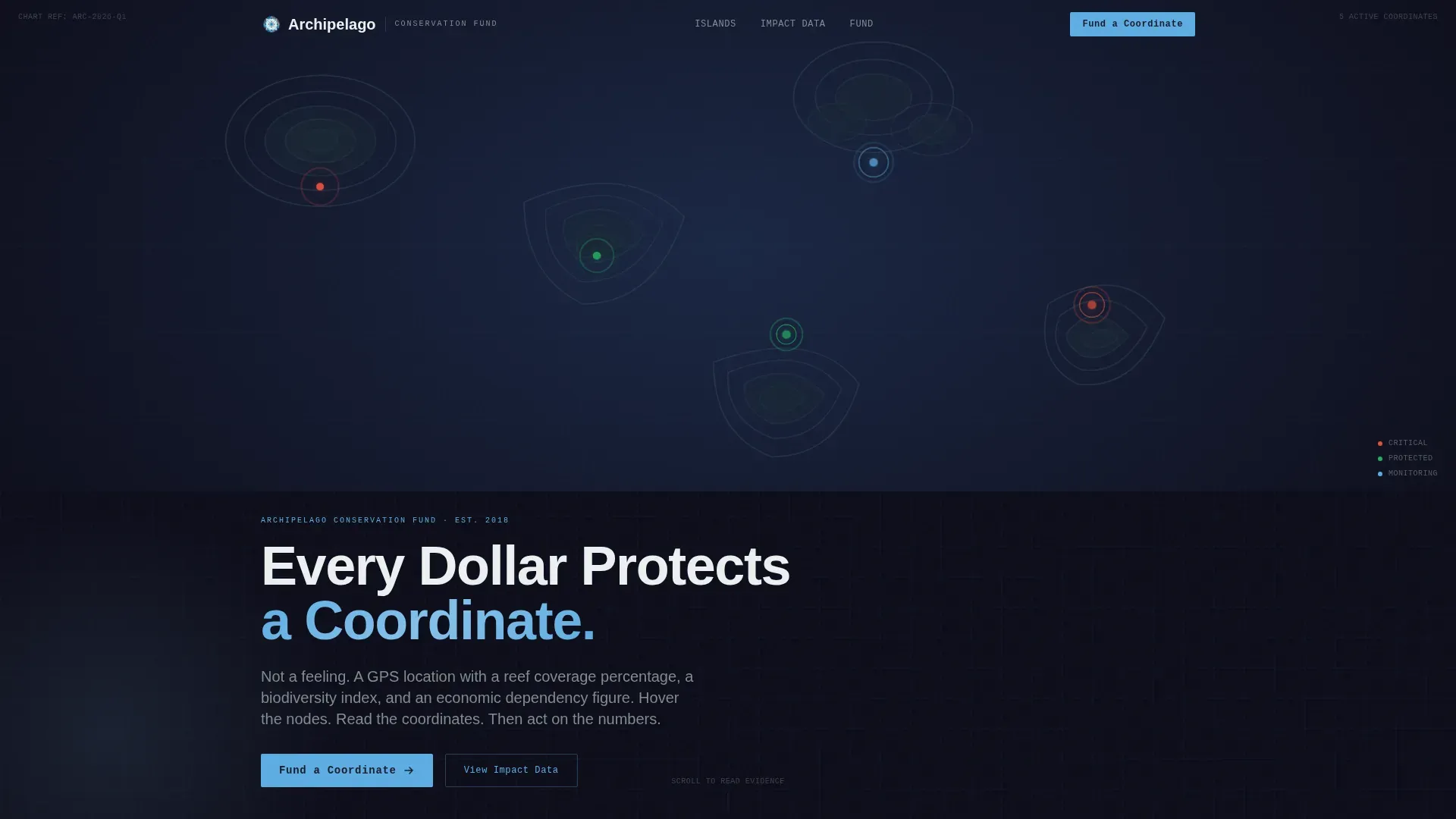
- An interactive topographic hero map with pulsing island nodes and hover metrics showing coral coverage, coastline protection, and visitor economic contribution
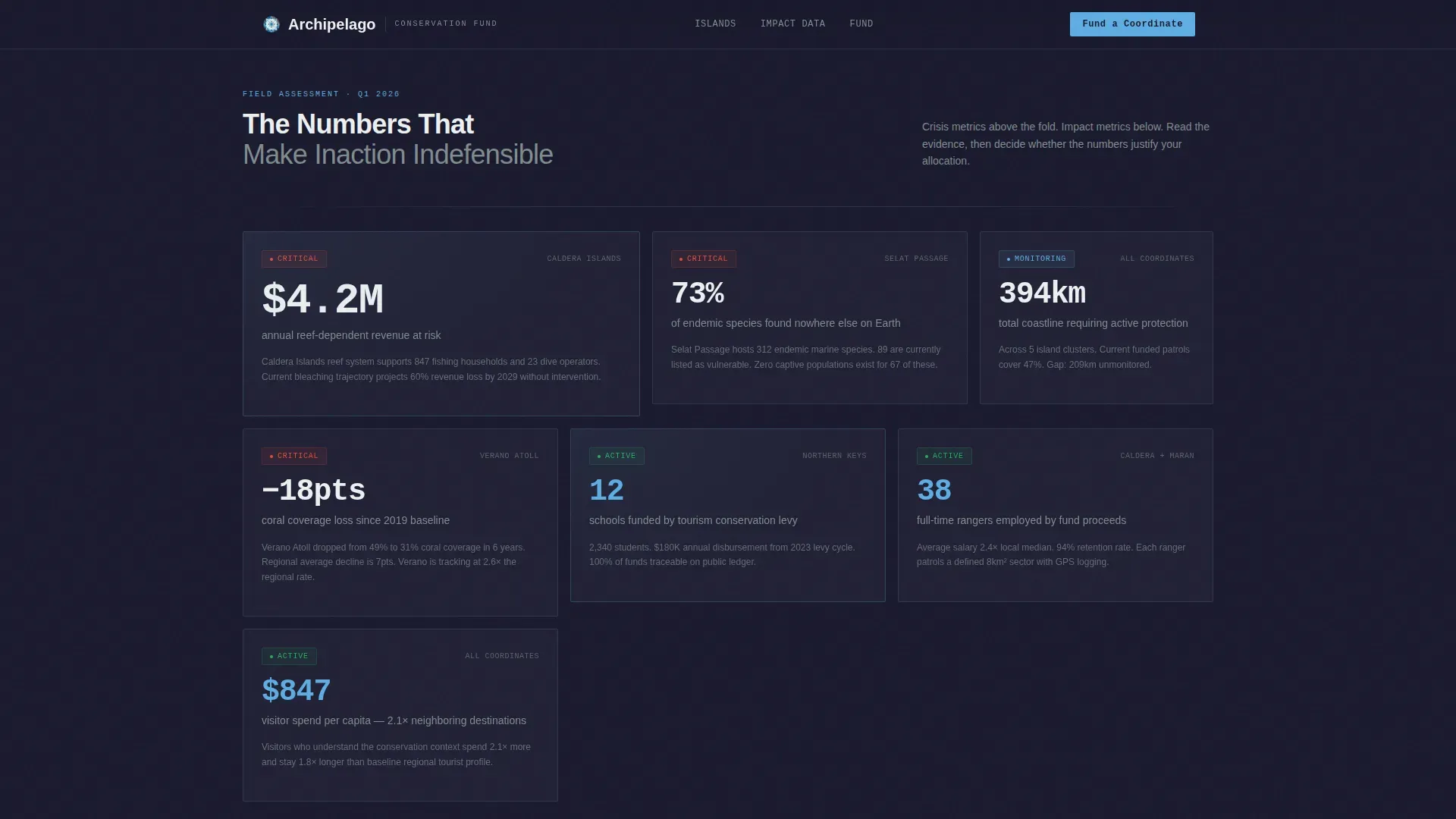
- A bento-style crisis metrics grid where each card leads with a hard number before any explanatory text
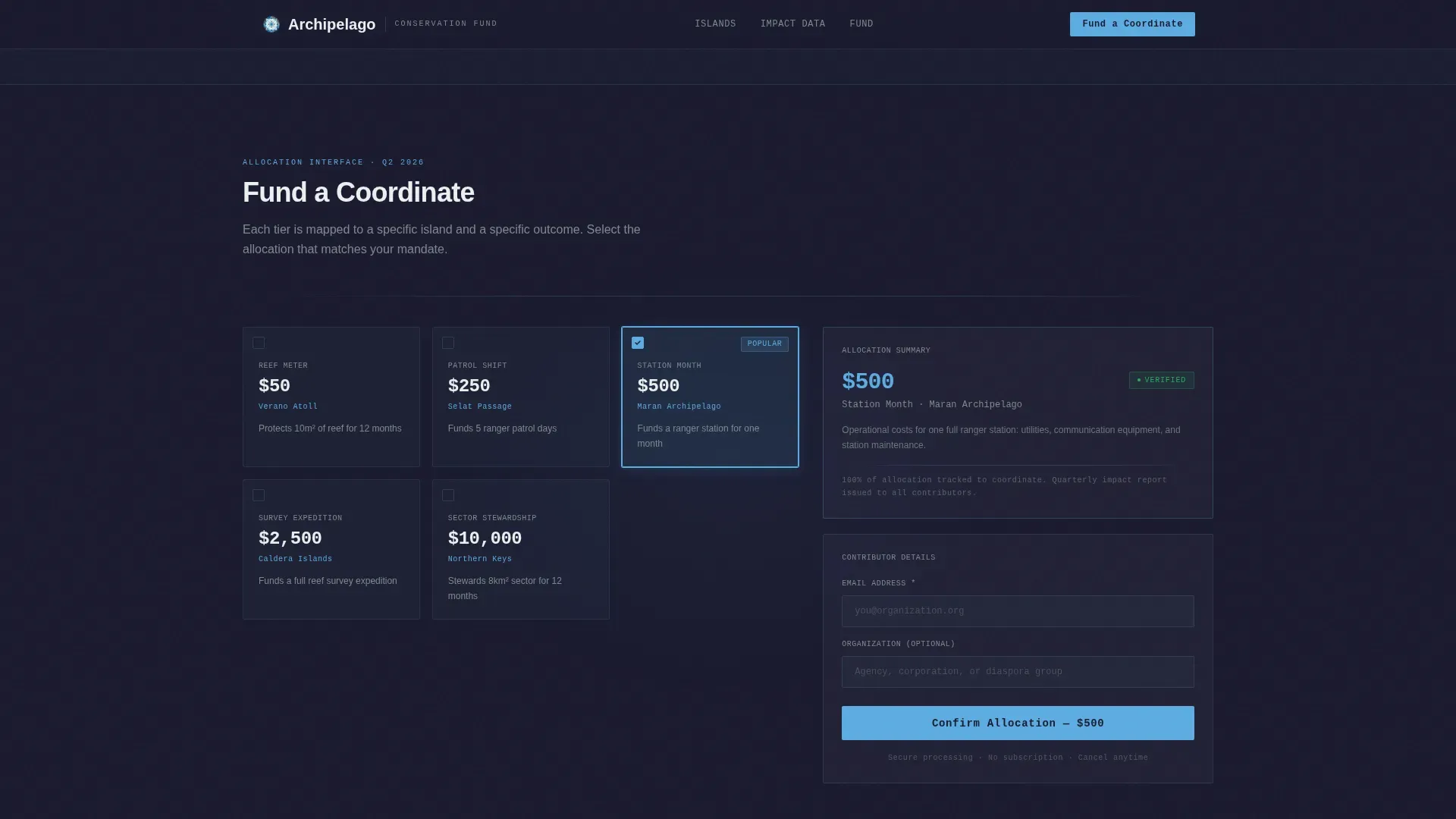
- A structured giving tier selector labeled "Fund a Coordinate," with island-mapped tiers and a secondary impact report download path for institutional donors not yet ready to give
Feature list
This template ships with a focused set of components designed for conversion in a high-stakes, data-dense context.
Interactive SVG Topographic Hero Map
The hero section renders a slate-monochrome topographic map of island clusters. Each island node pulses in cerulean and reveals live hover metrics: coral coverage percentage, kilometers of coastline under active protection, and annual visitor economic contribution. There is no paradise photography here. The map reads like a strategic operations dashboard where every island is a protected asset with quantifiable value, giving institutional donors immediate visual proof of the conservation management framework.
Stats-First Bento Crisis Grid
The crisis metrics grid leads every card with a number. Examples include "$4.2M annual reef revenue at risk" and "73% of endemic species found nowhere else." This Stats-First Impact creative direction ensures donors read the evidence before they encounter the ask. Scrolling down, the cards shift from crisis data to impact data, showing what past funding cycles achieved and building the accountability narrative that develops trust with scientific and policy audiences.
Fund a Coordinate Giving Tier Selector
The giving tier selector maps each contribution level to a specific island and a specific outcome. A $50 tier protects ten square meters of reef. A $500 tier funds a ranger station for one month. This tangible, coordinate-level framing answers the donor's core question: what does my gift actually do? The selector sits above a short form collecting email and optional organizational affiliation, keeping the commitment path as direct as possible.
Impact Report PDF Gate
A secondary conversion path offers institutional donors the option to download a full impact report without committing to a financial gift. This path captures development agency directors and policy stakeholders who need to present documentation to their own group before allocating resources. It keeps the page useful for every stage of the donor decision cycle.
Scroll-Triggered Metric Counters
As donors scroll through the impact proof section, animated stat counters reveal funding cycle outcomes with staggered timing. Each counter is formatted in IBM Plex Mono, reinforcing the data-dense, government-briefing aesthetic. The animation is medium intensity, enough to draw attention to the numbers without distracting from the content.
Single-Row Linear Footer
The footer follows a clean single-row linear pattern that keeps the page focused on its one primary action. There are no competing navigation links or off-topic destinations. The structure supports social media links to help amplify conservation messages while keeping the donor journey intact.
Page sections overview
| Section | Purpose |
|---|---|
| Hero Map | Display island nodes with hover metrics and headline |
| Crisis Metrics Grid | Lead with hard numbers showing what is at risk |
| Impact Proof Section | Show what past funding cycles achieved |
| Giving Tier Selector | Map contributions to specific island outcomes |
| Institutional Call to Action | Offer impact report download for undecided donors |
| Single-Row Footer | Close the page with minimal distraction |
Design & branding system
The visual identity follows a Corporate Precision theme that feels like a government briefing document left open on a desk overlooking the harbor. The palette is authoritative without being cold, and every color choice serves a specific communication purpose.
- Deep maritime slate (#2C3E50) anchors the primary structure, institutional charcoal (#1A1A2E) sets the background, and cloud-break white (#ECF0F1) lifts card surfaces out of the dark field
- Open-water cerulean (#5DADE2) functions as the single accent, cutting through the grays the way the horizon line cuts between sea and sky, used for pulsing map nodes, active tier highlights, and key data callouts
- Typography pairs DM Sans for headers with IBM Plex Mono for all data and number displays, reinforcing the navigational chart aesthetic where every figure reads like a cargo manifest entry
Mobile & speed optimization
Archipelago is designed desktop-first because its primary audience, institutional donors and agency directors, works primarily on desktop devices. A mobile fallback layout is included to ensure the page remains functional and readable across all screen sizes.
- The interactive map and animated stat counters use client-side rendering, while static content blocks use server-side components, supporting faster initial load for the majority of the page
- The card grid reflows cleanly on smaller screens, preserving the Stats-First Impact hierarchy so that numbers still lead on mobile just as they do on desktop
- The giving tier selector and email form collapse into a single-column layout on mobile, keeping the primary call to action reachable without horizontal scrolling
How this template helps you convert
The page earns the click by presenting ROI before requesting it. Every structural decision is in service of one goal: moving a data-oriented donor from informed interest to committed action.
- The hero map creates immediate context by placing every protected island coordinate in a visual field the donor can read and explore, establishing that this is a managed, measurable program and not a general appeal to nature conservation sentiment
- The crisis-to-impact card narrative builds a logical case: here is what is at risk, here is what past investment achieved, here is exactly what your contribution will protect, with the giving tier selector closing the argument at the coordinate level
- The dual conversion path, primary gift and secondary report download, ensures the page captures donors at every stage of the institutional decision cycle, from first contact to final approval
Other information about this template
This template draws on conservation communication principles relevant to organizations working across island nations and the broader pacific region. The design and content structure reflect the real challenges facing communities, scientists, and governments developing solutions for oceans under pressure from climate change.
- Islands are home to 20% of global biodiversity, and half of all threatened species depend on healthy island ecosystems. The urgency this page communicates is grounded in that reality.
- The pacific islands produce only 1.04% of global greenhouse gas emissions but are among the most negatively affected by climate change, making climate resilience strategy a core part of any credible conservation fund communication.
- Restoring ecosystems on islands, including removing invasive species such as invasive rats that devastate seabird and native wildlife populations, can help native species recover rapidly when the right resources and management are in place.
- Invasive species pose one of the most significant threats to island biodiversity. Removing them is a critical step in protecting the livelihoods of local communities who depend on healthy fisheries and productive land.
- Restored island forests can lock away tens of millions of metric tons of carbon, making island conservation a direct contribution to global climate resilience and carbon capture strategy.
- Islands play a critical role in capturing blue carbon from coastal and marine ecosystems. This makes them essential partners in any regional or international climate framework.
- Climate change is driving sea-level rise and warming waters that are degrading coral reefs, altering fisheries, and threatening the food security of indigenous people and local farmers across the pacific.
- Community-led conservation initiatives are essential for restoring ecosystems and creating green livelihoods. Engaging local communities produces better outcomes for wildlife, fisheries, and long-term development.
- The template supports recurring donation options, which are important for sustained conservation work. Donors can be offered monthly giving tiers in addition to one-time contributions.
- Collaborative efforts between conservation organizations, local communities, and stakeholders produce the most durable outcomes. This page is built to present that collaboration as a credible investment case.
- Wildlife foundation partners, organizations aligned with the nature conservancy model, national fish and wildlife programs, and department-level government agencies are all natural institutional members of the donor group this page is designed to reach.
- Programs modeled on frameworks developed in New Zealand, France, and across the pacific have demonstrated that islands can recover rapidly when invasive species are removed and marine species habitats are protected.
- Scientists and published research increasingly confirm that community involvement, innovative drone-based mapping, and environmental DNA tools are developing solutions that make conservation more efficient and accountable.
- This is the archipelago strategic island conservation fund landing page template, purpose-built for conservation organizations that need to present data-dense, coordinate-level accountability to institutional donors.
Theme
Corporate Precision
Creative direction
Stats-First Impact
Color system
Slate & Sky
Style
Card Grid (Modular)
Direction
Donation/Fundraising
Page Sections
Interactive Topographic Hero Map
Stats-first Crisis and Impact Card Grid
Fund a Coordinate Giving Tier Selector
Impact Report PDF Gate
Scroll-triggered Animated Metric Counters
Related questions
Who is this template designed for?
Can I customize the giving tier amounts and island assignments?
Does the template include the interactive map functionality?
Is there a conversion path for donors who are not ready to give immediately?
What do I need to customize before launching the page?