Indigenous-Owned Business Privacy Policy & Terms Website Template
Sovereign is a gallery and detail landing page template built for Indigenous-owned tech startups selling privacy-first digital infrastructure. It opens with price-anchored product cards, guides visitors through engineering stories and sovereignty metrics, and closes with an inline checkout. The Neo-Retro Cloud Canvas palette and beadwork-inspired animations give it a presence that feels ancient and precise at once.
by Rocket studio
Quick summary
Sovereign is a single-page gallery and detail landing page template designed for an Indigenous-owned software collective. It sells encrypted messaging, sovereign cloud storage, and digital governance tools to tribal councils, Indigenous nonprofits, and reservation school districts. The layout shows pricing first, builds trust through engineering stories and live sovereignty metrics, then converts visitors through a streamlined inline checkout.
Who this template is for
This template was built for a very specific kind of operator. It serves Indigenous-led software companies whose core value is data sovereignty and whose clients expect cultural accountability alongside technical performance. If your organization exists to return control of data and digital infrastructure to tribal communities, this template was shaped around your mission.
- Tribal council IT administrators and records managers who need to evaluate tools quickly and justify costs to leadership
- Indigenous nonprofit operations directors seeking to move off rented big tech infrastructure and onto community-owned systems
- Reservation school districts and educational institutions that require tools aligned with their jurisdictional reality and privacy obligations
What problem this template solves
Most technology landing pages are built for Silicon Valley companies selling to enterprise buyers. They assume a shared worldview about who owns data, where it lives, and which governments have authority over it. That assumption fails Indigenous organizations entirely. Tribal nations operate under distinct legal frameworks. Their data governance responsibilities are not adequately served by generic software-as-a-service platforms built for commercial markets and optimized for majority-culture compliance models.
The result is a trust gap. When a tribal council visits a standard SaaS landing page, they see no acknowledgment of sovereignty, no assurance that data stays on tribal land, and no engineers who share their context. Conversion fails not because the price is wrong but because the page never earns the right to ask for a purchase. This template is built to close that gap by leading with price transparency, earning trust through authentic engineering stories, and guiding buyers through a culturally grounded checkout experience.
- Tribal buyers see generic tech pages that ignore data sovereignty, jurisdictional complexity, and community accountability
- Indigenous nonprofits and school districts have no reliable visual language for evaluating whether a software product truly respects their data governance frameworks
- Standard checkout flows ask for irrelevant business information and never acknowledge the nation or community context of the buyer
What you get with this template
You get a complete, production-ready gallery and detail landing page structured specifically for Indigenous-owned technology products. Every section is pre-built and sequenced to move a skeptical tribal buyer from first glance to confident purchase. The template includes interactive product cards, an engineering story section, a sovereignty metrics display, audio-driven testimonials, and a two-path inline checkout. You do not need to retrofit a generic template. Everything here was designed for this use case from the ground up.
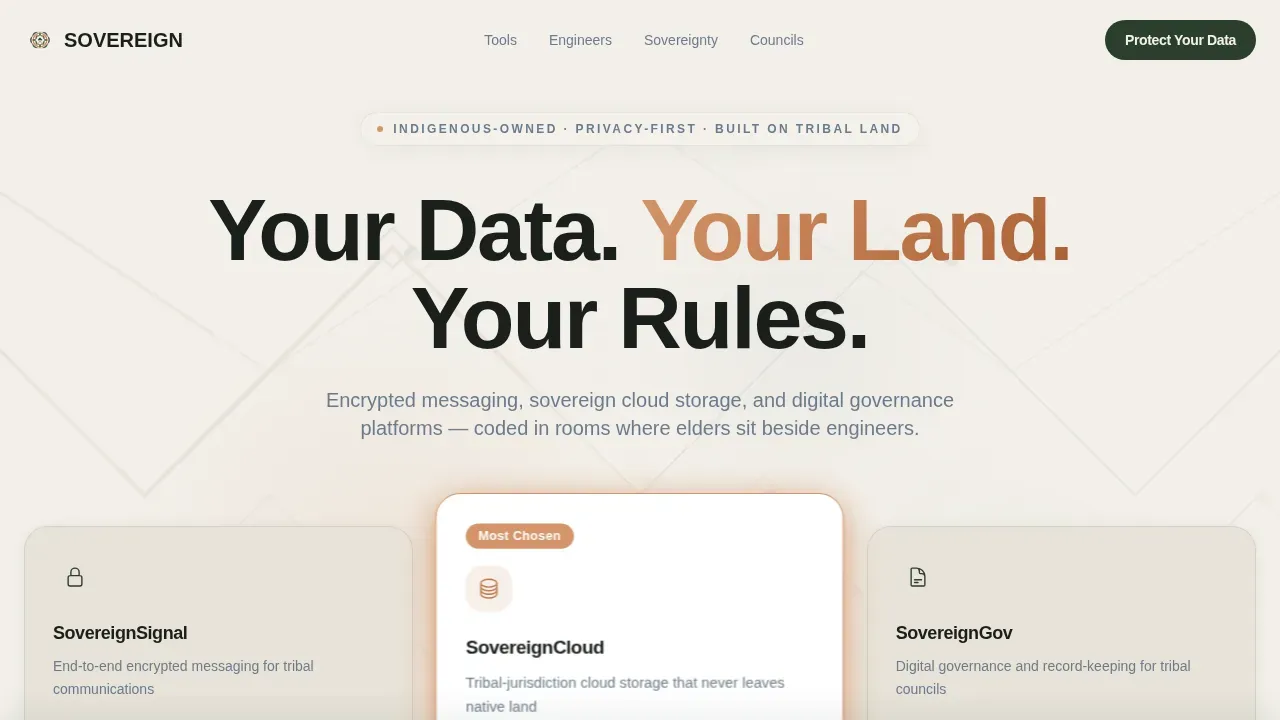
- A price-anchored hero with three product cards, a beadwork SVG animation, and the headline "Your Data. Your Land. Your Rules."
- An inline checkout modal supporting plan-remembered selection, tribal or organization name, admin email, and payment, plus a secondary "Request a Tribal Demo" path requiring only name, nation, and role
- A sticky bottom call-to-action bar that appears after the visitor scrolls past the first detail section and persists until checkout is complete
Feature list
The feature list below describes each major interactive and structural capability built into the Sovereign template. Every item comes directly from the project brief and represents a real, deliverable component.
Price-Anchored Hero with Beadwork Animation
The hero opens above the fold with three product cards already visible. Each card shows a tool name, a single-line description, and a monthly price in large deep juniper numerals. The most popular plan is scaled 20 percent larger and bordered in mesa clay to draw the eye without aggressive visual noise. Behind the cards, a looping SVG animation traces data packets along geometric paths inspired by traditional beadwork, where each node in the pattern represents an actual encryption handoff, not purely decorative motion.
Engineer Card-Flip Storytelling Section
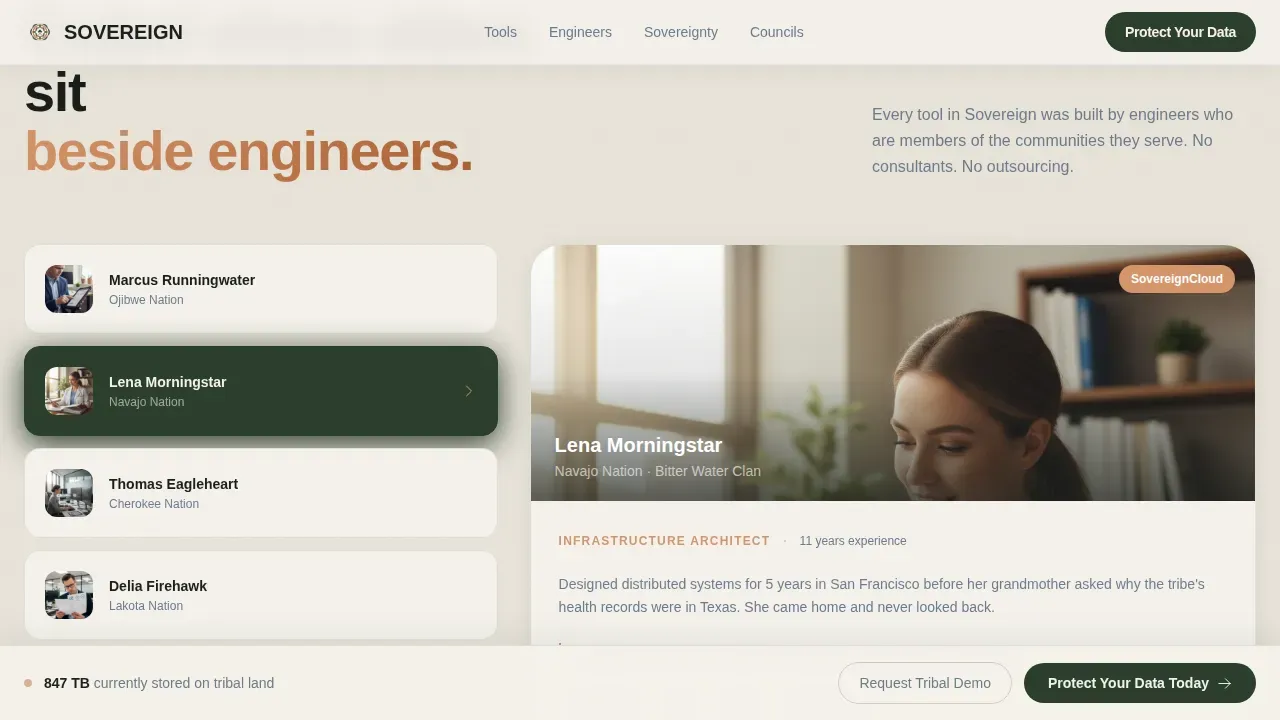
Hovering a product card flips it to reveal a short video of the engineer who built that tool. The engineer introduces themselves by nation and clan, grounding the product in human accountability. This section transforms a standard feature grid into a trust-building moment. It makes the invisible visible: the people behind the code, their communities, and the context they brought to the work.
Sovereignty Metrics Display
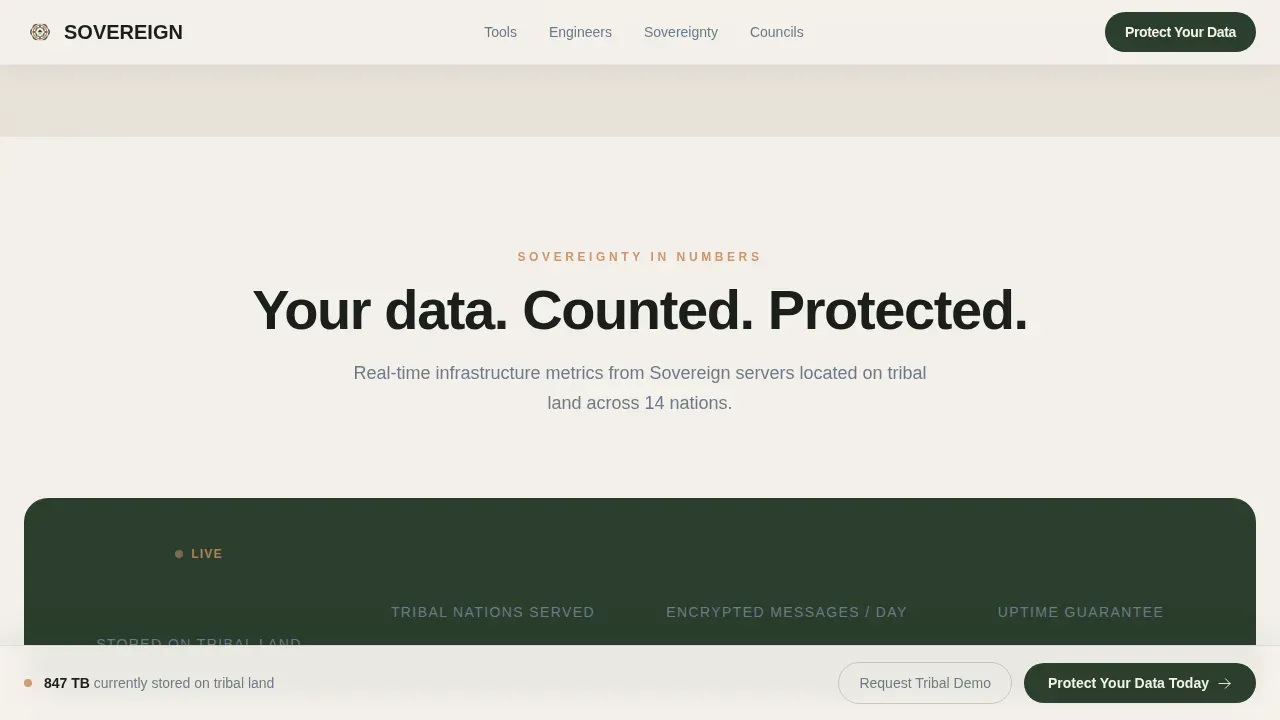
As visitors scroll into the detail sections, three live data points assemble on screen. A counter shows terabytes of data currently stored on tribal land. An encryption statistics panel updates to reflect current system activity. A sovereignty shield icon builds piece by piece as the reader moves down the page, rewarding attention with visual progress. These elements are not decorative. They give tribal IT administrators real numbers to reference in procurement conversations.
Audio Testimonials from Council Members
The testimonial section plays short audio clips from named council members describing specific outcomes. Clips auto-play in warm, brief bursts as the visitor reaches each testimonial card. This format respects the oral tradition of many Indigenous communities and avoids reducing real governance stories to pull-quote text. Each testimonial is tied to a named individual and a specific result, not a vague endorsement.
Two-Path Inline Checkout
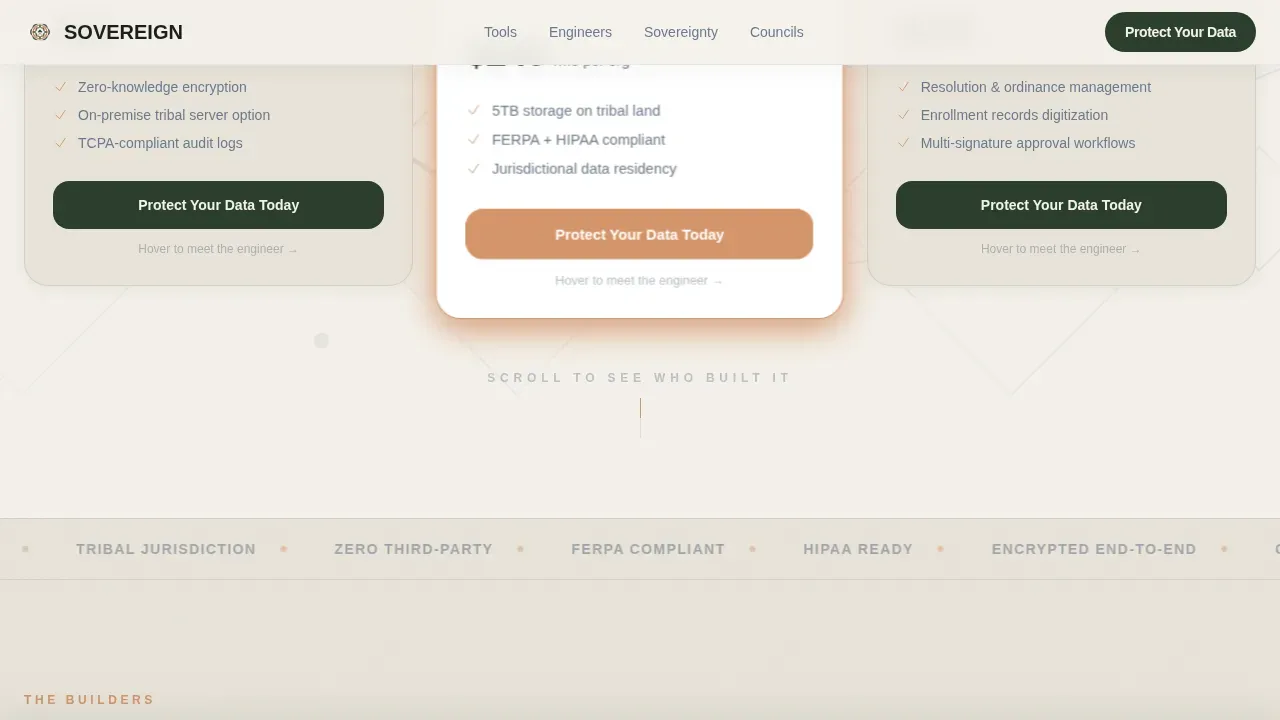
The primary conversion path is a direct purchase flow. Clicking "Protect Your Data Today" from any product card or the sticky bar opens an inline modal. Plan selection is pre-remembered from the card the visitor tapped. The form collects tribe or organization name, admin email, and payment. The secondary path, "Request a Tribal Demo," asks only for name, nation, and role, minimizing friction for councils that need group buy-in before committing. Both paths use active opt-in consent and collect only necessary information, consistent with Indigenous data sovereignty principles.
Sticky Call-to-Action Bar
After the visitor scrolls past the first detail section, a sticky bottom bar appears carrying the "Protect Your Data Today" call to action. It stays visible as the visitor reads engineering stories, reviews sovereignty metrics, and listens to testimonials. It disappears only when the checkout modal is open. This approach keeps the conversion path accessible without interrupting the trust-building scroll.
Page sections overview
| Section | Purpose |
|---|---|
| Hero, Price Cards | Show three products with prices and the headline above the fold |
| Beadwork Animation | Visualize encryption handoffs through traditional geometric motion |
| Engineering Stories | Flip cards reveal engineers by nation and clan with intro videos |
| Sovereignty Metrics | Live TB counter, encryption stats, and assembling shield icon |
| Council Testimonials | Audio clips from named council members describing real outcomes |
| Inline Checkout Modal | Plan-remembered purchase flow with tribal org name and payment |
| Tribal Demo Request | Secondary path collecting name, nation, and role only |
| Sticky call to action Bar | Persistent purchase prompt appearing after first detail scroll |
| Footer | Linear single-row pattern with privacy policy, terms, and data agreement links |
Design & branding system
Sovereign uses a Neo-Retro visual identity built on the Cloud Canvas color system. The palette was chosen to feel like a Polaroid taken in high desert: warm where the sunlight hits the clay, cool in the juniper shadows, the paper itself slightly cream with age. Typography is set in DM Sans, a rounded geometric sans-serif at weights 400 and 700. The letterforms nod to 1970s Indigenous activism posters without mimicking or appropriating them. Every visual decision prioritizes cultural weight over corporate polish.
- Color system: bone-white (#F4F1EB) for backgrounds, storm-approaching gray (#6B7B8D) for body text, sunlit mesa clay (#D4956A) for hover states and pricing highlights, deep juniper (#2C3E2D) for navigation and primary buttons
- Typography: DM Sans rounded geometric, regular weight 400 for body copy and bold weight 700 for headlines and pricing numerals
- Animation language: GSAP-powered card entrances, ScrollTrigger reveals, GPU-accelerated card flip, beadwork SVG path animation, cursor parallax, and sovereignty shield assembly on scroll
Mobile & speed optimization
The template is built desktop-first with full mobile responsiveness, acknowledging that council administrators frequently review procurement materials on tablets. The layout reflows cleanly across breakpoints. Interactive elements scale to touch targets without losing the visual hierarchy that makes pricing and engineering stories legible on smaller screens.
- GSAP ScrollTrigger powers section reveals so animations activate only when content enters the viewport, keeping the experience smooth on mid-range devices
- CSS native smooth scroll handles page-level navigation without additional JavaScript overhead, and GPU-accelerated transforms keep card-flip and parallax interactions fluid across devices
How this template helps you convert
The conversion strategy built into Sovereign is specific and intentional. It does not follow a standard SaaS template pattern. It follows the logic of earning a purchase from a buyer who has legitimate reasons to be skeptical of technology companies.
- Price is shown first, above the fold, so tribal buyers can immediately assess whether the investment is realistic. The justification for that price comes after, through engineering stories and sovereignty metrics, so that by the time visitors reach checkout, the number they saw feels modest against the value they now understand.
- The two-path checkout removes the binary between "buy now" and "disappear." Councils that need internal approval can request a tribal demo with minimal form fields, keeping them in the pipeline without pressure.
- The sticky call-to-action bar keeps the primary conversion action visible throughout the trust-building scroll. It appears after commitment, not before, so it feels like a natural next step rather than an aggressive interrupt.
Other information about this template
The Sovereign template was designed in direct response to a real and growing movement. Indigenous communities across the world are building their own frameworks to ensure emerging technologies serve their people rather than extract from them. The development of this template reflects that shift.
In the broader context of global data governance, nations and organizations everywhere are reconsidering who controls digital infrastructure. Countries are investing in infrastructure for computational and data centers to support the development of sovereign models, including sovereign large language models, or LLMs, that can be tailored to local contexts while ensuring data privacy and national security. National LLMs have demonstrated that they can outperform global models on localized benchmarks, providing enhanced data protection and safeguarding national security interests. Sovereign LLMs can also support open source intelligence analysis and enhance administrative efficiency across sectors including healthcare and public services.
This template sits inside that larger wave of technological innovation. Governments around the world are establishing regulatory frameworks for AI oversight, auditing artificial intelligence applications, and ensuring compliance with ethical standards. Investment in artificial intelligence development at the national level now includes significant financial commitments from both governments and private sectors. Countries are focusing on strategic autonomy in AI development to reduce reliance on foreign technologies. The parallels to what Indigenous communities have been saying for decades about data, land, and self-determination are not incidental.
The template is designed to support the full CARE framework for data governance: Collective Benefit, Authority to Control, Responsibility, and Ethics. It also aligns with OCAP principles, meaning Ownership, Control, Access, and Possession, which are the foundation of Indigenous data stewardship as practiced by communities across North America and beyond.
A significant portion of the world's Indigenous communities are already engaged in this work. The Indigenous Digital Sovereignty Initiative in Canada seeks to give First Nations control over data infrastructure and governance. The Maori Data Sovereignty Network in New Zealand asserts that data about Maori people should be subject to Maori governance. Across many parts of the world, tribal and First Nations governments are arriving at the same conclusion: the future of artificial intelligence must be shaped by the communities it affects, not imposed upon them.
The Cherokee Nation offers one of the clearest examples of this approach. The Cherokee Nation emphasizes that AI must serve the collective good and uphold cultural values. Their approach to AI governance is rooted in cultural preservation and data sovereignty. AI initiatives in the Cherokee Nation aim to strengthen citizen trust and reinforce tribal governance authority. The Gadugi Portal uses AI to provide authenticated access to tribal services, improving efficiency without reducing staffing, a model that demonstrates how technology aligned with community values can expand capability without displacing people. The Cherokee Nation is also using AI-driven scanning to replicate cultural artifacts traditionally used in ceremonies, promoting cultural preservation through technological innovation.
The broader investment world has taken notice of sovereign infrastructure at scale. The Adani Group announced a USD 100 billion investment to develop renewable-energy-powered, hyperscale AI-ready data centers in India by 2035, an initiative aimed at positioning India as a global leader in the emerging Intelligence Revolution. The Adani investment is expected to catalyze an additional USD 150 billion across server manufacturing and sovereign cloud platforms, creating a USD 250 billion AI infrastructure ecosystem over the decade. The Adani Group plans to create the world's largest integrated data center platform, combining renewable power generation and high performance computing at scale. Their investment strategy includes partnerships with major tech companies like Google and Microsoft to establish large-scale AI data center campuses. As Gautam Adani, Chairman of the Adani Group, has stated, nations that master the symmetry between energy and compute will shape the next decade.
That same principle applies at the tribal scale. The communities this template serves are not waiting for governments or big tech to solve data sovereignty. They are building the infrastructure themselves, and this template is the front door to that system.
Policy development in this space is accelerating. The European Union has established regulatory frameworks that require data to be processed within member state borders. South Korea has invested heavily in national AI infrastructure and sovereign compute capacity. South Korea's approach reflects a broader country-level strategy to develop AI models aligned with national language, culture, and governance structures. Across the globe, the evolution of AI governance is increasingly moving toward frameworks grounded in cultural and jurisdictional specificity. AI governance frameworks grounded in culture may be more effective than those based solely on top-down regulation, a view that aligns directly with the design philosophy behind Sovereign.
This template is relevant to any Indigenous-owned technology startup that wants to present its work with precision, cultural honesty, and commercial confidence. It does not ask buyers to choose between sovereignty and usability. It demonstrates that both are possible in the same product, the same page, and the same purchase flow.
- The footer includes visible links to Privacy Policy, Terms of Service, and a Data Processing Agreement, consistent with transparent data governance practices
- The checkout form uses active opt-in consent for data collection, never pre-ticked boxes, keeping every interaction aligned with Indigenous data sovereignty principles
- The template explicitly positions the startup as Indigenous-led, with engineer credentials displayed by nation and clan throughout the engineering stories section
- Generative AI tools are reshaping how communities think about language preservation and record-keeping; this template can support organizations at the intersection of generative AI and tribal governance
- As generative AI models become more capable, Indigenous communities that have invested in their own infrastructure will be better positioned to deploy AI systems aligned with their values rather than outsourcing to companies whose training data and development priorities reflect different cultural assumptions
- Research into emerging technologies consistently shows that communities with strong data governance frameworks are better positioned to benefit from new technologies without losing autonomy
- The template supports tax-exempt nonprofit purchasing workflows through the demo request path, which collects role and organization information that administrators need for internal approvals
- Software built for tribal sovereignty requires a sales process that respects the pace and decision-making structures of council governance; the dual-path checkout was designed specifically for that reality
Theme
Neo-Retro
Creative direction
Surprise & Delight
Color system
Cloud Canvas
Style
Gallery + Detail
Direction
Direct Sales
Page Sections
Price-anchored Hero with Beadwork Animation
Engineer Card-flip with Nation and Clan Identity
Live Sovereignty Metrics Display
Audio Testimonials From Named Council Members
Two-path Inline Checkout Modal
Sticky Call-to-action Bar with Scroll Trigger
Related questions
Who is this landing page template built for?
Does the template support two different buyer paths?
What makes this template different from a standard SaaS landing page?
Can this template support an organization focused on cultural preservation alongside technology?
Is this template suited for organizations building AI-aligned governance tools?