Advanced Retiree Insurance Professional Website Template
Shield is a sidebar companion landing page template built for retiree critical illness insurance. It uses an Executive Suite visual identity, an Industry Report content cadence, and a five-step diagnostic quiz to convert recently retired executives and small-business owners into leads. The template surfaces Medicare coverage gaps with calm authority and moves visitors toward a gated personalized gap analysis.
by Rocket studio
Quick summary
Shield is a single-page, sidebar companion template designed for retiree critical illness insurance agencies. It opens with a giant centered headline, guides visitors through authoritative data sections at an Industry Report pace, and closes with a five-question diagnostic quiz. The result is a landing page that earns trust before it asks for a name.
Who this template is for
This template serves insurance professionals who need a sophisticated, high-trust landing page aimed at retirement-age clients. It is built for agents, brokers, and boutique financial advisory firms working in the retiree critical illness insurance space.
- Recently retired executives and former small-business owners aged 62 to 72, living on fixed portfolio income and concerned about healthcare liquidity gaps
- Adult children aged 40 to 55 who are quietly researching critical illness cover options for aging parents
- Insurance professionals who need a polished, authority-driven tool to start conversations about critical illness insurance plans with high-net-worth retirees
What problem this template solves
Standard health insurance plans do a reasonable job covering hospitalisation expenses. They do not cover everything. When a serious illness lands, the financial gap between what a health insurance policy pays and what treatment actually costs can be enormous. Retirees on fixed portfolios feel that gap most acutely.
- Critical illness insurance cover addresses costs that fall outside a standard health plan, including non medical expenses such as travel to specialists, household expenses during recovery, and lost income that disrupts other financial commitments
- Executives often seek clear explanations of how a critical illness insurance policy fills the specific gaps left by Medicare and disability coverage, and this template is structured exactly around that explanation
- The quiz-led flow surfaces each visitor's personal coverage gap, turning an abstract problem into a concrete number that motivates action
What you get with this template
Shield delivers a complete, ready-to-customize landing page built around one conversion goal: moving a retiree from awareness to a personalized gap analysis. Every section is purposeful and prompt-backed.
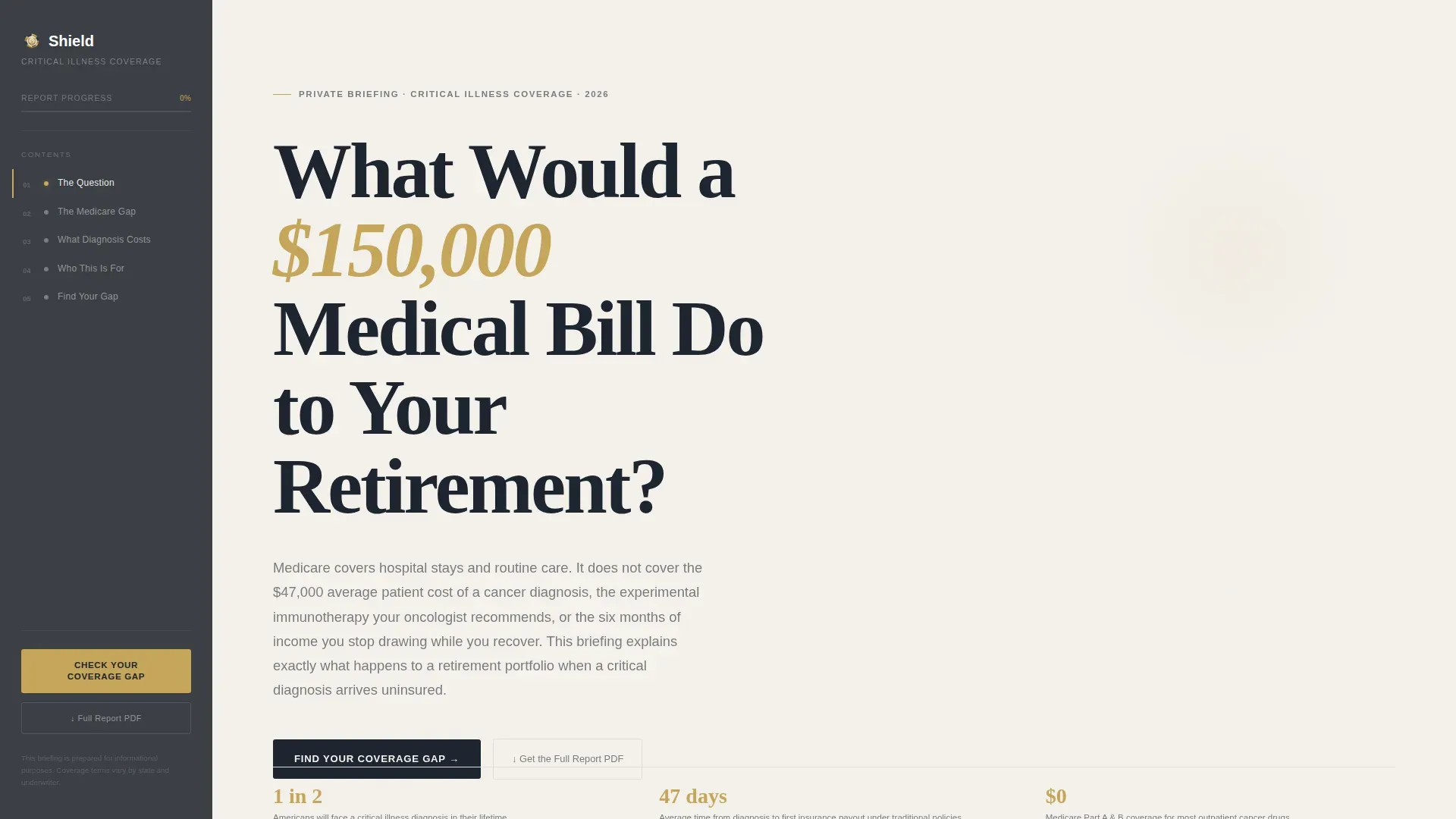
- A hero section with a giant centered headline, a fixed charcoal sidebar that tracks reading progress, and a gold-accented "Find Your Coverage Gap" call-to-action button that pulses at every scroll pause
- Four content sections covering the Medicare gap, real diagnosis costs for conditions such as cancer, stroke, heart attack, and kidney failure, and audience profile cards for exec retirees, small-business owners, and adult children
- A five-step diagnostic quiz with a gold progress bar, one question at a time, and gated results requiring an email and phone field positioned as "Where should we send your personalized gap analysis?"
Feature list
This section describes the specific built-in capabilities delivered inside the Shield template.
Giant Centered Headline Hero
The hero presents a single stark question in deep slate display type on a cloud canvas white field. The dollar figure renders in muted gold. There is no stock photography and no competing visual noise. The question lands the way a hospital invoice lands: alone on the page, impossible to soften.
Fixed Sidebar with Scroll-Linked Progress
A persistent charcoal sidebar tracks the visitor's position through the report like a table of contents in a private briefing. As the reader scrolls, the sidebar updates in real time. A "Check Your Coverage Gap" button pulses with muted gold at every scroll pause, maintaining a single dominant call-to-action that guides attention without distraction.
Industry Report Content Cadence
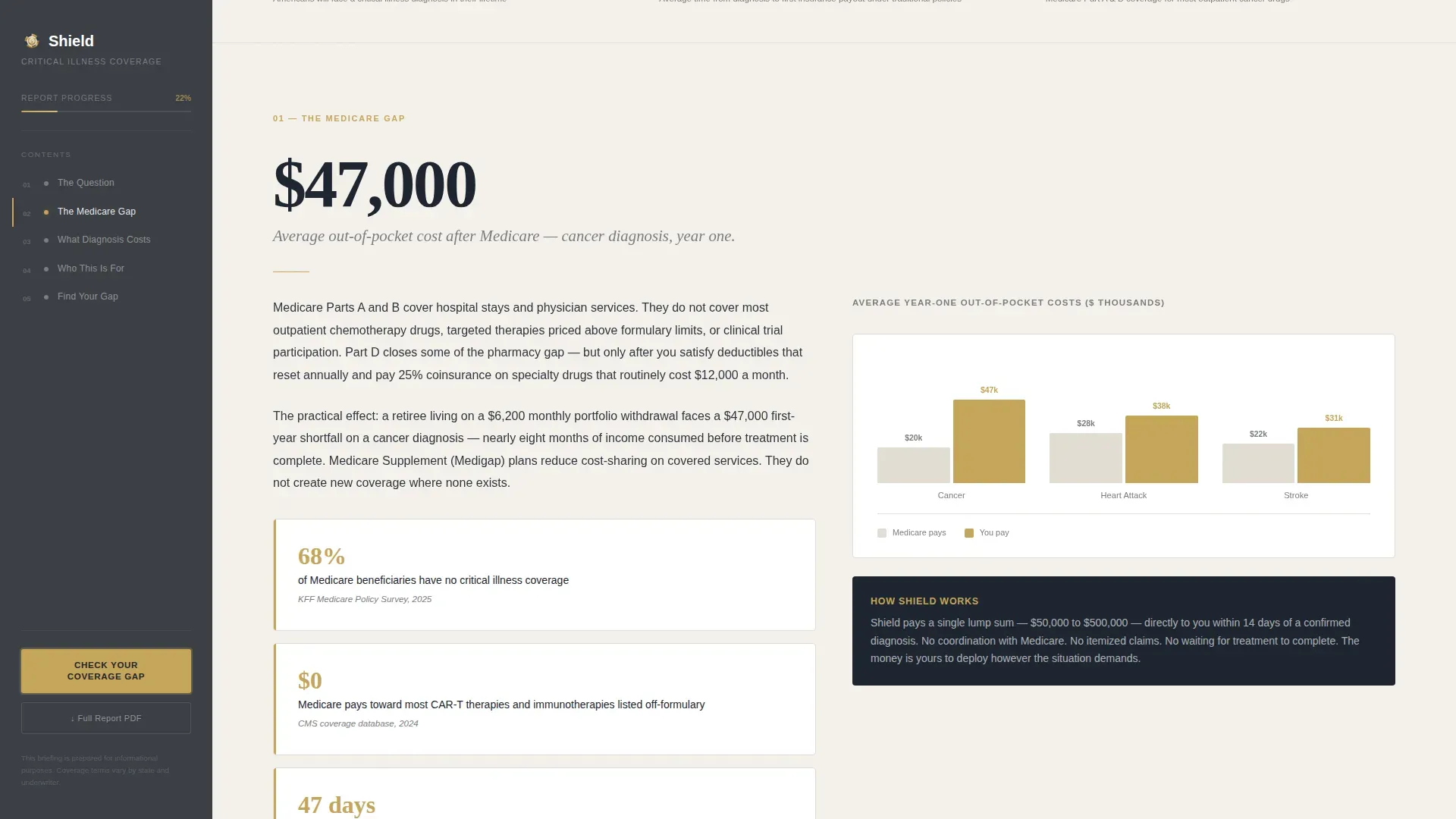
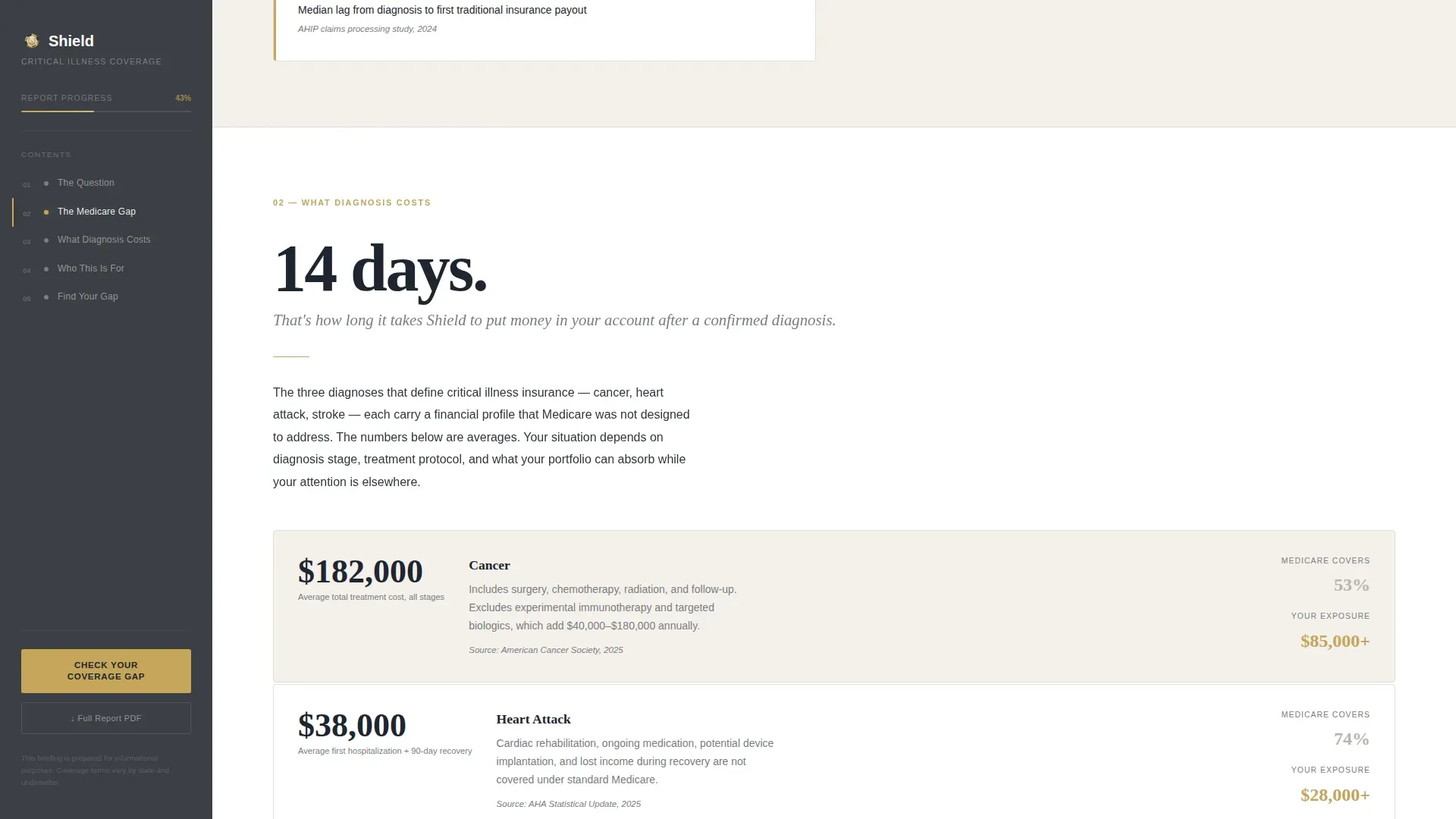
Each main content section opens with one large-rendered data point, such as average out-of-pocket cancer costs or median time from medical diagnosis to first claim payment. Calm, authoritative prose then unpacks the statistic. Charts are minimal and hand-drawn in feel, not corporate. The accumulating evidence structure means each section makes the next one harder to ignore.
Five-Step Diagnostic Quiz
The quiz launches from the primary call-to-action and presents five questions one at a time: current age, existing coverage type, retirement income bracket, family medical history (checkboxes for major illnesses including conditions at specified severity levels), and whether the visitor holds long-term care coverage. A gold progress bar advances after each answer. Results are gated behind a minimal form asking only for email and phone.
Gated Results and Secondary Lead Path
Quiz results are withheld behind an email and phone field framed as "Where should we send your personalized gap analysis?" This framing positions data collection as a service, not a barrier. A secondary path offers a downloadable PDF report for visitors not ready to complete the quiz but willing to exchange an email for substantive data on critical illness cover gaps.
Audience Profile Cards
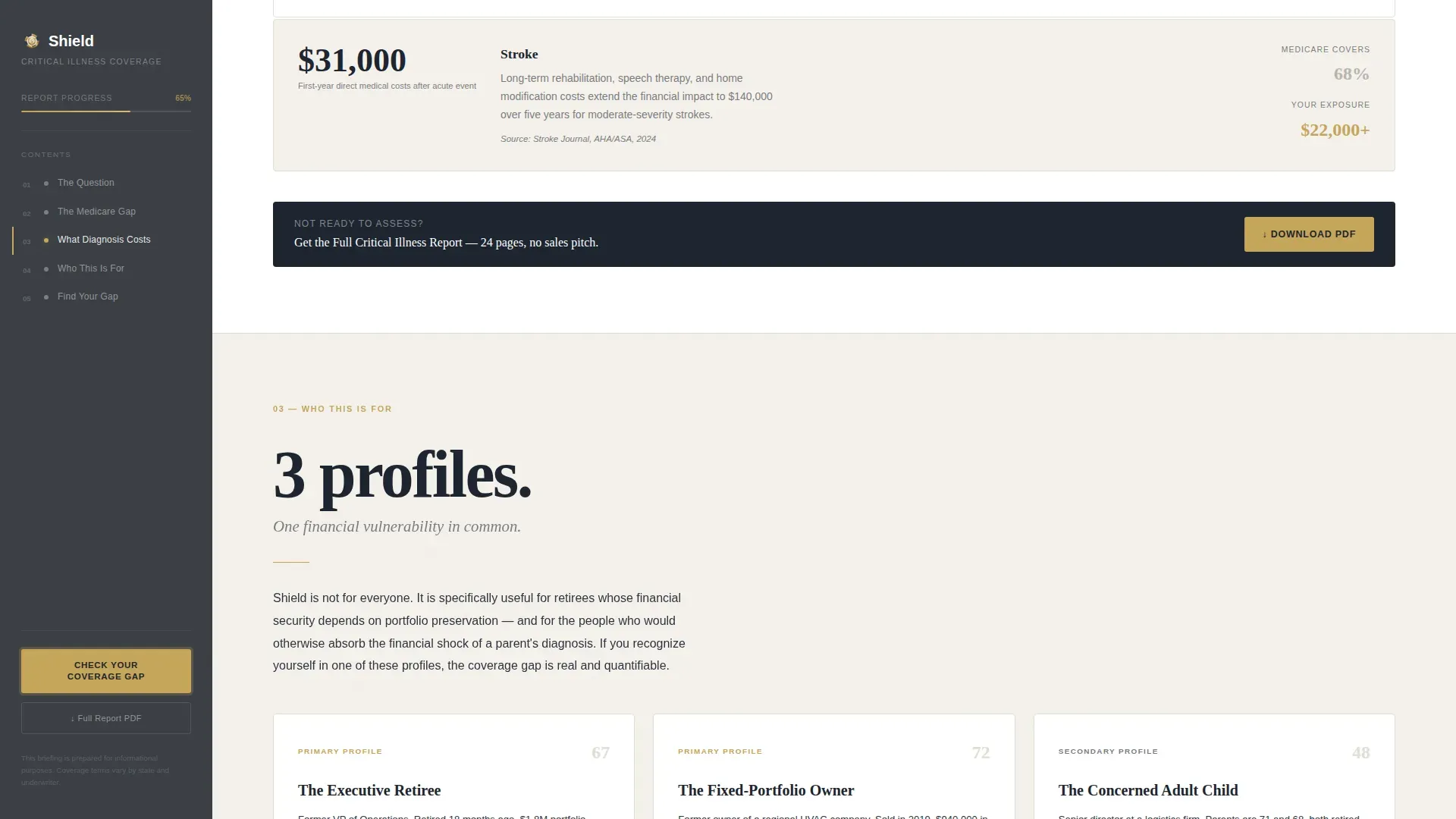
A dedicated section presents three profile cards representing the exec retiree, the former small-business owner, and the adult child researching coverage for a parent. Each card mirrors the visitor's situation, reinforcing relevance and reducing the cognitive distance between the page and the reader's real circumstances.
Page sections overview
| Section | Purpose |
|---|---|
| Hero Headline | Opens with a stark financial question in giant display type, dollar figure in muted gold, no imagery |
| Medicare Gap | Large stat plus calm prose explaining what standard health insurance leaves uncovered |
| Real Diagnosis Costs | Data points for cancer, stroke, heart attack, and kidney failure out-of-pocket expenses |
| Audience Profile Cards | Three reader personas that mirror the target visitor's exact situation |
| Coverage Gap Quiz | Five-question diagnostic with gold progress bar and gated personalized results |
| Footer | Horizontal flow footer with secondary contact and PDF download path |
Design & branding system
The visual identity follows an Executive Suite theme built on the Cloud Canvas color system. The palette evokes a private study: cream stationery, a brass desk lamp, and rain against tall windows. Gold never shouts; it underlines.
- Color palette: cloud canvas white (#F4F1EB) for the main content field, charcoal boardroom gray (#3B3F45) for the persistent sidebar, muted gold (#C5A55A) on interactive elements and progress indicators, and deep slate (#1E2530) for headline typography
- Typography: Fraunces display serif for headlines and DM Sans for body copy, a pairing that balances editorial weight with clean readability
- Interactive motion: medium-intensity scroll-linked sidebar progress, a gold pulse on the call-to-action button at scroll pauses, staggered stat reveals as the reader enters each section, and smooth quiz step transitions between questions
Mobile & speed optimization
Shield is built desktop-first to support the sidebar companion layout, which requires a wide viewport to display the fixed sidebar alongside the main content column. The layout collapses gracefully for smaller screens.
- On mobile, the sidebar converts to an inline table of contents and the quiz remains fully functional with touch-friendly inputs and the gold progress bar retained
- Static content sections are built with server components for fast initial load, while the quiz logic and sidebar tracking run as client components, keeping interactive weight isolated from the page's structural rendering
How this template helps you convert
The conversion architecture is deliberate. Every element exists to move a qualified visitor closer to submitting their information, without making them feel pressured.
- The giant headline creates immediate relevance by posing a financial question that retirees are already privately asking, making the page feel like a private briefing prepared specifically for them rather than a generic insurance pitch
- The Industry Report cadence builds accumulated evidence across four content sections, so by the time the visitor reaches the quiz, they have absorbed enough data about critical illness cover gaps, treatment costs, hospital bills, and lost income to feel the urgency themselves
- The gated quiz result, framed as a personalized gap analysis sent to the visitor's inbox, converts a passive reader into an active lead while the secondary PDF download captures visitors who need more time before committing to a conversation
Other information about this template
Shield is the template name for this executive retiree critical illness insurance landing page. The shield executive critical illness coverage gap landing page template is built specifically for the Finance and Insurance category, Retiree Insurance subcategory, targeting the retiree critical illness insurance niche.
- Critical illness insurance plans vary in the number of illnesses covered, typically ranging from 30 to 64 conditions. The diseases covered under a standard critical illness insurance policy commonly include cancer, heart attack, stroke, kidney failure, alzheimer's disease, multiple sclerosis, and benign brain tumour. Some plans also extend to conditions such as paralysis at a specified severity level.
- A critical illness insurance claim is generally simpler to process than a standard health insurance claim. The claim form requires minimal documentation, and once a covered critical illness is confirmed at the required specified severity and the survival period is satisfied, the lump sum payout is transferred directly to the policyholder's bank account.
- A critical illness rider can be added to an existing health insurance policy or life policy rather than purchased as a standalone plan. Premium costs and the sum insured may vary based on age, medical history, pre existing conditions, and the number of illnesses covered selected at enrollment.
- Premiums paid toward a critical illness insurance policy may qualify for tax benefits under applicable tax laws, including tax deductions available under the income tax act in relevant jurisdictions. Eligibility criteria and specific tax deductions may vary, so policyholders should verify current tax laws with a qualified adviser.
- The lump sum benefit paid upon a covered illness diagnosis can be used freely: to cover hospital bills, hospitalisation expenses, hospitalisation bills, medical expenses, non medical costs, non medical expenses, household expenses, and other financial commitments. There is no restriction on use. The policyholder retains complete discretion.
- This is typically structured as only one claim per covered illness event, though policy terms on multiple claims and the survival period may vary by plan. Newly eligible retirees should enroll within required deadlines. New coverage generally takes effect on the first day of the month following the retirement effective date.
- A dental health maintenance organization plan, often abbreviated as a dental HMO, is a managed-care dental plan where members select a primary dentist from a network. While a dental health maintenance organization is a separate product from critical illness cover, some retiree benefit packages bundle dental HMO options alongside supplemental critical illness insurance plans, so agents should be prepared to address both when speaking with senior citizens during enrollment.
- The template supports customizable components that agencies can adapt to their specific offer, eligibility criteria, and covered illness list. It is compatible with major design tools and includes a built-in design system based on the Cloud Canvas palette. A customer care executive reviewing the template for agency adoption will find the structure straightforward to adapt to their product's specific sum insured tiers and waiting period disclosures.
- Visitors who undergo medical tests and receive a medical diagnosis for a life threatening illness will benefit from understanding how quickly a critical illness insurance claim can deliver lump sum support to their bank account. The fixed lump sum payout removes the need to negotiate with insurers over specific medical bills, giving policyholders immediate financial assistance for income replacement, manage treatment costs decisions, and lifestyle adjustments during recovery.
- Both health insurance and critical illness insurance serve different but complementary roles. Health insurance covers medical expenses tied to hospitalisation. Critical illness insurance provides a lump sum amount to address the broader financial impact of a life threatening illness, including lost income, family responsibilities, and financial security over the long recovery arc. Buying critical illness insurance as a supplement to an existing health plan closes the gap that standard health insurance leaves open, particularly for illnesses diagnosed at advanced stages.
Theme
Executive Suite
Creative direction
Industry Report
Color system
Cloud Canvas
Style
Sidebar Companion
Direction
Quiz/Assessment
Page Sections
Giant Centered Headline Hero Section
Fixed Sidebar with Scroll Progress Tracking
Industry Report Data Sections
Five-step Diagnostic Quiz with Gold Progress Bar
Gated Personalized Gap Analysis and PDF Download
Audience Profile Cards Section
Related questions
What conditions are illnesses covered under a critical illness insurance policy?
How does a critical illness lump sum payout differ from what health insurance pays?
What is the waiting period before I can make a critical illness claim?
Can I add critical illness cover to an existing health insurance policy?
Are premiums paid for critical illness insurance eligible for tax benefits?