Intellectual Property Specialist FAQ Website Template
Shield is a split-screen landing page template built for brand protection services. It combines a civic-institutional visual identity with an FAQ-driven scroll experience to convert in-house counsel and e-commerce directors into qualified leads. The template guides visitors from urgent detection questions to a clear call to action, using typography, enforcement-red accents, and a structured lead generation form.
by Rocket studio
Quick summary
Shield is a single-page landing page template for brand protection firms. It uses a 50/50 split-screen layout and a civic-institutional design to walk prospects through detection, enforcement, and monitoring. The scroll unfolds as a consultation, moving visitors from urgency to trust to action. Every section earns its place.
Who this template is for
This template is designed for firms and agencies that identify and act against counterfeiters, unauthorized resellers, and trademark squatters. It speaks directly to buyers who already feel the problem and need proof that a solution exists.
- In-house legal counsel at mid-market consumer brands managing intellectual property risk
- E-commerce directors losing revenue to unauthorized sellers undercutting pricing on major marketplaces
- Founders who have discovered their trademarks or product designs copied without permission
What problem this template solves
Brand protection is an urgent but difficult sell. Prospects often do not know the scale of their exposure until someone shows them evidence. A generic services page does nothing to close that gap.
- Visitors arrive with vague concern but no framework for understanding their risk
- Standard service pages list features without demonstrating how enforcement actually works
- The lead form often appears before the visitor has absorbed enough to act
Shield solves these problems by structuring the page as a progressive consultation. Each FAQ pair escalates the stakes before the form ever appears.
What you get with this template
You get a fully structured single-page layout ready for a brand protection service. Every section is purpose-built to move a cautious, informed buyer from awareness to inquiry.
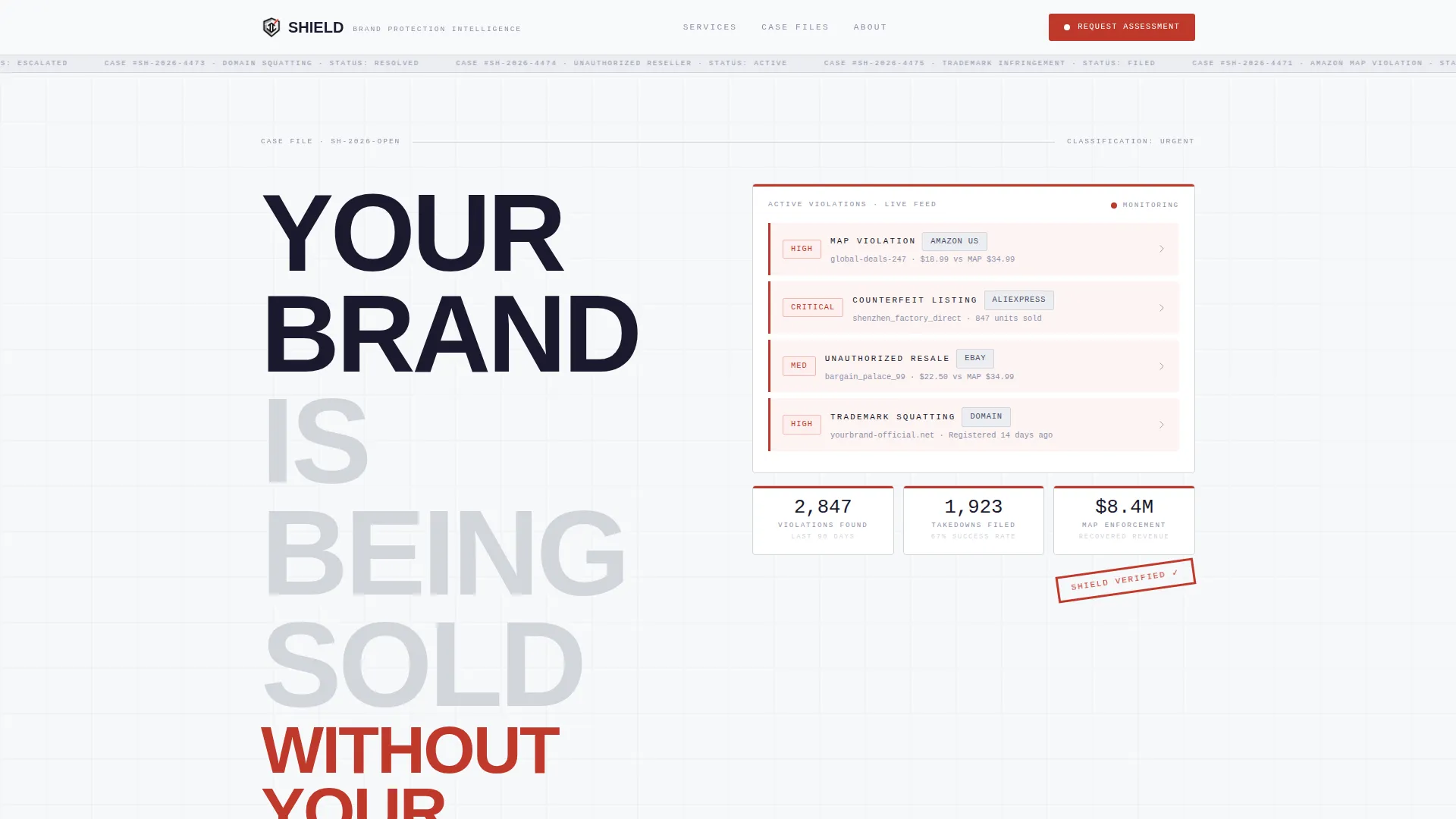
- A stacked display hero section with enforcement statistics in monospaced type
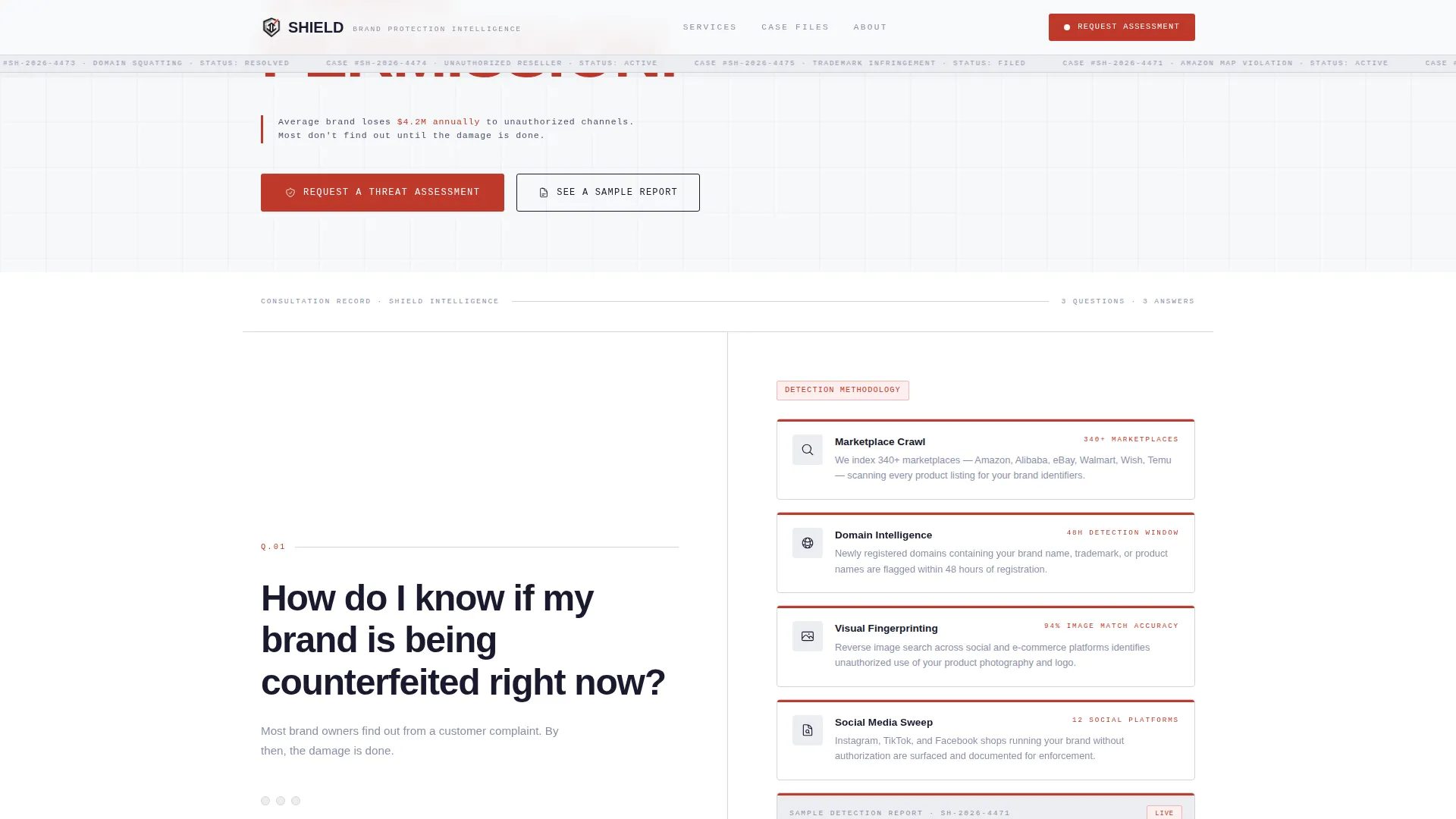
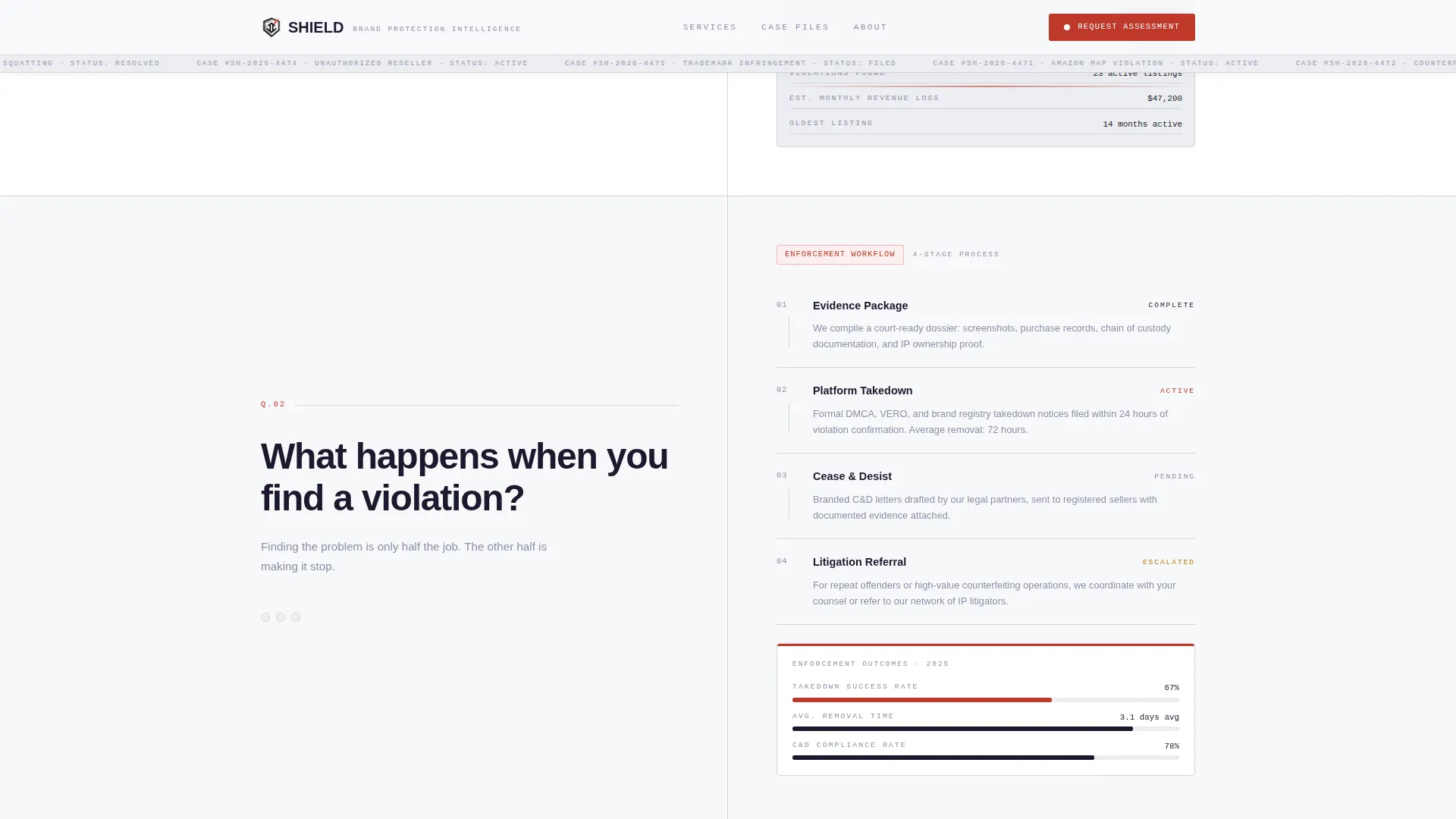
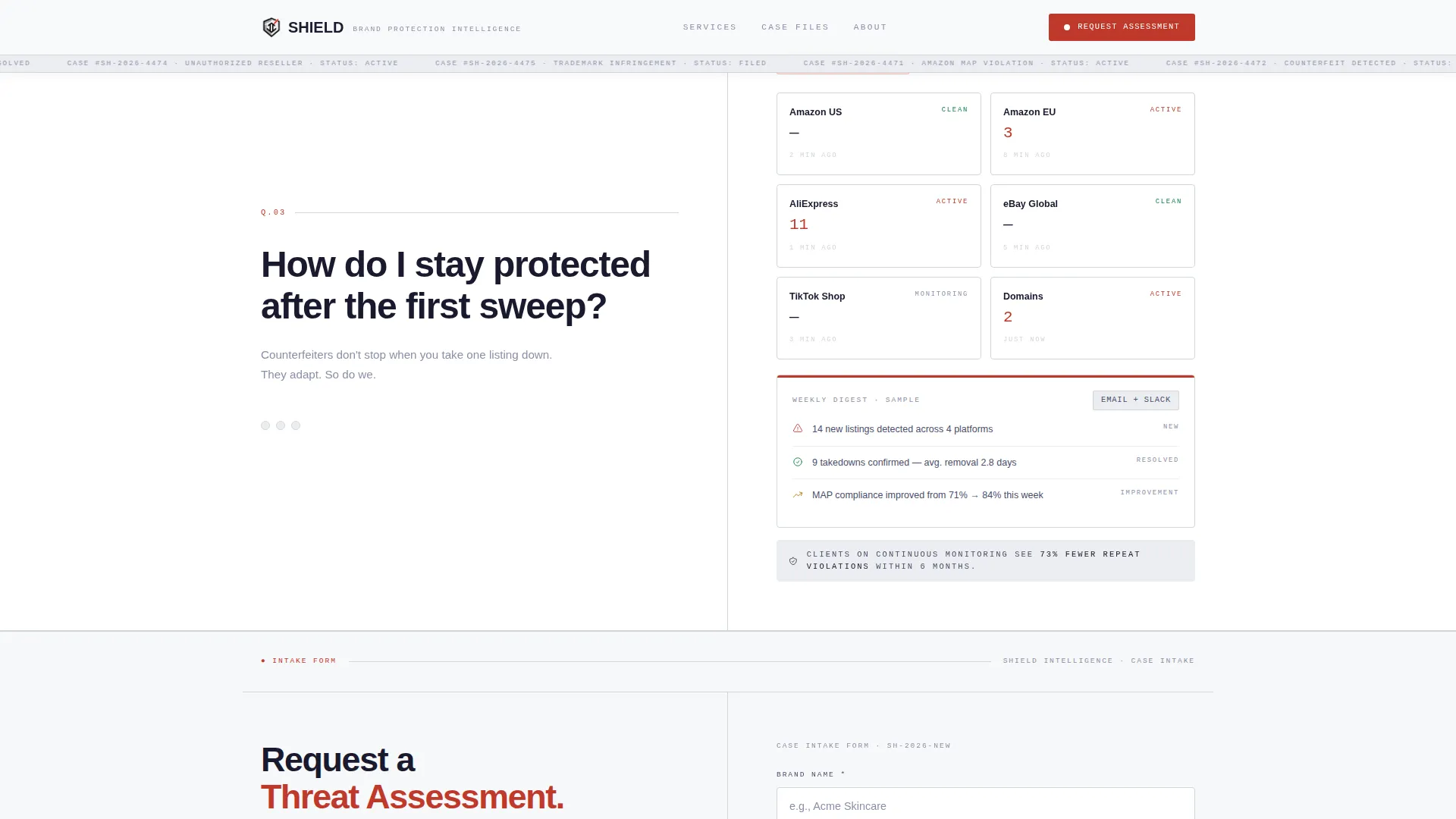
- Three FAQ split-screen sections covering detection, enforcement, and ongoing monitoring
- A dual-path lead generation section with a detailed intake form and a secondary gated report download
Feature list
This template includes six purpose-built features grounded in the source brief.
Stacked Type Tower Hero
The hero fills the viewport with three massive sans-serif lines in progressive sizes: carbon black, filing gray, and enforcement red. No photography or illustration is used. A single enforcement statistic in monospaced type sits below, set in a typewriter animation. Typography alone carries the entire opening argument.
FAQ-Driven Split Screen Layout
Each FAQ pair places the visitor's own question in oversized type on the left panel and the firm's detailed answer, with evidence and workflow context, on the right. The scroll rhythm mirrors a one-on-one consultation. Three FAQ pairs cover detection signals, enforcement workflow, and ongoing monitoring in that order.
Escalating Scroll Narrative
The page is sequenced deliberately. Detection comes first, enforcement second, monitoring third. Each section raises the stakes before the next one opens. By the time the lead form appears, the visitor has absorbed three rounds of evidence. This sequencing is built into the template structure.
Dual Conversion Path
The lead generation section offers two options simultaneously. The primary call to action, "Request a Threat Assessment," presents a structured intake form. The secondary path, "See a Sample Report," gates a downloadable report behind an email address only. Both paths capture visitors at different stages of readiness.
Structured Intake Form
The primary form collects brand name first to reduce friction at the start. It then asks for product category, primary sales channels, and a checkbox grid of known issues. The checkbox options include counterfeits detected, MAP violations, unauthorized marketplace sellers, and domain squatting. The form is designed to qualify leads before first contact.
Civic-Institutional Visual System
The color palette uses four values only: institutional white, filing-cabinet gray, carbon black, and enforcement red. Red is reserved strictly for alerts, active violations, and primary calls to action. Backgrounds alternate between white and pale gray to create the cadence of a case file being turned page by page.
Page sections overview
| Section | Purpose |
|---|---|
| Hero Type Tower | Opens with maximum urgency using stacked display typography and an enforcement statistic |
| FAQ Split One | Addresses counterfeiting detection signals with evidence context on the right panel |
| FAQ Split Two | Shows what happens after a violation is found, covering enforcement workflow |
| FAQ Split Three | Explains ongoing monitoring and protection after the initial sweep |
| Lead Generation Form | Captures qualified leads via intake form and secondary report download gate |
| Minimal Footer | Closes with a single-row footer following Pattern 8 minimal layout |
Design & branding system
The design language draws from civic and institutional sources. It is intentionally austere. Every visual decision reinforces the idea of a firm that operates with procedural authority.
- Four-color palette: institutional white (#F7F8FA), filing-cabinet gray (#D2D5DB), carbon black (#1A1A2E), and enforcement red (#C0392B) used sparingly as an alert and action color
- Typography uses DM Mono for labels and statistics, Manrope for body copy, and a large stacked display typeface for the hero tower
- Backgrounds alternate between white and pale gray across sections, creating a document-like page cadence with no decorative imagery
Mobile & speed optimization
The template is designed desktop-first, reflecting the primary audience of in-house counsel and e-commerce directors working at a desk. Responsive mobile behavior is built into the layout structure.
- The sticky split-screen and staggered fadeUp scroll animations are handled through client-side interactions, keeping static content server-rendered
- The split-screen layout collapses cleanly on smaller viewports so FAQ content remains readable without horizontal scrolling
- The typewriter animation on the hero statistic is a client-side interaction that does not block the static content from loading first
How this template helps you convert
The template is built around a specific conversion theory: show evidence before showing the form. Every layout decision supports that sequence.
- The hero creates immediate recognition of the problem, using a dollar-value enforcement statistic to anchor the visitor's sense of risk before a single service claim is made.
- Three FAQ split-screen sections progressively answer the questions a cautious buyer is already asking, building trust through workflow transparency rather than marketing language.
- The lead form appears only after the third FAQ pair, and offers two entry points so that visitors at different stages of decision-making both have a path forward.
Other information about this template
This template is built for the Legal and Compliance category with a specific focus on intellectual property protection and brand enforcement services. It is a good fit for firms operating in the brand protection service space.
- Template style is Split Screen (50/50), a layout that naturally separates the visitor's concern from the firm's response across every scroll step
- The Civic Service theme and Arctic White color system work together to communicate institutional credibility without relying on photography or illustration
- The FAQ-Driven creative direction and Lead Generation page direction are designed to work in sequence, with content building urgency before the conversion moment arrives
- The header concept, the Stacked Type Tower, is a deliberate typographic statement that functions as the entire hero without any supporting media
Theme
Civic Service
Creative direction
FAQ-Driven
Color system
Arctic White
Style
Split Screen (50/50)
Direction
Lead Generation
Page Sections
Stacked Type Tower Hero
Faq-driven Split Screen Layout
Escalating Scroll Narrative
Dual Conversion Path
Structured Lead Intake Form
Civic-institutional Color System
Related questions
What kind of business is this template designed for?
Can I customize the FAQ questions and enforcement workflow content?
Is the secondary 'See a Sample Report' conversion path included?
Does the template include the intake form and checkbox grid?
How many sections does this landing page template include?