Shield — Vehicle Model Insurance Quotes Landing Page Template
Shield is a Jeep-specific coverage comparison landing page template built for specialty insurance brokerages. It uses a cinematic Tech Glass aesthetic with a Charcoal and Amber color system to walk modified Jeep owners through an animated side by side comparison of generic policies versus Jeep-specific coverage. The result is a focused, conversion-driven landing page that turns coverage doubts into confident sign-ups.
by Rocket studio
Quick summary
Shield is a storybook single-page landing page template designed for a Jeep insurance specialist. It guides modified Jeep owners through a full visual story: from a cinematic hero photo to an animated comparison panel, a granular mod exploder, real claim stories, and a two-field gap analysis form. Every section earns the next click.
Who this template is for
This template is built for specialty insurance companies and independent brokerages serving the off-road vehicle community. It works for any business that needs high converting landing pages to move modified Jeep owners away from generic carriers and toward purpose-built coverage.
- Modified Jeep owners researching coverage for lifted Wranglers, Gladiators, and heavily built overlanders
- Jeep insurance brokerages and specialty automotive services companies that need to prove their advantages fast
- Marketers and agencies building competitor comparison landing pages for niche automotive insurance clients
What problem this template solves
Generic insurance landing pages fail modified Jeep owners. They do not address aftermarket parts, trail damage, winch liability, or rooftop tent replacement. Potential customers visit a standard policy page and leave with no data to compare and no reason to switch. This template solves that gap directly.
- Users cannot easily compare their current policy against a Jeep-specific alternative without a clear side by side comparison tool built into the page
- Potential buyers searching for mod-aware coverage have no visual proof of what their current carrier excludes until they see it row by row
- The business loses credibility when pages fail to build trust through real claim stories and honest, structured comparison data
What you get with this template
This template delivers a complete, well organized single-page experience structured around five purposeful sections. Each section is designed to move visitors further down the page and closer to submitting the gap analysis form.
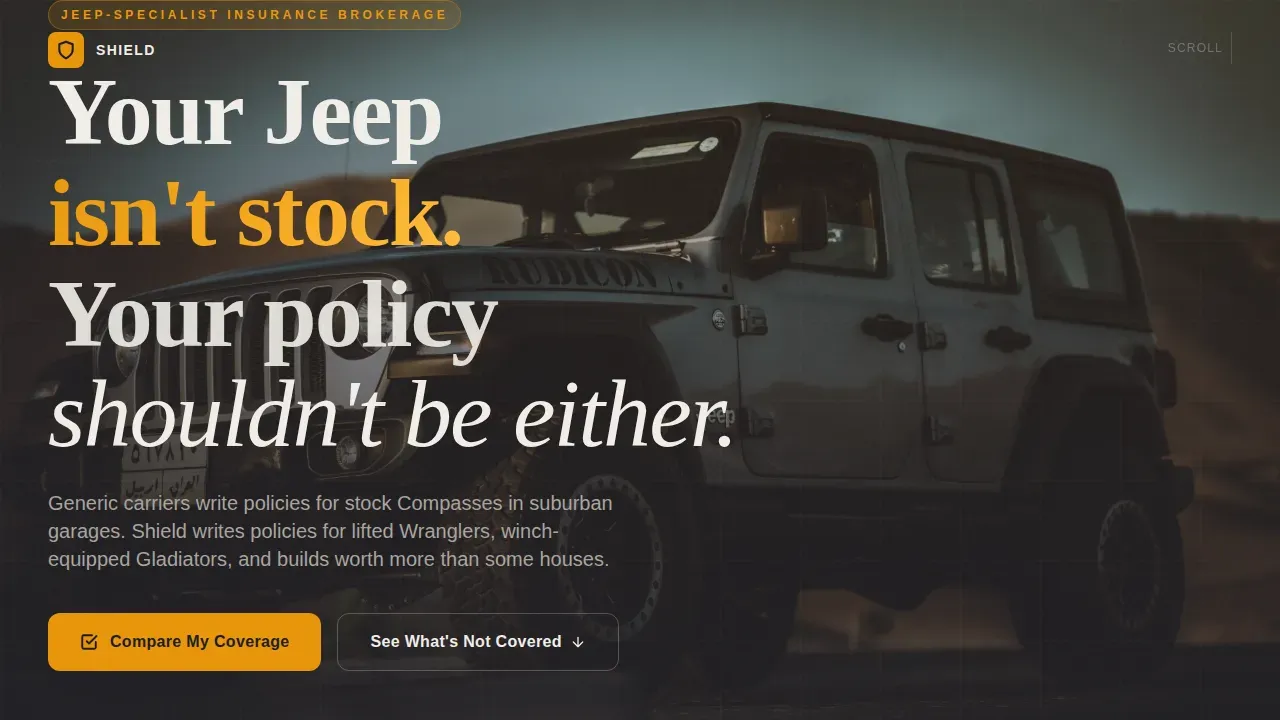
- A full-bleed cinematic hero section with a scroll-triggered headline fade-in and no visible navigation bar until the user begins to scroll
- An animated Versus Chamber comparison panel, a lift-kit mod exploder section, a glass-card testimonial room, and a two-field gap analysis call to action form
- A footer built on a Linear Single-Row pattern with clean links and minimal visual noise
Feature list
This template is packed with purposeful features. Each one serves the core goal: help users evaluate their current coverage, understand what they are missing, and take action. The structure is clear and the functionality is precise.
Animated Versus Chamber Comparison Panel
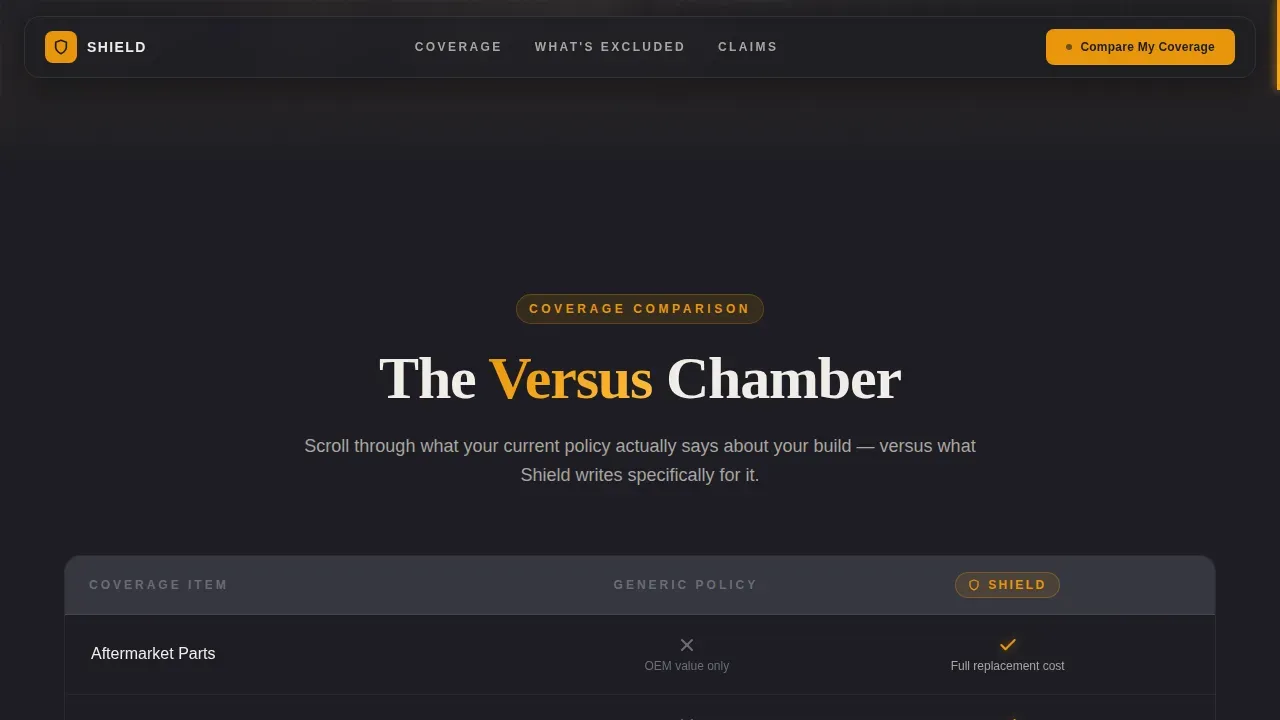
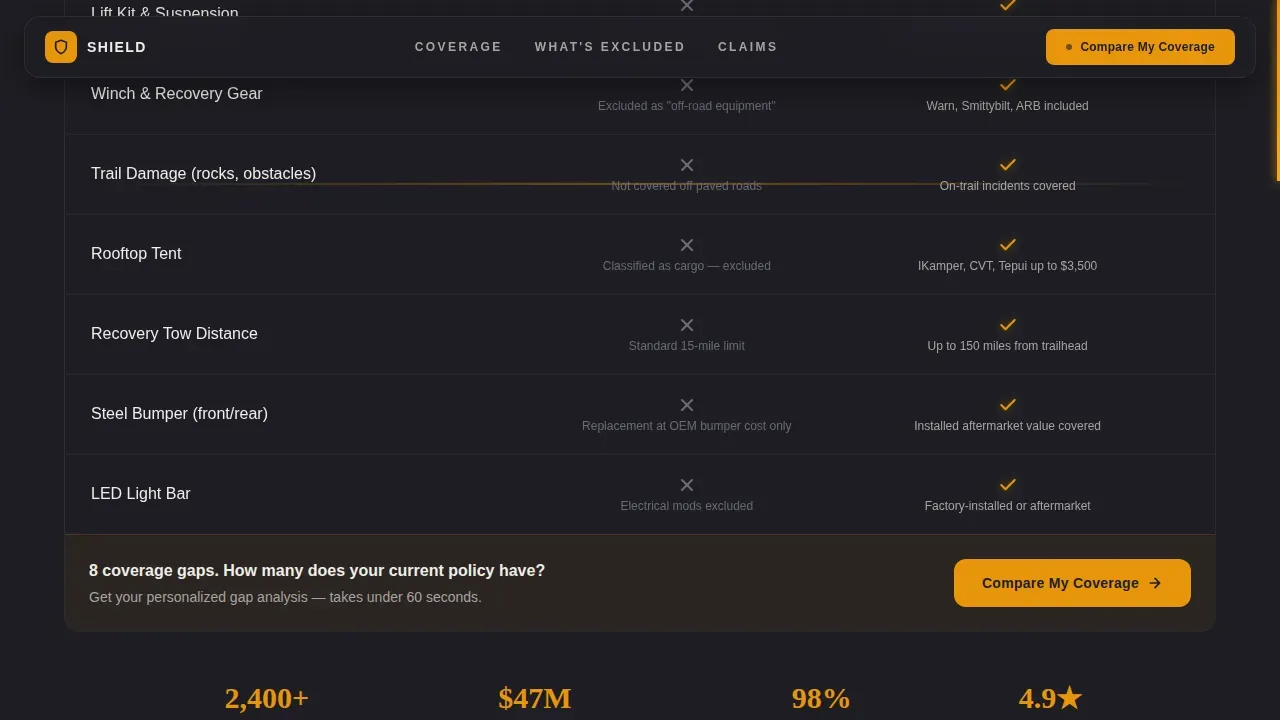
The Versus Chamber is the centerpiece of the comparison page. It places a generic policy on the left in muted gray and Shield's Jeep-specific policy on the right in amber-highlighted rows. Each row covers a specific coverage area: aftermarket parts, trail damage, winch liability, rooftop tent replacement, and recovery-tow distance. Rows animate in like data loading on a heads-up display as the visitor scrolls. This side by side comparison format helps potential customers determine exactly where their current plan falls short.
Lift-Kit Mod Exploder Section
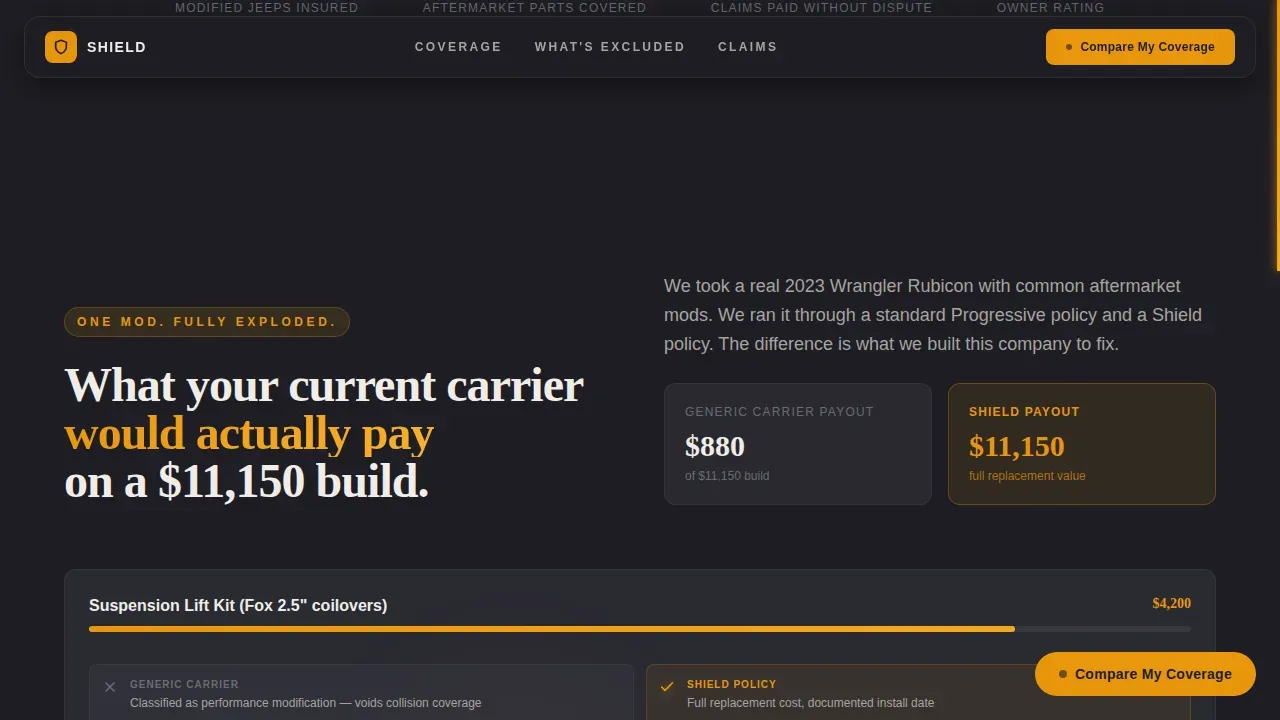
Section three zooms into a single modification, a lift kit, and breaks it into component cost data. It shows exactly what a generic policy would deny versus what the Jeep-specific policy covers. This granular proof section gives users the concrete evidence they need to evaluate their situation. It functions as both an educational tool and a persuasive conversion element for visitors who are not yet ready to submit the form.
Glass-Card Testimonial Room
The testimonial section presents real claim stories from real Jeep owners. Each story appears as a floating glass card set against deep charcoal space. Customer testimonials here include dollar amounts, Jeep model specifics, and named owners. This section highlights customer testimonials in a format that builds trust through specific, human-scale proof rather than generic review snippets.
Two-Field Gap Analysis Form
The call to action form is intentionally minimal. It asks for two pieces of data: the visitor's current carrier name selected from a dropdown of ten major auto insurers plus an "Other" option, and their Jeep model and year. No address, no vehicle identification number yet. The form is designed to lower friction and deliver a personalized coverage gap analysis report by email. A secondary path, labeled "See What's Not Covered," anchors directly to the lift-kit exploder for visitors who need more education before they convert.
Scroll-Triggered Hero with Persistent Call to Action
The hero is a full-bleed photo of a Wrangler Rubicon parked on slickrock. A single quartz-white headline fades in over the hood on load. The navigation bar stays hidden until scroll begins, keeping visual appeal clean and focused. The primary call to action button, "Compare My Coverage," appears first at the bottom of the Versus Chamber and then again as a persistent amber button after the third section. This placement follows best practices for high converting landing pages by enabling users to act at multiple natural decision points.
Tech Glass Dark user interface System
The entire template is built around a Tech Glass visual identity. Deep trail-dust charcoal forms the primary background. Smoked-glass mid-tone surfaces card panels and section dividers. Molten amber signals every interactive element and data highlight. Quartz white carries all body text. Typography pairs DM Sans for body copy with Fraunces display serif for the hero headline. The result is a landing page that feels like instrument gauges through a tinted windshield: dark, precise, and lit only where it matters.
Page sections overview
| Section | Purpose |
|---|---|
| Hero Photo | Full-bleed Wrangler image with fade-in headline and hidden nav bar |
| Versus Chamber | Animated side by side comparison panel, generic policy versus. Shield |
| Lift-Kit Exploder | Single-mod cost breakdown showing denial versus. coverage proof |
| Testimonial Room | Floating glass-card claim stories with dollar amounts and owner names |
| Gap Analysis Form | Two-field call to action form generating a personalized coverage report |
| Single-Row Footer | Clean footer with links and minimal layout |
Design & branding system
The design system is built around a single idea: precision in the dark. Every color choice, typographic decision, and animation behavior serves the Tech Glass aesthetic. The palette feels like staring at instrument gauges through a tinted windshield at dusk.
- Color system: Charcoal (#1E1E24) background, Smoked Glass (#3A3A44) card surfaces, Molten Amber (#E8960C) for all interactive elements and data highlights, Quartz White (#F0EDE8) for body text
- Typography: Fraunces display serif for the hero headline, DM Sans for all body and interface copy
- Amber never decorates; it signals. Buttons, comparison checkmarks, and the scroll progress bar along the right edge all use amber as a functional trail marker, not an ornamental one
Mobile & speed optimization
The template is designed desktop-first, reflecting the research behavior of its core audience. Modified Jeep owners typically search and compare coverage options on larger screens. That said, the layout includes solid mobile support so users can explore the page on any device.
- Hero image is set to priority load, keeping the above-the-fold experience fast and visually impactful on first visit
- CSS animations power the scroll-triggered row reveals, the heads-up display data-load effect, and the floating card entrances, reducing JavaScript dependency where possible
- The scroll progress bar traces down the right edge of the page, giving users a clear sense of how far they have traveled through the content on both desktop and mobile
How this template helps you convert
Creating competitor comparison pages that actually convert requires more than a table. This template layers comparison data, granular proof, and social confirmation into a single scrollable story. The architecture escalates deliberately: broad comparison first, then specific evidence, then human confirmation.
- The Versus Chamber delivers a well organized, row-by-row side by side comparison that enables users to see coverage gaps immediately, without needing to search through policy documents or visit a competitor's website
- The Lift-Kit Exploder section and glass-card testimonials work together as case studies and real-world proof, giving potential buyers the specific data and user stories they need to feel confident before submitting the form
- The persistent amber call to action button and the dual-path conversion flow, "Compare My Coverage" plus "See What's Not Covered," address visitors at different levels of readiness, keeping more of them engaged and moving toward the gap analysis form
Other information about this template
This template is part of a broader collection of specialty landing pages built for niche automotive services and insurance platforms. It is worth understanding how its design and structural choices connect to wider best practices for comparison-focused pages across industries.
- A competitor comparison landing page is designed to directly compare your product or service with those of your competitors. These pages highlight the strengths and advantages of your offerings while clearly demonstrating how they outperform other options in the market. Creating competitor comparison pages is a smart way to guide visitors toward choosing your product by answering the exact question they are asking.
- The best examples of competitor comparison landing pages are clear, honest, and backed by useful information. Honesty and transparency are fundamental in building trust. It is crucial to present accurate and fair comparisons rather than exaggerating claims. Regular updates are essential to ensure the information remains current, reflecting any changes in your offerings or those of your competitors.
- Competitor comparison landing pages are particularly effective in industries where multiple companies offer similar services. The average conversion rate for competitor comparison landing pages typically ranges between 3 percent and 10 percent. Supporting claims with data, such as third-party validations, adds a layer of credibility.
- The key elements of an effective comparison page include a clear headline, comparison table, benefits, a strong call to action, social proof, and visual appeal. Optimizing landing pages for conversions involves simplifying the design to help visitors find information without distractions.
- This template can be adapted for saas comparison use cases and reviewed using tools like Adobe XD for prototype review and team feedback before going live. Teams using Adobe XD can test layout flows, evaluate animation behavior, and share screens with stakeholders. Adobe XD also supports accessibility review passes before handoff.
- Coverage context for Jeep-specific plans: core coverage areas typically include the engine, transmission, and drive axle assembly. The 4x4 and drive assembly coverage includes the transfer case and all internal lubricated parts such as axle shafts and universal joints. These are often excluded from standard auto policies, which is exactly the gap this landing page is built to expose.
- Third-party shield-style plans for older Jeeps often offer more flexibility and include maintenance perks. However, warranty terms note that coverage is generally not transferable for shield or lifetime plans, requiring confirmation of specifics. Failure to follow the recommended maintenance schedule can void such warranties.
- Marketers building pages for saas companies or subscription-based insurance platforms will notice that the two-field form structure mirrors low-friction intake patterns used effectively across many saas comparison flows. The same principles that make a compelling saas comparison page work here: showcase unique value, make the comparison obvious, and reduce the steps to conversion.
- The template's pricing section context is handled through the gap analysis report rather than a static pricing table, allowing the business to address cost concerns in a personalized way after the visitor submits the form.
- Log your template customization notes and track design changes through your preferred project management tools before publishing. Managing version control across your pages helps teams stay organized, especially when regularly updating comparison data to keep it current.
Theme
Tech Glass
Creative direction
Spatial & Architectural
Color system
Charcoal & Amber
Style
Storybook/Full-Page
Direction
Comparison/Versus
Page Sections
Animated Versus Chamber Comparison Panel
Lift-kit Mod Exploder Section
Glass-card Testimonial Room
Two-field Gap Analysis Form
Persistent Amber Call to Action System
Tech Glass Dark User Interface with Scroll Progress Bar
Related questions
Can I customize the comparison rows in the Versus Chamber?
Does this template include the gap analysis email delivery system?
Is this template suitable for non-Jeep insurance businesses?
How does the secondary conversion path work?
Can this template be previewed or prototyped in Adobe XD?