Omani Cuisine Professional Website Template
Shuwa is a hero-dominant landing page template built for an authentic Omani restaurant specializing in traditionally buried slow-cooked lamb. It combines a cinematic full-bleed hero, scroll-linked Before/After Reveal sliders, and a direct online ordering flow. The warm earthen palette and immersive storytelling make every visitor feel the weight and patience behind the food before they place their order.
by Rocket studio
Quick summary
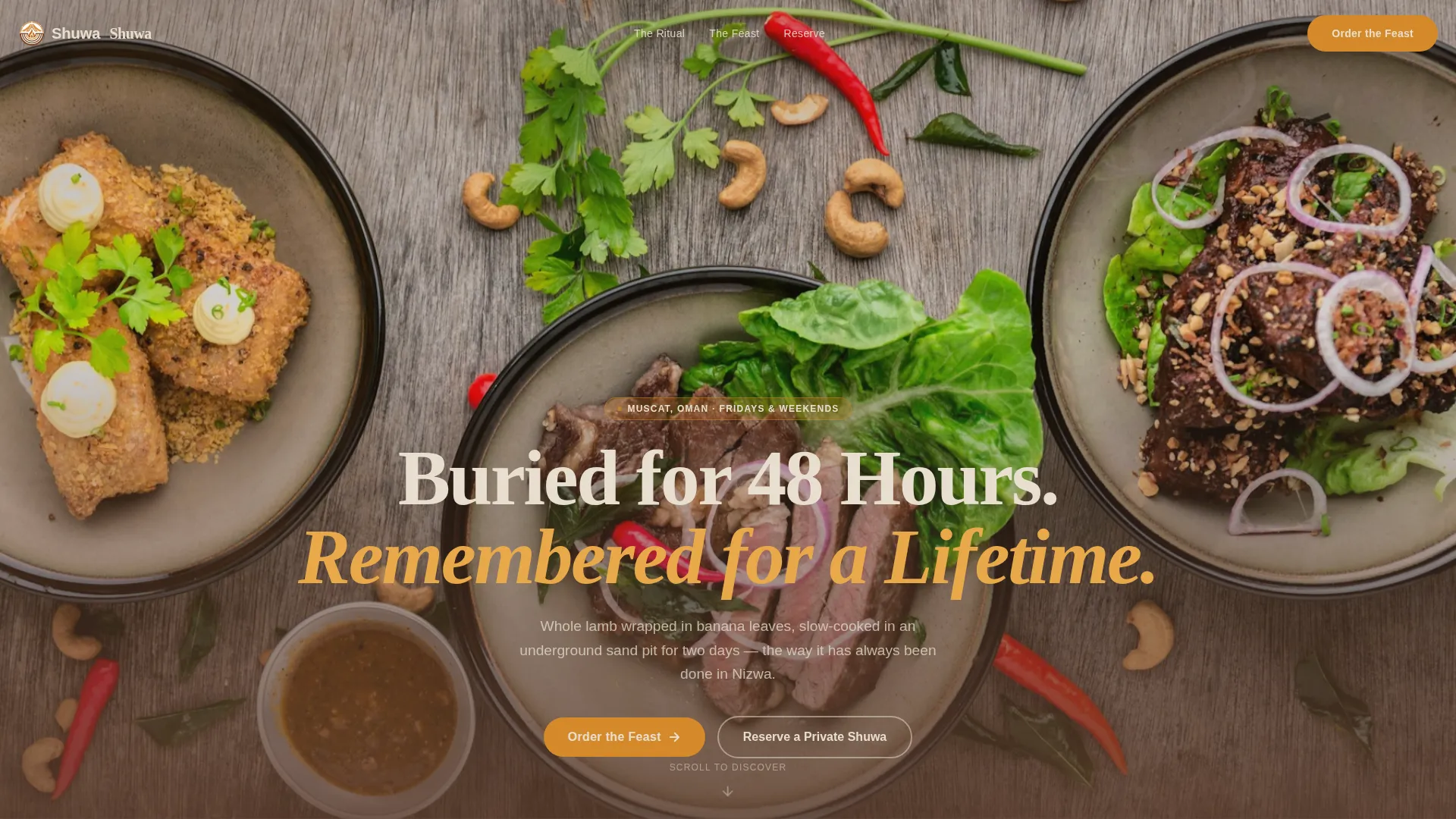
Shuwa is a single-page restaurant landing page template designed to sell an extraordinary dining experience. The layout is hero-dominant, with 90 percent of the visual weight placed on a raw, atmospheric overhead photograph of an open sand pit. Scroll-driven Before/After sliders reveal the cooking transformation, and a sticky order button guides visitors toward checkout at every moment.
Who this template is for
This template is built for Omani restaurant owners and operators who serve traditional shuwa or similarly process-rich heritage cuisine. It suits businesses that need to communicate authenticity, craftsmanship, and communal value before a customer places an order.
- Omani restaurant owners offering online ordering and private group dining bookings
- Food and beverage entrepreneurs targeting expat families, local food travelers, and community diners
- Hospitality teams launching a direct-to-consumer ordering page without a separate app or platform
What problem this template solves
Most restaurant pages fail to convey why a dish is worth waiting for. When the food takes 48 hours to prepare and the entire value lies in the process, a generic menu page destroys the story. This template solves the trust and appetite gap before the customer ever sees a price.
- Visitors arrive without context; the hero and sliders teach the process visually before any reading is required
- Abandoned carts caused by uncertainty are reduced through a delivery-zone map and minimum-order banner built into the ordering section
- Groups looking for a private dining experience have no clear path on a standard menu page; this template includes a dedicated reservation section with a date and headcount form
What you get with this template
You get a fully structured, one-page restaurant landing page that guides every visitor from curiosity to order confirmation. The layout is opinionated, focused, and built around one core product: shuwa.
- A cinematic hero section with a full-bleed overhead pit photograph and a headline that fades in after a deliberate pause
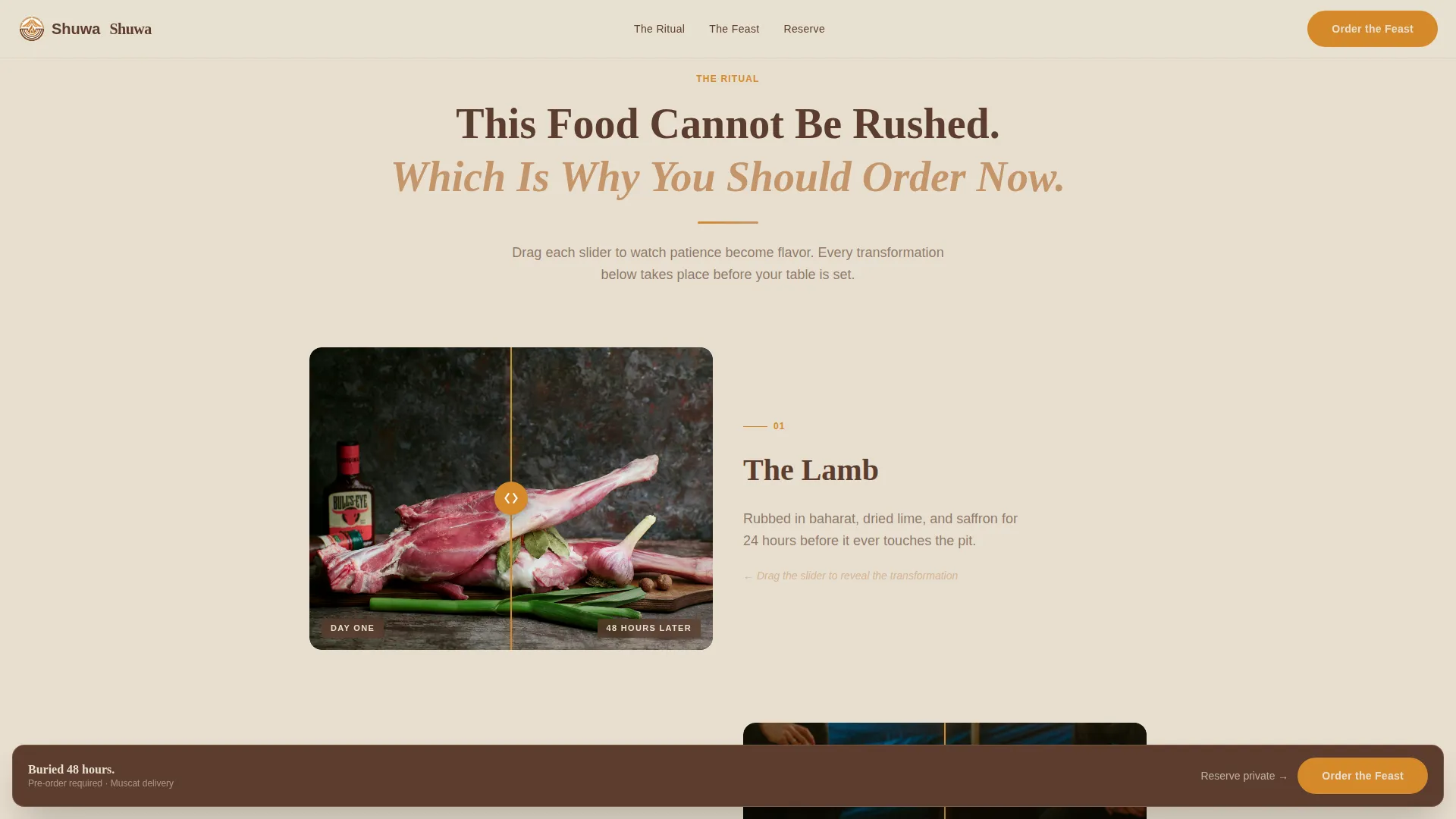
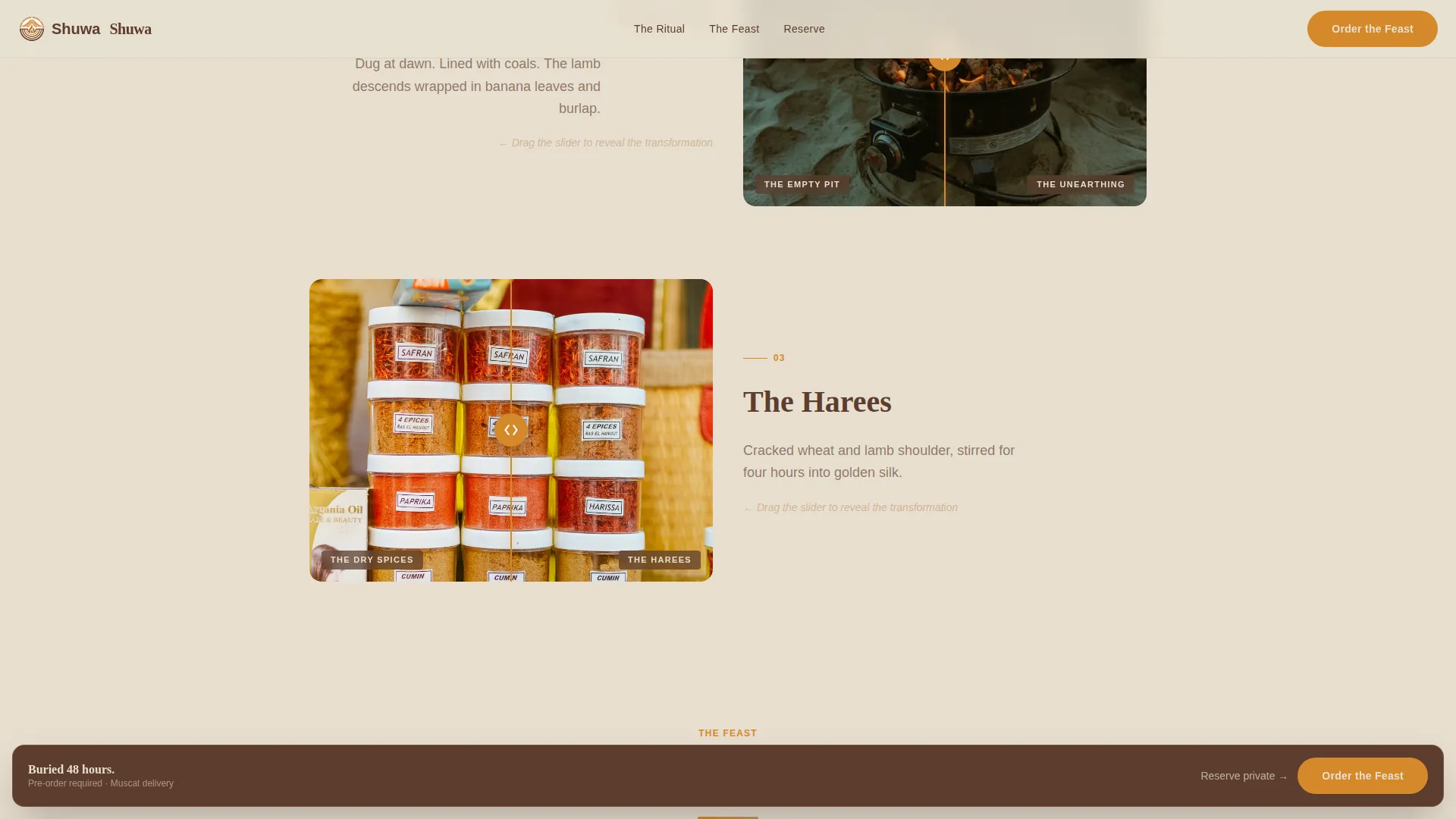
- Three scroll-linked Before/After Reveal comparison sliders showing raw versus finished transformations for the lamb, the pit, and the spice-to-harees journey
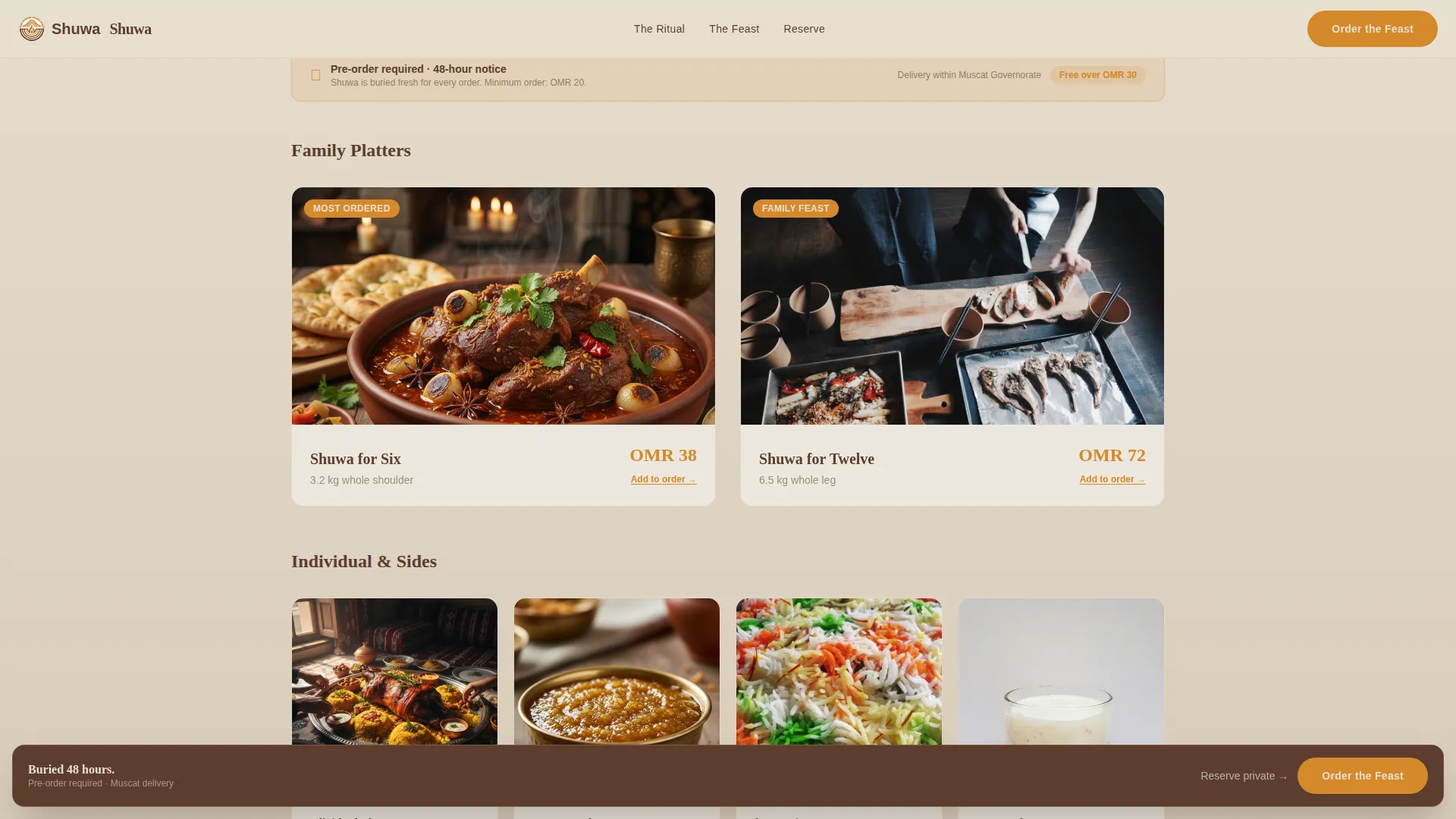
- A streamlined online ordering section with family platters, individual plates, a minimum-order notice, and a delivery-zone map
- Social proof testimonials from three distinct audience types: expat families, Omani grandmothers, and food travelers
- A Private Shuwa Experience section for groups of ten or more, with a date and headcount booking form
- A linear single-row footer completing the page structure
Feature list
This template includes a focused set of interactive and visual features built specifically for experiential food ordering.
Cinematic Hero with Headline Fade-In
The hero occupies 90 percent of the initial viewport. A full-bleed overhead photograph fills the screen, and the headline fades in after a short breath to let the image land first. The primary call to action appears in the hero before the sticky button takes over on scroll.
Scroll-Linked Before/After Reveal Sliders
Three draggable comparison sliders are woven through the page. Each one pairs a raw state with a finished result: marinated lamb beside a carved platter, an empty pit beside the unearthed feast, and dry spices beside finished harees porridge. Visitors drag to reveal the transformation at their own pace.
Sticky Order Call-to-Action Button
After the hero scrolls out of view, a persistent "Order the Feast" button remains pinned to the bottom of the viewport. It stays visible across all sections so the path to checkout is never more than one tap away.
Streamlined Menu Ordering Section
The menu section presents family platters and individual plates in a clean ordering modal. Each item shows one photograph, the weight, and the price in Omani Rials. Item descriptions are kept to six words or fewer. A minimum-order banner and a delivery-zone map appear here to reduce abandoned orders before checkout.
Private Experience Reservation Form
A dedicated section targets groups of ten or more guests. Visitors select a date and enter a headcount through a simple form. The section is visually separated from the main ordering flow to serve as a distinct conversion path.
Social Proof Testimonials Section
Three testimonial blocks represent the three core visitor types. Each testimonial is positioned to validate a different dimension of authenticity: family comfort, traditional accuracy, and discovery excitement.
Page sections overview
| Section | Purpose |
|---|---|
| Hero pit photograph | Establish atmosphere and present primary order call to action |
| Before/After sliders | Show raw-to-finished cooking transformation through draggable comparison |
| The Feast Menu | Display family platters and individual plates with photo, weight, and price |
| Social proof testimonials | Build trust with voices from expat families, grandmothers, and food travelers |
| Private experience booking | Capture group reservation leads with a date and headcount form |
| Linear footer | Close the page with contact and navigation links in a single row |
Design & branding system
The visual identity follows an Agrarian Root theme built entirely from earthen, mineral tones. Every color choice references a physical material from the Omani landscape, making the palette feel earned rather than chosen.
- Four-color Warm Stone palette: sun-baked clay (#C4956A) for structural warmth, date-palm brown (#5C3D2E) for all primary text and dark backgrounds, frankincense smoke (#E8DFD0) for page backgrounds and breathing space, and deep saffron (#D4892B) reserved strictly for buttons, price highlights, and spice-trail illustrations
- Typography pairs Fraunces serif for all headlines and display text with Manrope for body copy and interface elements, giving the page both warmth and legibility
- No studio lighting, garnish, or plating appears in the hero; all photography direction points toward raw communal moments lit by low morning sun
Mobile & speed optimization
The template is built with mobile-first behavior as its primary display priority. Restaurant ordering is predominantly a mobile activity, and the layout reflects that from the hero downward.
- The sticky call-to-action button is sized and positioned for one-thumb reach on small screens
- The hero image is set to priority load so the first visual impression arrives before the rest of the page assembles
- Remaining sections below the fold are lazy-loaded to keep the initial experience fast and unblocked
How this template helps you convert
Every design and layout decision in this template is aimed at reducing friction between appetite and order. The structure does not ask visitors to read before they feel.
- The Before/After sliders build perceived value before the menu appears; by the time a visitor sees a price, they already understand why 48 hours of preparation justifies it
- The sticky order button and the minimum-order banner work together to keep intent high and hesitation low across every section of the page
- The separate Private Experience section creates a second conversion path for high-value group bookings without disrupting the solo ordering flow
Other information about this template
This template is categorized under Food and Beverage, specifically within the Omani Cuisine subcategory. It is designed as a direct-to-consumer ordering page for an Omani restaurant, not a multi-page hospitality website.
- Localization details include English language copy, Omani Rial (OMR) currency formatting, Middle Eastern naming conventions, and references to Muscat geography
- Parallax depth layers and scroll-linked animations are included throughout the page to reinforce the sense of uncovering something buried
- The footer uses Pattern 1, a linear single-row layout, keeping the page clean and focused on ordering rather than exploration
- This template is suitable for building on platforms that support component-based page construction with custom animation and modal ordering flows
Theme
Agrarian Root
Creative direction
Before/After Reveal
Color system
Warm Stone
Style
Hero-Dominant (90/10)
Direction
Direct Sales
Page Sections
Cinematic Hero with Fade-in Headline
Scroll-linked Before/after Sliders
Sticky Floating Order Button
Streamlined Menu Ordering Modal
Private Experience Reservation Form
Social Proof Testimonial Section
Related questions
What makes this template different from a standard restaurant menu page?
Can I adapt this template for a restaurant that does not serve shuwa?
How does the online ordering flow work within this template?
Is the private dining reservation section included in this template?
What fonts and colors does this template use?