Traffic Safety Landing Page Template for Engineering Firms
Signal is a single-column landing page template built for road and traffic safety engineering firms. It leads with a bold crash-reduction guarantee, then systematically proves it through methodology, case studies, and compliance citations. The layout drives one action: a corridor assessment request from state agency project managers, public works directors, and civil engineering consultants.
by Rocket studio
Quick summary
Signal is a precision-crafted landing page template for traffic safety engineering firms. It opens with a zero-fatalities guarantee and uses every section below it to build contractual credibility. The single call to action, a corridor assessment request form, is designed for the exact decision-makers who control federal safety improvement funds and letting schedules.
Who this template is for
This template serves firms that engineer physical road safety systems and need to earn trust from highly technical, budget-accountable clients. The audience is not a general consumer. They are professionals with real liability on the line.
- State Department of Transportation project managers justifying federal safety improvement funds
- County public works directors responding to fatal crash clusters on their road network
- Civil engineering consultants who need a subconsultant that will not risk a project letting date
What problem this template solves
Most traffic safety firms present capability without proof. They list services, show equipment, and expect institutional clients to draw their own conclusions. That approach fails with state agency reviewers who need contractual evidence before recommending a subconsultant.
- There is no clear guarantee that separates the firm from competitors with similar credentials
- Technical audiences leave without enough data to internally justify a hire
- Generic contact forms create friction for engineers who do not respond to sales pressure
What you get with this template
This template gives you a complete, conversion-focused landing page structured around a single measurable promise. Every section is ordered to deepen credibility, not broaden scope.
- A guarantee-led header with contractual language and a gold-bordered callout block
- A methodology section covering Road Safety Audits (RSAs), countermeasure selection matrices, and before-and-after corridor crash data
- A focused lead capture form asking for corridor location, funding source, name, and agency email, with no phone field
Feature list
This landing page is built around one goal: turning a skeptical agency professional into a qualified corridor assessment lead. Each feature below serves that goal directly.
Guarantee-Led Header Block
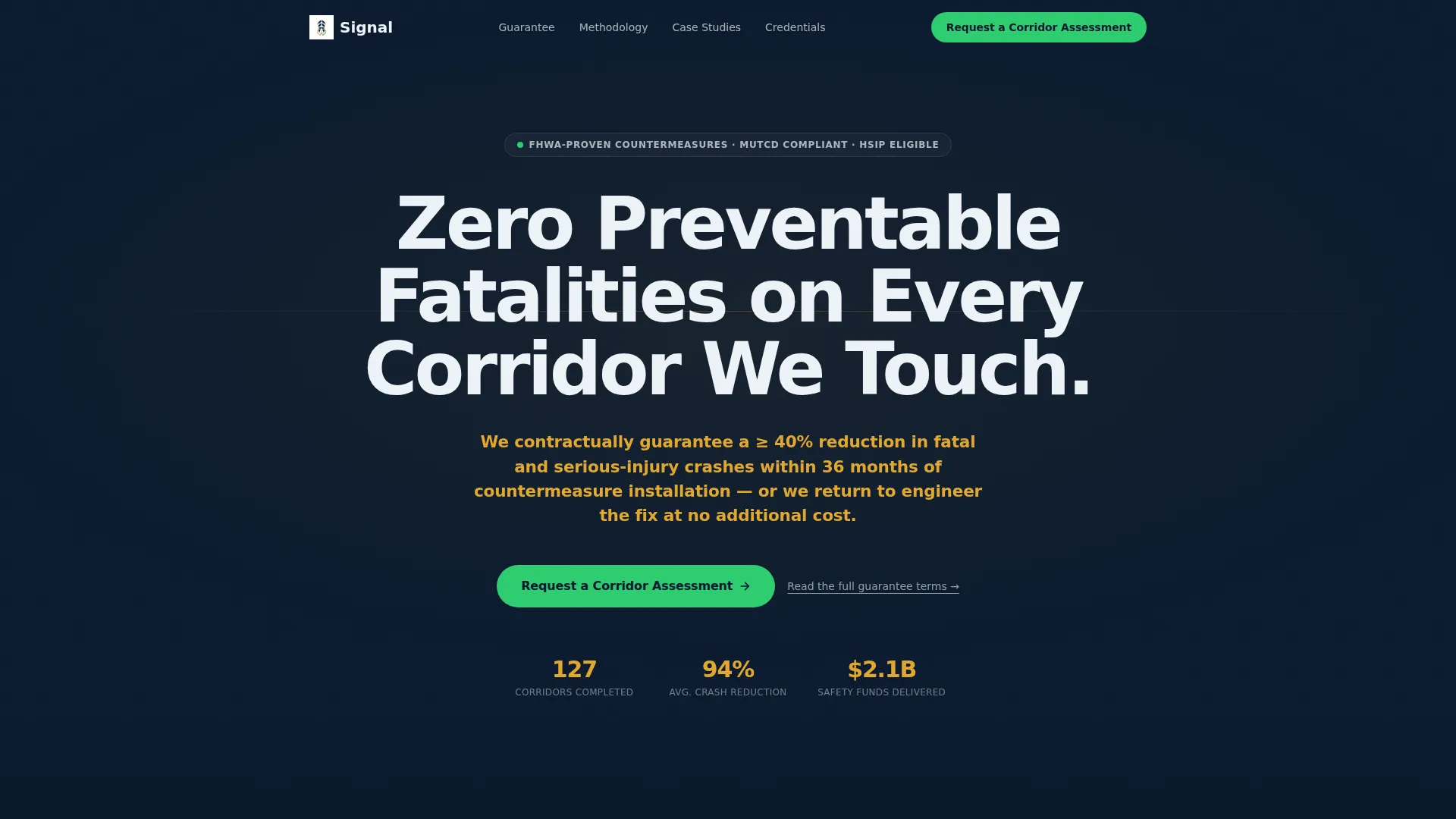
The page opens with a centered, full-width headline on a midnight navy field. White type at maximum weight states the zero-fatalities commitment. A single gold subline displays the measurable crash-reduction percentage backed by the firm's contract terms. Nothing competes with the promise.
Gold-Bordered Guarantee Callout
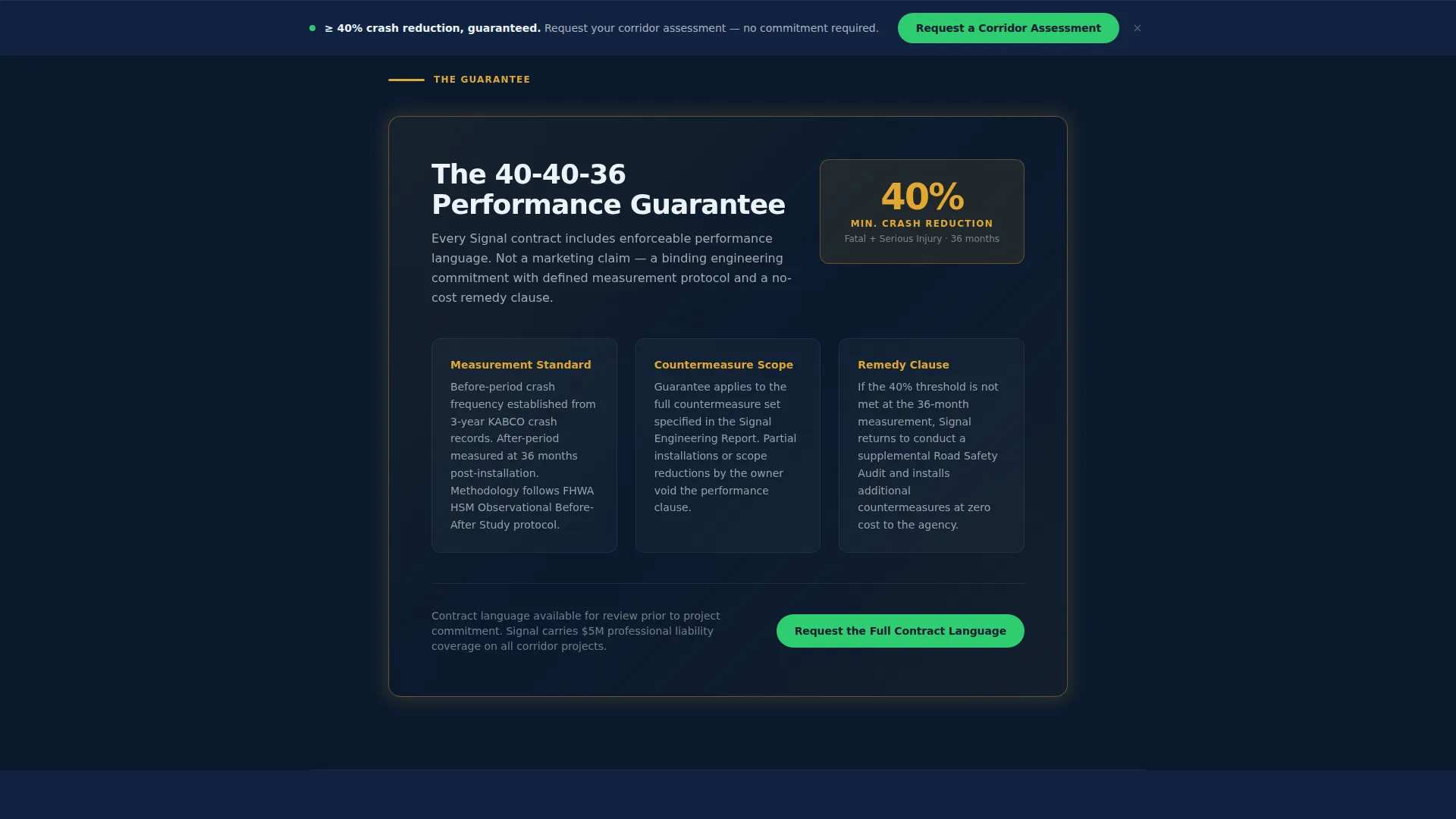
Immediately below the header, a structured callout block frames the guarantee in contractual language. The gold border signals measurability and accountability. This section anchors the entire page's credibility before any methodology is presented.
Engineering Methodology Section
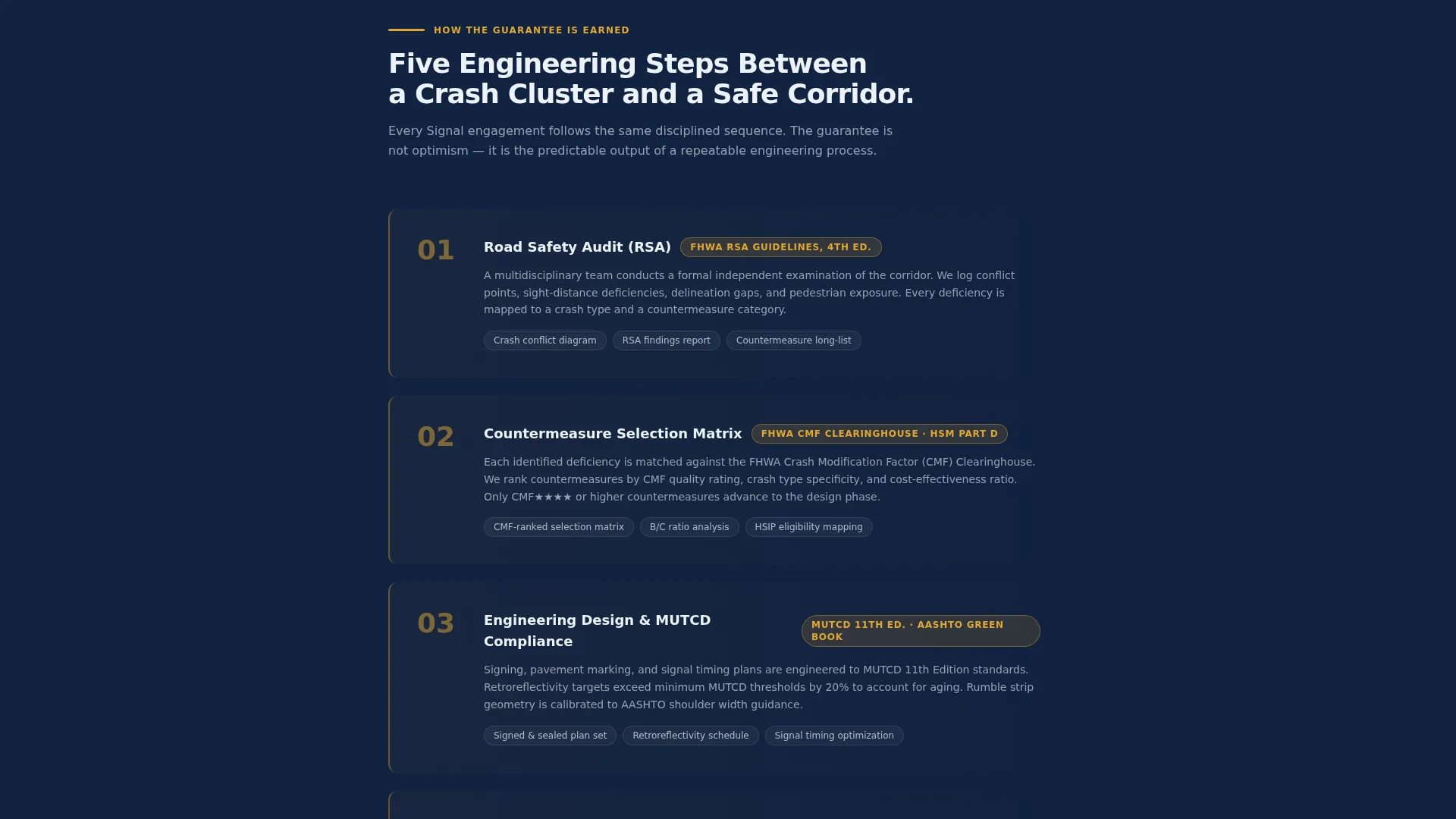
The methodology section breaks the guarantee into its engineering components. It covers RSA processes, countermeasure selection logic, Federal Highway Administration (FHWA)-proven results, Manual on Uniform Traffic Control Devices (MUTCD) compliance citations, and named corridor case studies with documented crash-reduction percentages.
Named Corridor Case Studies
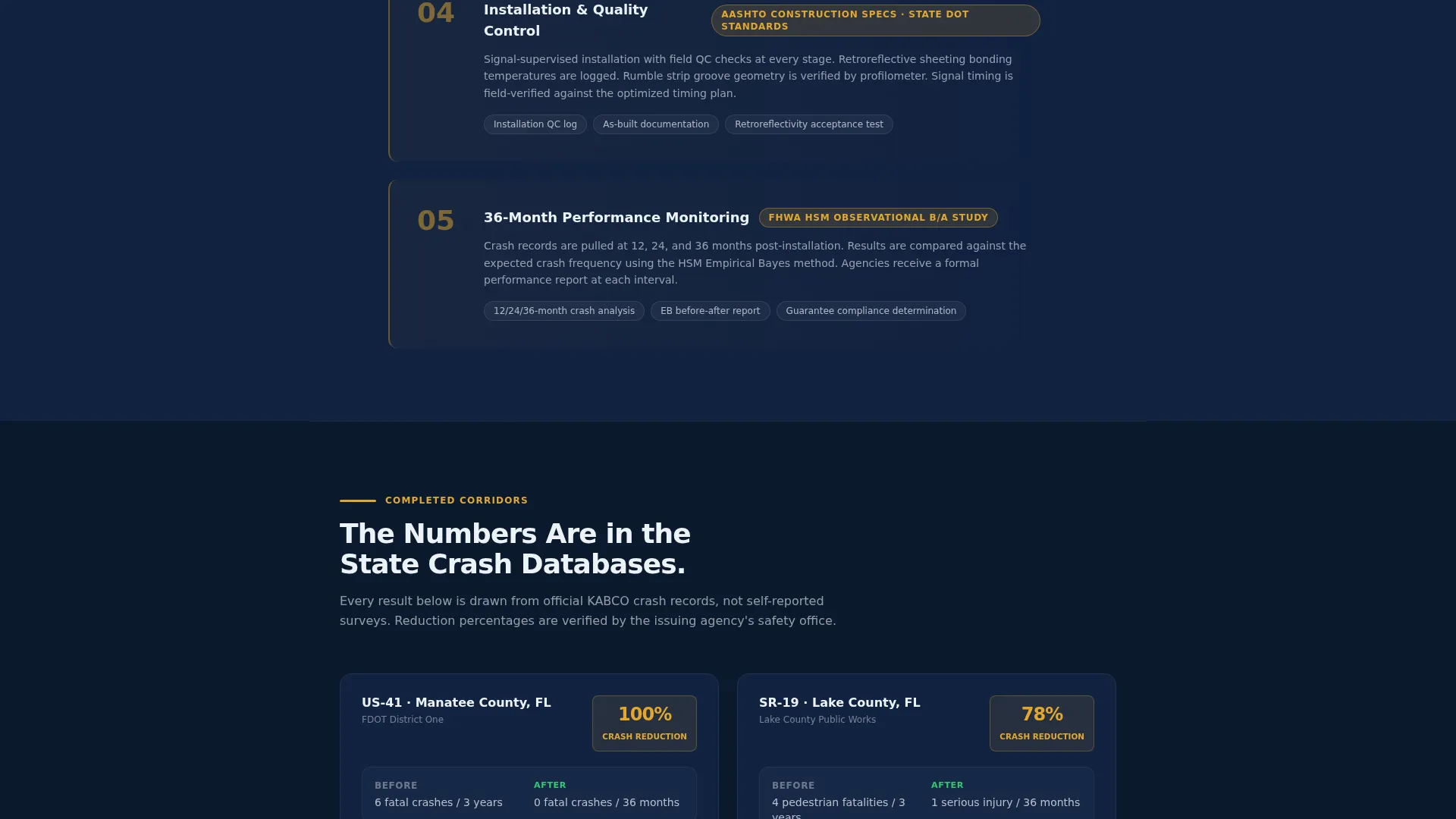
Completed corridor projects appear with specific crash-reduction figures. Each case study stacks real before-and-after data. Skepticism has less room to survive when the proof is project-specific and numerically grounded.
Low-Friction Lead Capture Form
The assessment request form opens with a corridor or intersection location field, the easiest field for an engineer to complete. It then asks for the funding source, choosing from Highway Safety Improvement Program (HSIP), local, or other. Name and agency email follow. No phone number field is included by design.
Persistent Bottom-Bar Call to Action
After the second scroll, a fixed bottom bar keeps the "Request a Corridor Assessment" call to action visible at all times. Engineers who are ready to act do not need to scroll back to the top to find the form.
Page sections overview
| Section | Purpose |
|---|---|
| Header Guarantee Block | Opens with the zero-fatalities headline and gold crash-reduction subline |
| Guarantee Callout Panel | Frames the contractual crash-reduction promise with a gold border |
| Methodology Breakdown | Explains RSAs, countermeasure matrices, and FHWA-proven steps |
| Corridor Case Studies | Shows named projects with documented before-and-after crash data |
| MUTCD Compliance Citations | Builds technical authority through standards references |
| Assessment Request Form | Captures corridor location, funding source, and agency email |
| Persistent Bottom Bar | Keeps the corridor assessment call to action visible on scroll |
Design & branding system
The visual system follows a Corporate Precision theme built on a Midnight Blue color palette. Every color in the system earns its place through function, not decoration.
- Deep command-center navy (#0B1A2E) dominates all backgrounds and section divides, lane-marking gold (#E2A72E) highlights statistics and guarantee badges, and highway-sign reflective white (#EDF2F7) carries all body text and data callouts
- Signal green (#2ECC71) appears exclusively on calls to action and success states, nowhere else on the page
- Typography uses maximum weight for headlines to match the authority of the guarantee, with clean, legible body text that respects the reader's time
Mobile & speed optimization
This template is built as a single-column flow, which naturally adapts to smaller screens without requiring complex breakpoint logic. The layout keeps vertical reading order intact on every device.
- The single-column structure means every section stacks cleanly on mobile without losing hierarchy or visual weight
- The persistent bottom-bar call to action remains functional on touch devices, keeping the assessment form accessible at every scroll position
- Heavy design elements are avoided by design; the dark navy surface and text-forward layout reduce image dependency and keep load behavior predictable
How this template helps you convert
Every structural decision in this template pushes a qualified visitor toward one action: requesting a corridor assessment. The conversion logic is deliberate and sequential.
- The guarantee headline creates immediate differentiation and stops the visitor from bouncing before they read the proof
- The stacked methodology and case study sections resolve the technical skepticism that agency professionals carry into every vendor evaluation
- The frictionless form, opening with location rather than personal information, respects the professional context of the user and increases the likelihood of a completed submission
Other information about this template
This template is designed specifically for the traffic safety consulting and road safety engineering market. It is suited for firms working within federally funded safety programs and county-level road improvement projects.
- The creative direction is Guarantee-Led, meaning the scroll begins with the boldest claim and each subsequent section exists to substantiate it
- The template style follows a single-column flow layout with modular section blocks, making it straightforward to adapt section content for different corridor specializations
- The page type is a landing page, not a multi-page website, which keeps the visitor focused on a single conversion path with no navigation distractions
Theme
Engineering Blueprint
Creative direction
Step-by-Step Guide
Color system
Midnight Blue
Style
Card Grid (Modular)
Direction
Content/Resource
Page Sections
Guarantee-led Header Block
Gold-bordered Guarantee Callout
Engineering Methodology Section
Named Corridor Case Studies
Low-friction Assessment Request Form
Persistent Bottom-bar Call to Action
Related questions
Who is this landing page template designed for?
Can I adapt the case study section for my own completed projects?
Why does the lead form not include a phone number field?
What does the persistent bottom bar do?
Is this template suitable for a firm covering both signage and signal timing services?