Chef & Culinary Personality Booking Website Template
Simmer is a warm, editorial landing page template built for cookbook authors who turn family recipes into published books and bookable cooking events. The modular card grid layout guides visitors through an emotionally layered origin story, from childhood kitchen memories to published work, ending with a clear invitation to book a cooking event or order the cookbook.
by Rocket studio
Quick summary
Simmer is a single-page, card grid landing page template designed for a generational cookbook author. It uses an Organic Flow visual theme, a Sunset Gradient color palette, and a full-screen video hero to pull visitors into an origin story that earns trust before asking for any action. The page closes with an inline booking form and a quiet cookbook order path beside every book card.
Who this template is for
This template is built for cookbook authors whose recipes carry real family history and whose work lives next to the stove, not on a display shelf. It suits creators who want to book cooking events and sell published cookbooks from a single, beautifully designed page.
- Generational cookbook authors who want to share the story behind their recipes as confidently as they share the recipes themselves
- Home cooks and self-published food writers who have finally decided to present their craft with a professional, editorial identity
- Culinary personalities who book private dinners, cooking demonstrations, or book signings and need one page that handles all three
What problem this template solves
Most cookbook authors lose potential bookings because their online presence feels either too corporate or too plain. Visitors land on a page, notice no real story, and leave before they ever talk to the author. This template solves that by building trust through narrative before presenting any call to action.
- It replaces cold inquiry forms with a warm, chapter-by-chapter origin story that makes visitors feel they already know the chef
- It removes the need for separate event booking pages and cookbook sales pages by combining both paths into one cohesive flow
- It gives food editors and event planners the visual confidence and social proof they need to decide quickly
What you get with this template
You get a fully structured, section-led landing page with a modular card grid layout and high-interactivity components. Every section is designed to fill a specific role in the author's story, from the first frame of video to the final booking form.
- A full-screen video hero with a hand-lettered quote fade-in, a sticky "Book a Cooking Event" call-to-action button, and warm saffron and persimmon color treatments across all interactive states
- Five named content sections: the video hero, an Origin Story card cluster covering childhood and craft, a Books and Press section with inline "Order the Cookbook" buttons, an Events and Booking section with an inline scheduling form, and a split-layout footer
- GSAP ScrollTrigger animations including staggered card reveals, a magnetic call-to-action button, and a grain overlay that gives the page the texture of aged parchment
Feature list
This template is packed with thoughtful, prompt-backed capabilities. Each feature serves the cookbook author's goal of turning a family archive into a bookable, sellable culinary experience.
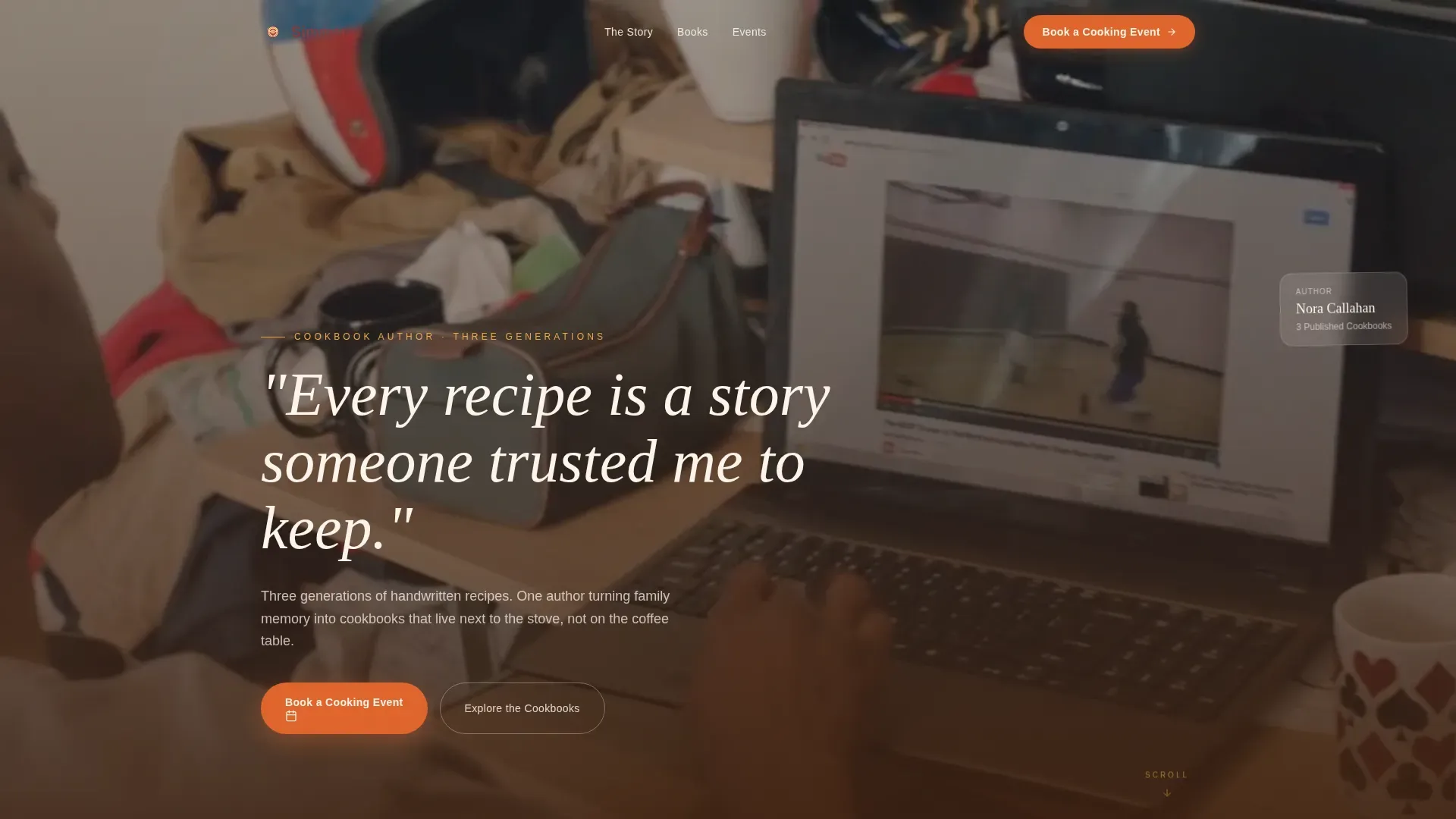
Full-Screen Video Hero with Inline Quote
The header runs a warm-graded, slow handheld video of kitchen scenes: hands tearing basil, flour dusting a leather-bound notebook, steam curling off a pot. A single hand-lettered line fades in over the footage. The effect feels like a memory you can taste, and it sets the emotional tone for every section that follows.
Modular Bento Card Grid with Origin Story Flow
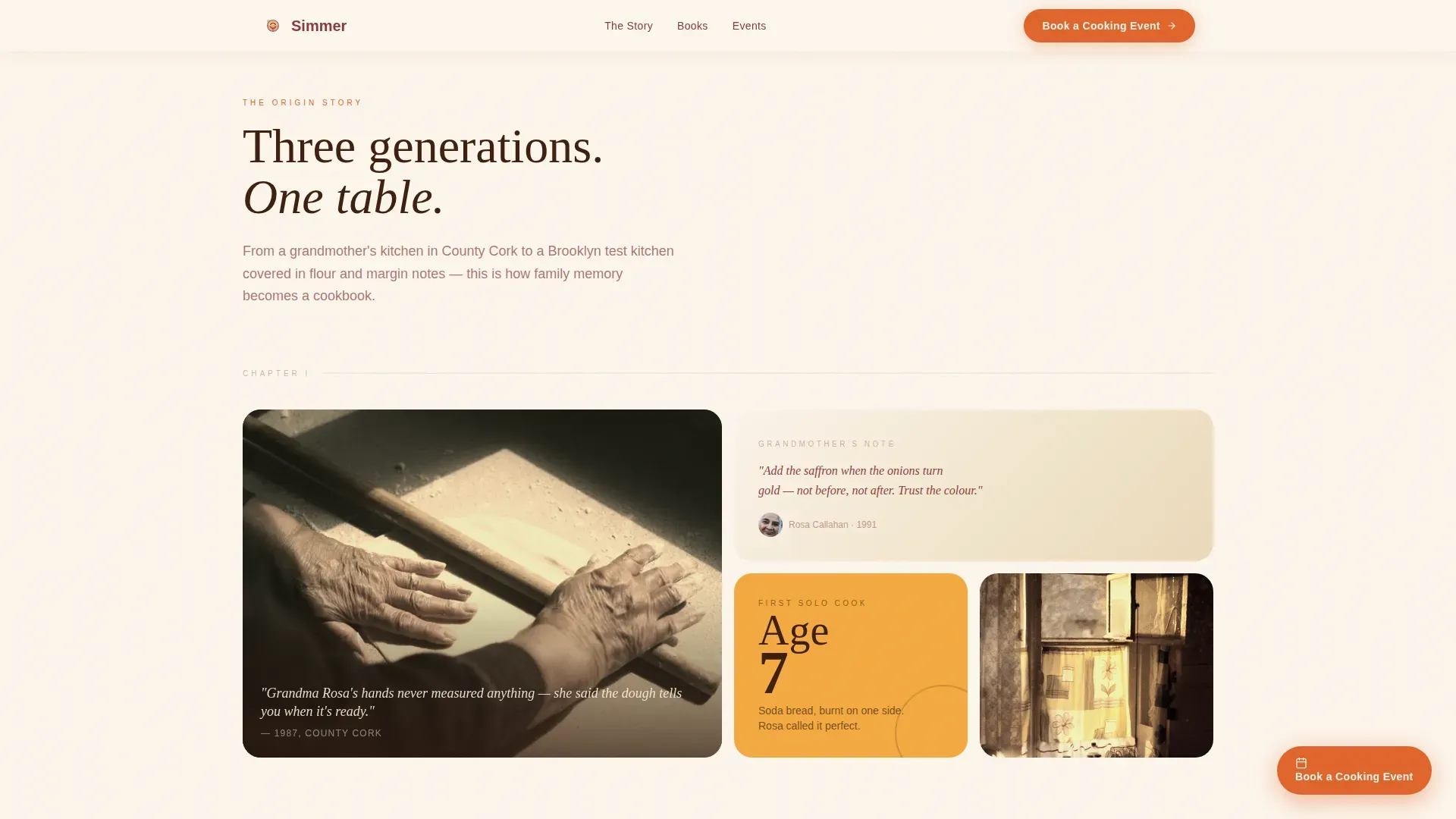
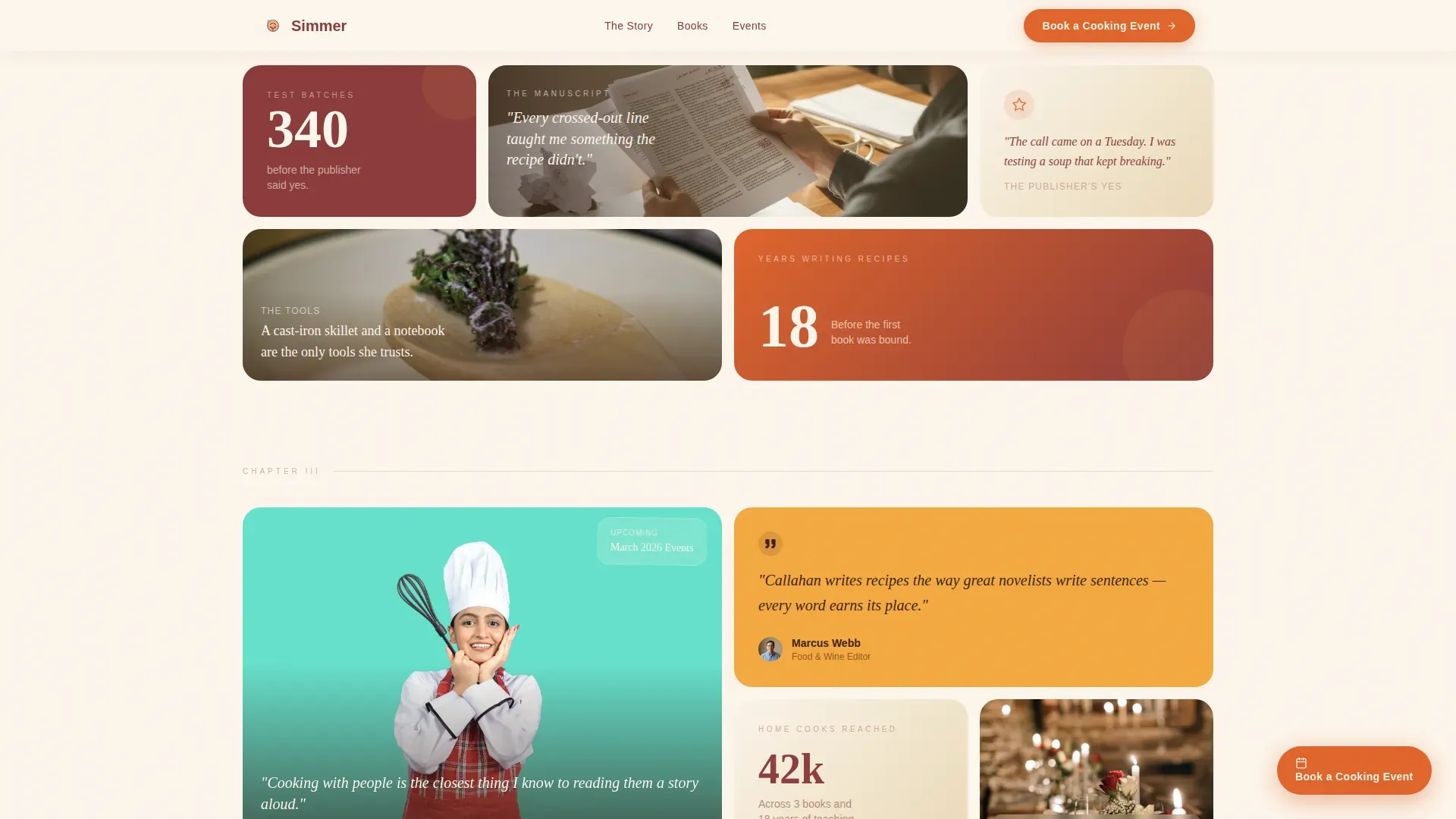
Below the hero, the page unrolls like the pages of a well-loved cookbook. Sepia-toned childhood photos sit beside a handwritten grandmother's note and the first dish cooked alone. The next card cluster covers craft: test kitchen failures, manuscript pages covered in red ink, the moment a publisher said yes. Cards vary in height and width on purpose, mimicking the organic rhythm of flipping through a book with dog-eared pages.
Inline Booking Form with Event Type Selector
The Events and Booking section contains an inline scheduling form with four fields: event type selector (private dinner, demo, or book signing), a guest count slider, a date picker in MM/DD/YYYY format, and a textarea labeled "Tell me about your gathering." No redirect. No cold corporate inquiry. The form keeps the conversation warm and personal from the first cup of coffee to the final confirmed date.
Sticky and Full-Width Call-to-Action Placement
The primary "Book a Cooking Event" call to action appears twice. First as a sticky button after the second scroll fold, then again as a full-width card at the story's end. The secondary "Order the Cookbook" path sits as a quieter persimmon-outlined button beside each book card, giving readers a free choice between booking and buying without one path overwhelming the rest.
GSAP ScrollTrigger Animations and Grain Overlay
Staggered card reveals fire as the visitor scrolls through each story cluster. The call-to-action button uses a magnetic interaction on hover. A subtle grain overlay runs across the full page, giving the parchment cream background the feel of unwritten paper. These animations are designed for a desktop-first audience, including food editors who research on larger screens.
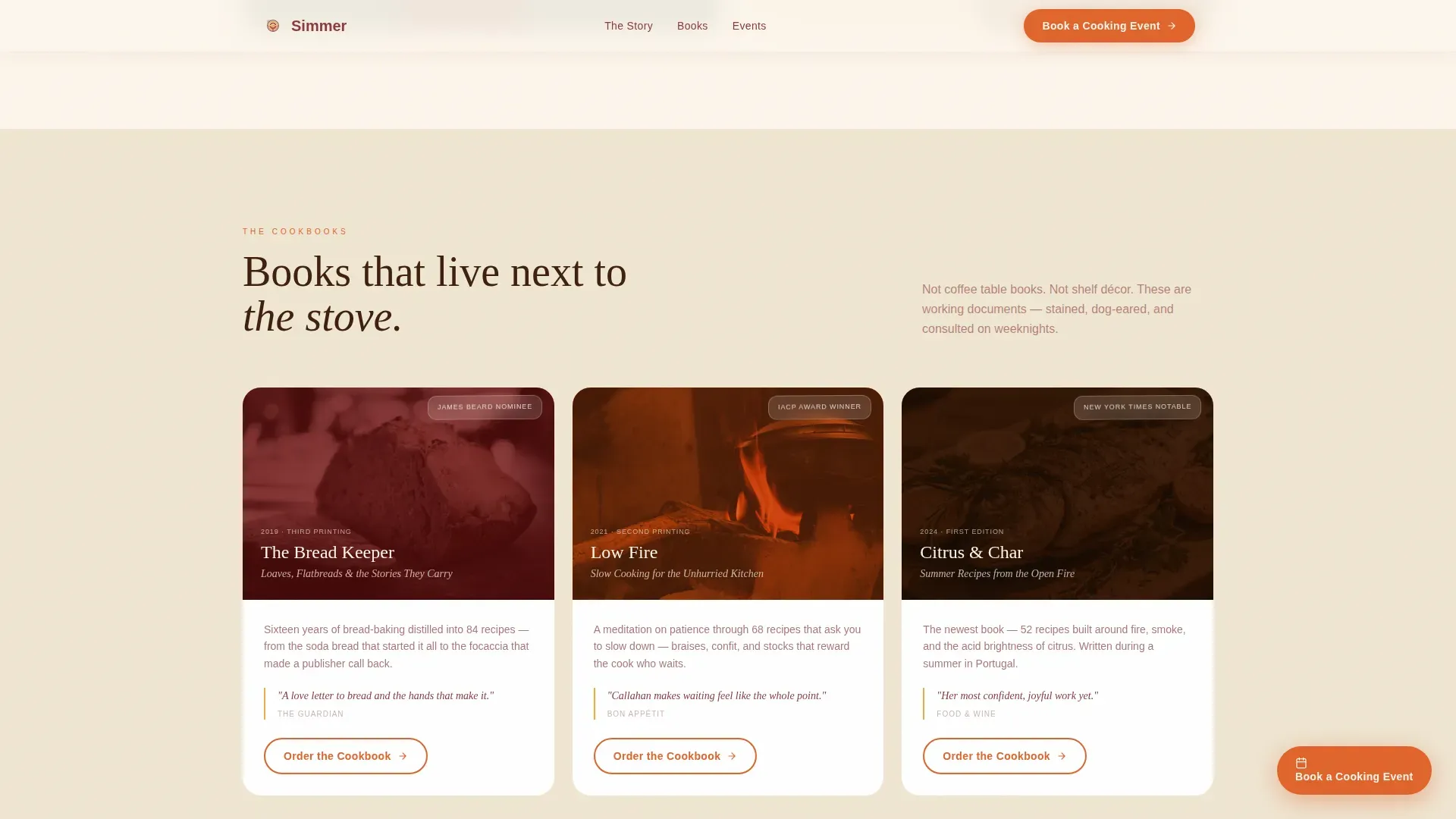
Books and Press Section with Pull Quotes
Book covers, press logos, and pull quotes from published reviews fill a dedicated section. Trust signals like expert blurbs, event testimonials, and media mentions are displayed clearly. The idea is to dish out social proof in the same storytelling rhythm as the rest of the page, so by the time a visitor reaches the booking form, the decision already feels made.
Page sections overview
| Section | Purpose |
|---|---|
| Video Hero | Introduce the author with warm footage and a hand-lettered quote |
| Origin Story Childhood | Sepia card cluster covering grandmother's recipes and first dish |
| Craft Story Cards | Manuscript pages, test kitchen failures, publisher milestone |
| Books and Press | Book covers, pull quotes, and "Order the Cookbook" buttons |
| Events and Booking | Event types, past snapshots, and inline scheduling form |
| Sticky Call to Action | Persistent booking button active after the second scroll fold |
| Full-Width call to action Card | Final booking invitation at the end of the story scroll |
| Split Footer | Logo and tagline left, navigation links right |
Design & branding system
The visual identity follows an Organic Flow theme rooted in farmhouse warmth and editorial cookbook aesthetics. The Sunset Gradient color system draws from the last hour of golden light spilling across a flour-dusted worktop scattered with citrus peels and spices.
- Four core colors anchor every decision: parchment cream (#FDF6EC) as the background, soft saffron (#F4A940) for headlines and hover states, ripe persimmon (#E0642B) for primary actions, and dusted rosewood (#8B3A3A) for body text with the weight of old ink on a recipe card
- Typography pairs Fraunces serif headings with DM Sans body text, giving the page the feel of a beautifully published cookbook opened to its first chapter
- Colors deepen progressively as the scroll moves forward, warming from cream and saffron in the childhood cards toward persimmon and rosewood in the Books and Press section, building visual confidence as the story builds
Mobile & speed optimization
The template is designed desktop-first to match the research habits of food editors and event planners who prefer larger screens for reviewing author profiles. The layout is fully responsive so home cooks browsing on a phone can still access every section and fill out the booking form without friction.
- The video hero is lazy-loaded to reduce the initial page weight, and static sections are built with Server Components to keep the rest of the page snappy
- Staggered card animations are handled by GSAP ScrollTrigger, which only triggers each element when it enters the viewport, keeping scroll performance smooth on both desktop and mobile
How this template helps you convert
The page is engineered to earn the click before it asks for one. Every scroll fold adds a bit more trust, so by the time the booking form appears, the visitor already feels like a friend who has read the whole cookbook.
- The video hero and hand-lettered quote create an immediate emotional connection, giving visitors a reason to keep scrolling before they ever see a call to action or a price
- The origin story card grid, moving from childhood through craft to published work, mirrors the natural way a reader builds trust in an author, making the eventual booking or purchase feel like a natural next step rather than a sales moment
Other information about this template
This template is a strong fit for cookbook authors inspired by the kind of generational storytelling seen across the food writing world, where authors connect recipes to memories, genealogy, and cultural identity. Traditional heritage recipes often reflect the cultural history and practices of a community, and many recipes passed down through generations preserve culinary heritage in ways that plain ingredient lists never could.
- Heritage recipes can vary significantly based on regional ingredients and cooking methods, so the template's flexible card grid lets you feature a savory slow-roasted chicken dish alongside a sweet pumpkin dessert, a bowl of spiced corn soup, or tender beef ribs with garlic and onion without forcing every card into the same mold
- The page supports the full range of a cookbook author's catalog: from recipes built around butter, flour, eggs, and sugar to more adventurous combinations using bacon, pork, rice, carrots, or seasonal fruits, all sitting naturally within the editorial card layout
- Cultural identity is often expressed through traditional cooking techniques and recipes, and this template gives those stories the visual space to breathe, whether the focus is a single food group, a geographic region, or a mix of savory and sweet across the whole cookbook
- Authors who have decided to self-publish maintain full creative control, and the self-publishing process can involve revisions and a bit of feedback before the work is finally ready; this template is built to display the result of that process with confidence
- The simmer warm heritage cookbook author landing page template is the right choice for any food writer who wants to get their creative juices flowing and build a site that feels as warm and tasty as the cooking it represents
- Authors can link out to retailers, post updates about new cookbook releases, and talk directly to readers through the booking form, all from one page
- The Organic Flow theme and Sunset Gradient palette provide fantastic visual resources for cookbook authors who want their page to feel as inspiring as the world inside their published books
- Women who cook, write, and teach from a place of personal history will find the template's tone and structure a natural fit for their voice and their audience
Theme
Organic Flow
Creative direction
Origin Story
Color system
Sunset Gradient
Style
Card Grid (Modular)
Direction
Booking/Scheduling
Page Sections
Full-screen Video Hero with Quote Fade-in
Modular Bento Card Grid Origin Story
Inline Booking Form with Event Selector
Sticky and Full-width Call to Action Placement
GSAP Scrolltrigger Animations
Books, Press, and Social Proof Section
Related questions
Can I use this template to sell my cookbook and book events at the same time?
Does the inline booking form support different event types?
Is this template suitable for a first-time cookbook author or only established chefs?
What makes the visual design feel different from a standard food blog?
Can this template support a heritage cookbook that covers multiple recipe categories?