Specialist Pathology Medicine Appointment Booking Website Template
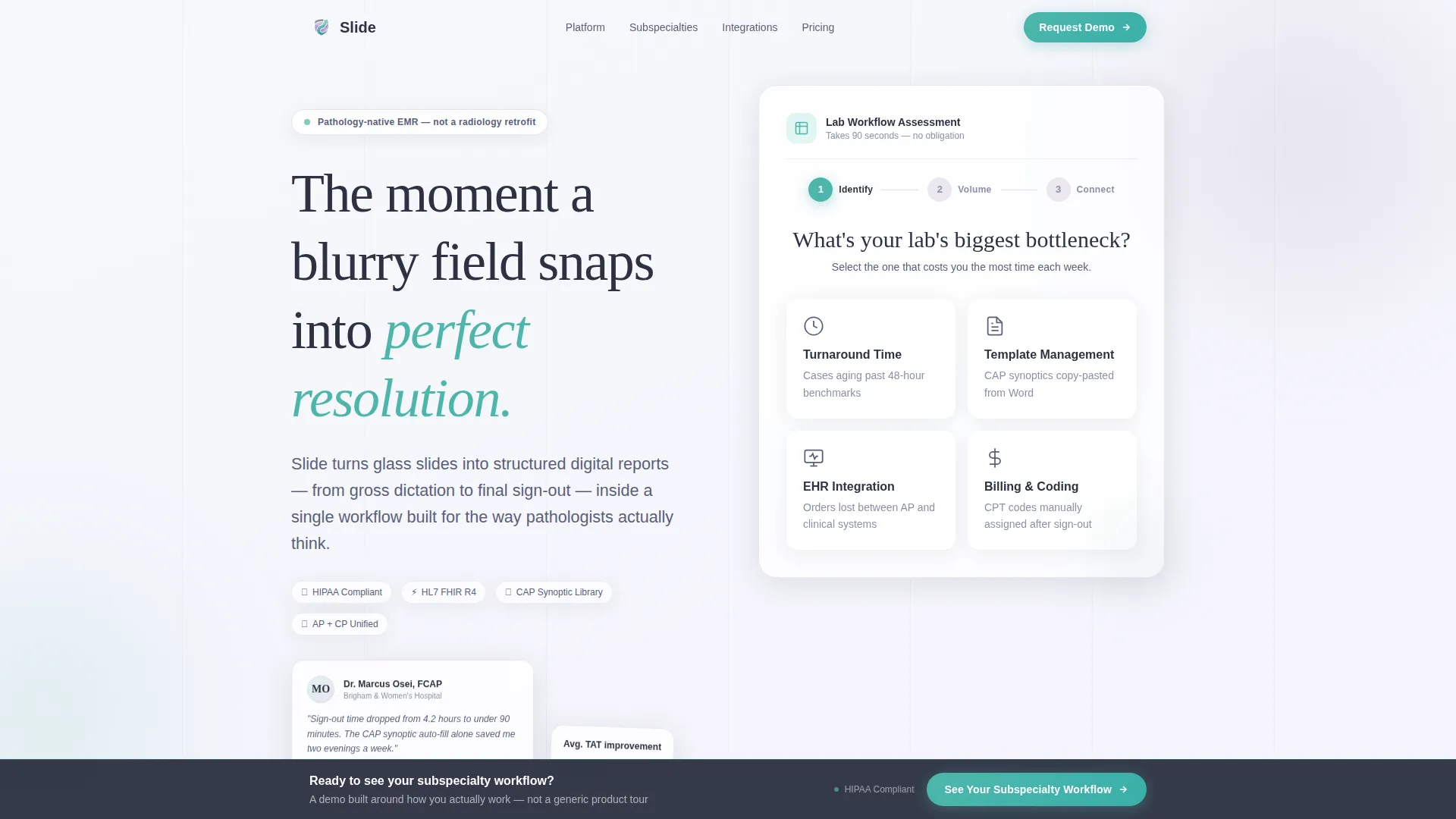
Slide is a single-column landing page template built for pathology EMR and software platforms. It opens with a multi-step diagnostic form, then walks visitors through subspecialty-specific expert panels. The Soft Mist color system and glassmorphism card styling create a clinical yet calm visual experience. It is designed to convert lab directors, pathologists, and hospital IT leads into booked demo requests.
by Rocket studio
Quick summary
Slide is a lead generation landing page template for pathology EMR and software platforms. It combines an interactive multi-step form with subspecialty expert panels to move visitors from self-identified pain point to demo request. The design uses a fog-lifting gradient palette and Fraunces serif headings to feel clinical without feeling cold.
Who this template is for
This template is built for healthcare technology companies and software vendors serving the pathology market. It speaks directly to the real frustrations of lab-side professionals and hospital IT teams.
- Lab directors and private practice pathologists who need a workflow purpose-built for anatomic and clinical pathology
- Pathology subspecialists in surgical pathology, dermatopathology, cytology, and molecular pathology seeking subspecialty-specific demo offers
- Hospital IT leads responsible for integrating anatomic pathology and clinical pathology systems under one platform while maintaining Health Insurance Portability and Accountability Act compliance
What problem this template solves
Pathology teams are stuck using systems designed for radiology and patched together over time. The result is evening hours lost to copy-pasting synoptic templates, fragmented electronic health record connections, and no clean path from gross dictation to final sign-out.
- Generic software landing pages fail to speak to pathologists by subspecialty, leaving high-intent visitors without a reason to stay
- Standard hero-and-call to action layouts do not let visitors self-qualify, which means sales teams receive low-context leads
- Stock-photo medical pages erode trust with specialist audiences who expect clinical precision in every detail
What you get with this template
This template delivers a fully structured single-column flow page with interactive components and a cohesive visual system ready to customize.
- A three-step lead capture form that opens the page, built around bottleneck selection, case volume input, and contact details
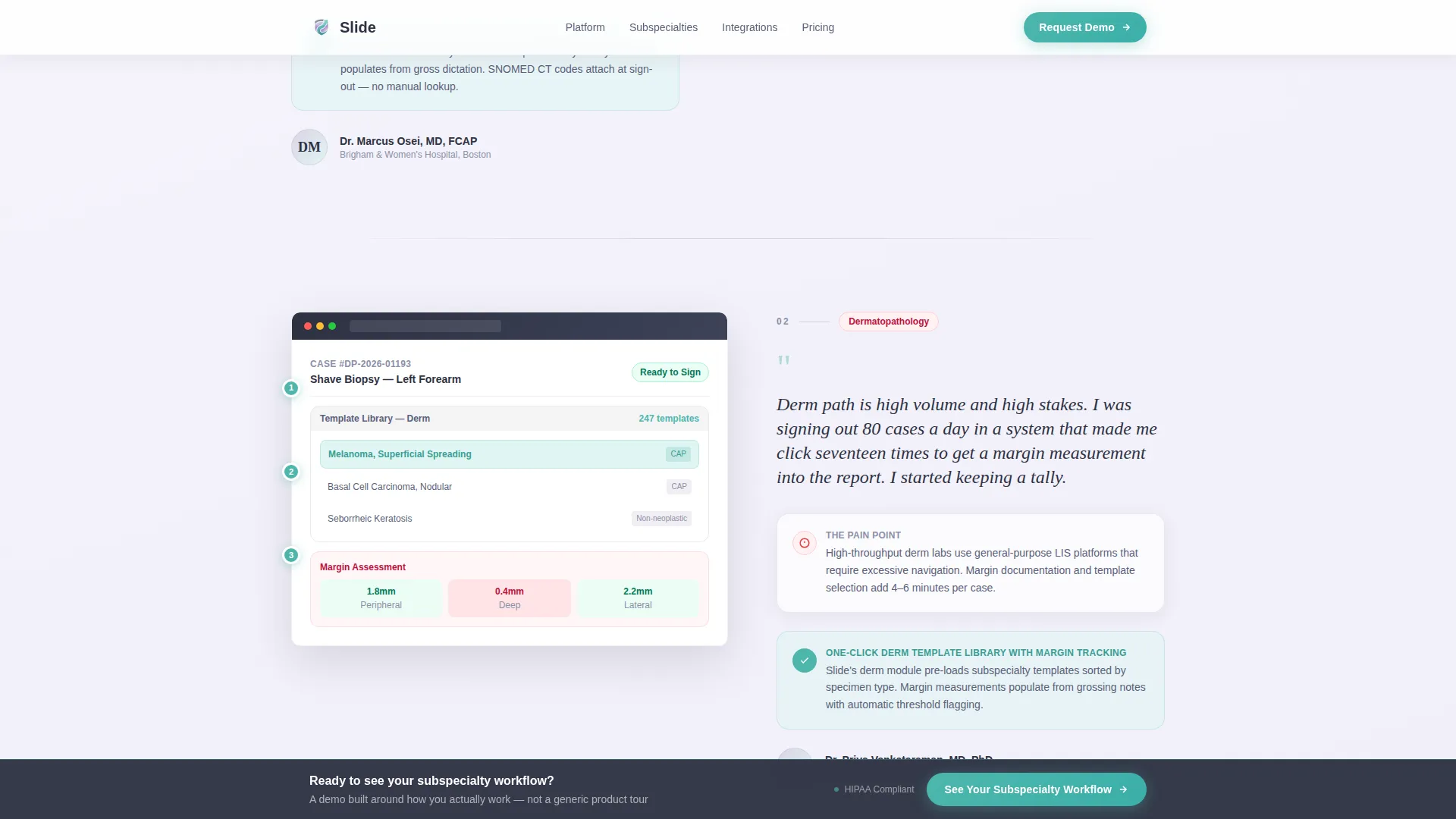
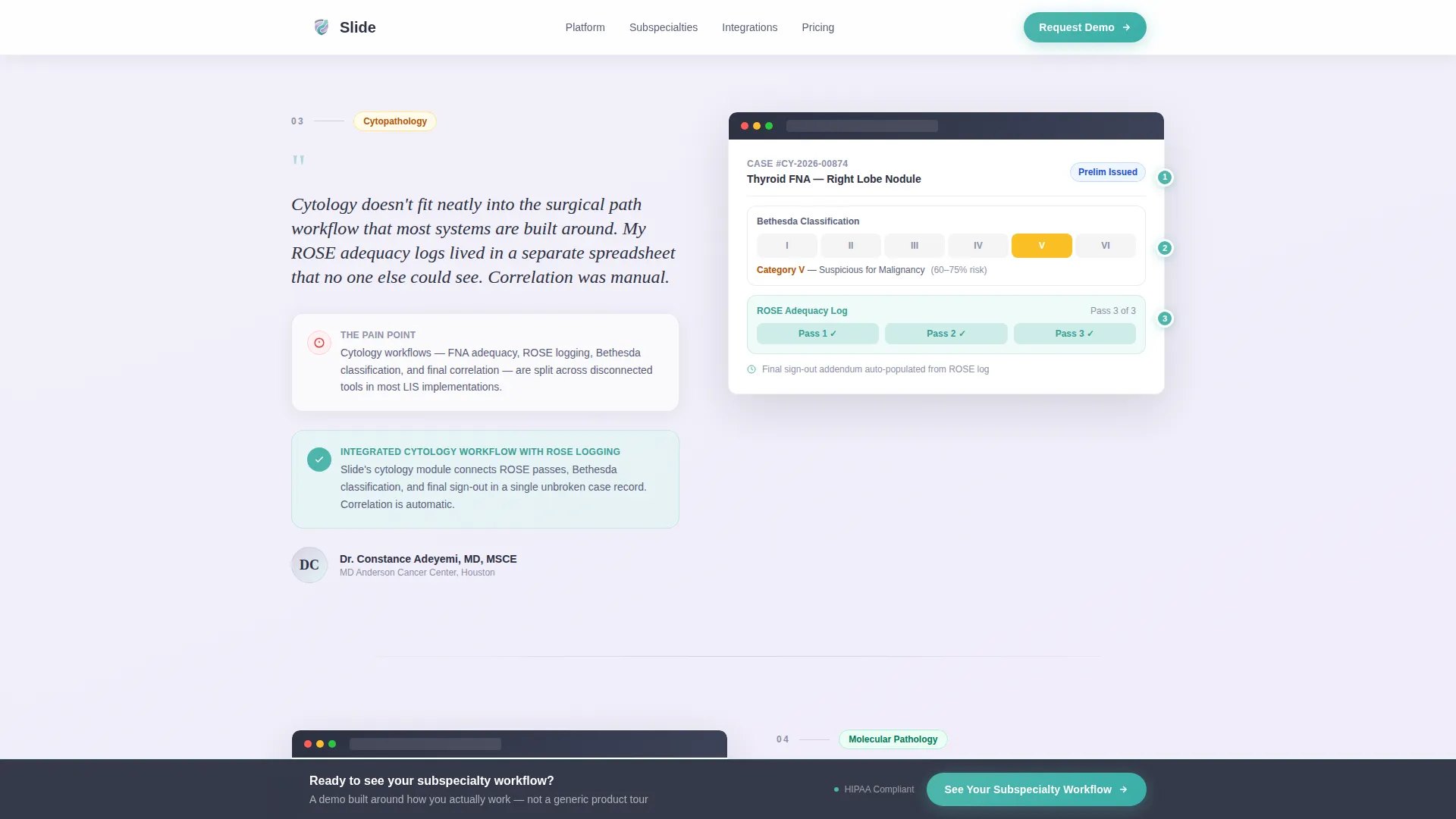
- Four subspecialty expert panels with first-person case study framing and annotated user interface screenshot placeholders
- A persistent bottom call-to-action bar that reappears after the third expert panel and re-opens the form pre-filled with the visitor's earlier selection
Feature list
This template packages several purpose-built components that work together to earn trust and capture qualified leads from a specialist audience.
Three-Step Diagnostic Form Header
The page opens immediately with a multi-step form. Step one presents four bottleneck cards: Turnaround Time, Template Management, EHR Integration, and Billing and Coding. Step two uses a slider for daily case volume. Step three captures name, institution, and email. No hero image, no stock photography.
Subspecialty Expert Panels
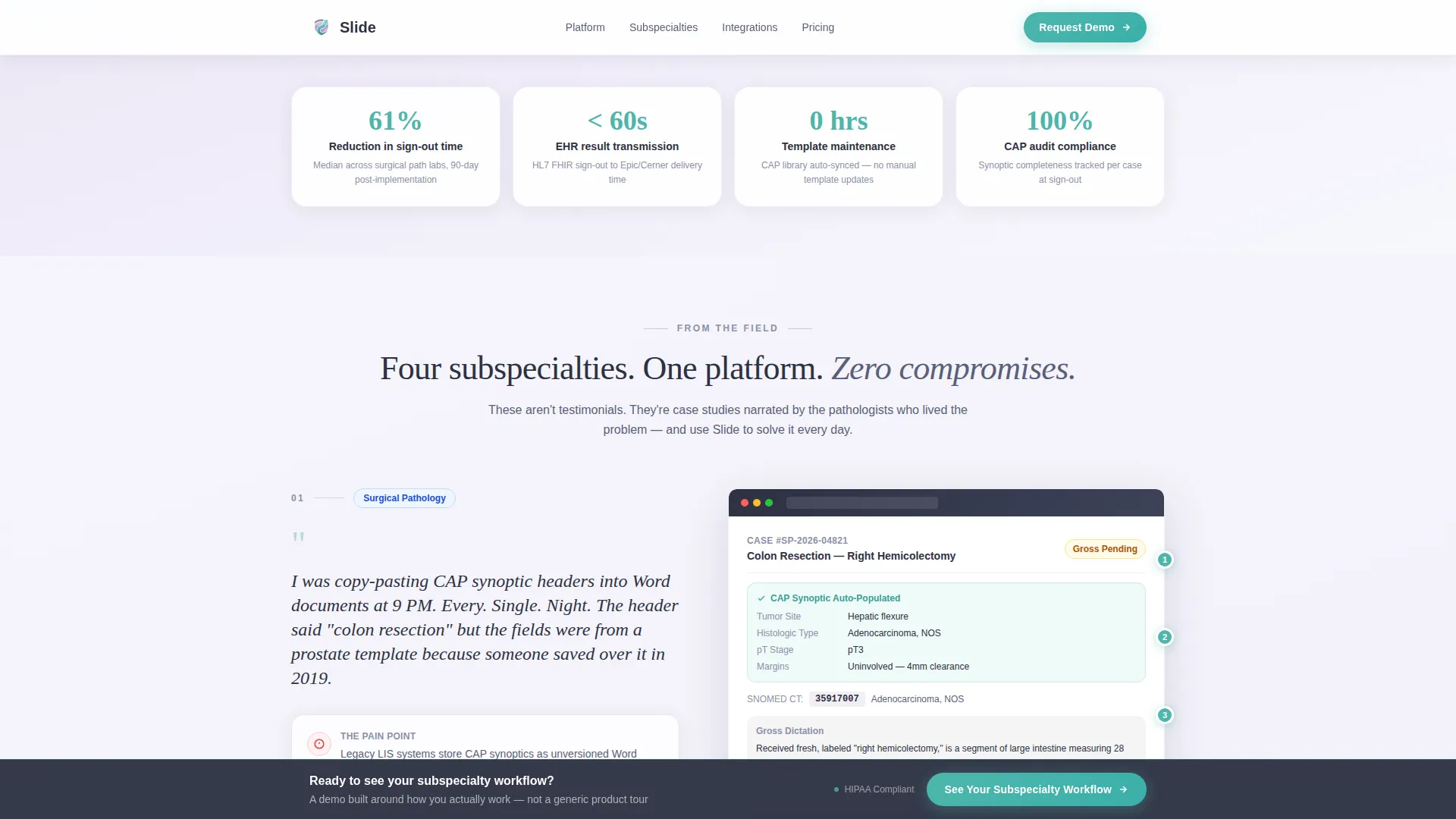
Four scroll-reveal panels each feature a named specialist voice in surgical pathology, dermatopathology, cytology, or molecular pathology. Each panel reads as a first-person mini case study paired with an annotated user interface screenshot placeholder. The accumulation of specific, peer-level voices builds credibility across the scroll.
Persistent Demo Request Bar
After the third expert panel, a bottom bar re-enters the viewport and stays visible. It carries the call to action "See Your Subspecialty Workflow." Clicking it reopens the form pre-filled with the visitor's bottleneck selection and adds a phone number field plus a preferred demo time picker.
Glassmorphism Card Styling
Section cards use a glassmorphism treatment: frosted-glass depth, soft shadows, and subtle layering. This keeps the visual system feeling modern and tactile without relying on photography or illustration-heavy design.
Integration and Compliance Section
A dedicated section covers Health Level Seven Fast Healthcare Interoperability Resources (HL7 FHIR) integration, Systematized Nomenclature of Medicine (SNOMED) coding, anatomic and clinical pathology unification, and Health Insurance Portability and Accountability Act compliance context. This section addresses the concerns of hospital IT decision-makers directly.
Metrics Strip
A concrete efficiency strip sits between the expert panels and the persistent call-to-action bar. It is designed to hold turnaround time improvements and workflow efficiency figures that validate the platform's claims with real numbers.
Page sections overview
| Section | Purpose |
|---|---|
| Multi-Step Form Header | Captures bottleneck selection, case volume, and contact details across three steps |
| Subspecialty Expert Panels | Four first-person case study panels with annotated user interface screenshot placeholders |
| Integration and Compliance | Highlights HL7 FHIR, SNOMED, AP/CP unification, and HIPAA context |
| Metrics Efficiency Strip | Displays concrete turnaround and workflow improvement figures |
| Persistent call to action Bar | Reappears after panel three with subspecialty-scoped demo request form |
| Linear Footer | Single-row footer with essential links and contact information |
Design & branding system
The visual identity uses a Soft Mist color system that feels like morning light in a clean laboratory. Every gradient shift between sections is intentional and subtle, guiding the eye without interruption.
- Color palette: cloud white (#F7F8FC) to pale lavender (#EDE7F6) background, deep graphite (#2D3142) body text, diffused lilac (#B8A9C9) section dividers, and teal (#4DB6AC) call-to-action buttons
- Typography: Fraunces serif for headlines to add warmth and authority, DM Sans for body text and user interface labels for clean readability
- Visual style: glassmorphism floating cards, scroll-reveal panel animation, no stock photography, form step transition animations
Mobile & speed optimization
The template is designed desktop-first to match the primary context of pathologists working at clinical workstations. It is built to scale responsively to tablet viewports as well.
- Interactive components including the multi-step form, case volume slider, and persistent bottom bar use client-side rendering only where interactivity is required
- Scroll-reveal animations and floating card depth effects are scoped to medium intensity to keep motion purposeful without slowing perception
- The static-first build approach keeps the base page lightweight, loading full interactivity only for the form elements that need it
How this template helps you convert
The conversion strategy is embedded in the page structure itself. Every section earns the next click rather than demanding it upfront.
- The multi-step form turns the first interaction into a self-diagnostic exercise. Visitors categorize their own lab's pain point before they read a single product claim, creating personal investment from the first second on the page.
- The expert panels validate the platform through peer voices in four subspecialties, moving from general workflow gains to specific features like built-in SNOMED coding and auto-populated tumor staging. Trust accumulates with every panel.
- The persistent bottom bar re-enters at the right moment with a subspecialty-scoped demo offer. Because the form is pre-filled and the ask is targeted, the step to booking a demo feels small and specific rather than generic.
Other information about this template
This template is category-matched to the Health and Medical vertical, specifically the Pathology Medicine subcategory and the pathology EMR and software niche. It is suited for B2B SaaS and Healthcare IT vendors building enterprise sales pipelines.
- Template style: Single Column Flow, optimized for a focused, distraction-free reading path
- Theme: Soft Gradient with the Soft Mist color system for a clinical-calm visual tone
- Header concept: Multi-Step Form, replacing traditional hero sections with an interactive lead qualifier
- Creative direction: Expert Panel scroll experience that builds subspecialty credibility section by section
- Landing page direction: Lead Generation, with the header form as primary conversion point and the persistent bar as secondary
- Localization: English language, United States date format, USD pricing context
Theme
Soft Gradient
Creative direction
Expert Panel
Color system
Soft Mist
Style
Single Column Flow
Direction
Lead Generation
Page Sections
Three-step Diagnostic Form Header
Subspecialty Expert Panel Scroll
Persistent Subspecialty Demo Bar
Integration and Compliance Section
Metrics Efficiency Strip
Glassmorphism Card Visual System
Related questions
Who is this landing page template designed for?
Can I customize the bottleneck categories in the multi-step form?
Does this template include real expert panel content?
What happens when a visitor clicks the persistent bottom bar call to action?
Is this template suited to a desktop-first pathology audience?