Smart Water Filtration | Free Website Template | Rocket
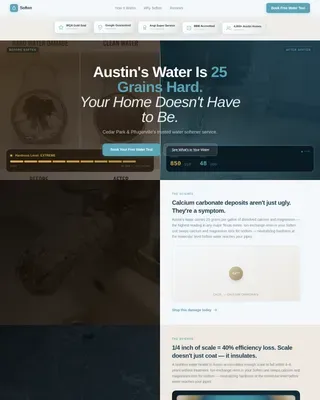
The Soften landing page template is built for Nairobi water softener services targeting homeowners, facility managers, and hotel operators dealing with aggressive hard water. It uses a boardroom-dark Executive Suite design with a seven-metric comparison table, a live cost calculator, and a stats-first scroll flow to convert cautious buyers into confident leads through data, not persuasion alone.
by Rocket studio
Quick summary
The Soften template is a single-page, data-led landing page designed for professional water softener services operating in hard water markets. It leads with a typographic manifesto, delivers a seven-metric water softener comparison chart, and follows with a live cost calculator and social proof. Every section is engineered to move a sceptical buyer toward one action: booking a free water test.
Who this template is for
This template is built for service businesses that need to convert educated, cost-aware buyers. It suits operators who serve residential and commercial clients dealing with measurable hard water damage. The design and copy framework assumes buyers already feel the problem and need financial evidence to act.
- Water softener service providers targeting luxury residential postcodes
- Facility managers and commercial property operators dealing with scale buildup on boilers and plumbing systems
- Hotel and hospitality operators whose guests notice hard water effects on skin, hair, and laundry quality
What problem this template solves
Hard water is invisible until it is expensive. Calcium and magnesium deposits accumulate quietly inside tank heaters, along pipes, and across fixtures, then announce themselves through failed appliances and rising plumbing bills. Most service landing pages describe this problem softly. This template confronts it with numbers.
- Buyers arrive knowing water hardness is an issue but needing a financial case to justify investment
- Standard water softeners pages bury the comparison data that actually closes the sale
- Visitors need to compare untreated borehole water against softened water across real metrics before they trust a service
What you get with this template
You get a fully structured, single-page layout that takes a hard water service from problem statement to booking confirmation. Every section has a defined role. The design does not waste scroll depth on decoration. It uses every pixel to build a financial and sensory case for water softening.
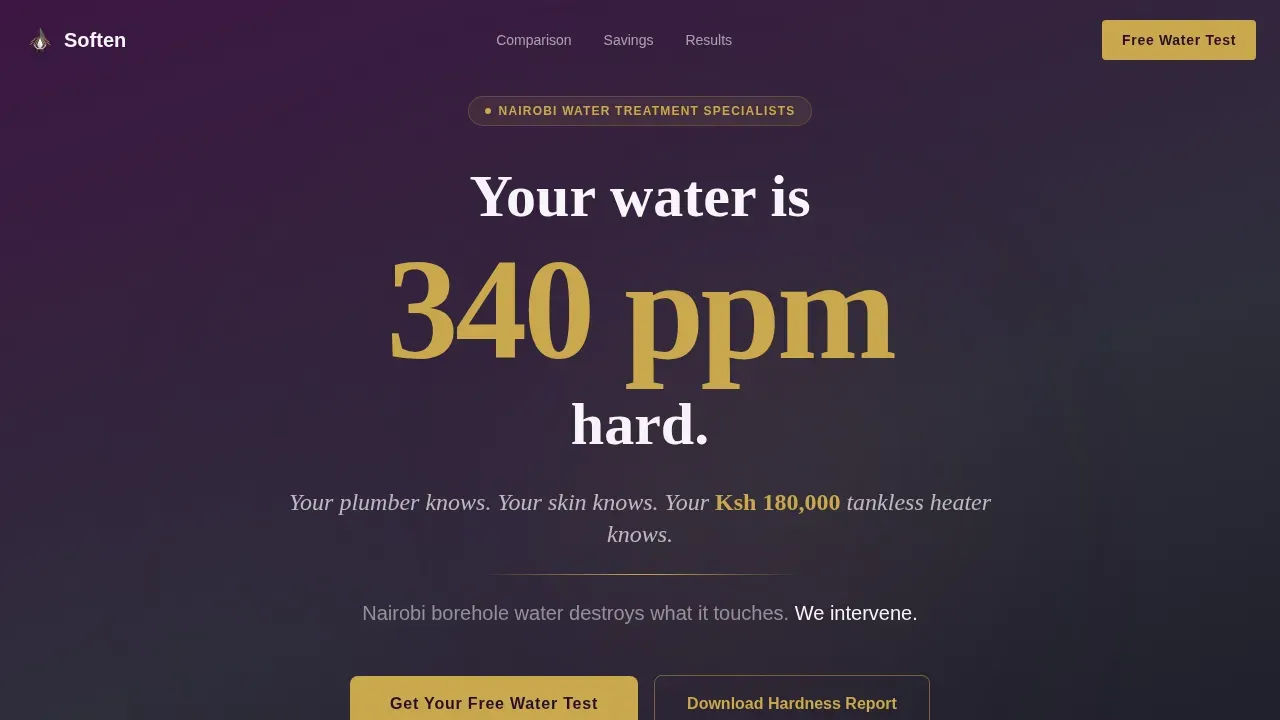
- A hero manifesto section with gold-highlighted hardness figures and a primary call-to-action button
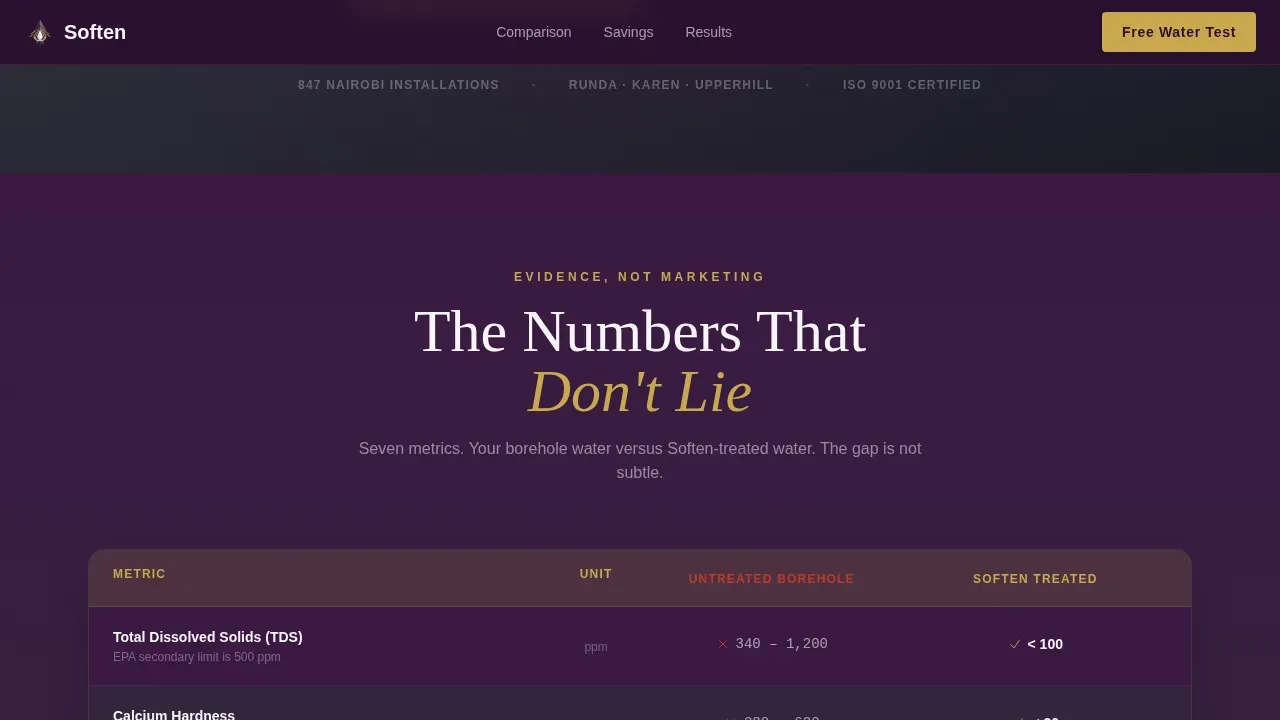
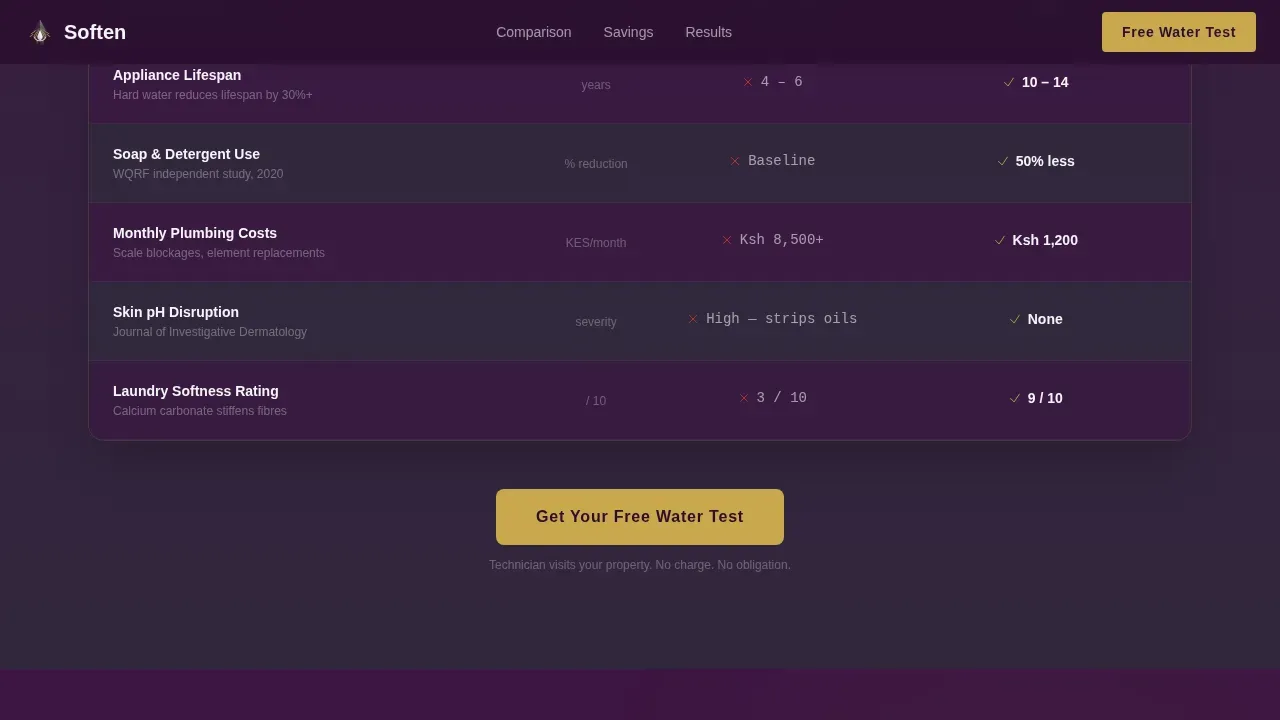
- A seven-metric water softener comparison chart with gold checkmarks and muted red indicators across key water quality dimensions
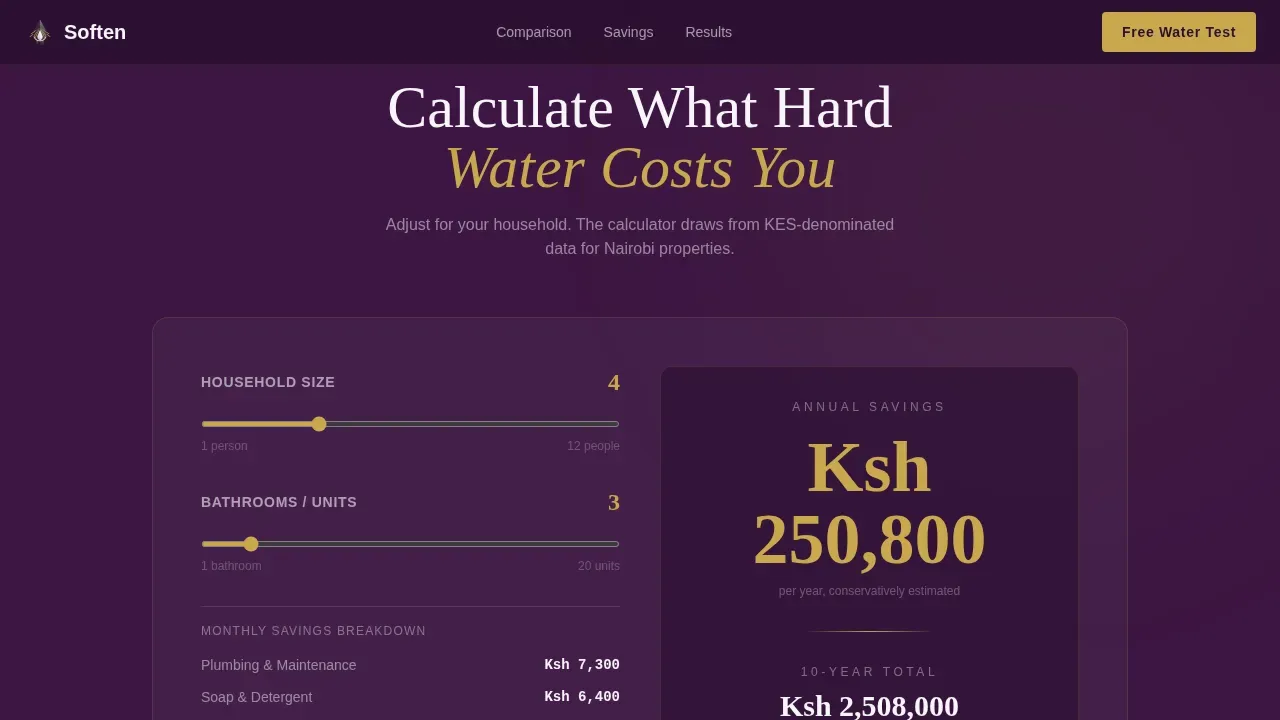
- A live cost calculator where visitors input household size and bathroom count to see annual savings rendered in aged gold figures
Feature list
This section details the core built-in capabilities of the Soften template as specified in the brief.
Seven-Metric Water Softener Comparison Chart
The comparison table sits at the heart of the layout. It lines up untreated borehole water against soft water across seven dimensions: total dissolved solids (TDS), calcium parts per million, appliance lifespan, soap consumption, monthly plumbing costs, skin pH impact, and laundry softness rating. Rows alternate between deep plum and brushed graphite. Gold checkmarks mark the softened column. Muted red strikes mark the raw water column. Visitors can compare side by side in seconds without reading a paragraph.
Live Household Cost Calculator
The interactive cost calculator accepts two inputs: household size and number of bathrooms. It instantly renders projected annual savings in aged gold. This is the section where abstract water hardness becomes a specific Kenyan shilling figure. The calculator uses client-side rendering for instant output, keeping the experience responsive and immediate.
Stats-First Hero Manifesto
The header is typography only, set against a plum-to-graphite gradient. The headline leads with a specific water hardness reading of 340 ppm. Key numbers appear oversized in aged gold, creating a boardroom-presentation effect. A single subline in quartz white follows. The primary call-to-action button, reading "Get Your Free Water Test," appears immediately below. This section sets the financial and sensory tone before the visitor scrolls a single pixel.
Cumulative Cost Timeline Section
A dedicated section visualises the compounding cost of untreated hard water over time. It shows pipe and appliance replacement costs accumulating year on year without a water softener installed. This timeline shifts the conversation from installation cost to inaction cost, which is the reframe that moves cautious buyers.
Social Proof and Installations Counter
The template includes a social proof section with hotel review quotes referencing water quality and a live-style counter showing installations completed across Nairobi postcodes. These trust signals answer the unspoken question every buyer has: has this actually worked for people like me?
Dual Call-to-Action Conversion Path
The primary call-to-action routes to a booking page with estate dropdown, date selection, and phone number confirmation. A secondary path, "Download the Hardness Report for Your Area," captures email addresses from visitors not yet ready to book. Both paths serve different stages of buyer readiness without losing either audience.
Page sections overview
| Section | Purpose |
|---|---|
| Hero Manifesto | Confront water hardness with gold-highlighted numbers and primary call-to-action |
| Comparison Table | Compare untreated versus softened water across seven real metrics |
| Cost Calculator | Convert household inputs into annual KES savings figures |
| Cost Timeline | Show compounding appliance and plumbing costs without treatment |
| Social Proof | Build trust with hotel review quotes and postcode installation counter |
| Footer | Close with linear single-row pattern and secondary navigation |
Design & branding system
The Soften template uses an Executive Suite visual identity that feels like a private members' lounge. Dark backgrounds dominate. Gold appears only where a decision needs to be made. Every colour choice is deliberate and restrained. Typography uses Fraunces for serif headlines and DM Sans for body text, creating a tension between editorial authority and clean readability.
- Deep boardroom plum (#3C1642) covers primary section backgrounds, with brushed graphite (#2E2E3A) anchoring body text and alternating table rows
- Polished quartz white (#F7F5F9) opens breathing room between data-heavy blocks, preventing the dark palette from feeling oppressive
- Aged gold (#C9A84C) appears exclusively on calls-to-action, stat highlights, table headers, and checkmarks, training the eye to stop only where action is needed
Mobile & speed optimization
The template is designed desktop-first to serve the Upperhill facility manager reviewing on a workstation. Full mobile support is included for residential buyers browsing on a phone after a plumber visit. Scroll-triggered reveals, counter animations, and staggered section entries add motion without loading overhead. The cost calculator uses client-side processing to deliver instant gold-highlighted output without a server round-trip.
- Desktop-first layout preserves the comparison table's full seven-column structure without collapsing critical data
- Scroll-triggered stagger animations and counter reveals are built for medium animation intensity, keeping the experience dynamic without distraction
- The live calculator runs client-side, so annual savings figures appear instantly without page reload
How this template helps you convert
The Soften template is a Click-Through landing page. Its single job is moving visitors from awareness to a booked water test or a captured email. The design uses every established conversion principle without stating them: scarcity of clean water, financial loss aversion, and social validation.
- The stats-first scroll sequence builds a financial case before any service claim is made, so when the call-to-action appears after the comparison table and cost calculator, the visitor has already done the maths
- Dual conversion paths ensure no visitor leaves empty-handed: the primary path books a test appointment, and the secondary path delivers a ward-level hardness report PDF that keeps the brand present until the buyer is ready to act
Other information about this template
This template is built specifically for the water softening systems market, which the global industry values at USD 13.9 billion in 2025 and projects to reach USD 25.5 billion by 2035 at a compound annual growth rate of 6.2%. The residential segment is projected to grow at 6.5% during the same period. Demand for softening systems is rising in urban and peri-urban areas where rapid construction and infrastructure stress are common.
The following factors shape how water softener services can use this template most effectively:
- Water hardness can be measured using different units of measure, including parts per million (ppm), milligrams per liter (mg/L), or grains per gallon (GPG). The template's comparison chart is built to display the unit your market understands, which for Nairobi borehole contexts is typically ppm.
- When evaluating systems, the following factors matter most: water hardness level, regeneration rate, household size, and space requirements near the main water line. The cost calculator is built around these same inputs.
- Salt-based systems use ion exchange, where a resin tank captures calcium and magnesium ions and releases sodium in their place. Salt-free systems, including those using template-assisted crystallization, prevent scale buildup without removing minerals from the water or adding sodium. Salt-free water softeners are ideal for households monitoring sodium intake.
- Salt-based water softeners use sodium chloride to reduce water hardness by over 97%. Salt-free technologies condition water differently: rather than removing calcium and magnesium, template-assisted crystallization causes those minerals to form harmless crystals that pass through without bonding to surfaces. Both salt-free systems and salt-based systems are represented fairly in the comparison chart so visitors can make an informed decision.
- High-capacity ion exchange systems provide nearly complete hardness removal at around 97.5%. High grain capacity models, such as those with 64,000-grain tanks, are appropriate for larger households that typically need more soft water volume throughout the day.
- Twin-cylinder water softening systems offer continuous softening without interruption during regeneration. Systems with dual tank configurations ensure unlimited soft water availability, which is particularly relevant for hotel and commercial clients whose demand for soft water does not pause overnight.
- Some premium models use demand-initiated regeneration to optimise salt usage, consuming up to 50% less salt than standard water softeners. This significantly reduces the operational cost of maintaining a salt-based system over a 10-to-15-year lifespan.
- Well water and borehole water typically carry higher hardness levels than municipal city supplies, making water softening especially crucial for properties not connected to treated mains. Contaminants such as chlorine, iron, and other minerals compound the problem in poorly filtered well water supplies.
- Remote monitoring capabilities in advanced water softener models allow facility managers to track resin tank status, salt levels, and water quality data without a site visit, which reduces maintenance overhead for commercial operators.
- Environmentally friendly salt-free systems do not discharge brine during regeneration, making them a suitable choice where wastewater regulations or sustainability commitments apply.
- The Soften template is the soften executive water softener comparison table landing page template built for professional service providers who need to drive growth through a data-first presentation. It supports this by giving every metric a visible place in the layout so buyers can compare with confidence rather than guessing.
- The Rayne Executive Series and SoftPro ECO and SoftPro Elite are examples of market-available water softener products whose performance specifications, including resin lifespan, salt efficiency, and grain capacity, illustrate the kinds of comparisons this template is designed to display. The SpringWell SS Series, with its 20 GPM flow rate, is a further example of a system suited to luxury homes with multiple bathrooms where pressure drop prevention is a key concern.
Theme
Executive Suite
Creative direction
Stats-First Impact
Color system
Plum Executive
Direction
Click-Through
Page Sections
Seven-metric Water Softener Comparison Chart
Live Household Cost Calculator
Stats-first Hero Manifesto Header
Cumulative Cost Timeline
Social Proof and Installation Counter
Dual Call-to-action Conversion Paths
Related questions
What type of water softener service is this template designed for?
Can the comparison chart show both salt-based and salt-free system options?
How does the cost calculator handle different household sizes?
Is this template suitable for commercial clients like hotels or office facilities?
What are the two conversion paths built into this template?